Yukgaejang (Spicy Beef Soup)
Fiery red beef brisket soup with shredded vegetables, egg ribbons, and enough gochugaru to clear your sinuses. Korea's most powerful soup.
Why This Recipe Works
Yukgaejang is not a soup you stumble into by accident. It is a calculated act of culinary aggression — a dish engineered over centuries to produce maximum physiological response from minimum ingredients. Three tablespoons of gochugaru. One pound of brisket. Eight cups of water. The numbers are almost insultingly simple. The result is anything but.
This recipe works because every single step has a reason, and ignoring any one of them produces an inferior bowl. Not "slightly worse." Categorically different. Let's dissect it.
The Brisket Argument
You are boiling beef brisket for forty to fifty minutes in a dutch oven before you do anything else. This is non-negotiable. Brisket is a working muscle — the chest of the animal — and working muscles are dense with connective tissue, specifically collagen. Forty minutes at a rolling boil converts that collagen into gelatin. Gelatin is what gives the finished broth body, that coating weight on the tongue that differentiates a real stock from flavored water. Skim the foam aggressively in the first ten minutes. That foam is coagulated myoglobin and albumin — it adds nothing to flavor and everything to cloudiness. A clean broth carries spice more clearly than a murky one.
When you pull the brisket out, shred it along the grain. Not across it. Along it. This is not aesthetics — fiber orientation determines how the beef behaves in the soup. Shredding along the grain gives you long, rope-like strands that hold their shape through the second cooking. Shredding across the grain gives you crumbles. Crumbles are fine for tacos. They disappear in soup.
The Oil Bloom: Where the Color Comes From
This is the step most home cooks skip, and it is the reason most home versions of yukgaejang look anaemic and taste flat. In a clean stockpot, you heat vegetable oil and sesame oil together before the gochugaru ever enters. Then — and this matters — you add the gochugaru to the hot oil and stir for thirty seconds before adding anything else.
Gochugaru contains two categories of compounds you want in this soup: capsaicinoids (the heat) and carotenoids (the red pigment, primarily capsanthin). Both are fat-soluble, not water-soluble. If you dump gochugaru directly into a water-based broth, you extract maybe twenty percent of its color and heat potential. The rest sits inert, suspended in liquid it cannot dissolve into. Blooming it in hot oil first extracts those compounds fully. The oil turns a violent, almost alarming shade of red-orange. That color transfers into the broth completely. This is why restaurant yukgaejang is that particular shade of deep arterial red, and why the version you make at home without this step looks like diluted ketchup.
Thirty seconds. Not twenty. Not two minutes. Thirty seconds at medium heat. Long enough to extract, short enough not to scorch. Scorched gochugaru tastes bitter and there is no recovering from it.
Layered Umami Architecture
This recipe uses three separate umami sources: soy sauce, fish sauce, and the beef broth itself. Each operates on a different frequency. Soy sauce contributes glutamates — the base savory signal. Fish sauce contributes nucleotides, specifically inosinate, which synergizes with glutamates to produce an umami effect greater than either compound alone. The beef broth contributes both, plus the gelatin body that carries them. Together they produce a flavor depth that reads as complex without being complicated. You are not building flavors in parallel. You are stacking them in sequence, each amplifying the one before it.
The garlic goes in with the shredded beef during the stir-fry phase, not later. Garlic added early — cooked in fat alongside the gochugaru-coated beef — develops rounder, mellower allium compounds through Maillard reactions. Raw garlic added late gives you a sharper, more aggressive hit. Both are valid approaches in different dishes. For yukgaejang, you want the garlic underneath the spice, not competing with it.
The Vegetable Timing Problem
Gosari — dried bracken fern, rehydrated — and leek are not interchangeable with each other, and they are not interchangeable with their substitutes in terms of timing. Traditional gosari, once rehydrated, is already partially cooked and needs only ten minutes in the simmering broth to finish. Bean sprout substitutes need five minutes maximum or they turn to mush and release water that dilutes your broth. The leek or green onion pieces should be cut long — three inches minimum — so they behave as ribbons, not as an aromatic background note. Size matters here: small-cut alliums dissolve into the soup. Large-cut pieces retain texture and give the bowl visual structure.
The Egg Ribbon Technique
A single beaten egg, drizzled into simmering soup in a thin, continuous stream while stirring gently, produces silky ribbons — the Korean equivalent of the Chinese egg drop technique. The key variable is temperature: the broth must be at a gentle simmer, not a rolling boil. Boiling agitation shreds the egg into fine flecks before it sets. A gentle simmer allows the egg to coagulate in structured sheets as it hits the hot liquid. Use a ladle or a spoon to create a slow circular current in the pot as you drizzle. The egg follows the current and sets in curving ribbons rather than lumps.
Why It Gets Better Overnight
Yukgaejang is one of the few soups that genuinely improves with refrigeration. The gochugaru compounds continue to infuse into the gelatin-rich broth over twelve to twenty-four hours, deepening both color and heat. The capsaicin perception actually moderates slightly as it binds to fat molecules — the heat feels more integrated, less sharp. The beef reabsorbs broth and softens further. If you are making this for guests, make it the night before. Reheat in the stockpot until fully bubbling — do not microwave portions, as uneven heating produces hot pockets of oil and cold broth simultaneously.
Serve it with steamed rice on the side, not stirred in. The rice should absorb broth at your pace, not the soup's.
Korea's Napalm Soup
Yukgaejang sits at the apex of Korean hot soups — a category that includes gochujang jjigae and nakji bokkeum but finds its most extreme expression here. Koreans have a concept called yi yeol chi yeol, fighting heat with heat — the summer logic that consuming spicy, sweat-inducing food cools the body more effectively than eating cold food. Yukgaejang is the flagship dish of this philosophy. On the hottest days of the year, at restaurants across Seoul, tables full of people are sweating into bowls of this soup, eating it as fast as they can, and ordering a second round.
The endorphin mechanism is real. Capsaicin triggers TRPV1 pain receptors, which signals the brain to release endorphins in response. The result is a mild euphoria that emerges about ten minutes into eating a bowl with the full three tablespoons of gochugaru. This is not marketing language. This is basic pain-response neurochemistry operating exactly as designed. The soup hurts you slightly, and your brain rewards you for surviving it.
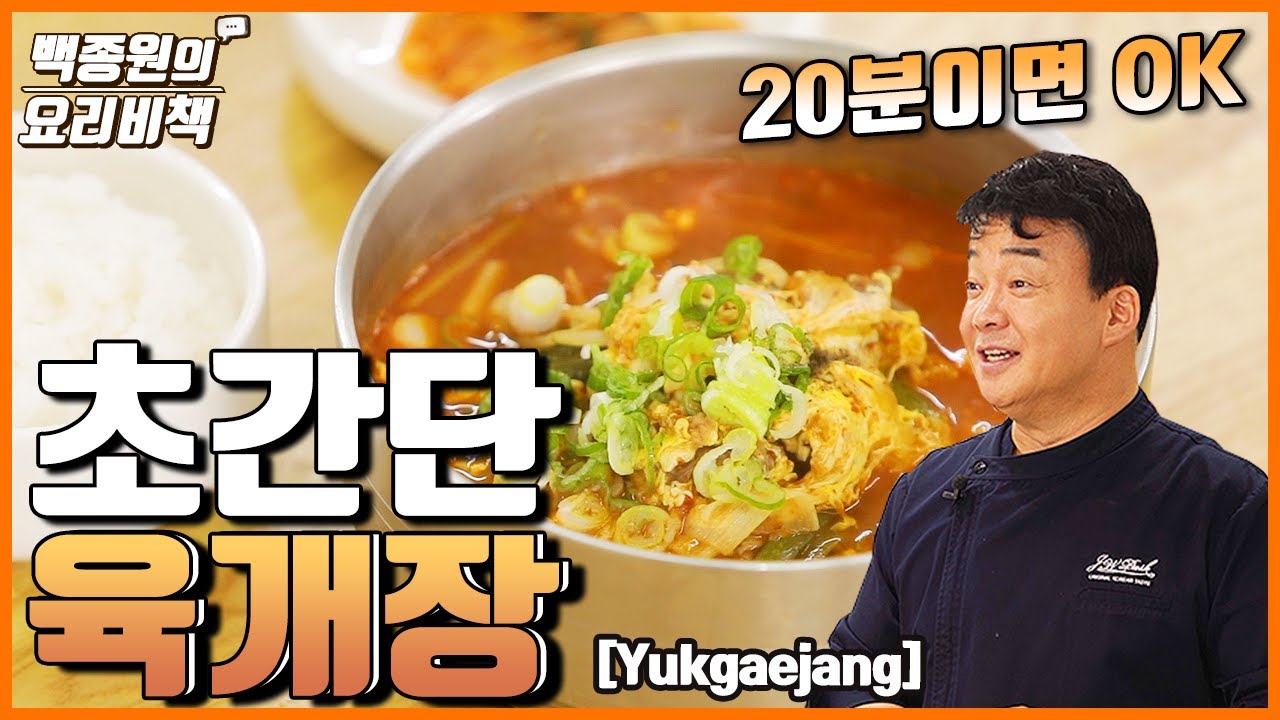
Baek Jong Won's streamlined twenty-minute version — the one with 3.6 million views — substitutes pre-sliced beef simmered briefly for the traditional slow-boiled brisket. It is faster. It also produces a lighter broth with less body. Both versions are correct. The traditional method is more correct.
Yukgaejang (Spicy Beef Soup)
🛒 Ingredients
- ✦1 lb beef brisket or shank
- ✦8 cups water
- ✦3 tablespoons gochugaru (Korean red pepper flakes)
- ✦1 tablespoon soy sauce
- ✦1 tablespoon sesame oil
- ✦3 cloves garlic, minced
- ✦1 tablespoon fish sauce
- ✦4 oz gosari (bracken fern), rehydrated, or bean sprouts
- ✦1 large leek or 4 green onions, cut into 3-inch pieces
- ✦1 egg, beaten
- ✦1 teaspoon salt
- ✦1/2 teaspoon black pepper
- ✦1 tablespoon vegetable oil
👨🍳 Instructions
01Step 1
Boil beef brisket in 8 cups water for 40-50 minutes until fork-tender. Skim foam during the first 10 minutes.
02Step 2
Remove beef, let cool slightly. Shred into thin strips along the grain. Reserve the broth.
03Step 3
In a pot, heat vegetable oil and sesame oil over medium heat. Add gochugaru and stir for 30 seconds — bloom the spice in the oil.
04Step 4
Add shredded beef and garlic. Stir-fry in the spicy oil for 2 minutes until every piece is coated red.
05Step 5
Pour in the reserved beef broth. Add soy sauce and fish sauce. Bring to a boil.
06Step 6
Add gosari (or bean sprouts) and leek. Simmer for 10 minutes.
07Step 7
Drizzle beaten egg into the simmering soup in a thin stream — it forms ribbons. Season with salt and pepper.
08Step 8
Serve bubbling hot with steamed rice.
Nutrition Per Serving
Estimates based on standard preparation. Adjustments alter macros.
🔄 Substitutions
Instead of Beef brisket...
Use Beef chuck or short rib meat
Any tough, flavorful cut that benefits from long cooking
Instead of Gosari...
Use Bean sprouts (6 oz)
More accessible — add in the last 5 minutes to keep crunch
Instead of Leek...
Use Green onions (6 stalks)
Cut into long pieces — they should look like ribbons in the soup
🧊 Storage & Reheating
In the Fridge
Store for 3-4 days. One of the best make-ahead Korean soups.
In the Freezer
Freeze for up to 2 months. Reheat from frozen in a pot.
Reheating Rules
Reheat in a pot until bubbling. Add water if it's too thick.
❓ Frequently Asked Questions
How spicy is yukgaejang?
Very. It's one of the spiciest standard Korean dishes — 3 tablespoons of gochugaru in a pot of soup creates serious heat. If you're spice-sensitive, start with 1.5 tablespoons and build up. The beef broth and egg ribbons help moderate the burn.
What is the difference between yukgaejang and galbitang?
Completely different soups. Yukgaejang is fiery red (gochugaru-based), uses shredded brisket, and is spicy. Galbitang is clear (no red pepper), uses bone-in short ribs, and is mild. They represent opposite ends of the Korean soup spectrum.

The Science of
Yukgaejang (Spicy Beef Soup)
We turned everything on this page into a beautiful, flour-proof PDF cheat sheet. Print it out, stick it to your fridge, and never mess up your yukgaejang (spicy beef soup) again.
*We'll email you the high-res PDF instantly. No spam, just perfectly cooked meals.
AlmostChefs Editorial Team
We translate the internet's most popular cooking videos into foolproof, beginner-friendly written recipes. We analyze multiple methods, test them in our kitchen, and engineer a single "Master Recipe" that gives you the best possible result with the least possible stress.