Yangnyeom Chicken (Sweet Spicy Fried Chicken)
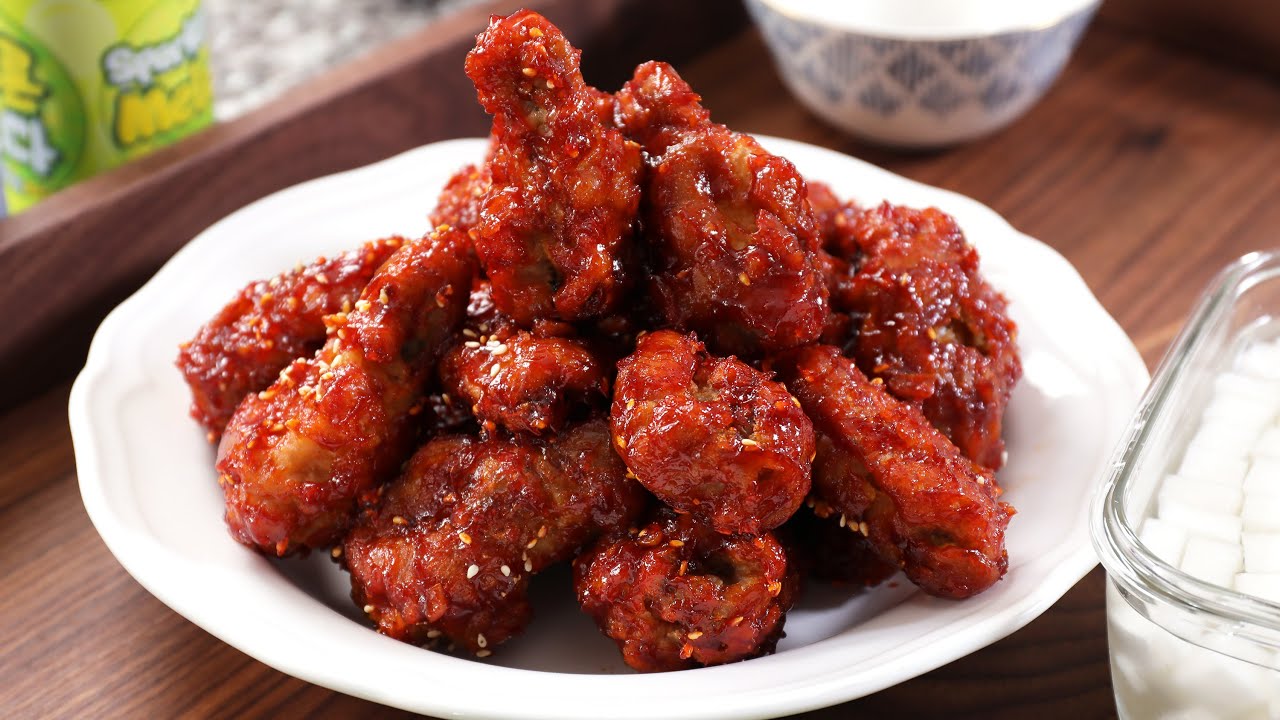
Korea's iconic saucy fried chicken — crispy battered pieces drenched in a sweet, spicy, garlicky gochujang glaze. The chicken that launched a thousand chimaek nights.
Why This Recipe Works
Most fried chicken fails for one reason: the cook doesn't understand what they're actually trying to accomplish. They think frying is about cooking the meat. It isn't. The meat is easy. Frying is about building a structural coating that can survive thermal shock, moisture migration, and — in this specific case — being drowned in aggressive, sticky sauce. Yangnyeom chicken is the hardest test a fried chicken recipe can face, and it passes because every decision in this formula is load-bearing.
The Batter Architecture
The 2:1 ratio of all-purpose flour to cornstarch is not decoration. Flour contains gluten-forming proteins that provide structural elasticity. Cornstarch contains no gluten whatsoever — it gelatinizes during frying into hard, glass-like granules that contribute crunch at the molecular level. You need both. Flour alone gives you soft, bready American fried chicken. Cornstarch alone gives you a coating that shatters and flakes. The hybrid gives you a crust that flexes slightly under a bite, then cracks — the exact texture that allows sauce to coat the surface without immediate soaking.
The sparkling water is where amateurs roll their eyes and professionals nod. Carbon dioxide gas dissolved in chilled water creates turbulence in the batter that leaves microscopic voids. Those voids expand violently in the first seconds of contact with hot oil, creating a network of air pockets inside the coating. The result is a crust that is structurally similar to a puff pastry layer — load-bearing on the outside, mostly air on the inside. This is why the batter must be mixed with cold liquid and used immediately. Warm sparkling water is flat sparkling water. Flat sparkling water is just water. Use ice-cold liquid and leave the batter lumpy; overmixing collapses the CO₂ and develops gluten, which tightens the batter and defeats the purpose entirely.
The Double-Fry Protocol
The first fry at 340°F (170°C) in your deep pot does one thing: it sets the coating and cooks the meat through. The target is internal doneness, not external color. You are deliberately frying at a temperature low enough that the coating doesn't brown aggressively — because you're not done. After the first fry, the chicken rests on a wire rack rather than paper towels. This is not aesthetic preference. Paper towels trap steam against the coating. A rack allows airflow on all sides, letting residual moisture escape rather than re-absorbing into the crust you just built.
The second fry at 375°F (190°C) is the actual crust-building phase. At this higher temperature, the moisture remaining in the batter layer flashes off rapidly, and the starch structure undergoes final dehydration. The result is a coating so dry and rigid that it can hold up against a hot, wet, heavily sugared sauce without immediately becoming a soggy shell. Without the second fry, the yangnyeom sauce wins. The crust loses. You end up with sauced meat in a paste. That is not yangnyeom chicken.
Use a thermometer. This is not optional advice padded to fill word count. Oil temperature is the single most important variable in this entire recipe. At 315°F or lower, the batter absorbs oil before the exterior sets, and you get greasy chicken. At 400°F or higher, the coating burns before the interior reaches temperature. The differential between first and second fry temperatures is also critical — the deliberate step-up forces the coating through two distinct structural phases. A thermometer costs less than the chicken you will ruin without it.
The Sauce Chemistry
Yangnyeom sauce is a masterclass in flavor stacking, and every component earns its place. Gochujang delivers fermented depth — the funky, complex, miso-adjacent backbone that separates this sauce from any hot sauce you've used before. Gochugaru adds fresh chili heat and a different textural dimension, since the flakes don't fully dissolve and leave visible red specks in the finished glaze. Ketchup is the ingredient that makes every serious cook uncomfortable, right up until they taste the result. It contributes concentrated tomato sweetness, glutamate-driven savoriness, and a glossy body that helps the sauce cling to curved surfaces. Rice syrup or corn syrup thickens the sauce and creates the signature high-gloss finish — it's a texture agent as much as a sweetener.
The sauce is built in a large pan over medium heat and stirred until it tightens. Hot chicken goes directly into hot sauce — never let either cool first. The thermal contact when hot chicken meets hot sauce causes the outer layer of the glaze to set almost instantly on the crust surface rather than soaking through. Toss hard. Every surface must be coated, and the coating must be even. The sauce should be thick enough to cling to vertical surfaces and thin enough that it still drips slightly when the piece is lifted.
The Chimaek Context
Yangnyeom chicken did not emerge from a home kitchen tradition. It was engineered for Korean fried chicken shops (chikin-jip) that proliferated after the 1997 financial crisis, when unemployment drove tens of thousands of Koreans to start small food businesses with low overhead. The double-fry technique had been present in Korean cooking before that, but the chikin-jip culture industrialized it and refined it to an exact science, because shop owners needed a product that stayed crunchy during delivery and packaging.
The standard Korean fried chicken order arrives with chicken mu — small cubes of lightly pickled daikon radish. This is not garnish. It is a palate reset tool. The sauce is sweet, spicy, garlicky, and intensely umami. Two or three pieces in, your palate starts to saturate. A piece of chicken mu, with its sharp vinegar cut and cool crunch, clears the receptor load and makes the next piece of chicken taste like the first. If you are not serving chicken mu, you are not serving yangnyeom chicken. You are serving half a meal.
Yangnyeom Chicken (Sweet Spicy Fried Chicken)
🛒 Ingredients
- ✦2 lbs chicken drumsticks and wings
- ✦1 cup all-purpose flour
- ✦1/2 cup cornstarch
- ✦1 teaspoon salt
- ✦1/2 teaspoon black pepper
- ✦1 cup ice-cold sparkling water (or regular water)
- ✦Vegetable oil for deep frying
- ✦3 tablespoons gochujang (Korean red pepper paste)
- ✦2 tablespoons gochugaru (Korean red pepper flakes)
- ✦3 tablespoons ketchup
- ✦3 tablespoons sugar
- ✦2 tablespoons rice syrup or corn syrup
- ✦2 tablespoons soy sauce
- ✦4 cloves garlic, minced
- ✦1 tablespoon sesame oil
- ✦Sesame seeds for garnish
👨🍳 Instructions
01Step 1
Pat chicken pieces very dry. Combine flour, cornstarch, salt, and pepper in a bowl. Add ice-cold sparkling water and mix into a light, lumpy batter.
02Step 2
Heat oil to 340°F (170°C) in a deep pot. Dip each piece in batter, letting excess drip off. Fry in batches for 12-15 minutes until cooked through and golden.
03Step 3
Remove chicken and drain on a wire rack. Increase oil to 375°F (190°C).
04Step 4
Fry chicken a second time for 3-5 minutes until deeply golden and ultra-crispy.
05Step 5
While the chicken fries, make the sauce: combine gochujang, gochugaru, ketchup, sugar, rice syrup, soy sauce, garlic, and sesame oil in a large pan over medium heat. Stir until it bubbles and thickens slightly, about 2 minutes.
06Step 6
Add the hot chicken to the sauce and toss vigorously to coat every piece. The sauce should be thick enough to cling but wet enough to drip.
07Step 7
Transfer to a plate, sprinkle with sesame seeds, and serve immediately with pickled radish (chicken mu).
Nutrition Per Serving
Estimates based on standard preparation. Adjustments alter macros.
🔄 Substitutions
Instead of Chicken drumsticks/wings...
Use Boneless thighs
Cut into large chunks. Faster cooking time (10 min first fry, 2 min second)
Instead of Gochujang...
Use Sriracha + miso paste (2:1)
Different flavor profile but a decent approximation
Instead of Sparkling water...
Use Regular ice water or vodka
Vodka evaporates faster than water, also creating a crispier batter
🧊 Storage & Reheating
In the Fridge
Store for 1-2 days. The coating softens considerably.
In the Freezer
Not recommended — the saucy coating does not freeze well.
Reheating Rules
Reheat in a 400°F oven for 10-12 minutes. Avoid the microwave — it turns the crust rubbery.
❓ Frequently Asked Questions
What is chimaek?
Chimaek (치맥) is the Korean portmanteau of chicken (치킨) and maekju (맥주, beer). It's a beloved cultural ritual — friends gather at chicken shops to eat yangnyeom chicken and drink beer, often while watching baseball or K-dramas.
How is yangnyeom chicken different from American buffalo wings?
The coating technique is completely different. American wings are usually single-fried with a flour coating, then tossed in butter-based hot sauce. Korean yangnyeom chicken is double-fried with a starch batter, creating a much crunchier crust, and the sauce is sweet-spicy rather than vinegary.

The Science of
Yangnyeom Chicken (Sweet Spicy Fried Chicken)
We turned everything on this page into a beautiful, flour-proof PDF cheat sheet. Print it out, stick it to your fridge, and never mess up your yangnyeom chicken (sweet spicy fried chicken) again.
*We'll email you the high-res PDF instantly. No spam, just perfectly cooked meals.
AlmostChefs Editorial Team
We translate the internet's most popular cooking videos into foolproof, beginner-friendly written recipes. We analyze multiple methods, test them in our kitchen, and engineer a single "Master Recipe" that gives you the best possible result with the least possible stress.