Creamy Tuscan Chicken (The Weeknight Dinner That Actually Delivers)
Tender seared chicken breasts in a rich sun-dried tomato and garlic sauce with fresh spinach, Greek yogurt instead of heavy cream, and enough flavor depth to make you forget it took 40 minutes. We built this from the most popular YouTube methods and fixed the sauce-breaking problem everyone runs into.
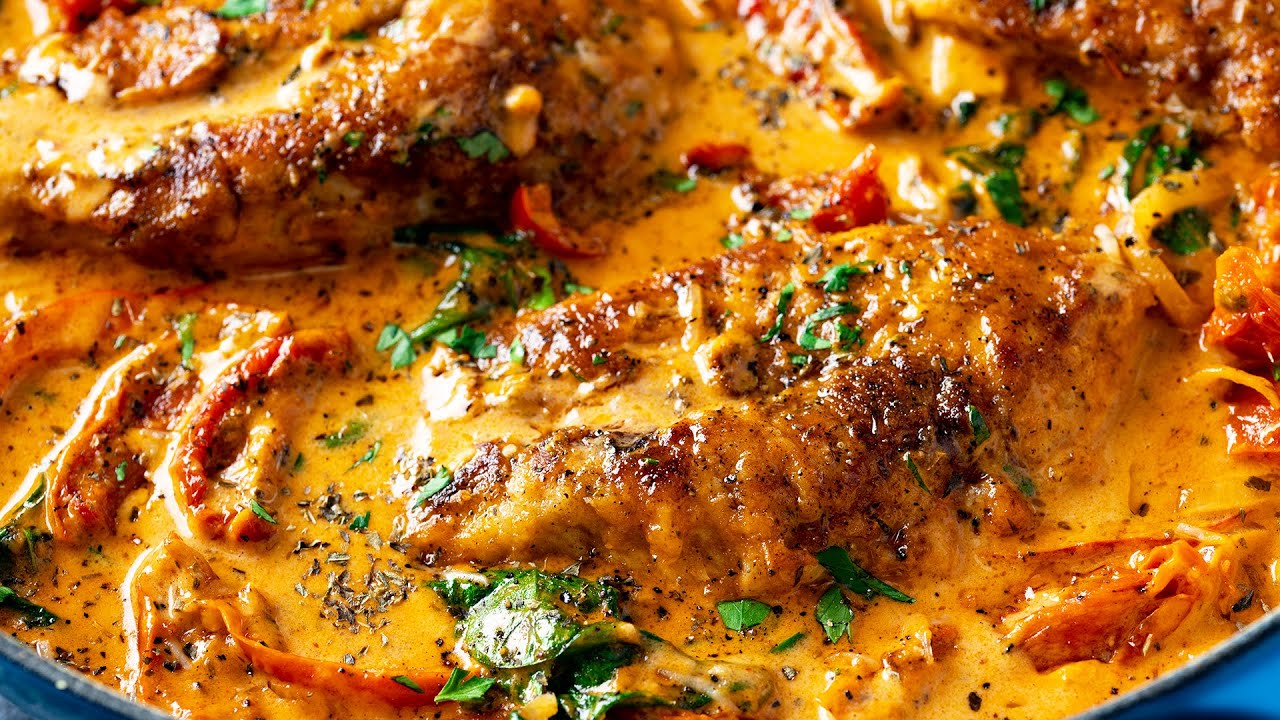
“Tuscan chicken is everywhere on the internet and most of it is the same: heavy cream sauce that breaks when you reheat it, sun-dried tomatoes straight from an oil-soaked jar, dried basil doing nothing. We stripped it back to what actually matters — a properly seared breast, a sauce built with patience, and Greek yogurt that gives you the silkiness without the weight. Forty minutes. One pan. No curdled disaster.”
Why This Recipe Works
Tuscan chicken exists in a strange culinary purgatory. It's not Italian. It's not American. It's a dish invented by someone who had a jar of sun-dried tomatoes, a container of cream, and a loose interpretation of "Mediterranean." The name stuck because it sounds good, and the dish stuck because — when made correctly — it actually is good.
The problem is that most versions of this recipe are either caloric landmines or flavor voids. Heavy cream sauce that breaks on reheating, dried herbs that contribute nothing, chicken that's either pink in the center or dry enough to sand a deck. We built this version to solve every one of those problems in a single 40-minute pan.
The Sear Is the Sauce
Tuscan chicken is fundamentally a pan sauce dish, which means everything depends on what happens in the first five minutes. You're not just cooking the chicken — you're building flavor architecture on the bottom of the pan that the sauce will later absorb.
A proper sear on a dry chicken breast in a 12-inch skillet develops fond: those dark, almost-burnt-looking bits that stick to bare metal. Fond is not burnt food. It's the Maillard reaction made solid — concentrated proteins and sugars that dissolve instantly into liquid and transform a basic broth into something that tastes like it's been simmering for hours. Skip the sear or do it in a crowded pan, and you're making sauce from scratch with nothing underneath it.
The rule: don't move the chicken. It releases from the pan on its own when the crust has set. Forcing it early tears the sear and leaves half your fond attached to the meat instead of the pan. Set a timer, walk away, come back.
Sun-Dried Tomato Paste vs. the Jar
Most recipes call for sun-dried tomatoes in oil, scooped straight from the jar. The result is greasy, heavy, and one-dimensional — oil-soaked tomato flavor with nothing to contrast it. Sun-dried tomato paste behaves differently. It's concentrated and slightly thick, which means when you add it to the pan and stir it over medium heat for 90 seconds, it caramelizes on the pan surface and develops a deep, slightly sweet complexity that the jarred version never achieves. The extra step takes two minutes and changes the flavor entirely.
Yogurt as a Serious Sauce Base
Greek yogurt replacing heavy cream is not a sacrifice. It's a trade-off with a specific advantage: yogurt has natural acidity that cuts through the richness of the sun-dried tomatoes and olive oil, creating a brighter, more balanced sauce that doesn't sit heavy. The caloric reduction is real — 135 fewer calories per serving — but that's a side effect, not the point.
The technique matters more than the ingredient. Yogurt at high heat curdles. The proteins seize and you get white lumps floating in orange liquid, which is appetizing to no one. The fix is straightforward: whisk the yogurt completely smooth, reduce the sauce to a bare simmer or pull it off heat entirely, then stir the yogurt in slowly. Thirty seconds of attention prevents an irreversible problem.
The Spinach Timing
Fresh spinach is not a forgiving ingredient. It goes from raw to perfectly wilted to waterlogged gray mess in about three minutes total. Add it last, fold it gently, and stop the moment the leaves collapse. The residual heat in the sauce finishes the job. If the pan is still on high heat when the spinach goes in, you'll drain off a cup of dark green liquid and have nothing to show for it.
The balsamic vinegar and lemon wedges at the end are not optional. The yogurt and tomato paste both contribute acidity, but balsamic adds a depth — sweet, slightly syrupy, distinctly Italian — that no other acid replicates. The lemon at the table is for each person to adjust to taste. Between the two, the sauce has enough brightness to balance everything else.
This is a dish that rewards patience in two places: the sear and the yogurt addition. Rush either one and you'll understand exactly why so many versions of Tuscan chicken are mediocre. Slow down in those moments and you'll have the kind of weeknight dinner that people ask for by name.
Where Beginners Mess This Up
Before we start, read this. These are the 4 reasons your creamy tuscan chicken (the weeknight dinner that actually delivers) will fail:
- 1
Adding cold yogurt directly to a hot sauce: Greek yogurt curdles the instant it hits a sauce above 180°F that hasn't been tempered. You need to whisk the yogurt smooth first, then lower the heat to a bare simmer before stirring it in slowly. Cold dairy into screaming hot liquid is a one-way ticket to grainy, broken sauce.
- 2
Skipping the sear and going straight to braising: The fond — those dark brown bits stuck to the pan after searing — is where the sauce gets its savory backbone. Chicken that goes directly into liquid comes out pale, soft, and textureless. Two minutes of patience per side builds flavor that the sauce can't provide on its own.
- 3
Crowding the pan during the sear: Four chicken breasts in a small skillet trap steam between them. The surface temperature drops, the Maillard reaction stalls, and you get gray poached chicken instead of a golden crust. Use a 12-inch skillet or sear in two batches.
- 4
Cooking the spinach too long: Fresh spinach wilts in 90 seconds. If you add it and walk away, you'll return to a pool of dark green water and shrunken leaves that turn bitter. Add it last, fold it in off heat if necessary, and stop the moment it collapses.
The Video Reference Library
Want to see it in action? Here are the exact videos we analyzed and combined to build this foolproof recipe translation:
The source video with strong technique on the sear and sauce-building sequence. Watch specifically for how they handle the yogurt addition — slow and off-heat.
🛠️ Core Equipment
- 12-inch stainless steel or cast iron skilletYou need surface area for an even sear and enough volume to hold the sauce and chicken without crowding. Nonstick pans don't build fond properly — the browned bits that define this sauce require bare metal.
- Instant-read thermometerChicken breast has a 10-degree window between perfectly cooked and dry sawdust. Pull at 160°F — carryover heat takes it to 165°F while it rests on the plate. Guessing by time alone is how you ruin dinner.
- Small whiskFor smoothing the Greek yogurt before it goes into the sauce. Lumpy yogurt into hot liquid means lumpy sauce. Thirty seconds of whisking prevents an irreversible texture problem.
Creamy Tuscan Chicken (The Weeknight Dinner That Actually Delivers)
🛒 Ingredients
- ✦4 boneless, skinless chicken breasts (about 6 oz each)
- ✦2 tablespoons extra virgin olive oil
- ✦1 large yellow onion, finely diced
- ✦4 cloves garlic, minced
- ✦1 cup fresh cherry tomatoes, halved
- ✦1/2 cup sun-dried tomato paste
- ✦1 cup low-sodium chicken broth
- ✦3/4 cup plain Greek yogurt
- ✦4 cups fresh spinach leaves
- ✦1/4 cup fresh basil, chopped
- ✦2 tablespoons balsamic vinegar
- ✦1 teaspoon dried oregano
- ✦1/2 teaspoon red pepper flakes
- ✦1 teaspoon sea salt
- ✦1/2 teaspoon black pepper
- ✦1/4 teaspoon nutmeg
- ✦2 tablespoons fresh parsley, minced
- ✦1 lemon, cut into wedges for serving
👨🍳 Instructions
01Step 1
Pat the chicken breasts completely dry with paper towels, then season both sides evenly with sea salt, black pepper, and dried oregano.
02Step 2
Heat extra virgin olive oil in a large skillet over medium-high heat until shimmering, about 2 minutes.
03Step 3
Sear the chicken breasts for 5-6 minutes per side until deep golden brown, then transfer to a clean plate. Do not move them during searing.
04Step 4
Reduce heat to medium. Add diced onion to the same skillet and sauté until softened and translucent, about 4 minutes.
05Step 5
Add minced garlic and red pepper flakes, cooking for 1 minute until fragrant.
06Step 6
Add the sun-dried tomato paste and stir constantly for 1-2 minutes to caramelize slightly and deepen the flavor.
07Step 7
Add the halved cherry tomatoes and cook for 3 minutes, stirring occasionally, until they begin to soften.
08Step 8
Pour in the chicken broth and balsamic vinegar, scraping the bottom of the pan thoroughly to release all the fond.
09Step 9
Return the chicken to the skillet, nestling it into the sauce. Simmer on low for 5 minutes to meld the flavors.
10Step 10
Remove the pan from heat or reduce to the lowest possible setting. Whisk the Greek yogurt in a small bowl until completely smooth, then slowly stir it into the sauce with the nutmeg.
11Step 11
Fold in the fresh spinach and basil. Stir gently until the spinach is just wilted, about 90 seconds.
12Step 12
Taste and adjust salt and pepper as needed.
13Step 13
Plate the chicken with sauce spooned over the top, garnish with fresh parsley, and serve with lemon wedges alongside.
Nutrition Per Serving
Estimates based on standard preparation. Adjustments alter macros.
🔄 Substitutions
Instead of Greek yogurt...
Use Heavy cream
Classic version. Richer and more stable at high heat — no curdling risk. About 140 extra calories per serving. Add at the end of simmering, no tempering required.
Instead of Chicken broth...
Use Low-sodium bone broth
Deeper, richer flavor with added collagen. Sauce body improves slightly. Use the same quantity.
Instead of Chicken breast...
Use Boneless, skinless chicken thighs
More forgiving — thighs stay juicy even if slightly overcooked. Reduce sear time to 4-5 minutes per side. Flavor is richer and more savory.
Instead of Fresh spinach...
Use Baby kale or arugula
Kale takes 3-4 minutes to wilt fully and adds a slightly bitter, earthy note. Arugula wilts in 60 seconds and adds a peppery finish. Both work — adjust timing accordingly.
🧊 Storage & Reheating
In the Fridge
Store in an airtight container for up to 3 days. The sauce thickens as it cools — this is normal and actually improves the flavor.
In the Freezer
Freeze for up to 2 months. The yogurt-based sauce may separate slightly on thawing — whisk it back together over gentle heat. Cream-based version freezes more cleanly.
Reheating Rules
Reheat gently on the stovetop over low heat with 2-3 tablespoons of chicken broth to loosen the sauce. Microwave heating causes the yogurt proteins to separate and the spinach to become waterlogged.
❓ Frequently Asked Questions
Why did my sauce curdle?
The yogurt hit the sauce while it was too hot. Greek yogurt proteins seize and separate above roughly 180°F. You need to lower the heat to a bare simmer — or pull the pan off heat entirely — before adding the yogurt slowly. Whisking the yogurt smooth before it goes in also helps. If the sauce has already broken, whisk vigorously off heat and add a splash of cold broth. It won't fully recover but it'll be presentable.
Can I use dried basil instead of fresh?
You can, but the character changes significantly. Dried basil turns slightly bitter after simmering and loses the floral brightness that fresh brings. If you must substitute, use 1 teaspoon dried and add it with the garlic rather than at the end. Add a squeeze of lemon at serving to compensate for the lost freshness.
My chicken is cooked through but the sauce tastes flat. What happened?
You likely skipped or rushed two steps: the fond development (searing the chicken and building those brown bits) and the caramelization of the sun-dried tomato paste. Both steps require patience and medium-high heat. If the sauce tastes flat, deglaze with a splash more balsamic vinegar and simmer for 2 minutes uncovered to concentrate it.
Can I make this ahead of time?
Yes — and it's actually better the next day. Make the full recipe, cool it completely before refrigerating, and reheat gently on the stovetop. The flavors meld overnight in a way they don't have time to do fresh. The spinach will be softer the next day but the sauce improves noticeably.
What should I serve this with?
Crusty bread for the sauce, full stop. Beyond that: orzo, polenta, mashed potatoes, or simple steamed rice. The sauce is rich enough that you want something starchy to carry it. A light green salad with lemon vinaigrette on the side cuts through the richness well.
Can I add pasta directly to the sauce?
Yes — undercook the pasta by 2 minutes, reserve a cup of pasta water, and finish cooking the pasta in the sauce. The starchy pasta water helps the sauce cling and thickens it naturally. You'll need to increase the broth volume by about half a cup to account for absorption.

The Science of
Creamy Tuscan Chicken (The Weeknight Dinner That Actually Delivers)
We turned everything on this page into a beautiful, flour-proof PDF cheat sheet. Print it out, stick it to your fridge, and never mess up your creamy tuscan chicken (the weeknight dinner that actually delivers) again.
*We'll email you the high-res PDF instantly. No spam, just perfectly cooked meals.
AlmostChefs Editorial Team
We translate the internet's most popular cooking videos into foolproof, beginner-friendly written recipes. We analyze multiple methods, test them in our kitchen, and engineer a single "Master Recipe" that gives you the best possible result with the least possible stress.