Creamy Tuscan Chicken (Restaurant Results in 30 Minutes)
Seared chicken breasts in a rich sun-dried tomato cream sauce with garlic, spinach, and parmesan. We broke down the most-watched YouTube methods to find the technique that gets you a golden crust and a sauce that actually clings — not one that breaks and pools on the plate.
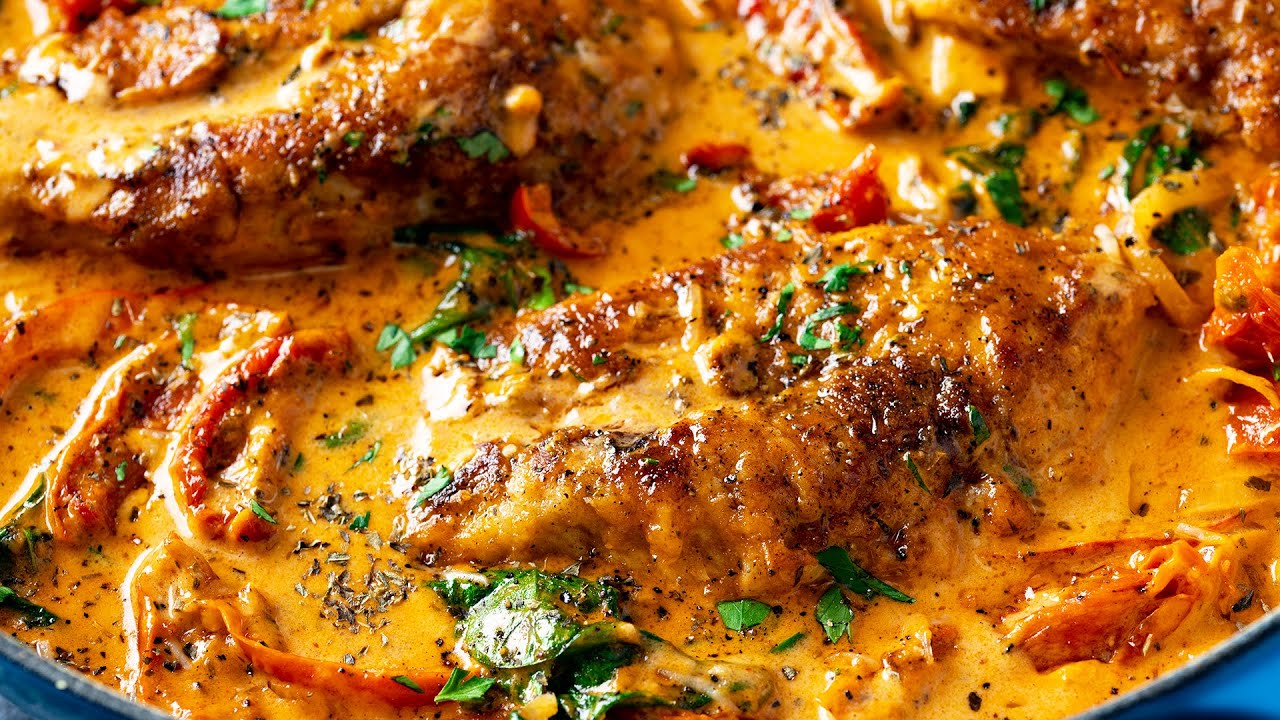
“Tuscan chicken is everywhere on the internet and almost uniformly executed wrong. The dish looks simple — seared chicken, cream sauce, done — but every shortcut taken between pan and plate shows up as a broken sauce, a rubbery crust, or wilted spinach that turns the whole thing gray. The version worth making starts with one principle: the sear is not optional, and the sauce is built directly in the same pan. Everything else follows from that.”
Why This Recipe Works
Tuscan chicken is a dish that masquerades as simple and punishes everyone who treats it that way. It is, at its core, a pan sauce built on a proper sear — and if you don't understand that the sear is the sauce, you will produce something that looks vaguely correct and tastes like cream with chicken floating in it. The technique here is not complicated. But every step is deliberate, and none of them are optional.
The Sear Is Infrastructure
The entire flavor architecture of this dish is built in the first five minutes when the chicken hits the pan. A properly preheated stainless steel or cast iron skillet gets hot enough to trigger the Maillard reaction — the same browning chemistry behind great steak, good bread crust, and roasted coffee. At the surface of the chicken, hundreds of new flavor compounds form in a matter of seconds. These compounds don't just improve the chicken. They adhere to the pan as fond, and the fond becomes the base of the cream sauce. Skip the sear, and you are building your sauce on nothing.
This is why nonstick pans are wrong for this dish. Their surface coating prevents fond formation by design — that's the whole point of nonstick. You want the sticking. You want the browning. The apparent inconvenience of washing a stainless pan is the price of admission for a sauce that tastes like something.
Why the Chicken Comes Out First
Pulling the chicken before it's fully cooked through is counterintuitive, but the logic is exact. Chicken breast at 155°F is already nearly done — carryover heat will push it to 165°F in the 5 minutes it rests on the plate while you build the sauce. When the chicken returns to the pan for its final 4–5 minutes in the simmering cream, it absorbs the sauce rather than just sitting on top of it, and it finishes at the correct temperature without overcooking. The alternative — cooking the breast fully through before the sauce is made, then adding it back — produces a chicken that hits 175°F or higher in the pan and has the texture of warm sawdust. Use a meat thermometer and pull it early. The numbers exist for a reason.
Sun-Dried Tomatoes and the Acid Counterweight
Sun-dried tomatoes do three things in this dish that fresh tomatoes cannot. Their water has been removed, concentrating the glutamates (natural flavor amplifiers) to a level that makes the surrounding sauce taste richer and more complex without adding any additional ingredients. Their natural sugars have caramelized slightly during drying, which contributes a sweetness that balances the fat in the cream. And their slight acidity cuts through the richness of the parmesan in a way that keeps the sauce tasting bright rather than heavy. The lemon juice added at the end reinforces this acid balance — not because you want the dish to taste lemony, but because high-fat cream sauces without acid taste flat and one-dimensional.
The Spinach Question
Fresh spinach is 92% water by weight. Drop a full handful directly into warm cream sauce and you have just added the equivalent of several tablespoons of liquid that the sauce has no framework to absorb. The emulsion breaks. The sauce thins. Adding the spinach in two stages — letting the first batch wilt and release its water before the second goes in — gives the sauce time to reabsorb and restabilize between additions. It is an extra thirty seconds of work that is the difference between a sauce that coats and a sauce that pools.
Parmesan as Structure, Not Garnish
Most recipes treat parmesan as a finishing touch — a snowfall of cheese over a completed dish. In Tuscan chicken, it is a structural ingredient. Added in small increments to the simmering cream, it melts into the sauce and contributes both body and a sharp, savory depth that heavy cream alone cannot provide. Add it all at once and the proteins in the cheese seize up in the heat and clump rather than emulsifying. Add it in stages, stirring between each addition, and each increment fully integrates before the next one arrives. The result is a sauce with a silky, cohesive texture that clings to every surface it touches — the chicken, the pasta, the bread you are going to use to clean the plate.
Where Beginners Mess This Up
Before we start, read this. These are the 4 reasons your creamy tuscan chicken (restaurant results in 30 minutes) will fail:
- 1
Skipping the proper sear: Tuscan chicken lives or dies by the fond — the browned bits left in the pan after searing the chicken. That caramelized layer is the flavor base for the entire sauce. If you add the chicken to a cold or underhot pan, it steams instead of sears, produces no fond, and you end up with a cream sauce that tastes like... cream. Get the pan hot before the chicken touches it.
- 2
Using fresh spinach straight from the bag: Fresh spinach has enormous water content. Add it directly to a cream sauce and it releases a flood of liquid that breaks the emulsion and turns your sauce thin and watery. You must wilt it in a separate step — or add it in stages — so the water can evaporate before it dilutes the sauce.
- 3
Overcrowding the pan during the sear: Steam is the enemy of crust. If you crowd the chicken pieces, the temperature drops, steam builds up between them, and instead of a golden sear you get a pale, soft surface that's already cooked through before any real browning happens. Sear in batches if necessary.
- 4
Boiling the cream sauce: Heavy cream sauce should simmer, never boil. A hard boil causes the fat and water in the cream to separate, breaking the sauce into a greasy, grainy mess. Keep the heat at medium-low once the cream goes in and let it reduce slowly. Patience here buys you the silky texture that makes this dish worth making.
The Video Reference Library
Want to see it in action? Here are the exact videos we analyzed and combined to build this foolproof recipe translation:
The source video for this recipe. Strong technique on the sear and sauce-building order, with clear visual cues for when the cream has reduced to the right consistency.
A foundational video on fond, deglazing, and emulsifying cream sauces. Watch this if the sauce-building logic in the main recipe isn't clicking — it explains the why behind every step.
A broader walkthrough of skillet chicken techniques including sear temperatures, resting times, and how to tell when a pan sauce has reduced enough to coat the back of a spoon.
🛠️ Core Equipment
- 12-inch stainless steel or cast iron skilletYou need a pan that gets genuinely hot and builds serious fond. Nonstick skillets prevent the browning that makes the sauce. Stainless steel or cast iron are the only correct choices here.
- Meat thermometerChicken breast is done at 165°F internal temperature. Because you're finishing the chicken in the sauce, you want to pull it from the sear around 155°F and let carry-over heat and the sauce finish the job. A thermometer removes the guesswork entirely.
- TongsFor pressing the chicken gently against the pan during searing and for transferring without piercing. Every pierce loses juice. Tongs are the right tool and a fork is not.
- Wooden spoon or silicone spatulaFor scraping up the fond when you deglaze. Metal tools on a hot stainless pan work fine, but a wooden spoon gives you more control when building the sauce base.
Creamy Tuscan Chicken (Restaurant Results in 30 Minutes)
🛒 Ingredients
- ✦4 boneless, skinless chicken breasts (about 6–7 oz each), pounded to even thickness
- ✦1 teaspoon garlic powder
- ✦1 teaspoon smoked paprika
- ✦1/2 teaspoon dried Italian seasoning
- ✦Kosher salt and freshly ground black pepper
- ✦2 tablespoons olive oil
- ✦1 tablespoon unsalted butter
- ✦5 garlic cloves, minced
- ✦1/2 cup sun-dried tomatoes in oil, drained and roughly chopped
- ✦1/2 cup low-sodium chicken broth
- ✦1.5 cups heavy cream
- ✦1/2 cup freshly grated parmesan cheese
- ✦3 cups fresh baby spinach
- ✦1 teaspoon fresh lemon juice
- ✦1/4 teaspoon crushed red pepper flakes (optional)
- ✦Fresh basil leaves for garnish
👨🍳 Instructions
01Step 1
Pat the chicken breasts completely dry with paper towels. Season both sides generously with garlic powder, smoked paprika, Italian seasoning, salt, and pepper.
02Step 2
Heat olive oil in a 12-inch stainless steel or cast iron skillet over medium-high heat until shimmering — about 2 minutes. The pan must be properly hot before the chicken goes in.
03Step 3
Add the chicken breasts to the hot pan without crowding. Sear undisturbed for 5–6 minutes per side until deep golden brown. The chicken will release naturally when it's ready — if it sticks, it hasn't seared long enough.
04Step 4
Transfer the seared chicken to a plate. It does not need to be fully cooked through — target 155°F internal temperature. It will finish in the sauce.
05Step 5
Reduce heat to medium. Add butter to the same pan. Once melted, add minced garlic and sauté for 60 seconds until fragrant but not browned.
06Step 6
Add the sun-dried tomatoes and cook for 1–2 minutes, stirring, until they begin to caramelize slightly around the edges.
07Step 7
Pour in the chicken broth and scrape the bottom of the pan aggressively with a wooden spoon to release all the fond. Let the broth reduce by half, about 2 minutes.
08Step 8
Reduce heat to medium-low. Pour in the heavy cream and bring to a gentle simmer. Do not boil. Cook for 4–5 minutes, stirring occasionally, until the sauce has thickened enough to coat the back of a spoon.
09Step 9
Stir in the grated parmesan in small increments, allowing each addition to fully melt before adding more. Add the crushed red pepper flakes if using.
10Step 10
Add the fresh spinach in two batches, stirring each batch until wilted before adding the next. This takes about 2 minutes total.
11Step 11
Return the seared chicken breasts to the pan, nestling them into the sauce. Spoon sauce over each piece. Cook on low heat for 4–5 minutes until the chicken reaches 165°F internal temperature.
12Step 12
Add the lemon juice, taste, and adjust salt. Garnish with fresh basil and serve immediately.
Nutrition Per Serving
Estimates based on standard preparation. Adjustments alter macros.
🔄 Substitutions
Instead of Heavy cream...
Use Full-fat coconut cream
Dairy-free alternative that emulsifies similarly to heavy cream. Adds a subtle sweetness that actually complements the sun-dried tomatoes. Use the same quantity.
Instead of Parmesan cheese...
Use Pecorino Romano
Saltier and slightly sharper than parmesan. Reduce added salt in the dish if substituting. Nutritional yeast is a vegan option but produces a thinner, less cohesive sauce.
Instead of Chicken breasts...
Use Bone-in chicken thighs
Thighs are more forgiving and harder to overcook. Increase sear time to 7–8 minutes per side and add 5–8 minutes to the finish time in the sauce.
Instead of Baby spinach...
Use Kale or Swiss chard
Both hold up better in the sauce and won't turn gray as quickly as spinach. Remove tough stems and add 2–3 minutes to the wilt time.
🧊 Storage & Reheating
In the Fridge
Store in an airtight container for up to 3 days. The sauce thickens significantly when cold — this is normal.
In the Freezer
Cream-based sauces do not freeze well. The emulsion breaks on thawing and the sauce becomes grainy. This dish is best eaten fresh or within 3 days.
Reheating Rules
Reheat gently on the stovetop over low heat with a splash of chicken broth or cream to rehydrate the sauce. Stir frequently. Microwave reheating causes the sauce to separate and the chicken to toughen.
❓ Frequently Asked Questions
Why did my cream sauce break and turn greasy?
The heat was too high. Cream sauce breaks when it boils — the fat and water separate and you're left with grease and liquid. Keep the sauce at a gentle simmer once the cream goes in, and never let it come to a rolling boil. If the sauce breaks, remove from heat and whisk in a tablespoon of cold butter to re-emulsify.
Can I use milk instead of heavy cream?
Whole milk will produce a much thinner sauce that struggles to coat the chicken. If you must use milk, whisk in 1 tablespoon of flour or 2 teaspoons of cornstarch with the garlic before adding it, which gives the sauce enough body to work. Half-and-half is a better compromise — same process, better results.
My chicken came out dry. What happened?
It cooked too long. Chicken breast hits 165°F quickly — especially if it was pounded thin. Use a meat thermometer and pull the chicken from the sear at 155°F. The carryover cooking and time in the sauce will bring it to 165°F without drying it out.
Can I make this ahead of time for a dinner party?
You can make the sauce up to a day ahead and refrigerate it separately. Sear the chicken fresh, reheat the sauce gently, and combine them in the pan to finish. Assembling the full dish in advance causes the chicken to overcook when reheated and the spinach to go gray.
What should I serve this with?
Pasta (fettuccine or pappardelle) is the classic pairing and the most practical — the broad noodles catch the sauce. Crusty ciabatta works equally well. If you're avoiding carbs, the dish holds up well over cauliflower rice or alongside roasted asparagus.
Can I add mushrooms or artichoke hearts?
Yes to both — they're traditional additions to the broader Italian-American canon this dish draws from. Sauté sliced cremini mushrooms with the garlic before adding the sun-dried tomatoes. Drained artichoke hearts go in with the spinach. Neither requires any adjustment to timing or liquid ratios.

The Science of
Creamy Tuscan Chicken (Restaurant Results in 30 Minutes)
We turned everything on this page into a beautiful, flour-proof PDF cheat sheet. Print it out, stick it to your fridge, and never mess up your creamy tuscan chicken (restaurant results in 30 minutes) again.
*We'll email you the high-res PDF instantly. No spam, just perfectly cooked meals.
AlmostChefs Editorial Team
We translate the internet's most popular cooking videos into foolproof, beginner-friendly written recipes. We analyze multiple methods, test them in our kitchen, and engineer a single "Master Recipe" that gives you the best possible result with the least possible stress.