Restaurant-Grade Tuna Tartare (Stop Paying $24 for This)
Sushi-grade ahi tuna, diced clean and dressed with bright citrus, sesame, and avocado. A raw fish appetizer that looks like it took all day and takes twenty minutes. We broke down the technique so you never have watery, flavorless tartare again.

“Tuna tartare is not a complicated dish. It is a cold dish — and that distinction explains every bad version you've ever had. Warm hands, warm plates, and a ten-minute delay between prep and service turn buttery sushi-grade tuna into a gray, mealy, fishy-tasting disappointment. Get the temperature right and everything else follows.”
Why This Recipe Works
Tuna tartare is one of the most misunderstood dishes in home cooking — not because it's technically difficult, but because home cooks approach it as an assembly problem when it's actually a temperature management problem. Everything in this recipe serves a single engineering goal: keep the tuna cold, the flavors clean, and the textures distinct from each other.
The Temperature Mandate
Sushi-grade ahi tuna sits at roughly 38°F when it comes out of proper refrigeration. Your kitchen counter is 68°F. Your hands run at 98.6°F. Every surface the fish touches accelerates its journey from pristine to compromised. This is not food safety theater — it's the actual mechanism behind why restaurant tartare tastes different from the version you assembled at room temperature twenty minutes before guests arrived.
The solution is systematic cold management. Freeze the plates. Refrigerate the mixing bowl. Work quickly with the knife. Dress and plate in immediate sequence. None of these steps require skill. They require acknowledging that temperature is the ingredient with the most influence on the final result — more than the quality of the soy sauce, more than the variety of citrus.
The Knife Technique
Uniform dice is not an aesthetic preference. When cubes are inconsistent — some large, some small — the dressing adheres unevenly, the wasabi distributes unevenly, and each bite tastes like a different dish. The goal is 1/4-inch cubes cut in single forward strokes with a sharp chef's knife, not a sawing motion that shreds muscle fibers.
Pat the tuna completely dry before cutting. A wet surface causes the knife to slip, produces ragged cuts, and introduces diluting moisture before the dressing even enters the bowl. This one step — thirty seconds of paper towel pressure — visibly improves the final dish.
The Folding Principle
Folding is not slow stirring. It is a specific motion: spatula under the mixture, turning it over itself once, rotating the bowl a quarter turn, repeating. The goal is to coat every piece of tuna in dressing without breaking apart the cubes you just cut with precision. Two passes is usually sufficient. Three is the maximum. If you're still folding on pass five, you have tartare paste, not tartare.
Add the avocado last among the vegetables and fold it in with a single pass. Avocado is structurally fragile — it bruises on contact and creates green smears through the mixture that look like guacamole contamination rather than deliberate ingredient choice.
The Wasabi Distribution Problem
Wasabi paste dropped directly into a bowl of tartare creates uneven heat pockets — one bite is mild, the next is sinus-clearing. The fix is micro-dispersion: mix the wasabi paste into a small spoonful of the dressed tuna until fully incorporated, then fold that back into the main batch. This is the same principle behind blooming spices in oil rather than adding them dry — pre-distribution ensures even delivery.
Plating as Structure
The ring mold is not decoration. It compresses the tartare into a self-supporting cylinder that holds its shape long enough for guests to admire it before destroying it. More practically, it creates defined height — the crackers lean against the base at an angle, the sesame seeds land on a flat top surface, and the nori strips have a foundation to rest against. Without structure, the same ingredients become a flat pile that communicates nothing about the care that went into making them.
Pack the mold firmly. Hesitant packing produces a loose cylinder that collapses when you lift. Firm packing produces clean edges. Lift the mold in a single smooth vertical motion — no twisting, no hesitation.
The Timing Rule
This dish has a hard deadline: five minutes from plate to mouth. The lime juice begins denaturing the tuna proteins the moment it contacts the fish. After ten minutes you have accidental ceviche. After twenty minutes the texture has changed noticeably. After an hour the dish is still edible but no longer what you made.
This is not a dish you can hold. It is a dish you make and serve. Build your dinner party timeline around that fact, not around the hope that it will wait patiently on the counter while people finish their drinks.
Where Beginners Mess This Up
Before we start, read this. These are the 4 reasons your restaurant-grade tuna tartare (stop paying $24 for this) will fail:
- 1
Not chilling the plates: Room-temperature plates begin warming the tartare the moment it's plated. Sushi-grade tuna deteriorates quickly above 40°F — texture softens, color dulls, and the clean oceanic flavor starts reading as 'fishy.' Fifteen minutes in the freezer before plating is not optional. It's the most important step in the recipe.
- 2
Over-mixing the tuna: Tartare is folded, not stirred. Every aggressive stir breaks down the muscle fibers of the fish, turning clean cubes into a mushy paste. Use a rubber spatula and fold in two or three slow passes. If it looks perfectly combined, you've already mixed it one time too many.
- 3
Using the wrong tuna: Sushi-grade is a marketing term, but it matters here. The fish must be handled as sashimi-safe product — frozen to FDA-specified temperatures to eliminate parasites. Regular fresh tuna from a grocery case is not appropriate for raw consumption regardless of how fresh it looks or smells.
- 4
Dressing too far in advance: The citrus in the dressing begins denaturing the tuna proteins the moment it makes contact — this is ceviche chemistry. Dress the tartare no more than five minutes before serving. If you assemble thirty minutes ahead, the lime juice will start cooking the fish and you'll have accidental ceviche with a different texture than intended.
The Video Reference Library
Want to see it in action? Here are the exact videos we analyzed and combined to build this foolproof recipe translation:
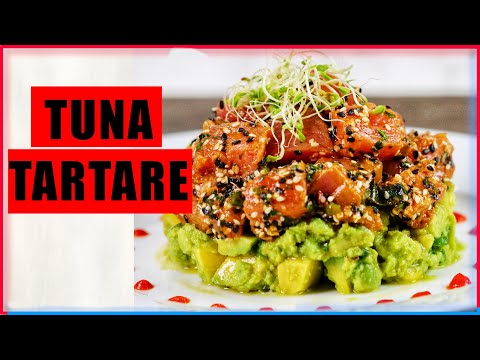
The primary reference video for this recipe — covers knife technique for uniform dice and the critical role of temperature control throughout prep and plating.
2. Knife Skills for Raw Fish
Detailed walkthrough on breaking down sushi-grade fish for tartare and crudo preparations. Focuses on clean cuts that preserve texture.
3. Plating Restaurant Appetizers at HomePractical guide to ring mold technique, garnish placement, and building height in cold appetizer presentations.
🛠️ Core Equipment
- Sharp chef's knife ↗Clean dice requires a blade that severs rather than tears. A dull knife shreds the tuna's delicate muscle fibers, producing ragged edges that break apart during folding. The knife should glide through the fish in a single forward stroke.
- Ring mold ↗Produces the restaurant-style cylindrical presentation that signals care and intention to every guest at the table. A clean tuna can with both ends removed works identically. Without it, you're serving a pile.
- Chilled mixing bowl ↗Keep the mixing bowl in the refrigerator until the moment you start combining ingredients. If your hands are warm and your bowl is warm, the tuna starts warming from both directions simultaneously.
Restaurant-Grade Tuna Tartare (Stop Paying $24 for This)
🛒 Ingredients
- ✦1 pound sushi-grade ahi tuna, finely diced into 1/4-inch cubes
- ✦3 tablespoons fresh lime juice, preferably from 2-3 Persian limes
- ✦2 tablespoons low-sodium soy sauce
- ✦1 tablespoon extra-virgin olive oil
- ✦1 teaspoon sesame oil
- ✦1 medium avocado, finely diced
- ✦1/4 cup English cucumber, finely diced
- ✦3 scallions, thinly sliced on the bias
- ✦2 tablespoons fresh cilantro, minced
- ✦1 tablespoon pickled ginger, finely chopped
- ✦1 teaspoon wasabi paste, or to taste
- ✦1/2 teaspoon sea salt
- ✦1/4 teaspoon freshly cracked black pepper
- ✦1/4 teaspoon red pepper flakes
- ✦8 crispy rice crackers or wonton chips for serving
- ✦1 nori sheet, cut into thin strips for garnish
- ✦1 tablespoon sesame seeds, toasted
- ✦Ice for chilling serving plates
👨🍳 Instructions
01Step 1
Place four serving plates in the freezer for at least 15 minutes before you begin any prep.
02Step 2
Pat the sushi-grade tuna dry with paper towels. On a cold cutting board, dice into uniform 1/4-inch cubes using smooth forward strokes of a sharp knife. Do not saw.
03Step 3
In a small bowl, whisk together the lime juice, low-sodium soy sauce, extra-virgin olive oil, and sesame oil until fully combined.
04Step 4
Transfer the diced tuna to a chilled mixing bowl. Pour the dressing over the tuna and fold gently with a rubber spatula — two or three slow passes only.
05Step 5
Add the diced avocado, cucumber, scallions, cilantro, and pickled ginger. Fold together just until distributed, about 2-3 gentle passes.
06Step 6
In a small dish, mix the wasabi paste into a teaspoon of the tartare mixture until smooth, then fold this back into the bowl. This distributes heat evenly rather than leaving spicy pockets.
07Step 7
Season with sea salt, cracked black pepper, and red pepper flakes. Taste once and adjust. Do not over-season — the soy sauce carries significant salt already.
08Step 8
Retrieve the chilled plates from the freezer. Set a ring mold in the center of each plate and pack the tartare firmly. Lift the mold straight up in a single smooth motion.
09Step 9
Arrange rice crackers or wonton chips around the tartare mound at even intervals.
10Step 10
Scatter toasted sesame seeds over the top of each portion. Lay nori strips decoratively around the base.
11Step 11
Serve immediately. Instruct guests to eat within five minutes while the fish is at optimal temperature and the crackers remain crisp.
Nutrition Per Serving
Estimates based on standard preparation. Adjustments alter macros.
🔄 Substitutions
Instead of Sushi-grade ahi tuna...
Use Sushi-grade yellowtail or halibut
Yellowtail is richer and more buttery. Halibut is milder and slightly firmer. Both work with identical technique. The dish changes character, not quality.
Instead of Low-sodium soy sauce...
Use Coconut aminos
Sweeter profile, approximately 65% less sodium. Gluten-free by default. The umami depth is slightly lower — compensate with an extra few drops of sesame oil.
Instead of Rice crackers...
Use Thinly sliced cucumber rounds or seaweed snacks
Eliminates refined carbohydrates entirely. Cucumber adds fresh crunch and hydration. Seaweed snacks reinforce the oceanic flavor profile.
Instead of Sesame oil...
Use Toasted walnut oil
Earthy, slightly bitter finish that plays well against the lime. Higher in omega-3s. Avocado oil works if you want neutral fat without sesame flavor.
🧊 Storage & Reheating
In the Fridge
Dressed tartare does not store — the citrus continues denaturing the fish and it becomes ceviche within an hour. If you have leftovers, they are compromised. Undressed diced tuna can be refrigerated for up to 4 hours.
In the Freezer
Do not freeze assembled tartare. Raw sushi-grade tuna that has been properly frozen to FDA specifications can be refrozen once thawed only if it was never dressed.
Reheating Rules
There is no reheating. This dish is cold or it is nothing.
❓ Frequently Asked Questions
How do I know if tuna is actually sushi-grade?
Ask your fishmonger directly whether it has been frozen to FDA-specified temperatures for parasite elimination. Reputable fish counters at Japanese grocery stores and specialty seafood markets handle this correctly. 'Looks fresh' is not a safety standard for raw consumption.
Can I make this ahead of time?
You can prep all components separately — dice the tuna, make the dressing, prep the vegetables — and hold everything refrigerated for up to two hours. Combine and dress no more than five minutes before plating. The moment lime juice hits raw fish, the clock starts.
Why is my tartare watery?
Two likely causes: the cucumber released water into the mix (salt it lightly and let it drain for ten minutes before adding), or the tuna was not properly dried before dicing. Pat the fish firmly dry before cutting. Residual moisture dilutes every flavor in the dressing.
What's the difference between tartare and ceviche?
Time and intent. Ceviche intentionally 'cooks' raw fish in citrus acid over 15-30 minutes until the proteins are fully denatured. Tartare is dressed and served immediately — the fish is raw by design, not by oversight. Same chemistry, opposite goals.
Can I use canned tuna for this?
No. Canned tuna is cooked, has a completely different texture, and lacks the clean flavor that makes tartare worth eating. This dish exists specifically to celebrate the raw protein. There is no canned substitute.
How spicy should the wasabi be?
Subtle. Wasabi should be a background note that makes people say 'there's something in here' rather than a heat event that overrides the tuna. Start with half the amount called for, taste, and add from there. You can always add more. You cannot take it back.
The Science of
Restaurant-Grade Tuna Tartare (Stop Paying $24 for This)
We turned everything on this page into a beautiful, flour-proof PDF cheat sheet. Print it out, stick it to your fridge, and never mess up your restaurant-grade tuna tartare (stop paying $24 for this) again.
*We'll email you the high-res PDF instantly. No spam, just perfectly cooked meals.
AlmostChefs Editorial Team
We translate the internet's most popular cooking videos into foolproof, beginner-friendly written recipes. We analyze multiple methods, test them in our kitchen, and engineer a single "Master Recipe" that gives you the best possible result with the least possible stress.