Tteokbokki (Spicy Rice Cakes)
Chewy Korean rice cakes smothered in a sweet, spicy gochujang sauce with fish cakes and scallions. The king of Korean street food.
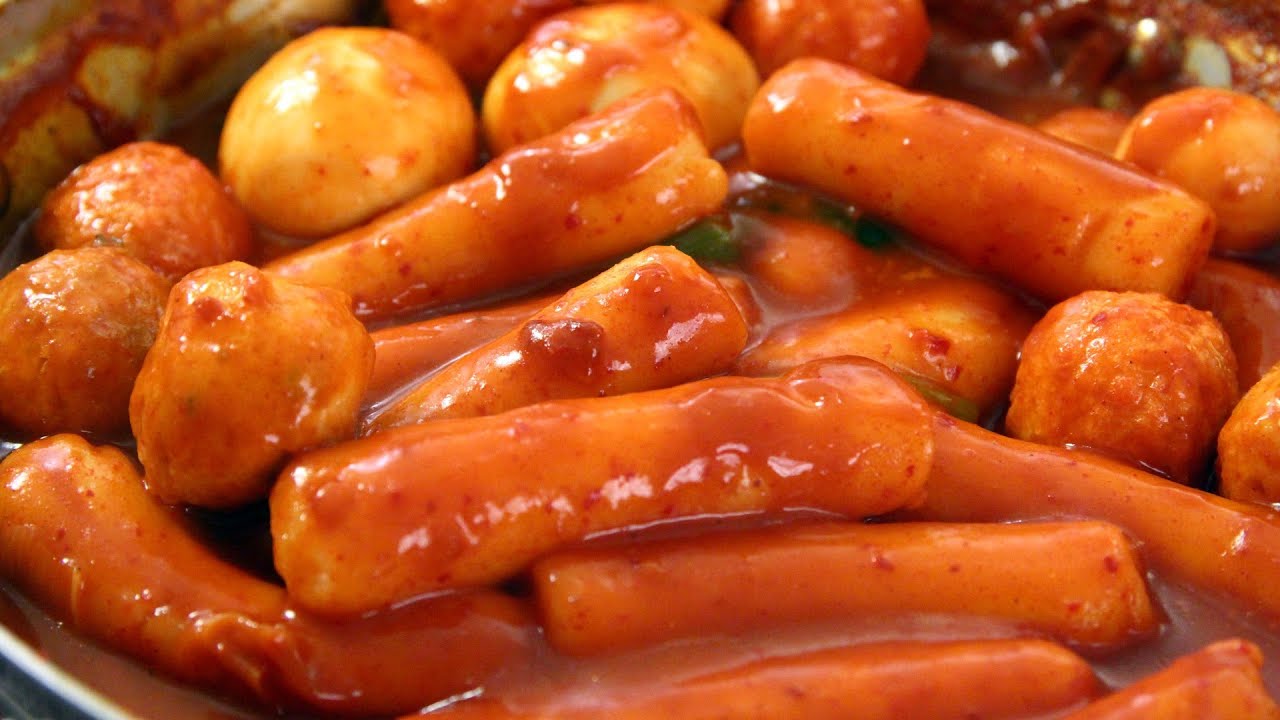
Why This Recipe Works
Let's dispense with the romance. Tteokbokki is not subtle. It does not care about your palate's nuance or your Instagram aesthetic. It is a blunt instrument — a thick, sticky, nuclear-red sauce clinging to chewy cylinders of compressed rice starch, served scalding hot in a styrofoam cup to a teenager standing on a Seoul sidewalk at 11pm. It is one of the most precisely calibrated street foods on the planet, and understanding why it works requires you to stop thinking like a home cook and start thinking like a food scientist.
The Double-Spice Architecture
Most amateur recreations of tteokbokki collapse into a one-dimensional wall of heat. The reason this recipe doesn't is the deliberate separation of spice sources. Gochujang and gochugaru are not interchangeable — they are not even the same category of ingredient. Gochujang is a fermented paste: slow-built, savory, carrying months of microbial activity that produces complex Maillard-adjacent compounds, organic acids, and a deep background sweetness from the glutinous rice in its base. Gochugaru is raw flake heat — the front-palate burn that registers immediately and fades quickly. Together, they occupy completely different temporal positions in your flavor perception. The gochujang arrives last, long, and deep. The gochugaru hits first and steps aside. This is not an accident. This is the entire structural logic of the sauce, and it is the reason tteokbokki tastes like more than just "spicy."
Starch-Thickened Sauce: The Self-Completing System
The sauce in this recipe contains no added thickener. No cornstarch slurry, no roux, no reduction tricks. This is not laziness — it is elegant systems design. Korean rice cakes (tteok) are, at their core, dense cylinders of gelatinized glutinous rice starch. When submerged in simmering liquid, the outer layers of the tteok begin to hydrate and leach starch directly into the cooking liquid. The sauce thickens because the main ingredient is the thickener. The longer the rice cakes cook, the more starch enters suspension, and the more the sauce transforms from a thin, watery broth into the glossy, clingy coating that defines the dish. This is why you use a wide, shallow pan — surface area controls evaporation rate, which controls how fast the sauce reduces alongside the starch release. A deep pot disrupts the ratio entirely and you end up with either waterlogged tteok or a scorched paste.
The Anchovy-Dashima Stock: Non-Negotiable Umami Infrastructure
Water is a solvent. Stock is an argument. Anchovy-dashima stock — made from dried anchovies (myeolchi) and kelp (dashima) — is the flavor infrastructure upon which everything else sits. Dried anchovies contribute nucleotides, specifically inosinate (IMP), a flavor-active compound that triggers the same umami receptors as glutamate but through a different molecular pathway. Kelp contributes glutamate directly. When these two compounds combine in hot liquid, they create a synergistic amplification effect — the umami perception is not additive, it is multiplicative. This is the same principle behind dashi in Japanese cooking. You are not adding flavor on top of water. You are building a charged base that makes every subsequent ingredient — the gochujang, the soy sauce, the garlic — more legible on the palate. Using plain water is technically permissible. It is also structurally illiterate.
The Corn Syrup Finish: Gloss as Texture Signal
The final addition of corn syrup or rice syrup (mulyeot) is one of those steps that looks like decoration and is actually physics. Corn syrup is a solution of glucose, maltose, and longer-chain dextrins. Unlike sucrose (table sugar), it does not crystallize at ambient temperatures. When stirred into a hot, starch-thickened sauce, it lowers the water activity at the sauce's surface and dramatically increases its viscosity coefficient — in plain language, it makes the sauce cling harder and stay glossy as it cools slightly. The visual effect — that high-sheen, lacquered surface on every rice cake — is a direct readout of physical texture. Your brain interprets gloss as richness and freshness simultaneously. Seoul street vendors know this. The corn syrup finish is not added because it tastes like anything in particular. It is added because it makes the food look like it tastes exactly as good as it does.
Rice Cake Geometry: Why Cylinders and Not Ovals
The frontmatter note about using cylindrical garae-tteok over sliced oval-shaped tteok is not a matter of tradition or preference — it is surface-area-to-volume ratio applied to flavor delivery. Cylindrical rice cakes expose a consistent, smooth surface to the sauce along their entire length. Oval sliced tteok has two cut faces with exposed cross-sections that hydrate faster than the rounded edges, creating uneven softening and a mushy center before the exterior is properly glazed. The cylinder form also holds structural integrity under prolonged stirring, which is necessary given that you are moving the pan contents continuously for 10 minutes to prevent the starch from fusing with the pan's surface. Shape is function. This is not a small point.
Seoul Street Food King
Tteokbokki is omnipresent in Korea not because it is easy, but because it is correct. It hits salt, sweet, spice, and chew in a single serving. It is warm when the weather is not. It costs almost nothing and delivers more than it has any right to. The orange-red sauce coating styrofoam cups at pojangmacha stalls across Seoul is as structurally inevitable as it is iconic — every element of the recipe is doing exactly the work it needs to do, nothing more, nothing less. That is what good street food is. That is what this recipe is. Make it hot. Eat it immediately. There are no second chances with tteokbokki once it cools.
Tteokbokki (Spicy Rice Cakes)
🛒 Ingredients
- ✦1 lb Korean rice cakes (tteok), cylindrical type
- ✦4 sheets Korean fish cake (eomuk), cut into triangles
- ✦2 cups anchovy-dashima stock (or water)
- ✦3 tablespoons gochujang (Korean red pepper paste)
- ✦1 tablespoon gochugaru (Korean red pepper flakes)
- ✦2 tablespoons soy sauce
- ✦1 tablespoon sugar
- ✦1 tablespoon corn syrup or rice syrup (mulyeot)
- ✦2 cloves garlic, minced
- ✦3 green onions, cut into 2-inch pieces
- ✦2 hard-boiled eggs (optional)
👨🍳 Instructions
01Step 1
If using refrigerated or frozen rice cakes, soak them in warm water for 10 minutes to soften. Fresh rice cakes can go straight in.
02Step 2
Combine anchovy-dashima stock, gochujang, gochugaru, soy sauce, sugar, and garlic in a wide, shallow pan. Whisk until the paste dissolves.
03Step 3
Bring the sauce to a boil over medium-high heat.
04Step 4
Add rice cakes and fish cake triangles. Stir to coat everything in sauce.
05Step 5
Cook over medium heat, stirring frequently, for 8-10 minutes until the rice cakes are soft and chewy and the sauce has thickened to a glossy coat.
06Step 6
Add corn syrup and stir for another minute — this gives the sauce its characteristic glossy sheen.
07Step 7
Add green onions and halved hard-boiled eggs if using. Cook 1 more minute.
08Step 8
Serve immediately in the pan while still bubbling. Tteokbokki firms up as it cools.
Nutrition Per Serving
Estimates based on standard preparation. Adjustments alter macros.
🔄 Substitutions
Instead of Korean rice cakes...
Use Gnocchi
Surprisingly similar texture — use shelf-stable gnocchi, don't pre-boil
Instead of Fish cake (eomuk)...
Use Extra firm tofu, sliced
For a vegetarian version — won't have the same springy texture but absorbs the sauce well
Instead of Anchovy-dashima stock...
Use Vegetable stock
For vegetarian — add a splash of soy sauce for extra umami
Instead of Corn syrup...
Use Honey
Slightly different flavor but adds the same glossy finish
🧊 Storage & Reheating
In the Fridge
Store for 1-2 days max. Rice cakes harden significantly in the fridge.
In the Freezer
Not recommended — texture changes drastically after freezing.
Reheating Rules
Add 2-3 tablespoons water, reheat in a pan over medium heat, stirring constantly until sauce loosens and tteok softens again.
❓ Frequently Asked Questions
Where do I buy Korean rice cakes?
Any Korean or Asian grocery store carries them — fresh, refrigerated, or frozen. Fresh is best (softer, chewier), frozen is most common and works great after soaking. Look for garae-tteok (가래떡) — the long cylindrical tubes.
Why is my tteokbokki too spicy?
Reduce the gochugaru (red pepper flakes) first — that's the raw heat. Gochujang is fermented and more savory than spicy. You can also add more sugar or corn syrup to balance the heat. Some people add cream cheese for a milder, creamy version.
What is rose tteokbokki?
Rose (rosé) tteokbokki is a trendy Korean fusion version that adds heavy cream or milk to the gochujang sauce, creating a creamy, pink, less spicy version. It's wildly popular in Seoul right now.
The Science of
Tteokbokki (Spicy Rice Cakes)
We turned everything on this page into a beautiful, flour-proof PDF cheat sheet. Print it out, stick it to your fridge, and never mess up your tteokbokki (spicy rice cakes) again.
*We'll email you the high-res PDF instantly. No spam, just perfectly cooked meals.
AlmostChefs Editorial Team
We translate the internet's most popular cooking videos into foolproof, beginner-friendly written recipes. We analyze multiple methods, test them in our kitchen, and engineer a single "Master Recipe" that gives you the best possible result with the least possible stress.