Classic Tres Leches Cake (The Soak Makes or Breaks It)
A light sponge cake fully saturated with a three-milk mixture and topped with fresh whipped cream. The technique here is about two things: building an open, airy crumb that absorbs the soak evenly, and cooling the cake completely before the liquid ever touches it. Everything else is secondary.
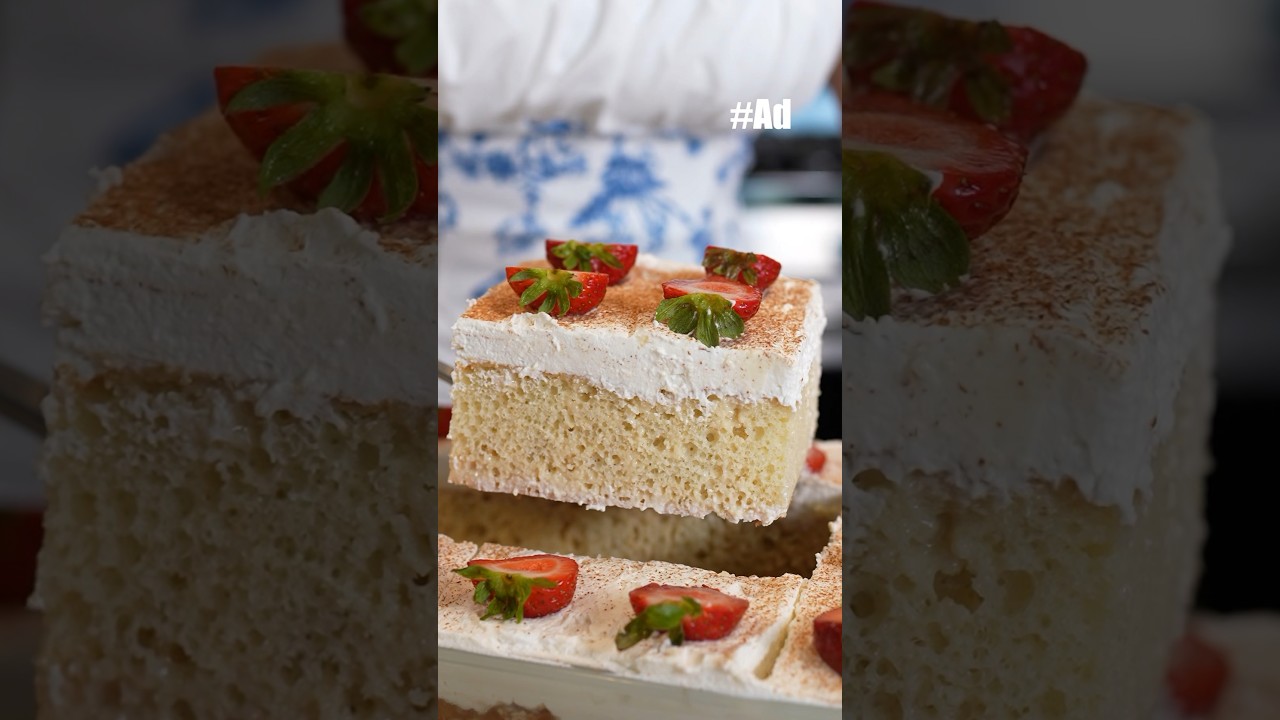
“Most tres leches failures come down to one moment: the soak. People pour the milk mixture over a fully cooled cake, watch it puddle on the surface, declare it done, and wonder why the center tastes like dry sponge two hours later. The cake needs to be warm when the milk hits it, pierced more aggressively than you think, and given real time — not one hour, not two — to absorb. Get that right and the rest is just assembly.”
Why This Recipe Works
Tres leches is one of the few cakes in existence where the baking is almost beside the point. Get a decent sponge in the oven, don't collapse the egg whites, don't overbake — that part is straightforward. The entire performance happens after the cake comes out of the oven, in the forty-five seconds when everything can go right or disastrously wrong depending on whether you understand what you're actually doing.
The Sponge Is a Vehicle, Not the Destination
A tres leches sponge has one job: to be porous enough to absorb three times its own weight in liquid without disintegrating. This is why it uses no butter or oil. Fat coats the gluten strands and creates a tight, rich crumb that repels liquid — ideal for a layer cake, catastrophic for a soaked one. The tres leches sponge is intentionally lean and airy, structured almost entirely by beaten egg whites that create an open, sponge-like network of air pockets.
Beat the yolks to ribbon stage — pale, thick, falling in slow trails from the beater. Fold the whites in two careful additions with a wide rubber spatula. These are not suggestions. The egg whites are the only leavening in this cake, and every careless fold deflates them. A collapsed sponge produces a dense, closed crumb that will sit on your counter pooling milk for four hours and still come out dry.
The Soak Window Is Exactly 10 Minutes Wide
Pull the cake from the oven. Set a timer for 10 minutes. Use those 10 minutes to make the milk mixture, because when that timer goes off, you need to pour immediately.
Here's why: a freshly baked sponge is structurally flexible. Its crumb is open, its gluten is relaxed from heat, and the air pockets left by steam and beaten egg whites are still expanded. Milk poured into this state flows freely into the interior. Wait 20 minutes and the crumb starts to set and tighten. Wait until the cake is fully cooled and you're pouring liquid onto a closed structure — it pools on the surface, runs to the edges, and the center never sees it.
Pierce the surface before you pour. Not twelve holes — a hundred. Every half inch across the entire surface, deep enough that your fork nearly touches the bottom of the 9x13 baking dish. These channels are the infrastructure for the soak. Sparse piercing means some sections of cake get saturated while others stay dry, and no amount of resting time will fix uneven distribution.
What Three Milks Actually Does
The three-milk combination is not arbitrary. Each component does something specific. Sweetened condensed milk contributes sweetness and viscosity — it's thick enough to stay suspended in the cake rather than weeping straight through. Evaporated milk is whole milk with half its water removed, which concentrates the milk proteins and gives the soak body without adding sweetness. Heavy cream adds fat, richness, and a slight resistance to absorption that slows the soak and gives the liquid time to distribute evenly rather than racing straight to the bottom.
Together they create a soak that's thick enough to cling, sweet enough to balance the neutral sponge, and rich enough that a single slice satisfies completely. The rum — if you use it — cuts through all that sweetness with its complex, woody heat. It is strongly recommended.
The Overnight Imperative
Pour the milk, cover the pan, and put it in the refrigerator for the night. Not because the recipe says so — because the physics demands it. Liquid migration through a crumb structure happens slowly. What you see immediately after the pour is not the final distribution. The top layer is saturated. The center is partially absorbed. The bottom is pooling.
Over 8 hours in the fridge, that uneven distribution equalizes. Liquid moves from high-concentration zones toward low-concentration zones through capillary action. The result is a cake that's uniformly moist from edge to edge, surface to base — the texture that makes people stop mid-conversation when they take a bite. Slice it after four hours and it's good. Slice it the next morning and it's something else entirely.
The whipped cream goes on last, within two hours of serving. It's not decoration — it's the cooling counterpoint to the rich soak. Apply it too early and moisture from the cake thins it from beneath. Apply it too late and you're serving warm cream. Timing here is the final act of an otherwise patient process.
Where Beginners Mess This Up
Before we start, read this. These are the 4 reasons your classic tres leches cake (the soak makes or breaks it) will fail:
- 1
Pouring the milk over a cold cake: A fully cooled sponge has already set its crumb structure and becomes resistant to liquid absorption. The milk sits on top and pools at the edges instead of penetrating. Pull the cake from the oven, let it rest exactly 10 minutes, then pour. The residual warmth keeps the crumb open and receptive.
- 2
Under-piercing the surface: A dozen fork holes is not enough. You need to cover the entire surface densely — every half inch — going deep enough to reach the bottom layer. These channels are the only paths the milk mixture has into the interior. Sparse piercing means dry pockets in every slice.
- 3
Deflating the egg whites: Tres leches is a sponge cake. The only leavening is the air beaten into the egg whites. Fold them in with gentle, deliberate strokes — not stirring. Two additions, not one. Any aggressive mixing collapses the structure and produces a dense, flat cake that won't absorb evenly.
- 4
Skipping the overnight rest: Four hours is the minimum. Overnight is the answer. The milk migration from surface to center happens slowly — flavors meld, texture evens out, the top layer that was waterlogged becomes indistinguishable from the center. Patience transforms a good cake into a remarkable one.
The Video Reference Library
Want to see it in action? Here are the exact videos we analyzed and combined to build this foolproof recipe translation:
Clear walkthrough of the full technique from sponge to soak to topping. Best visual reference for the egg white fold and how to judge when absorption is complete.
🛠️ Core Equipment
- 9x13-inch baking dishThe wide, shallow footprint gives you maximum surface area for even soaking. Smaller pans build height but sacrifice absorption distribution — the center stays dry while edges oversaturate.
- Electric hand or stand mixerBeating egg whites to stiff peaks by hand is technically possible and practically miserable. A mixer gets you there in 5 minutes and gives you consistent results. The stiff peak stage is load-bearing — underdeveloped whites produce a dense cake.
- Large liquid measuring cupMixing and pouring the three-milk mixture from a 4-cup measuring cup lets you distribute it in a slow, controlled stream across the entire surface. Pouring from a bowl means floods and dry spots.
- Offset spatulaFor spreading the whipped cream topping evenly across the surface without compressing it. A flat knife drags and tears. An offset spatula floats across the cream and gives you the clean, professional finish this cake deserves.
Classic Tres Leches Cake (The Soak Makes or Breaks It)
🛒 Ingredients
- ✦1 cup all-purpose flour
- ✦1 teaspoon baking powder
- ✦1/4 teaspoon fine sea salt
- ✦5 large eggs, separated
- ✦3/4 cup granulated sugar, divided
- ✦1/3 cup whole milk
- ✦2 teaspoons vanilla extract
- ✦1 can (12 ounces) evaporated milk
- ✦1 can (14 ounces) sweetened condensed milk
- ✦1/2 cup heavy cream
- ✦1 1/2 cups heavy whipping cream, chilled
- ✦2 tablespoons powdered sugar
- ✦1 teaspoon vanilla extract for topping
- ✦Fresh strawberries or maraschino cherries for garnish
- ✦2 tablespoons rum or 1 tablespoon rum extract (optional)
👨🍳 Instructions
01Step 1
Preheat your oven to 350°F. Line a 9x13-inch baking dish with parchment paper, leaving slight overhang on the sides.
02Step 2
Whisk together the flour, baking powder, and sea salt in a medium bowl. Set aside.
03Step 3
Separate the eggs carefully — whites into a large bowl, yolks into a separate medium bowl. Any yolk in the whites will prevent them from reaching stiff peaks.
04Step 4
Beat the egg yolks with 1/2 cup of the granulated sugar on medium speed until the mixture is pale, thick, and falls in ribbons from the beater — about 3 minutes.
05Step 5
Stir the whole milk and 2 teaspoons vanilla extract into the yolk mixture, then gently fold in the flour mixture until just combined. Do not overmix.
06Step 6
Beat the egg whites on high speed, gradually adding the remaining 1/4 cup sugar, until stiff peaks form — about 5 minutes. The peaks should stand straight up without drooping.
07Step 7
Fold the whipped egg whites into the batter in two additions using a wide rubber spatula. Use slow, deliberate strokes — cut through the center, sweep around the bowl, rotate. Stop the moment no white streaks remain.
08Step 8
Pour the batter evenly into the prepared baking dish and bake for 25-30 minutes, until a toothpick inserted in the center comes out clean and the top is lightly golden.
09Step 9
Remove the cake from the oven and let it rest for exactly 10 minutes — not longer. While it rests, combine the evaporated milk, sweetened condensed milk, heavy cream, and rum extract (if using) in a large measuring cup and whisk until blended.
10Step 10
Pierce the entire surface of the warm cake with a fork, creating dense, deep holes spaced every half inch across the entire surface.
11Step 11
Slowly pour the three-milk mixture evenly across the entire surface, starting at the edges and working toward the center. Let each pour absorb before adding more. Allow 5 minutes total.
12Step 12
Cover the pan with plastic wrap and refrigerate for at least 4 hours, preferably overnight.
13Step 13
Just before serving, whip the chilled heavy cream with powdered sugar and 1 teaspoon vanilla extract until stiff peaks form, about 3-4 minutes.
14Step 14
Spread the whipped cream evenly across the entire surface of the chilled cake using an offset spatula.
15Step 15
Garnish with fresh strawberries or maraschino cherries and serve directly from the dish.
Nutrition Per Serving
Estimates based on standard preparation. Adjustments alter macros.
🔄 Substitutions
Instead of Sweetened condensed milk...
Use Evaporated milk mixed with 2 tablespoons honey
Slightly less sweet with more nuanced flavor. Reduces added refined sugar while maintaining the creamy richness that defines the soak.
Instead of All-purpose flour...
Use 3/4 cup all-purpose flour and 1/4 cup almond flour
Adds a subtle nuttiness and slightly improves the nutritional profile. The cake structure stays light because almond flour still allows the egg whites to lift it.
Instead of Heavy whipping cream topping...
Use Greek yogurt whipped with 1 tablespoon honey and 1/2 teaspoon vanilla
Tangier flavor, lower fat, better for dairy-sensitive guests. Texture is slightly denser than whipped cream but still spreadable. Apply immediately before serving — it doesn't hold as long.
Instead of Whole milk in batter...
Use Unsweetened oat milk
Produces a slightly lighter cake. Oat milk's natural sweetness integrates well. Avoid almond milk here — its low fat content makes the batter thinner and the crumb tighter.
🧊 Storage & Reheating
In the Fridge
Store tightly covered in the baking dish for up to 4 days. The texture actually peaks on day 2 after an overnight rest.
In the Freezer
Freeze individual slices (without the whipped cream topping) wrapped in plastic wrap for up to 1 month. Thaw overnight in the fridge and add fresh whipped cream before serving.
Reheating Rules
This cake is served cold. Do not reheat. If a slice has been out too long, return it to the fridge for 20 minutes — it will recover.
❓ Frequently Asked Questions
Why is my tres leches cake dry in the middle?
Two causes: under-piercing or pouring over a cold cake. The fork holes need to be dense and deep — every half inch, all the way to the pan bottom. And the milk must go on while the cake is still warm (10 minutes out of the oven), when the crumb is still open and receptive.
Can I make tres leches the day before?
You should. The overnight rest is where the magic happens. The milk migrates evenly from surface to center, the flavors meld, and the texture evens out. Day-of tres leches is fine. Day-after tres leches is exceptional. Add the whipped cream topping just before serving.
Why did my sponge come out flat and dense?
The egg whites were either under-beaten or deflated during folding. They need to reach true stiff peaks — standing straight up without drooping. And the fold must be gentle: two additions, deliberate strokes, stop the moment no white streaks remain. Over-folding collapses the air you worked 5 minutes to build.
Can I use a different pan size?
A 9x13 is strongly preferred for maximum surface area and even soaking. A 9x9 pan builds more height but the increased depth makes even milk penetration much harder — expect dry spots in the center. If you go smaller, double the piercing density.
Is the rum necessary?
No, but it adds significant depth. The alcohol cuts through the richness of the three-milk soak and adds a warm, complex note that makes the cake taste less one-dimensional. Rum extract at half the amount delivers most of the flavor without alcohol.
Why does my whipped cream topping weep and go thin?
Two reasons: the cream wasn't cold enough when whipped, or it was applied too far in advance. Chill your bowl and beaters before whipping. Apply the topping within 2 hours of serving. Beyond that, moisture rising from the soaked cake thins the cream from underneath.

The Science of
Classic Tres Leches Cake (The Soak Makes or Breaks It)
We turned everything on this page into a beautiful, flour-proof PDF cheat sheet. Print it out, stick it to your fridge, and never mess up your classic tres leches cake (the soak makes or breaks it) again.
*We'll email you the high-res PDF instantly. No spam, just perfectly cooked meals.
AlmostChefs Editorial Team
We translate the internet's most popular cooking videos into foolproof, beginner-friendly written recipes. We analyze multiple methods, test them in our kitchen, and engineer a single "Master Recipe" that gives you the best possible result with the least possible stress.