Authentic Tacos Al Pastor (The Spit-Roasted Secret, Decoded)
Thin-sliced pork marinated in dried chilies, achiote, and pineapple, stacked and roasted until the edges char and caramelize. We broke down the most-watched YouTube methods to reverse-engineer the taqueria technique you can actually pull off at home — without a vertical spit.
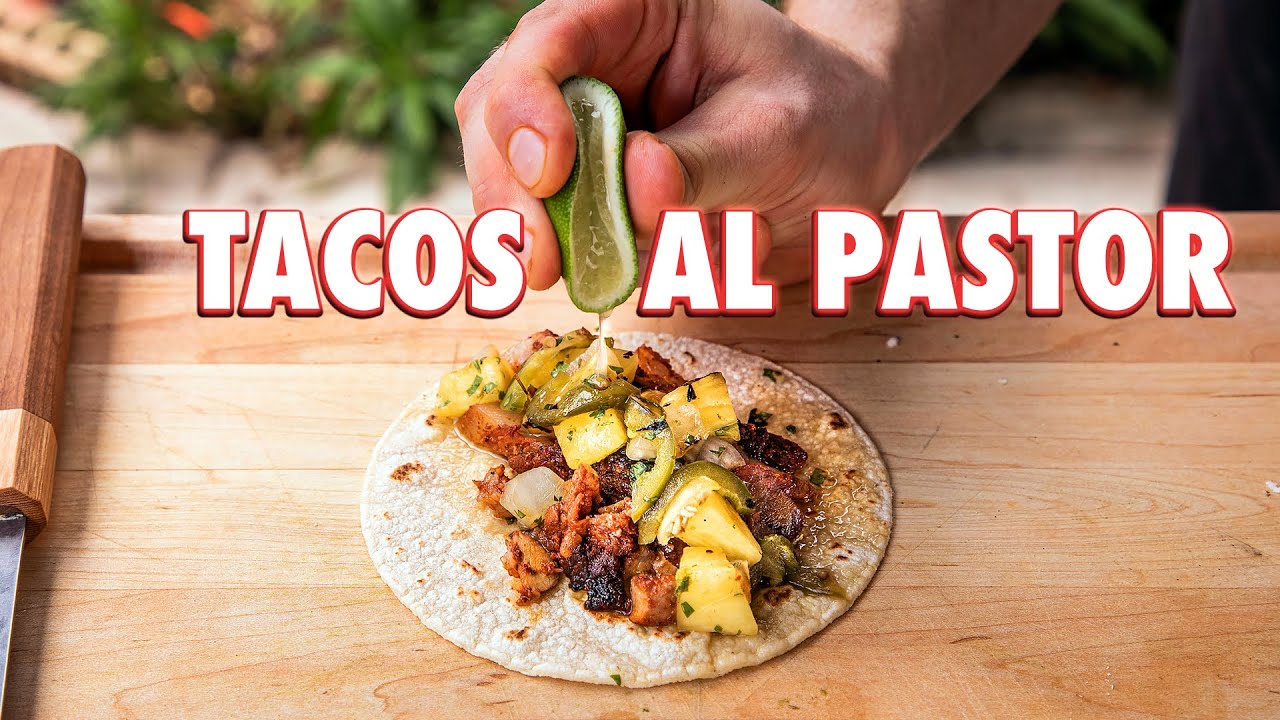
“Al pastor is the taco that converted a generation of skeptics. Smoky dried chilies, tangy achiote, sweet pineapple, pork with enough fat to stay juicy under heat that would dry out a chicken breast — it's a dish engineered for maximum flavor contrast in each bite. The problem is most home versions skip the marinade time, use the wrong cut of pork, and cook at temperatures too low to develop the char that makes al pastor taste like al pastor. Every shortcut costs you something. Here's the version that doesn't cut corners.”
Why This Recipe Works
Al pastor is not a Mexican dish. It is a Lebanese dish that Mexico absorbed, transformed beyond recognition, and then perfected. Lebanese immigrants arriving in Mexico City in the early twentieth century brought shawarma — lamb marinated in spices and cooked on a vertical rotisserie. Mexican cooks replaced the lamb with pork, swapped Middle Eastern spices for dried chilies and achiote, added pineapple, and invented one of the most structurally brilliant tacos in existence. Understanding this history explains why the dish works the way it does: it is a precision fusion of two completely different culinary logics, and every element is load-bearing.
The Dried Chili Architecture
Most home cooks treat dried chilies as interchangeable heat sources. They are not. Guajillo, ancho, and pasilla each contribute distinct flavor dimensions that create the marinade's complexity. Guajillo provides a fruity, slightly tannic backbone — the base note the palate registers first. Ancho, made from dried poblano, adds chocolate and raisin undertones that deepen during cooking and prevent the marinade from tasting one-dimensional. Pasilla contributes earthy, herbaceous tones that bridge the fruitiness of the guajillo and the sweetness of the achiote.
Toast them before rehydrating. This step is not optional ceremony — it is chemistry. The dry heat drives off residual moisture in the chili skin and triggers Maillard browning of the surface sugars, creating new aromatic compounds that cold rehydration cannot replicate. Thirty seconds per side in a dry skillet transforms flat, dried chili into something that smells like the inside of a taqueria. Do not skip it.
What Achiote Actually Does
Achiote paste — made from ground annatto seeds, spices, and vinegar — serves a function that most recipes describe inaccurately. It is not primarily a coloring agent. The vivid red-orange it imparts to the pork is a side effect of its primary role: providing a fermented, earthy base flavor that binds all the dried chili notes together and prevents the marinade from tasting simply like "spiced pork." Without achiote, the finished taco tastes bright and one-dimensional. With it, there is a low, resonant undertone that you notice by its absence if you skip it.
The Pineapple Enzyme Problem
Fresh pineapple contains bromelain, a protease enzyme that cleaves protein bonds in meat fibers. In correct concentrations and marination times, this produces a slightly more tender surface texture on the pork — not mushy, but yielding. The problem is bromelain is aggressive. Beyond 8-10 hours of contact with pork shoulder, the surface proteins begin breaking down past the point of tenderness into something closer to paste. This is why overnight marination works and 24-hour marination does not. It is also why canned pineapple juice is useless in the marinade — the heat processing required for canning completely denatures bromelain. Canned pineapple as a topping is fine. Canned pineapple in your marinade is just sugar water with a label.
The Heat Principle
The taqueria trompo achieves something a home skillet can only approximate: sustained high radiant heat on the exterior of the meat while the interior slowly continues cooking from residual heat. The outermost millimeter of each stack layer is in a constant state of caramelization, with rendered fat basting the layer below as it drips. This creates what al pastor actually tastes like — a contrast between lightly charred, caramelized exterior and juicy, spice-saturated interior in every single bite.
At home, you achieve this by cooking in small, uncrowded batches in a cast iron skillet at maximum heat. One layer, enough space around each slice for steam to escape, and enough patience to let the char develop rather than flipping the moment you see color. The Maillard reaction at the edges of the pork is the flavor — not a side effect of it. Treat the char as the goal, not an accident to be managed.
The Tortilla Is Not Incidental
Every element of al pastor is calibrated for corn tortilla specifically. The smokiness, the fat level, the acid from the pineapple and lime — all of it is tuned for the slight earthiness and structural resistance of fresh masa. Flour tortillas make the taco sweeter and softer in a way that flattens the flavor contrast. The double-tortilla convention exists because a single corn tortilla cannot contain the structural load of properly sauced, pineapple-topped al pastor. Stack them. It is not optional.
Where Beginners Mess This Up
Before we start, read this. These are the 4 reasons your authentic tacos al pastor (the spit-roasted secret, decoded) will fail:
- 1
Using lean pork loin instead of shoulder: Pork loin has almost no intramuscular fat, which means it dries out violently under high heat before it can develop any char. Al pastor needs pork shoulder — also called pork butt — because the fat marbling bastes the meat from within during cooking. Lean pork gives you jerky, not tacos.
- 2
Marinating for less than 4 hours: The achiote-chili marinade is not a coating — it is a transformation. The acids from the dried chili rehydration liquid and the pineapple enzyme bromelain need time to penetrate the pork and soften the muscle fibers. Less than 4 hours and you get pork with a stained surface. Six to twelve hours gives you meat that's flavored through to the center.
- 3
Cooking at medium heat instead of high: Al pastor gets its signature flavor from the Maillard reaction and controlled char at the edges of each slice. That requires sustained high heat. Medium heat produces steam, not sear — and steamed pork, regardless of how well it's marinated, will never replicate the taqueria flavor. Cast iron or a screaming-hot grill is non-negotiable.
- 4
Skipping the fresh pineapple finish: The grilled pineapple on top of the taco is not a garnish. It is a flavor counterweight — its acidity and sweetness cut through the fat and smoke of the pork and reset your palate between bites. Using canned pineapple in syrup instead of fresh makes the taco cloying. Skipping it entirely makes it heavy.
The Video Reference Library
Want to see it in action? Here are the exact videos we analyzed and combined to build this foolproof recipe translation:
The foundational video for this recipe. Covers the dried chili selection, achiote paste preparation, and the broiler-as-trompo technique in detail. Essential watch before your first attempt.
Focused breakdown of guajillo vs. ancho chili ratios and how pineapple enzymes affect marination time. Useful for understanding why the marinade proportions in this recipe are what they are.
Demonstrates the cast iron high-heat technique for home cooks without a vertical spit. Clear visuals of the edge char you're targeting and how to tell when each slice is ready to flip.
🛠️ Core Equipment
- Cast iron skillet or carbon steel panAchieves and holds the extreme surface temperatures required for proper edge char on the pork slices. Non-stick pans cannot handle the heat and warp. Stainless steel works but requires more oil management.
- BlenderFor processing the rehydrated dried chilies into a completely smooth marinade paste. A food processor leaves fibrous chili skin in the marinade, which creates an uneven coating and slightly bitter patches on the finished meat.
- Sharp slicing knife or mandolineAl pastor slices should be 3-4mm thin. Thick slices take too long to cook through at high heat, resulting in char on the outside and raw fat in the center. A mandoline set to 3mm produces perfect, consistent slices.
- Metal skewers or vertical skewer setupIf you want to replicate the trompo at home in the oven, threading the pork slices onto two parallel metal skewers and standing them vertically under the broiler is the closest approximation. The vertical position allows fat to baste the stack as it cooks.
Authentic Tacos Al Pastor (The Spit-Roasted Secret, Decoded)
🛒 Ingredients
- ✦3 pounds pork shoulder, sliced 3-4mm thin against the grain
- ✦4 dried guajillo chilies, stemmed and seeded
- ✦2 dried ancho chilies, stemmed and seeded
- ✦2 dried pasilla chilies, stemmed and seeded
- ✦3 tablespoons achiote paste
- ✦1/2 cup fresh pineapple juice
- ✦4 tablespoons white vinegar
- ✦6 garlic cloves
- ✦1 teaspoon dried Mexican oregano
- ✦1 teaspoon ground cumin
- ✦1/2 teaspoon ground black pepper
- ✦1.5 teaspoons sea salt
- ✦1/4 teaspoon ground cloves
- ✦2 tablespoons neutral oil, plus more for cooking
- ✦1/2 fresh pineapple, cored and sliced into 1/2-inch rings
- ✦18-24 small corn tortillas
- ✦1 white onion, finely diced
- ✦1 cup fresh cilantro leaves, roughly chopped
- ✦Lime wedges, for serving
- ✦Salsa verde or salsa roja, for serving
👨🍳 Instructions
01Step 1
Toast the dried guajillo, ancho, and pasilla chilies in a dry skillet over medium heat for 30-45 seconds per side until they deepen in color and become fragrant. Do not let them smoke or burn.
02Step 2
Place the toasted chilies in a bowl and cover with 2 cups of boiling water. Weigh them down with a small plate and soak for 20-25 minutes until fully softened and pliable.
03Step 3
Drain the rehydrated chilies and transfer to a blender along with the achiote paste, fresh pineapple juice, white vinegar, garlic cloves, oregano, cumin, black pepper, cloves, salt, and the reserved 1/2 cup soaking liquid. Blend on high for 2-3 minutes until completely smooth.
04Step 4
Place the thinly sliced pork shoulder in a large zip-lock bag or airtight container. Pour all of the marinade over the pork and massage it thoroughly so every slice is evenly coated. Seal and refrigerate for a minimum of 6 hours, ideally overnight.
05Step 5
Remove the pork from the refrigerator 30 minutes before cooking. Heat a cast iron skillet over high heat until it begins to smoke lightly. Add a thin layer of neutral oil.
06Step 6
Working in batches, lay the marinated pork slices in a single layer in the skillet. Do not crowd the pan — overcrowding drops the temperature and you will steam the meat rather than sear it. Cook 2-3 minutes per side until the edges are deeply caramelized and slightly charred.
07Step 7
Transfer cooked pork to a cutting board and let rest for 3 minutes. Then chop into rough, small pieces — a mix of charred edges and tender interior pieces. This is the traditional presentation.
08Step 8
In the same skillet over high heat, grill the fresh pineapple rings for 2-3 minutes per side until caramelized with visible grill marks. Remove and dice into small cubes.
09Step 9
Warm the corn tortillas directly over a gas burner or in a dry skillet until lightly charred and pliable. Stack and keep wrapped in a clean kitchen towel to stay warm.
10Step 10
Assemble the tacos: a layer of chopped al pastor, a few pieces of grilled pineapple, finely diced white onion, fresh cilantro, and a squeeze of lime. Serve with salsa verde or roja on the side.
Nutrition Per Serving
Estimates based on standard preparation. Adjustments alter macros.
🔄 Substitutions
Instead of Pork shoulder...
Use Chicken thighs
Slice thin and marinate for only 2-3 hours — bromelain in the pineapple juice will begin to turn chicken mushy beyond that. Higher protein turnover, slightly less fat.
Instead of Achiote paste...
Use Annatto powder + vinegar paste
Mix 2 teaspoons annatto powder with 1 teaspoon white vinegar and 1/2 teaspoon oil. Provides the color and earthy base but lacks the full complexity of the fermented paste.
Instead of Dried guajillo chilies...
Use New Mexico dried chilies
Similar heat level and fruity undertone. Slightly less complex than guajillo but widely available and a legitimate substitution in a pinch.
Instead of Fresh pineapple...
Use Fresh mango
Provides similar acidity and sweetness on top of the finished taco. Does not work as a marinade substitute — mango lacks the bromelain enzyme that helps tenderize the pork.
🧊 Storage & Reheating
In the Fridge
Store cooked, chopped al pastor in an airtight container for up to 4 days. Keep the pineapple and toppings separate to prevent the tortillas from getting soggy.
In the Freezer
Freeze cooked al pastor in portions for up to 3 months. The marinade-soaked meat freezes exceptionally well. Thaw overnight in the refrigerator.
Reheating Rules
Reheat in a hot cast iron skillet with a splash of water or reserved marinade, stirring frequently until re-caramelized. Microwave reheating works but sacrifices the char — avoid if possible.
❓ Frequently Asked Questions
What cut of pork is best for al pastor?
Pork shoulder, also called pork butt. The intramuscular fat keeps the meat moist under high heat and contributes to the characteristic charred-edge, juicy-center texture. Pork loin is too lean and will dry out before it chars properly.
Can I skip the achiote paste?
Technically yes, but you lose the earthy, slightly peppery base note that anchors the flavor profile. The annatto powder substitution works. Pure chili marinade without any achiote tastes flat by comparison — it's missing the foundation.
How thin should I slice the pork?
Three to four millimeters — about the thickness of two quarters stacked. Thinner than that and the slices fall apart in the marinade. Thicker and they take too long to cook through at high heat, developing grey exteriors instead of char.
Why does my al pastor taste different from the taqueria?
Three likely culprits: insufficient marinade time, cooking temperature too low, or missing the char on the edges. Taquerias cook al pastor on a rotating vertical spit at sustained high radiant heat for hours — the outermost layer is constantly caramelizing while the interior stays moist. Replicating this at home requires maximum pan heat and not overcrowding.
Is the pineapple just a topping or does it serve a function?
Both. In the marinade, fresh pineapple juice contains bromelain, a protease enzyme that breaks down surface proteins in the pork for a more tender texture. As a topping, the grilled pineapple provides acid and sweetness that balances the fat and smoke of the finished meat. Canned pineapple is heat-processed, which denatures bromelain — it only works as a topping, not in the marinade.
What salsa is traditional with al pastor?
Salsa verde — tomatillo-based green salsa — is the most traditional pairing. Its brightness and acidity complement the smoky, fatty pork. Salsa roja works equally well for those who want more heat. Avoid thick, creamy salsas; they mute the complexity of the marinade.

The Science of
Authentic Tacos Al Pastor (The Spit-Roasted Secret, Decoded)
We turned everything on this page into a beautiful, flour-proof PDF cheat sheet. Print it out, stick it to your fridge, and never mess up your authentic tacos al pastor (the spit-roasted secret, decoded) again.
*We'll email you the high-res PDF instantly. No spam, just perfectly cooked meals.
AlmostChefs Editorial Team
We translate the internet's most popular cooking videos into foolproof, beginner-friendly written recipes. We analyze multiple methods, test them in our kitchen, and engineer a single "Master Recipe" that gives you the best possible result with the least possible stress.