Stuffed Cabbage Rolls (The Eastern European Classic Done Right)
Tender cabbage leaves wrapped around seasoned lean turkey and brown rice, simmered low and slow in a tangy tomato-paprika sauce. We broke down the technique to solve the two problems that ruin most homemade versions: leaves that tear and filling that turns to paste.

“Stuffed cabbage rolls have exactly two failure modes: the leaves rip when you roll them, or the filling turns into a dense, mealy brick. Both failures trace back to the same two steps — how long you boil the cabbage and how much you mix the filling. Get those right and everything else is just assembly. This recipe fixes both.”
Why This Recipe Works
Stuffed cabbage rolls are one of those dishes that looks intimidating but is structurally simple. The problem isn't complexity — it's that most recipes skip over the two moments where everything goes wrong. Fix those moments and you have a reliable weeknight dinner that tastes like it took far more effort than it did.
The Blanching Window
The cabbage head goes into boiling water whole. This is not a step you can rush. The goal is a specific texture: leaves that flex without cracking, with enough structural integrity to roll under tension. Too little time and the leaf spine is still rigid — it snaps when you bend it and splits the roll open. Too much time and the outer leaves turn to wet paper, disintegrating when you try to fold them.
Eight to ten minutes is the range. The test is tactile: peel a leaf away from the head. It should come off with minimal resistance and drape over your hand without cracking at the curve. If you feel any resistance at the base near the spine, the head needs more time. Return it to the water. Two minutes is always enough to fix an under-blanched cabbage. Nothing fixes an over-blanched one.
The inner cabbage that's left after you peel your rolling leaves gets chopped and scattered around the rolls in the pan. This is not waste management — it's a technique. The chopped pieces cook down into a soft, jammy layer that keeps the rolls elevated off the pan floor, preventing any scorching at the contact point while adding body to the tomato sauce.
What You're Actually Building in the Sauce
The tomato base here is a three-layer structure: diced tomatoes for texture and brightness, tomato sauce for body, tomato paste for concentrated depth. The chicken broth thins the sauce to a consistency that can penetrate the rolls during the simmer without becoming watery. The lemon juice is a background player — its job is acid balance, not flavor dominance. Add it in the sauce, not as a finish garnish, so it rounds out the sweetness of the tomatoes rather than cutting through the whole dish.
Paprika is the signature spice. Sweet Hungarian paprika carries a complexity that the generic supermarket variety doesn't — dried red pepper with depth rather than just color. If you can find labeled Hungarian paprika, it changes the sauce noticeably. If not, the recipe still works. It's just not quite the same.
The Filling Equation
Lean ground turkey is a good choice for this recipe because it stays tender at the low simmer temperatures and doesn't release the fat pools that can make the sauce greasy. Its weakness is that it's easy to overwork. The myosin proteins in ground meat bind together under mechanical stress — the more you mix, the tighter the matrix. In a meatball you can get away with some overworking. Inside a cabbage roll, where there's no crust to add contrast, a dense filling is just texturally wrong.
Mix with your hands. Mix until you no longer see dry pockets of rice or unmixed onion. Stop there. The filling should feel slightly sticky and cohesive, not packed. If you press a handful together and it holds its shape like modeling clay, you've gone too far. There's no recovery from overworked turkey — season it well and move on.
The pre-cooked brown rice inside the filling adds fiber and a nutty chew that white rice doesn't provide. Use rice that's slightly undercooked — still a little firm at the center — because it will absorb sauce moisture and finish cooking inside the roll. Fully cooked rice turns soft. Overcooked rice turns the filling paste.
The Simmer Is the Cook
Once the rolls go seam-side down in the Dutch oven and the sauce goes over, you are done making decisions. The only variable left is heat. Medium-low, covered, with barely perceptible bubbling — this is the entire technique. The sauce steams the top of the rolls while the liquid conducts heat from below. The lid traps moisture so the sauce doesn't reduce to paste before the filling cooks through.
Forty minutes is the window. At the 35-minute mark, pull one roll and cut it in half. The turkey should be fully opaque with no pink, and the rice should give without crunch. If either condition isn't met, cover and go another five minutes. The rolls don't overcook easily at this temperature — patience is an asset here, not a risk.
This is old food. It was designed for kitchens without thermometers or timers, cooked by people who had learned to read a pot by sound and smell. The technique is forgiving because it had to be. Trust the low heat. Trust the lid. The rolls will take care of themselves.
Where Beginners Mess This Up
Before we start, read this. These are the 4 reasons your stuffed cabbage rolls (the eastern european classic done right) will fail:
- 1
Under-boiling the cabbage: Cabbage leaves need 8–10 minutes in a full rolling boil before they'll peel away cleanly. Pull them early and you'll tear every leaf you try to separate. The outer leaves should drape like wet cloth — pliable, yielding, with no resistance at the spine. If they crack, they need two more minutes.
- 2
Overmixing the filling: Ground turkey is a lean protein with very little fat to lubricate the mix. Work it too hard and the myosin proteins bind tightly, turning your filling from light and savory into a dense rubber puck. Mix with your hands until the ingredients are just combined — no more. Some visible onion and rice in the mixture is correct.
- 3
Rolling too loosely or too tightly: Too loose and the rolls open in the sauce, dumping filling everywhere. Too tight and the rice has no room to expand, causing the roll to split. Three to four tablespoons of filling per leaf, folded snug but not compressed. Think burrito, not spring roll.
- 4
Simmering at too high a heat: High heat causes the tomato sauce to reduce aggressively before the filling cooks through. The rolls dry out on top while the centers stay raw. Gentle medium-low simmer — barely bubbling — for the full 35–40 minutes is the only way to finish the filling and build the sauce simultaneously.
The Video Reference Library
Want to see it in action? Here are the exact videos we analyzed and combined to build this foolproof recipe translation:
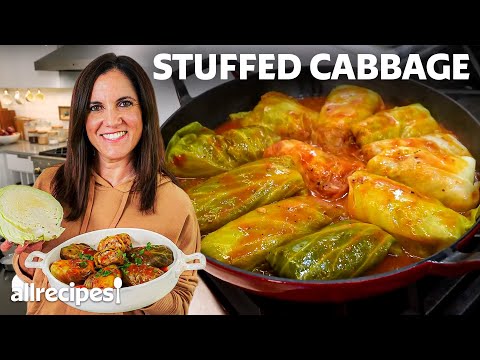
The source video that informed this recipe's technique. Clear demonstration of the blanching method and rolling process, with good close-ups of the correct leaf pliability before peeling.
2. Classic Stuffed Cabbage Rolls Step by Step
A thorough walkthrough covering the tomato sauce build and the oven versus stovetop simmer debate. Useful for understanding how sauce consistency should look at the 20-minute mark.
3. Eastern European Cabbage Rolls — Family MethodCovers the traditional Polish golabki technique with useful detail on filling ratios and how tightly to roll for different cabbage leaf sizes.
🛠️ Core Equipment
- Large pot for blanching ↗The whole cabbage head needs room to rotate freely in boiling water. A cramped pot produces uneven softening — some leaves come out pliable, others still stiff. Eight-quart minimum.
- Dutch oven or deep skillet with lid ↗You need even, contained heat for the long simmer. A [Dutch oven](/kitchen-gear/review/dutch-oven) is ideal — the heavy base prevents scorching and the tight lid holds steam without rattling off. A wide, shallow pan loses too much liquid.
- Large mixing bowl ↗Gives your hands room to fold the filling without compressing it. Mixing in a tight container forces you to press harder, which overworks the turkey.
- Tongs ↗For handling the hot cabbage head in and out of the boiling water without burning yourself or dropping it. Also essential for turning the rolls if needed mid-simmer.
Stuffed Cabbage Rolls (The Eastern European Classic Done Right)
🛒 Ingredients
- ✦1 large head green cabbage, approximately 2 pounds
- ✦1 pound lean ground turkey
- ✦3/4 cup cooked brown rice
- ✦1 medium yellow onion, finely diced
- ✦3 cloves garlic, minced
- ✦1 can (14.5 ounces) diced tomatoes, no sugar added
- ✦1 can (8 ounces) tomato sauce, low sodium
- ✦2 tablespoons tomato paste
- ✦1 cup low-sodium chicken broth
- ✦2 tablespoons extra virgin olive oil
- ✦1 teaspoon sweet paprika
- ✦1/2 teaspoon dried oregano
- ✦1/4 teaspoon red pepper flakes
- ✦1 teaspoon fresh lemon juice
- ✦Salt and black pepper to taste
- ✦2 tablespoons fresh parsley, chopped
- ✦1/4 cup grated Parmesan cheese, optional
👨🍳 Instructions
01Step 1
Bring a large pot of water to a rolling boil over high heat. Carefully lower the whole cabbage head into the water and boil for 8 to 10 minutes until the outer leaves soften and begin to peel away from the head.
02Step 2
Remove the cabbage with tongs and set it on a cutting board to cool until safe to handle. Gently peel away 12 to 14 large leaves. Chop the remaining cabbage into bite-sized pieces and set aside.
03Step 3
Combine the ground turkey, cooked brown rice, diced onion, minced garlic, paprika, oregano, red pepper flakes, salt, and pepper in a large mixing bowl.
04Step 4
Mix the filling with your hands until just combined. Stop as soon as no dry pockets remain. Overworking binds the proteins too tightly.
05Step 5
Place 3 to 4 tablespoons of filling near the base of each cabbage leaf. Fold the sides inward over the filling, then roll firmly away from you, tucking as you go.
06Step 6
Whisk together the diced tomatoes, tomato sauce, tomato paste, chicken broth, and lemon juice in a bowl to build the sauce.
07Step 7
Heat olive oil in a large [Dutch oven](/kitchen-gear/review/dutch-oven) or deep skillet over medium-high heat until shimmering. Arrange the rolls seam-side down in a single layer.
08Step 8
Pour the tomato sauce mixture over the rolls and scatter the chopped cabbage pieces around them.
09Step 9
Bring to a gentle simmer, then reduce heat to medium-low. Cover and cook for 35 to 40 minutes until the sauce has thickened slightly and the filling is cooked through.
10Step 10
Taste the sauce and adjust seasoning with salt, pepper, and lemon juice as needed.
11Step 11
Divide the rolls among plates, spoon sauce over each portion, and garnish with fresh parsley and Parmesan if using. Serve immediately.
Nutrition Per Serving
Estimates based on standard preparation. Adjustments alter macros.
🔄 Substitutions
Instead of Ground turkey...
Use Ground chicken breast or plant-based ground meat
Ground chicken is slightly leaner and milder. Plant-based ground adds fiber and works well with the tomato sauce — season more aggressively since it lacks the fat to carry flavor.
Instead of Brown rice...
Use Cauliflower rice or wild rice blend
Cauliflower rice lowers carbs significantly and keeps the filling lighter. Wild rice adds a nuttier chew and more minerals. Both require the same 3–4 tablespoon fill ratio.
Instead of Canned diced tomatoes...
Use Fresh tomatoes, diced and cooked down, or fire-roasted canned tomatoes
Fire-roasted tomatoes add a subtle smokiness that complements the paprika. Fresh tomatoes give brighter acidity but require an extra 10 minutes of reduction time.
Instead of Olive oil...
Use Avocado oil
Higher smoke point makes it more stable at medium-high heat for the initial sear. Neutral flavor doesn't compete with the paprika-forward sauce.
🧊 Storage & Reheating
In the Fridge
Store cooled rolls and sauce together in an airtight container for up to 4 days. The flavors deepen significantly after 24 hours.
In the Freezer
Freeze in portions with sauce for up to 3 months. Freeze flat first, then stack. Thaw overnight in the refrigerator before reheating.
Reheating Rules
Reheat covered in a pan over low heat with a splash of chicken broth or water to loosen the sauce, 10–15 minutes. Microwave works in a pinch — cover loosely and heat at 70% power to prevent the filling from drying out.
❓ Frequently Asked Questions
Why do my cabbage rolls fall apart during cooking?
Two causes: the leaves weren't soft enough before rolling, or the rolls were placed seam-side up in the pan. Blanch until the leaves drape without resistance, and always start seam-side down. The sauce holds the rolls closed from below throughout the simmer.
Can I bake these instead of simmering on the stovetop?
Yes. Arrange the rolls seam-side down in a baking dish, pour the sauce over, cover tightly with foil, and bake at 350°F for 60–70 minutes. The result is slightly drier but the flavors concentrate more intensely. Uncover for the last 10 minutes if you want the top to brown.
Do I need to pre-cook the brown rice before adding it to the filling?
Yes. Uncooked rice in the filling will absorb all available moisture during the simmer and the rolls will be dense and gummy. Pre-cooked rice stays distinct, giving the filling its texture. Use rice that's slightly undercooked — it finishes in the roll.
Can I make these ahead of time?
They're actually better made ahead. Assemble the rolls and refrigerate them in the sauce, uncooked, for up to 24 hours. The turkey absorbs the tomato and paprika flavors, and the rolls hold their shape better after resting. Simmer directly from cold — add 5 minutes to the cook time.
What cabbage works best — green, savoy, or napa?
Green cabbage is the traditional choice and the most forgiving to work with — the leaves are sturdy enough to roll without tearing. Savoy cabbage has a milder flavor and softer leaves that need less blanching but tear more easily. Napa cabbage is too delicate for this recipe.
How do I know the filling is cooked through?
An instant-read thermometer inserted into the center of a roll should read 165°F. Without a thermometer: cut a roll in half after 35 minutes — the turkey should be fully opaque with no pink, and the rice should be tender, not crunchy.
The Science of
Stuffed Cabbage Rolls (The Eastern European Classic Done Right)
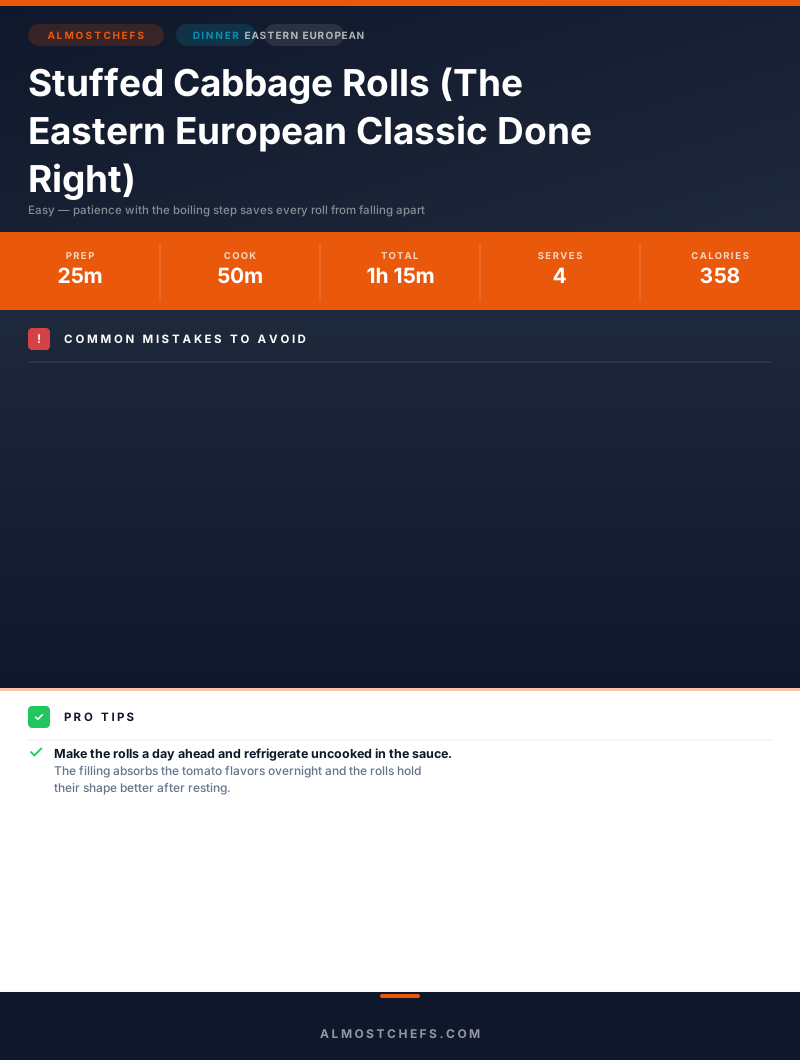
We turned everything on this page into a beautiful, flour-proof PDF cheat sheet. Print it out, stick it to your fridge, and never mess up your stuffed cabbage rolls (the eastern european classic done right) again.
*We'll email you the high-res PDF instantly. No spam, just perfectly cooked meals.
AlmostChefs Editorial Team
We translate the internet's most popular cooking videos into foolproof, beginner-friendly written recipes. We analyze multiple methods, test them in our kitchen, and engineer a single "Master Recipe" that gives you the best possible result with the least possible stress.