Classic Sponge Cake (The Only Technique That Actually Works)
A light, airy sponge cake built on precisely whipped eggs, no chemical leaveners, and a folding technique that refuses to compromise. We broke down the most-watched YouTube methods and distilled them into one foolproof approach that delivers height, crumb, and flavor every time.

“Sponge cake looks deceptively simple. Four ingredients, one pan, thirty minutes. And yet home bakers pull dense, rubbery discs out of their ovens every single day and blame the recipe. The truth is, sponge cake is almost entirely a technique problem. Get the egg foam right, fold with discipline, and avoid even one moment of carelessness and you get a cake that springs back when you press it and tears into feathery layers. Get any of those things wrong and you get a hockey puck with ambition.”
Why This Recipe Works
A sponge cake has no fat to hide behind, no chemical leaveners to compensate, and no complex flavor compounds doing the heavy lifting. It is four ingredients and pure technique — which is why it exposes every shortcut and punishes every moment of inattention with a dense, flat result that tastes like regret.
The Science of the Egg Foam
Everything in a sponge cake begins and ends with the egg foam. When you whip eggs and sugar together at high speed, you are doing two things simultaneously: trapping air bubbles within the protein network of the egg whites, and dissolving sugar into those proteins to stabilize the bubble walls against collapse. The target is ribbon stage — that thick, pale, tripled-in-volume state where the batter holds its shape long enough to write your initials on the surface before slowly sinking back in.
Ribbon stage is not a guess. It is a measurable physical state. Pull the whisk from the bowl and let batter fall from it. That falling batter should form a wide, glossy ribbon that sits on top of the foam for three full seconds before disappearing. At two seconds, you're close. At one second, you need two more minutes on the mixer. At zero seconds — where the batter falls and disappears instantly — you have an under-whipped foam that will produce a dense, pale cake with almost no rise. There is no recovering from this point. The only fix is to start the whipping process over.
The sugar plays a structural role far beyond sweetness. Caster sugar's fine grain dissolves readily into the egg protein, forming a semi-rigid matrix around each air bubble. This matrix holds up under the weight of flour and butter additions and survives the heat of the oven long enough for the egg proteins to fully coagulate and lock the structure permanently. Coarser granulated sugar dissolves incompletely, leaving undissolved crystals that puncture bubble walls and produce an uneven, grainy crumb.
Folding: The Make-or-Break Moment
If whipping builds the structure, folding determines whether it survives long enough to reach the oven. The technique is not metaphorical — the motion is literally a fold, a slow scoop from the bottom of the bowl that lifts batter up and over itself. What you are trying to do is distribute flour and butter through the foam without cutting through the air bubbles that took five minutes to create.
A large rubber spatula is the only acceptable tool here. Its wide, flexible blade can carry a full load of batter per stroke, which means fewer total strokes needed. A wooden spoon is too narrow and too rigid, each stroke slicing through the foam rather than displacing it. A whisk is catastrophic — it was engineered to do precisely the thing you are trying to avoid.
The counter-intuitive rule: stop before you think you're done. A few faint flour streaks at stroke twelve will hydrate during the 30-second transfer to the pan. They will not appear in the baked cake. But the deflation caused by three extra unnecessary folds absolutely will appear — as a denser crumb, lower rise, and that slightly gummy texture in the center that people blame on the oven temperature.
Heat and Structure
A wire cooling rack is not optional equipment. It is load-bearing. The moment a sponge comes out of the oven, it is still generating steam from residual moisture in the crumb. If that steam cannot escape through the bottom — if the cake is sitting on a solid surface — it condenses against the base and softens the crust from inside, collapsing the bottom layer under the weight of the cake above it.
Five minutes in the pan. Five minutes exactly. Long enough for the edge to contract slightly from the pan wall, making unmolding clean and damage-free. Short enough that the steam hasn't had time to compromise the crust. Then immediately onto the wire rack, parchment peeled back, air flowing underneath. This is not fussiness. This is the difference between a sponge that slices cleanly and one that compresses into a wet layer every time the knife touches it.
The Case for Simplicity
What makes a classic sponge worth mastering is that every other cake — the Victoria sponge filled with jam and cream, the Italian tiramisu base soaked in espresso, the Swiss roll wrapped around whipped cream and berries — is built on this foundation. Get the foam right once and you have unlocked an entire category. The technique transfers perfectly. The discipline does not change. Neither does the payoff: a cake so light it almost floats off the fork, with a crumb so even and fine it looks like it was engineered rather than baked.
Where Beginners Mess This Up
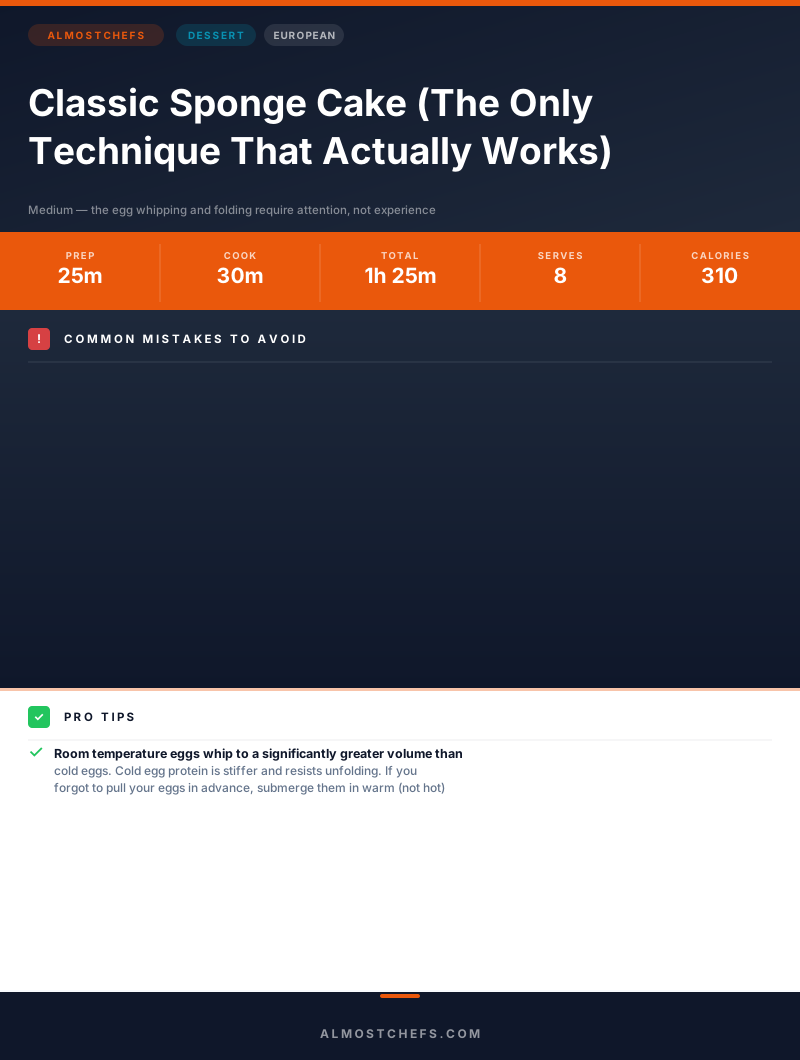
Before we start, read this. These are the 4 reasons your classic sponge cake (the only technique that actually works) will fail:
- 1
Under-whipping the eggs: The entire structure of a sponge cake is built on air trapped in whipped eggs. If the eggs don't reach the thick, pale, ribbon-stage — where the batter falls from the whisk in a slow, glossy ribbon and holds its shape on the surface for three seconds — there is nothing to hold the cake up. No amount of baking powder fixes under-whipped eggs. The cake will collapse the moment it cools.
- 2
Deflating the batter while folding: This is where most sponges die. Stirring, mixing, or folding aggressively after adding the flour cuts through every air bubble you just spent five minutes creating. The fold must be slow, deliberate, and minimal — no more than 12-15 strokes from the bottom of the bowl upward. If you still see flour streaks at stroke 10, the choice between under-mixed and over-mixed always favors under-mixed.
- 3
Opening the oven door too early: A sponge cake builds its structure in the first 20 minutes of baking through egg protein coagulation and starch gelatinization. Opening the door before that structure is set causes the cake to drop irreversibly — cold air rushes in, thermal momentum breaks, and the center collapses. Set a timer for 22 minutes before you even think about checking.
- 4
Cooling in the pan: Leaving a sponge in its pan after baking traps steam against the bottom and sides, turning the crust soft and causing the cake to pull in on itself. Turn it out onto a wire rack within 5 minutes of leaving the oven, every single time.
The Video Reference Library
Want to see it in action? Here are the exact videos we analyzed and combined to build this foolproof recipe translation:

🛠️ Core Equipment
- Stand mixer or hand mixerWhipping eggs to ribbon stage by hand requires 15-20 minutes of constant effort and produces inferior results. A stand mixer or electric hand mixer reaches the correct volume in 5-7 minutes and maintains a consistent speed that's impossible to replicate manually.
- 8-inch round cake panA standard 8-inch round gives the correct depth-to-diameter ratio for even heat penetration. Deeper pans mean the center takes longer to set, which forces you to overbake the edges. Shallower pans bake unevenly.
- Wire cooling rackAir must circulate under the cake immediately after unmolding. A flat surface traps moisture against the bottom and softens the crust. Non-negotiable for texture.
- Large rubber spatulaThe folding motion requires a wide, flexible blade that can scoop from the bottom of the bowl and turn the batter without cutting through it. A wooden spoon or whisk will deflate the foam in seconds.
Classic Sponge Cake (The Only Technique That Actually Works)
🛒 Ingredients
- ✦4 large eggs, room temperature
- ✦3/4 cup (150g) caster sugar
- ✦1 cup (120g) plain all-purpose flour, sifted twice
- ✦1/4 cup (60g) unsalted butter, melted and cooled
- ✦1 teaspoon pure vanilla extract
- ✦1/4 teaspoon fine sea salt
- ✦1 tablespoon neutral oil (for greasing pan)
- ✦2 tablespoons plain flour (for dusting pan)
👨🍳 Instructions
01Step 1
Preheat the oven to 350°F (175°C). Grease an 8-inch round cake pan with neutral oil, line the bottom with parchment paper, and dust the sides with flour. Tap out any excess.
02Step 2
Combine eggs, caster sugar, vanilla extract, and salt in the bowl of a stand mixer. Whip on high speed for 5-7 minutes until the mixture is very thick, pale yellow, and has tripled in volume.
03Step 3
Sift the flour over the egg mixture in three additions, folding gently after each with a large rubber spatula. Use slow, sweeping strokes from the bottom of the bowl up and over the top. Stop as soon as no dry streaks remain.
04Step 4
Drizzle the cooled melted butter around the edges of the batter. Fold in gently with 4-5 strokes only. The butter will streak slightly — that is fine.
05Step 5
Pour the batter into the prepared pan immediately and smooth the surface gently with a spatula. Do not tap the pan.
06Step 6
Bake on the center rack for 28-32 minutes without opening the oven door. The cake is done when the top is deep golden, the edges pull slightly from the pan, and a skewer inserted into the center comes out clean.
07Step 7
Remove from the oven and run a thin knife around the edge immediately. Let rest in the pan for exactly 5 minutes, then invert onto a wire cooling rack. Peel off the parchment. Cool completely before slicing or filling, at least 45 minutes.
Nutrition Per Serving
Estimates based on standard preparation. Adjustments alter macros.
🔄 Substitutions
Instead of Caster sugar...
Use Granulated sugar processed in a blender for 30 seconds
Caster sugar's finer grain dissolves more readily into the eggs during whipping. Coarse granulated sugar can leave undissolved crystals that weaken the foam structure. Processing it fine is a genuine substitute, not a shortcut.
Instead of All-purpose flour...
Use Cake flour
Cake flour has lower protein content (7-9% vs 10-12%) which produces a slightly more tender crumb. Use the same weight measurement. The result will be marginally more delicate — ideal if you want the most cloud-like texture possible.
Instead of Unsalted butter...
Use Refined coconut oil, melted and cooled
Produces a dairy-free sponge with a very subtle coconut undertone. The crumb is slightly firmer because coconut oil solidifies at room temperature. Do not use unrefined coconut oil — the flavor is too assertive.
Instead of Vanilla extract...
Use Almond extract (use half the amount)
Almond extract is twice as potent and completely changes the flavor profile. Use 1/2 teaspoon in place of 1 teaspoon vanilla. Pairs exceptionally well with cherry or apricot fillings.
🧊 Storage & Reheating
In the Fridge
Wrap unfilled sponge tightly in plastic wrap and refrigerate for up to 3 days. Bring to room temperature 30 minutes before serving — cold sponge is noticeably denser.
In the Freezer
Wrap individual layers in plastic wrap and then foil. Freeze for up to 2 months. Thaw overnight in the fridge still wrapped, then unwrap at room temperature for 1 hour before using.
Reheating Rules
Sponge cake should not be reheated. Gentle warming in a low oven (300°F for 5 minutes) can revive a slightly stale texture, but heat drives out moisture and the cake will be drier than before.
❓ Frequently Asked Questions
Why did my sponge cake sink in the middle?
The three most common causes: you opened the oven door before the structure was set (under 22 minutes), you under-whipped the eggs so there wasn't enough air to hold the rise, or you over-folded the batter and collapsed the foam before it went into the pan. A sunken center that is still moist and tender usually points to underbaking. A sunken center that is gummy or dense points to deflated foam.
Do I need baking powder in a sponge cake?
No. A true sponge cake uses only air as its leavener. The lift comes entirely from the foam structure created by whipping eggs and sugar together. Adding baking powder produces a chemically leavened cake that rises faster but has a coarser, less even crumb. If your sponge needs baking powder to rise, the egg foam wasn't built correctly.
Can I make this as a sheet cake instead of a round?
Yes. Pour into a parchment-lined 9x13 inch pan and reduce baking time to 18-22 minutes. Watch carefully after 18 minutes — a thinner layer of batter sets faster and overbakes quickly. The texture will be identical; only the shape changes.
Why does my sponge stick to the pan even though I greased it?
Greasing alone is not sufficient. A sponge's high sugar content causes it to bond aggressively to metal during baking. You need both a layer of parchment paper on the base and a flour dusting on the sides. Skipping either one almost guarantees sticking.
How do I get a flat top on my sponge?
Spread the batter so it's very slightly higher at the edges than the center before baking. As the cake rises, the center domes to meet the edges, and the result is relatively flat. Alternatively, use a cake leveler or serrated knife to slice off the dome after cooling — this also exposes the crumb for better filling absorption.
Can I add fruit or chocolate to the batter?
With caution. Folding in wet additions like fresh berries introduces liquid that can destabilize the egg foam and cause sinking. If you want fruit, fold in very small amounts of freeze-dried fruit powder or stir zest into the batter just before folding in the flour. For chocolate, fold in 2 tablespoons of Dutch-process cocoa sifted with the flour — it won't affect structure.
The Science of
Classic Sponge Cake (The Only Technique That Actually Works)
We turned everything on this page into a beautiful, flour-proof PDF cheat sheet. Print it out, stick it to your fridge, and never mess up your classic sponge cake (the only technique that actually works) again.
*We'll email you the high-res PDF instantly. No spam, just perfectly cooked meals.
AlmostChefs Editorial Team
We translate the internet's most popular cooking videos into foolproof, beginner-friendly written recipes. We analyze multiple methods, test them in our kitchen, and engineer a single "Master Recipe" that gives you the best possible result with the least possible stress.