Crispy Singapore Noodles (The 30-Minute Takeout Killer)
Thin rice noodles tossed in a fragrant curry sauce with shrimp, egg, and crisp vegetables — all cooked in a screaming-hot wok in 30 minutes. We broke down the most popular methods to find the technique that nails the signature yellow coating without turning your noodles into a soggy clump.

“Singapore Noodles from a takeout box arrive in a grease-logged container where the noodles have spent 20 minutes steaming themselves into mush. Making it at home takes the same amount of time and produces something structurally different: noodles that are individually coated in toasted curry, vegetables that still have snap, and shrimp that didn't spend 15 minutes sweating under a heat lamp. The window where this dish is perfect lasts about four minutes. You need to be ready.”
Why This Recipe Works
Singapore Noodles has one structural problem: it's a dish that demands restaurant-grade heat but gets cooked on home equipment. The solution is not to fight that constraint — it's to work around it with batch cooking, dry surfaces, and a sauce that's mixed before the wok ever heats up.
The Heat Problem
A commercial wok burner outputs 100,000 to 200,000 BTU. A home gas range outputs 12,000 to 18,000 BTU at maximum. This is not a minor difference — it's an order of magnitude. What this means for Singapore Noodles is that every extra ingredient you add to the wok drops the surface temperature and shifts the cooking from searing to steaming. Steamed noodles are soft. Seared noodles have edges that char slightly, absorb curry evenly, and don't stick together.
The fix: cook in strict batches. Eggs first, transferred out. Shrimp second, transferred out. Vegetables third, still in the wok. Everything else comes together at the end. This keeps the wok surface at maximum temperature for each ingredient rather than trying to cook everything simultaneously and failing at all of it.
The Curry Powder Rule
Raw curry powder is a collection of fat-soluble aromatic compounds sitting inert inside ground plant matter. Those compounds don't become fragrant until heat causes them to volatilize — a process that requires direct contact with a hot dry surface or hot fat for at least 60 seconds. Sprinkle curry powder into a wet sauce and you get a flat, slightly gritty result with none of the bloomed depth that makes the dish smell correct.
The technique here is to dust the curry powder directly over the hot vegetables before the sauce enters the pan. The residual oil in the wok is enough to bloom it. You'll know it's working when the aroma in the kitchen shifts from raw spice to toasted curry — a noticeably sharper, richer smell. That's the Maillard reaction doing its job on the spice surface.
Noodle Prep Is Make or Break
Thin rice noodles have almost no structural integrity on their own. They're held together by surface starch, which also causes them to bond aggressively to themselves and to other noodles the moment they cool. The cold water rinse after boiling removes this excess starch and stops carryover cooking simultaneously.
The second step — letting them drain completely and tossing with a few drops of oil — prevents the starch that remains on the noodle surface from causing clumping in the wok. Wet noodles hitting a hot carbon steel wok instantly drop the surface temperature and release steam. Dry, lightly oiled noodles hit the pan and sear on contact. Same ingredient, completely different result.
Mise en Place Is the Actual Skill
This dish cooks in approximately 15 minutes of active time. There is no pause to measure anything once the wok is hot — the window between perfectly cooked shrimp and rubbery shrimp is under two minutes. The window between bloomed curry and burned garlic is about 30 seconds.
Every vegetable should be cut. Every liquid should be combined in one bowl. Every protein should be measured and sitting at arm's reach. The wok spatula should already be in your hand. The plate for the eggs should already be next to the stove. Cooking this dish is execution, not improvisation — and execution only works when the setup is complete before you start.
This is the habit that separates people who can cook stir fry from people who can't. It has nothing to do with skill or experience. It's entirely organizational.
Where Beginners Mess This Up
Before we start, read this. These are the 4 reasons your crispy singapore noodles (the 30-minute takeout killer) will fail:
- 1
Soaking instead of boiling the rice noodles: Many packages instruct you to soak rice noodles in warm water rather than boil them. For a stir fry, this produces noodles that are too firm to toss evenly and too starchy to separate in the wok. Boil them briefly, rinse under cold water immediately, and toss with a few drops of oil to prevent clumping.
- 2
Crowding the wok: Singapore Noodles requires sustained high heat across every ingredient. The moment you add too much volume, the wok temperature drops and everything steams instead of sears. Work in batches — cook the eggs separately, cook the shrimp separately, then bring everything together at the end.
- 3
Adding the curry powder too late: Raw curry powder added to liquid tastes flat and slightly dusty. It must hit hot oil or a hot dry surface for at least 60 seconds to bloom — the heat volatilizes the aromatic compounds that make curry smell like curry. Sprinkle it over the vegetables while still dry, before the sauce goes in.
- 4
Using wet noodles when they hit the wok: If your drained noodles are still dripping water when they hit the wok, you've instantly killed your heat and started steaming. After rinsing, drain completely and let them sit for 2 minutes on a clean towel. Dry noodles char. Wet noodles stew.
The Video Reference Library
Want to see it in action? Here are the exact videos we analyzed and combined to build this foolproof recipe translation:
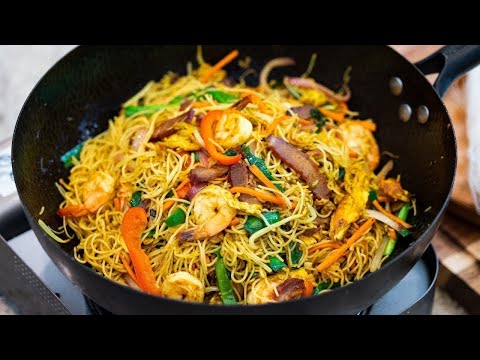
The source video for this recipe. Covers wok technique, curry blooming, and the correct noodle texture you're aiming for before they hit the pan.
2. Wok Hei at Home — Getting the Heat Right
A deep dive into managing home stove heat for stir fry. Essential context if your wok isn't getting hot enough and your noodles keep stewing instead of searing.
3. The Science of Stir Fry — Why High Heat MattersExplains the Maillard reaction in stir fry contexts and why ingredient order, dry surfaces, and batch cooking are the three pillars of a good wok dish.
🛠️ Core Equipment
- 14-inch carbon steel wok ↗The sloped sides and extreme heat conductivity of a [carbon steel wok](/kitchen-gear/review/carbon-steel-wok) are what make stir fry work. A flat-bottomed skillet holds too much liquid and can't reach the surface temperature needed for proper searing. If you only have a skillet, use 12 inches minimum and do not crowd it.
- Wok spatula or fish spatula ↗You need a tool that can toss noodles upward without tearing them. A flat [wok spatula](/kitchen-gear/review/wok-spatula) gets under the noodles efficiently and lets you work fast without pulling the dish apart.
- Small mixing bowl for sauce ↗The sauce must be premixed and ready to pour in one motion. There is no time to measure soy sauce while your shrimp is overcooking. Combine every liquid ingredient before you turn on the heat.
- Colander or fine-mesh sieve ↗For draining and rinsing the noodles quickly. The cold rinse stops cooking instantly and removes excess surface starch that causes clumping.
Crispy Singapore Noodles (The 30-Minute Takeout Killer)
🛒 Ingredients
- ✦8 ounces thin rice noodles
- ✦3 tablespoons vegetable oil, divided
- ✦3 cloves garlic, minced
- ✦1 tablespoon fresh ginger, finely minced
- ✦8 ounces large shrimp, peeled and deveined
- ✦2 large eggs, beaten
- ✦1 medium red bell pepper, thinly sliced
- ✦1 cup snap peas, cut into bite-sized pieces
- ✦2 medium carrots, julienned
- ✦4 green onions, sliced into 1-inch pieces
- ✦2 tablespoons curry powder
- ✦3 tablespoons soy sauce
- ✦1 tablespoon oyster sauce
- ✦1 teaspoon sesame oil
- ✦1 tablespoon rice vinegar
- ✦1 teaspoon lime juice
- ✦½ teaspoon white pepper
- ✦¼ teaspoon red pepper flakes
- ✦2 tablespoons low-sodium chicken broth
👨🍳 Instructions
01Step 1
Boil the rice noodles according to package directions, drain, and rinse immediately under cold running water. Toss with a few drops of oil and set aside.
02Step 2
Combine the soy sauce, oyster sauce, sesame oil, rice vinegar, lime juice, white pepper, red pepper flakes, and chicken broth in a small bowl. Set next to the stove.
03Step 3
Heat 1 tablespoon oil in a large wok over medium-high heat until shimmering. Pour in the beaten eggs and scramble continuously into small broken pieces, about 2 minutes. Transfer to a clean plate.
04Step 4
Add the remaining 2 tablespoons oil to the wok and let it heat for 30 seconds. Add garlic and ginger and stir constantly until fragrant, about 45 seconds.
05Step 5
Add the shrimp in a single layer and cook, stirring frequently, until pink and opaque throughout, about 3-4 minutes.
06Step 6
Add the bell pepper, snap peas, and carrots. Stir-fry over medium-high heat until vegetables are tender-crisp, about 4 minutes.
07Step 7
Sprinkle the curry powder directly over the vegetables and stir constantly for 1 minute to toast the spices in the residual oil.
08Step 8
Pour the premixed sauce into the wok and toss everything to coat evenly, about 1 minute.
09Step 9
Add the drained rice noodles and toss with two utensils until all ingredients are combined and heated through, about 2 minutes.
10Step 10
Return the cooked eggs to the wok and fold gently into the noodles to distribute.
11Step 11
Top with sliced green onions and serve immediately.
Nutrition Per Serving
Estimates based on standard preparation. Adjustments alter macros.
🔄 Substitutions
Instead of Shrimp...
Use Diced chicken breast or extra-firm tofu
Chicken needs 5-6 minutes to cook through — add it before the vegetables. Tofu should be pressed dry and cubed; cook until golden on two sides before adding the aromatics.
Instead of Soy sauce and oyster sauce...
Use Low-sodium tamari and coconut aminos
Reduces sodium significantly while maintaining umami depth. Coconut aminos are slightly sweeter, so reduce by half a teaspoon of the rice vinegar to compensate.
Instead of Curry powder...
Use Turmeric, cumin, and coriander blend (equal parts)
More complex spice profile. Use 1.5 tablespoons total — the individual spices are more potent than a blended powder. Toast each one separately before combining.
Instead of White rice noodles...
Use Brown rice noodles or whole grain rice noodles
Slightly nuttier flavor and firmer texture. Cook time increases by 1-2 minutes. Rinse more aggressively to prevent clumping — brown rice noodles carry more surface starch.
🧊 Storage & Reheating
In the Fridge
Store in an airtight container for up to 3 days. The noodles will continue to absorb moisture — expect a slightly softer texture on day two.
In the Freezer
Not recommended. Rice noodles become mushy after freezing and thawing, losing their structural integrity entirely.
Reheating Rules
Reheat in a dry skillet or wok over medium-high heat for 3-4 minutes, tossing frequently. Add a tablespoon of chicken broth if the noodles have dried out. Microwave produces gummy results.
❓ Frequently Asked Questions
Why do my noodles stick together in the wok?
Two causes: the noodles weren't rinsed after boiling (excess starch), or they were still wet when they hit the pan (instant clumping). Rinse thoroughly, let drain for 2 minutes, toss with a few drops of oil, and add them to a very hot wok — not a warm one.
Is Singapore Noodles actually from Singapore?
No. It's a dish invented in Hong Kong in the 1950s, likely inspired by the popularity of curry flavors from South and Southeast Asia. It has no direct culinary origin in Singapore. The name stuck anyway.
Can I make this vegetarian?
Yes. Replace the shrimp with pressed extra-firm tofu and substitute vegetable broth for chicken broth. Use mushroom sauce instead of oyster sauce. The curry flavor profile stays intact — the protein just changes texture.
My curry powder tasted raw and dusty. What happened?
It didn't bloom. Curry powder needs direct contact with hot oil or a hot dry surface for at least 60 seconds to release its aromatic compounds. Add it to the vegetables before any liquid enters the pan, stir constantly, and wait until you smell it shift.
How do I keep the shrimp from getting rubbery?
Cook them separately and pull them early — the moment the last translucent gray patch disappears. They'll continue cooking for another 30 seconds from residual heat. If they're perfectly pink when you remove them, they'll be rubbery by the time you plate. Pull them at 90%.
Can I prep this ahead?
Partially. Prep and measure every ingredient up to 24 hours ahead and store separately in the fridge. Boil the noodles up to 2 hours ahead, rinse, oil lightly, and refrigerate uncovered. Do not cook the full dish ahead — stir fry degrades rapidly and is meant to be eaten immediately.
The Science of
Crispy Singapore Noodles (The 30-Minute Takeout Killer)
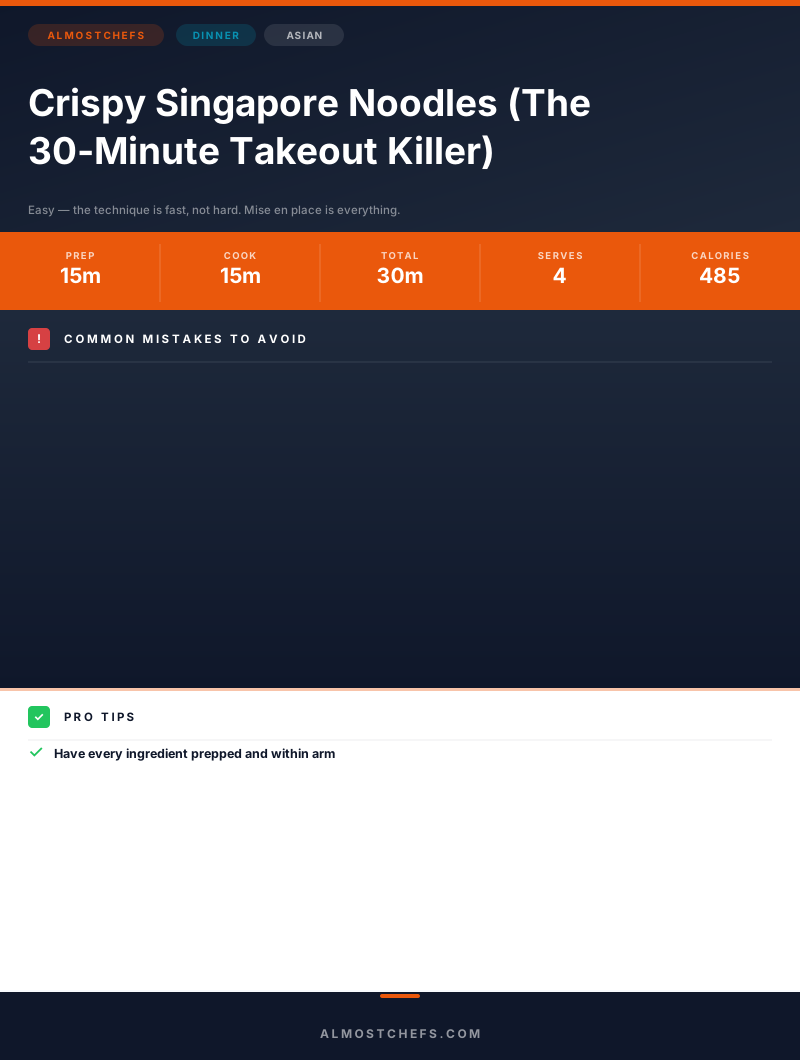
We turned everything on this page into a beautiful, flour-proof PDF cheat sheet. Print it out, stick it to your fridge, and never mess up your crispy singapore noodles (the 30-minute takeout killer) again.
*We'll email you the high-res PDF instantly. No spam, just perfectly cooked meals.
AlmostChefs Editorial Team
We translate the internet's most popular cooking videos into foolproof, beginner-friendly written recipes. We analyze multiple methods, test them in our kitchen, and engineer a single "Master Recipe" that gives you the best possible result with the least possible stress.