Braised Short Rib Ragu (The Sunday Sauce You'll Make Every Winter)
Bone-in beef short ribs braised low and slow in red wine and crushed tomatoes until they collapse into a deeply savory, unctuous ragu. We broke down the technique step by step — from hard sear to glossy finish — so your pasta night becomes the meal everyone asks you to repeat.
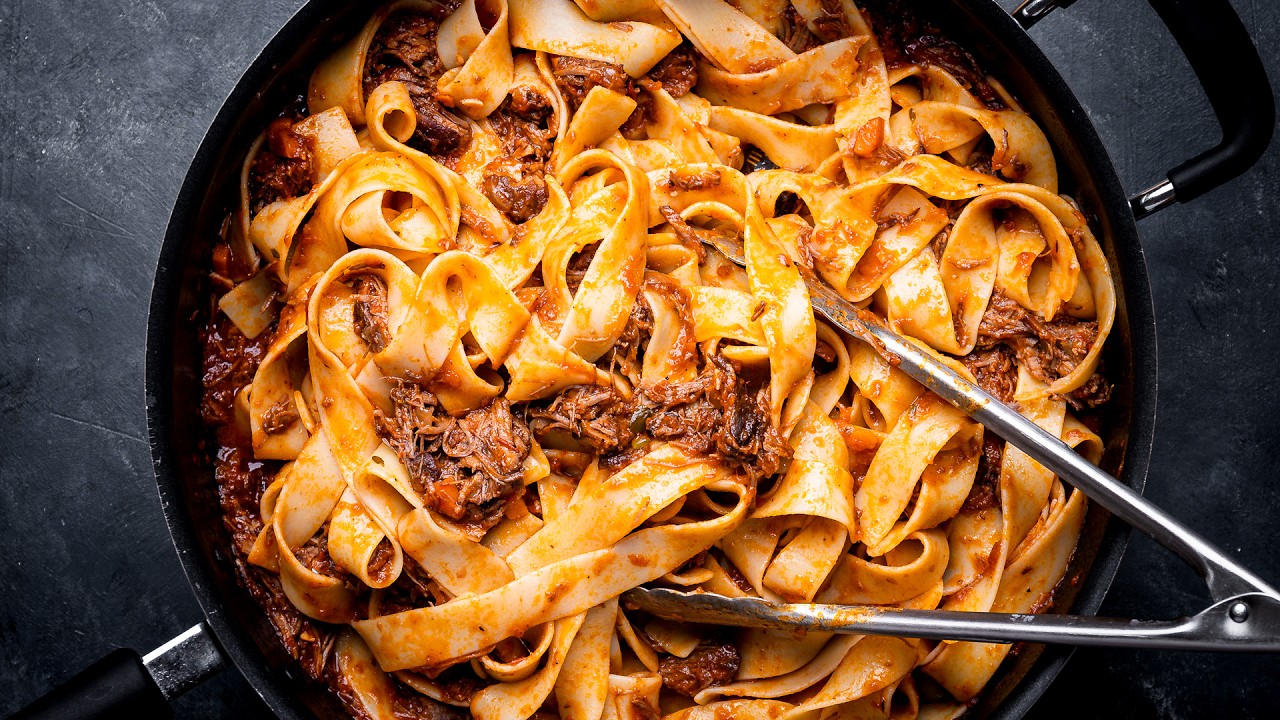
“Short rib ragu is everything a weeknight bolognese wants to be when it grows up. Where ground beef gives you texture, bone-in short ribs give you architecture — collagen that melts into the sauce over three hours, basting every strand of pasta from the inside out. The window for failure is narrow: a hard sear you don't rush, a braise temperature you don't exceed, and a reduction you don't skip. Get those three right and the rest takes care of itself.”
Why This Recipe Works
Short rib ragu is not a complicated dish. It is a patient one. The entire technique is built around a single biological process — the conversion of collagen to gelatin — and every step either supports that process or protects it. Once you understand what you're actually doing for three hours, the recipe stops feeling like following instructions and starts feeling like applied physics.
The Sear Is the Whole Game
Before the braise even begins, the quality of your ragu is determined by the quality of your sear. This is not decorative browning. When the surface of a short rib hits a Dutch oven at 450°F, hundreds of volatile flavor compounds form through the Maillard reaction — the same chemistry responsible for the crust on a great steak, the complexity in a dark roast coffee, and the caramelization on those onions you stayed with longer than you wanted to. None of those compounds exist in raw beef. All of them end up in your sauce.
The critical mistake is rushing. Short ribs have a thick fat cap and dense connective tissue that takes time to form a proper crust. Move them too early and you tear the developing surface, leaving your browned bits on the pot rather than on the meat. Wait for the natural release — when the crust has fully set, the meat will lift freely with tongs. If it resists, give it ninety more seconds. It's telling you something.
What Collagen Actually Does
Collagen is the structural protein in connective tissue — the silver sinew that makes cheap cuts chewy when cooked quickly and extraordinary when cooked slowly. Short ribs are approximately 30% connective tissue by weight, which is both their liability at high heat and their superpower at low heat. Between 160°F and 180°F sustained over two to three hours, collagen hydrolyzes into gelatin. That gelatin dissolves into the braising liquid, coating every molecule of the sauce in a rich, silky body that clings to pasta with extraordinary tenacity.
This is why braise temperature matters so much. A rolling boil sits at 212°F — hot enough to push through collagen conversion quickly, but also hot enough to squeeze moisture out of the muscle fibers faster than it can be reabsorbed. The result is tight, stringy, dry meat sitting in thin liquid. A lazy 180°F simmer gives the collagen time to dissolve gradually while keeping the muscle fibers relaxed and moist. The difference in texture is not subtle. One produces cafeteria beef stew. The other produces silk.
The Reduction Is Not Optional
Three hours of braising produces a flavorful liquid, but not yet a sauce. It's thin, slightly murky, and nowhere near concentrated enough to coat pasta. The reduction step — straining the liquid, skimming the fat, and simmering it hard for twelve to fifteen minutes — is where the dish transforms. Water evaporates. Flavor compounds concentrate. The gelatin that's been dissolving all afternoon starts to assert itself, thickening the sauce into something glossy and coating rather than watery and sliding.
A fine-mesh sieve is the right tool here. It lets you press the softened aromatics through, extracting their remaining flavor while leaving behind the herb stems and larger solids. The result is a cleaner, more refined sauce than you'd get from leaving everything in. Strain, skim, reduce. This step takes twenty minutes total and accounts for roughly half the final quality of the dish.
The Pasta Finish
The last five minutes are where ragu becomes a complete dish rather than a meat sauce with pasta next to it. The pasta finishes cooking directly in the sauce over medium heat, absorbing flavor while releasing starch into the pan. That starch, combined with reserved pasta water (which is essentially a dilute stock at this point), emulsifies with the added butter and Parmigiano-Reggiano into a coating sauce that clings to every surface of the pasta rather than pooling at the bottom of the bowl.
This technique — called mantecatura in Italian — is standard in professional kitchens and almost never used at home. It's the single biggest gap between restaurant pasta and home pasta, and it requires nothing beyond the pasta water you were going to throw away anyway. Pull the pasta two minutes early. Reserve a cup of water. Finish it in the sauce. The difference is immediate and dramatic.
Short rib ragu rewards patience at every step. The sear you didn't rush. The braise you didn't boil. The reduction you didn't skip. The finish you didn't shortcut. Make it once with full attention and it becomes the dish you make on every grey Sunday afternoon for the rest of your life.
Where Beginners Mess This Up
Before we start, read this. These are the 4 reasons your braised short rib ragu (the sunday sauce you'll make every winter) will fail:
- 1
Under-searing the ribs: The sear is not a formality. It's the foundation of every flavor compound in the finished dish. Short ribs need 3-4 minutes per side in a dry, scorching-hot pot until they release a deep brown crust. If they're still sticking, they're not ready to flip. Grey, steamed-looking meat going into a braise produces flat, thin ragu. Mahogany-brown meat going in produces something entirely different.
- 2
Braising at a boil instead of a simmer: The liquid should barely move — a lazy bubble every few seconds, not a rolling boil. Boiling denatures the collagen too aggressively, pushing moisture out of the meat fibers before it has time to dissolve into the braising liquid. The result is stringy, dry beef sitting in thin, watery sauce. Low and slow is not a suggestion — it's the physics of collagen conversion.
- 3
Skipping the reduction step: After pulling the ribs from the braising liquid, you must reduce that liquid by roughly half before shredding the meat back in. Unreduced braising liquid is watery, one-dimensional, and slides off pasta instead of coating it. Reduction concentrates every flavor compound you spent three hours building. This step takes 15 minutes and is non-negotiable.
- 4
Using the wrong pasta: Thin pastas drown under ragu this heavy. Pappardelle, rigatoni, or paccheri are the correct vessels — wide surfaces and ridges that capture the sauce rather than letting it pool at the bottom of the bowl. Fresh pappardelle is ideal. Dried rigatoni is a worthy substitute. Angel hair is a mistake.
The Video Reference Library
Want to see it in action? Here are the exact videos we analyzed and combined to build this foolproof recipe translation:
A precise, technique-focused walkthrough covering the sear, aromatics, wine reduction before braising, and the final sauce reduction. The slow-motion sear footage alone is worth watching before you start.
Covers the science behind collagen conversion and why braise temperature is the single most important variable in any low-and-slow beef recipe. Useful context before attempting any long braise.
If you want to go the full distance, this covers hand-rolled fresh pappardelle in under 30 minutes. The texture difference over dried pasta with ragu this heavy is significant.
🛠️ Core Equipment
- Dutch oven or heavy-bottomed braising potEven heat retention across a 3-hour braise is critical. Thin pots create hot spots that scorch the bottom while leaving the center underdone. A 5-6 quart Dutch oven is the ideal size for this recipe.
- TongsFor turning short ribs during the sear without piercing the crust. A fork punches through the exterior and releases the juices you're trying to lock in. Tongs preserve the crust architecture.
- Fine-mesh sieve or fat separatorShort ribs release significant fat during braising. Straining the braising liquid and skimming the fat before reduction keeps the final sauce glossy and coating — not greasy and heavy.
- Wide shallow pasta bowlRagu this thick needs surface area to distribute evenly. Deep bowls trap sauce at the bottom and leave the top of the pasta dry. A shallow bowl gives you the right sauce-to-pasta ratio in every forkful.
Braised Short Rib Ragu (The Sunday Sauce You'll Make Every Winter)
🛒 Ingredients
- ✦3.5 pounds bone-in beef short ribs (4-6 ribs)
- ✦2 tablespoons neutral oil (avocado or grapeseed)
- ✦1 large yellow onion, finely diced
- ✦3 medium carrots, finely diced
- ✦3 stalks celery, finely diced
- ✦6 cloves garlic, minced
- ✦3 tablespoons tomato paste
- ✦1.5 cups dry red wine (Barolo, Chianti, or Côtes du Rhône)
- ✦1 can (28 oz) whole San Marzano tomatoes, hand-crushed
- ✦2 cups beef stock, low-sodium
- ✦2 sprigs fresh rosemary
- ✦4 sprigs fresh thyme
- ✦2 bay leaves
- ✦1 tablespoon Worcestershire sauce
- ✦1 teaspoon red pepper flakes (optional)
- ✦1 pound pappardelle or rigatoni
- ✦1/2 cup freshly grated Parmigiano-Reggiano, plus more for serving
- ✦2 tablespoons unsalted butter
- ✦Kosher salt and freshly ground black pepper to taste
- ✦Fresh flat-leaf parsley, roughly chopped, for garnish
👨🍳 Instructions
01Step 1
Remove short ribs from the refrigerator 45 minutes before cooking to bring them to room temperature. Pat completely dry with paper towels. Season aggressively on all sides with kosher salt and black pepper.
02Step 2
Heat 2 tablespoons of neutral oil in a [Dutch oven](/kitchen-gear/review/dutch-oven) over medium-high heat until shimmering and just beginning to smoke. Add short ribs in a single layer — do not crowd the pot. Sear 3-4 minutes per side without moving until deep mahogany brown on all four sides. Work in batches if necessary.
03Step 3
Transfer seared ribs to a plate. Reduce heat to medium. Pour off all but 2 tablespoons of fat. Add diced onion, carrots, and celery to the pot. Cook, stirring occasionally, for 8-10 minutes until softened and beginning to caramelize.
04Step 4
Add the minced garlic and tomato paste. Cook, stirring constantly, for 2 minutes until the tomato paste darkens from bright red to brick-red and begins sticking to the bottom of the pot.
05Step 5
Pour in the red wine. Scrape up all browned bits from the bottom of the pot with a wooden spoon — this is pure flavor. Let the wine reduce by half over medium heat, about 5-6 minutes.
06Step 6
Add the hand-crushed San Marzano tomatoes, beef stock, Worcestershire sauce, rosemary, thyme, bay leaves, and red pepper flakes if using. Nestle the seared short ribs back into the pot, bone-side up, so the meat is mostly submerged in liquid.
07Step 7
Bring the liquid to a bare simmer — a lazy bubble every few seconds. Reduce heat to low, cover tightly, and braise for 2.5 to 3 hours until the meat is completely fork-tender and pulling away from the bone.
08Step 8
Remove the short ribs from the braising liquid and set aside to cool slightly. Remove and discard the rosemary sprigs, thyme sprigs, and bay leaves. Strain the braising liquid through a [fine-mesh sieve](/kitchen-gear/review/mesh-sieve) into a wide saucepan, pressing the softened aromatics through. Skim visible fat from the surface.
09Step 9
Bring the strained braising liquid to a vigorous simmer over medium-high heat and reduce by half, about 12-15 minutes, until slightly thickened and deeply glossy.
10Step 10
While the sauce reduces, shred the short rib meat off the bones using two forks. Discard bones, cartilage, and any large pockets of solidified fat. The meat should fall apart with almost no resistance.
11Step 11
Add the shredded meat back to the reduced sauce. Stir to combine and simmer together for 5 minutes to integrate. Taste and adjust salt and pepper.
12Step 12
Cook pasta in heavily salted boiling water until 1 minute shy of al dente. Reserve 1 cup of pasta water before draining.
13Step 13
Add the drained pasta directly to the ragu over medium heat. Toss continuously, adding splashes of pasta water as needed to loosen the sauce until it coats every strand. Remove from heat and stir in butter and Parmigiano-Reggiano.
14Step 14
Divide between wide, shallow bowls. Top with additional Parmigiano-Reggiano and a scatter of flat-leaf parsley. Serve immediately.
Nutrition Per Serving
Estimates based on standard preparation. Adjustments alter macros.
🔄 Substitutions
Instead of Dry red wine...
Use Beef stock with a tablespoon of red wine vinegar
Non-alcoholic option that preserves the acidity. The flavor is slightly thinner but still produces a good ragu. Increase the tomato paste by one tablespoon to compensate.
Instead of Bone-in short ribs...
Use Boneless short ribs or beef chuck
Boneless short ribs work but produce a slightly less gelatinous sauce. Chuck is leaner and will shred more finely. Both require the same cooking time.
Instead of Pappardelle...
Use Rigatoni, paccheri, or polenta
Rigatoni and paccheri capture the chunky ragu in their ridges and tubes. Polenta is an excellent non-pasta alternative — the creamy base absorbs the ragu beautifully.
Instead of San Marzano tomatoes...
Use Fire-roasted crushed tomatoes
San Marzano tomatoes have lower acidity and more natural sweetness. Fire-roasted crushed tomatoes are a good substitute — slightly smokier, slightly more acidic. Reduce red pepper flakes if using.
🧊 Storage & Reheating
In the Fridge
Store ragu (without pasta) in an airtight container for up to 4 days. The flavor improves significantly on day two.
In the Freezer
Freeze ragu in portions for up to 3 months. Thaw overnight in the refrigerator before reheating.
Reheating Rules
Reheat gently in a covered saucepan over low heat with a splash of beef stock to restore consistency. Avoid high heat — it tightens the sauce and can make the meat stringy.
❓ Frequently Asked Questions
Can I make short rib ragu in a slow cooker?
Yes, with one important caveat: you must still sear the ribs and cook down the aromatics and wine on the stovetop first. The slow cooker cannot achieve the temperatures needed for Maillard browning. After searing, transfer everything to a slow cooker and cook on low for 8-10 hours or high for 5-6 hours.
Why is my ragu sauce watery?
You either skipped the wine reduction before braising, skipped the post-braise reduction, or braised at too high a temperature (boiling drives off moisture too fast and prevents collagen dissolution). Reduce the strained braising liquid until it coats the back of a spoon before adding the shredded meat back in.
Do I have to use red wine?
No, but the flavor will be noticeably different. Red wine contributes acidity, tannins, and complexity that beef stock alone cannot replicate. If avoiding alcohol, substitute equal parts additional beef stock and add a tablespoon of red wine vinegar and a teaspoon of Worcestershire sauce to compensate.
How do I know when the short ribs are done braising?
The meat should fall off the bone with no resistance when prodded with a fork. If it's still clinging or feels at all tough, it needs more time. Short ribs are not the type of meat that overcooks easily — an extra 30 minutes at a proper simmer will not hurt them.
Can I use this ragu for lasagna?
Absolutely — and it's exceptional. Skip the pasta step entirely, let the ragu cool, and use it as-is between lasagna sheets with béchamel and Parmigiano-Reggiano. The long braise makes it the most flavorful lasagna filling you'll ever use.
What wine should I use for braising?
Use a dry, full-bodied red you'd actually drink — Chianti, Barolo, Barbera d'Asti, or Côtes du Rhône all work well. Avoid sweet reds, cooking wine, or anything labeled 'cooking wine' — they contain added salt and produce a flat, one-dimensional sauce.

The Science of
Braised Short Rib Ragu (The Sunday Sauce You'll Make Every Winter)
We turned everything on this page into a beautiful, flour-proof PDF cheat sheet. Print it out, stick it to your fridge, and never mess up your braised short rib ragu (the sunday sauce you'll make every winter) again.
*We'll email you the high-res PDF instantly. No spam, just perfectly cooked meals.
AlmostChefs Editorial Team
We translate the internet's most popular cooking videos into foolproof, beginner-friendly written recipes. We analyze multiple methods, test them in our kitchen, and engineer a single "Master Recipe" that gives you the best possible result with the least possible stress.