Samgyeopsal Bokkeum (Pork Belly Stir-Fry)
Thick-cut pork belly stir-fried with Chef Kim's secret sauce until caramelized and sticky. The 3.9-million-view weeknight dinner that disappears in minutes.
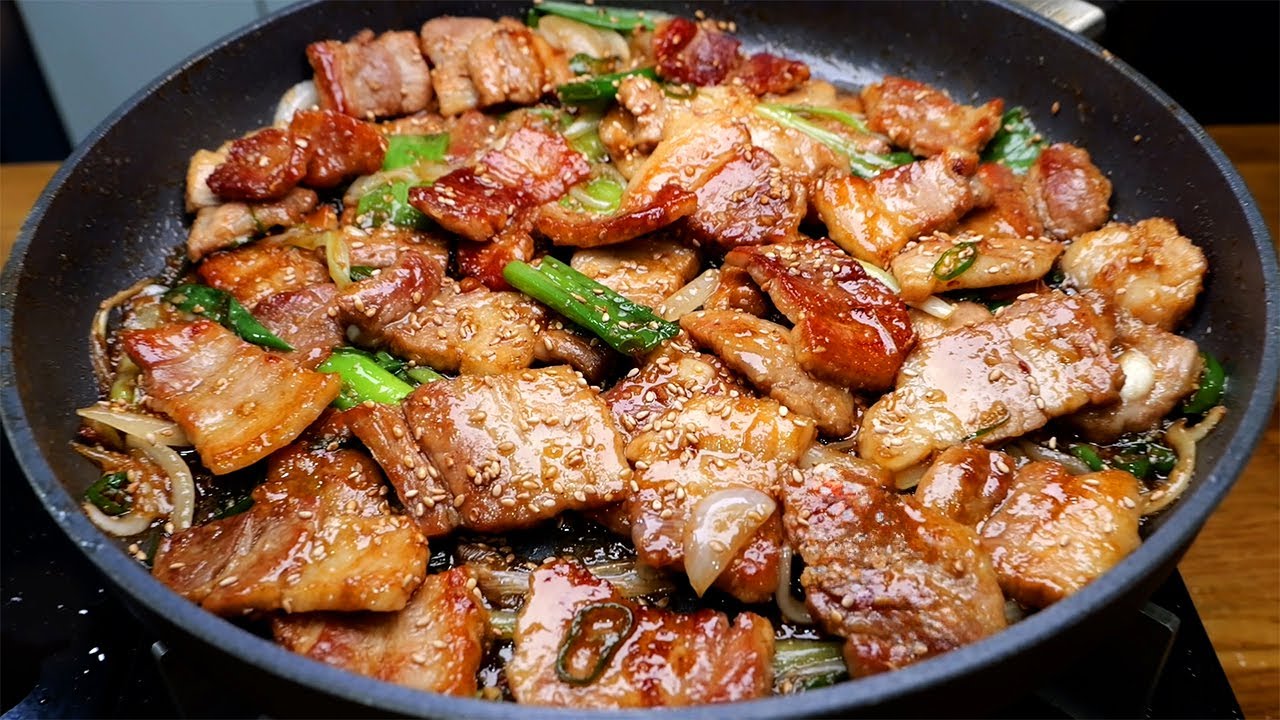
Why This Recipe Works
Most stir-fry recipes fail before the sauce ever hits the pan. They skip the physics. They ignore the chemistry. They throw everything in at once and wonder why the finished dish looks like braised sadness swimming in a puddle of rendered fat and false promises. Samgyeopsal bokkeum is not a forgiving dish for the careless — it rewards methodology and punishes shortcuts with greasy, under-caramelized mediocrity. So let's talk about what's actually happening in that pan, because there are at least four distinct scientific events occurring in a 15-minute window, and if you miss any one of them, you're eating a different, inferior dish.
Event One: Cold-Start Dry Rendering
You are not sautéing the pork belly. You are rendering it. There is a difference, and conflating the two is how you end up with tough, greasy meat in a sauce that refuses to stick. Pork belly is roughly 50% fat by volume in a properly cut piece. That fat is subcutaneous and intramuscular, sealed behind connective tissue that only releases under sustained, moderate heat. Start in a skillet that is warm but not screaming hot — medium, maybe nudging toward medium-high — and the fat has time to liquefy from the inside out, basting the meat in its own rendered lipids while the exterior develops a Maillard crust. Hit it with a blazing pan from the start and you seal the exterior prematurely. The fat stays trapped. The edges burn. The center stays soft and wet. The excess fat you pour off after rendering is not waste — it is proof that the process worked.
Event Two: Fat Removal as a Technical Step
This is where most home cooks balk. Pouring fat out of a hot pan feels wrong, feels like wasting flavor, feels like something your grandmother would never do. Your grandmother was also not achieving a lacquered gochujang glaze on her pork belly. Remove all but approximately one tablespoon of the rendered fat. The residual tablespoon is enough to carry heat, prevent sticking, and emulsify the incoming sauce. More than that and you have a fat-to-sauce ratio that prevents caramelization — the sugars in the sauce dilute rather than concentrate, and you get a loose, greasy coating instead of the tight, sticky glaze that made this recipe earn 3.9 million views. Fat and caramelization are fundamentally incompatible above a certain threshold. Know the threshold.
Event Three: The Sauce Architecture
The mixing bowl step is not optional and not ceremonial. Combine the sauce before the pork goes in the pan — not while it's cooking, not by adding components sequentially into the heat. Here is why: gochujang is a fermented paste with significant sugar content and dense, uneven viscosity. Added directly to a hot pan, it scorches on contact with the hot metal before it has any chance to coat the meat. Pre-combined with soy sauce, mirin, and rice syrup, it becomes a fluid, homogeneous emulsion with distributed sugars and a lower effective scorching point. The mirin adds a secondary alcohol-driven aromatic lift when it hits the heat. The soy sauce contributes glutamates that amplify the savory register of both the pork and the gochujang. These things do not happen if you add them one by one. They happen because you treated sauce-making like the chemistry it is, in advance, in a bowl, before the heat got involved.
Event Four: Rice Syrup and the Lacquering Mechanism
Rice syrup — mulyeot — is not interchangeable with honey or simple syrup, regardless of what substitution charts tell you. It is a complex sugar syrup with a higher proportion of maltose than sucrose. Maltose caramelizes at approximately 180°C, compared to sucrose at 186°C — a small difference in Celsius that translates to a dramatically wider working window at medium-high stir-fry temperatures. This is why the glaze stays glossy and pliable on the pork rather than crystallizing or burning. Honey's fructose content burns violently fast at stir-fry temperatures. Corn syrup works as a substitute because it is also glucose-dominant. Sugar does not. The lacquered, sticky finish that defines Korean bokkeum sauces — that visual quality that makes the dish photograph well and eat even better — is a direct function of maltose chemistry in a pan that has been properly degreased. It is not magic. It is applied food science, executed through peasant cooking tradition refined over centuries.
The Vegetable Timing Calculus
Onion and zucchini go in after the pork is rendered and excess fat is removed. Not before. Not simultaneously. After. Onion requires approximately two minutes at medium-high heat to soften its sharp allium bite while retaining structural integrity — its cell walls should still resist the tooth. Zucchini's high water content (roughly 95% water by weight) means it needs to hit a hot, mostly dry surface to sear rather than steam. If you add vegetables to a pan full of rendered pork fat, they absorb fat, leach water, and drop the pan temperature below searing threshold. You get soft, oil-saturated vegetables in a wet pan, which means the sauce you add next will steam rather than caramelize. Sequence is not a stylistic preference in this recipe. It is the architecture that makes every other step pay off.
The 25-Minute Honest Assessment
Samgyeopsal bokkeum is a weeknight dinner that performs like a weekend project. It is fast because each step is short. It is good because each step is non-negotiable. The cynical read is that this is just pork belly in chili sauce. The accurate read is that it is a tightly sequenced rendering-caramelization process that produces textures and glaze characteristics most home cooks assume require restaurant equipment. It requires a pan, a bowl, and the willingness to follow the physics rather than improvise around them. Do that, and you have the dish. Don't, and you have a different dish — one that nobody is filming for YouTube, and nobody is making twice.
Samgyeopsal Bokkeum (Pork Belly Stir-Fry)
🛒 Ingredients
- ✦1 lb pork belly, sliced into 1/4-inch thick bite-sized pieces
- ✦2 tablespoons gochujang (Korean red pepper paste)
- ✦1 tablespoon soy sauce
- ✦1 tablespoon rice syrup or corn syrup (mulyeot)
- ✦1 tablespoon mirin
- ✦1 teaspoon gochugaru (Korean red pepper flakes)
- ✦3 cloves garlic, minced
- ✦1 teaspoon fresh ginger, grated
- ✦1 medium onion, sliced
- ✦1 small zucchini, sliced into half-moons
- ✦2 green onions, cut into 2-inch pieces
- ✦1 tablespoon vegetable oil
- ✦Toasted sesame seeds for garnish
- ✦Steamed rice for serving
👨🍳 Instructions
01Step 1
Combine gochujang, soy sauce, rice syrup, mirin, gochugaru, garlic, and ginger in a small bowl. Mix into a smooth sauce.
02Step 2
Heat a large, dry skillet over medium-high heat. Add pork belly pieces in a single layer — no oil needed, the pork fat renders its own.
03Step 3
Cook pork for 4-5 minutes per side until golden and the fat is rendered and slightly crispy. Pour off excess rendered fat, leaving about 1 tablespoon in the pan.
04Step 4
Add onion and zucchini. Stir-fry for 2 minutes.
05Step 5
Pour the sauce over everything. Toss vigorously to coat every piece. Cook for 3-4 minutes until the sauce caramelizes and becomes glossy.
06Step 6
Add green onions and toss for 30 seconds. Garnish with sesame seeds. Serve immediately over steamed rice.
Nutrition Per Serving
Estimates based on standard preparation. Adjustments alter macros.
🔄 Substitutions
Instead of Pork belly...
Use Pork shoulder (moksal)
Leaner, still great flavor — more forgiving for beginners
Instead of Rice syrup...
Use Corn syrup or honey
Corn syrup caramelizes similarly; honey adds floral notes but burns faster
Instead of Gochujang...
Use Sriracha + miso (2:1)
Approximates the fermented-spicy profile
🧊 Storage & Reheating
In the Fridge
Store for up to 3 days. The glaze keeps the pork moist during storage.
In the Freezer
Freeze portioned for up to 2 months.
Reheating Rules
Reheat in a hot skillet to restore the caramelized glaze. Add a splash of water if the sauce is too thick.
❓ Frequently Asked Questions
What cut of pork belly should I use?
Pre-sliced samgyeopsal from a Korean market is ideal — it's cut to the right thickness. If buying a whole slab, slice it 1/4-inch thick against the grain. The meat-to-fat ratio should be roughly equal for the best texture.
Why drain the rendered fat?
Pork belly releases a lot of fat when cooked. If you leave it all in, the sauce won't caramelize — it'll just float in grease. Draining most of it (keeping 1 tablespoon) lets the gochujang sauce coat and glaze the pork properly.

The Science of
Samgyeopsal Bokkeum (Pork Belly Stir-Fry)
We turned everything on this page into a beautiful, flour-proof PDF cheat sheet. Print it out, stick it to your fridge, and never mess up your samgyeopsal bokkeum (pork belly stir-fry) again.
*We'll email you the high-res PDF instantly. No spam, just perfectly cooked meals.
AlmostChefs Editorial Team
We translate the internet's most popular cooking videos into foolproof, beginner-friendly written recipes. We analyze multiple methods, test them in our kitchen, and engineer a single "Master Recipe" that gives you the best possible result with the least possible stress.