Perfect Korean Ramyeon (Stop Cooking It Wrong)
Korean instant ramyeon elevated with egg tricks, steamed mandu, nurungji, and broth hacks straight from the country that made instant noodles an art form. We broke down the most-watched Korean ramyeon technique videos to build one definitive guide that covers every upgrade worth knowing.

“Everyone in Korea has an opinion on how to cook ramyeon. Most of those opinions are correct — because ramyeon is not a recipe, it is a system. The packet is the baseline. What you do in the next five minutes determines whether you eat something forgettable or something you think about the next day. The difference is not expensive ingredients. It is knowing which three moves actually change the bowl.”
Why This Recipe Works
Ramyeon is not a lazy meal. It is a five-minute exercise in applied heat and timing, and the Koreans who have been eating it daily for sixty years have developed a body of technique around it that most non-Korean cooks have never encountered. This is not about making instant noodles feel "gourmet." It is about understanding what actually happens in that pot and making decisions accordingly.
The Boil Is Non-Negotiable
Everything starts with the boil. Not a simmer. Not a gentle bubble. A hard, violent, full-rolling boil that means the water temperature has stabilized at 100°C throughout the pot. Noodles dropped into sub-boiling water hydrate unevenly — the outer layer absorbs liquid while the core stays dry, and you end up with noodles that are simultaneously gummy on the outside and chalky in the middle.
Adding the seasoning packet before the noodles is a small move that costs nothing. The dissolved solids raise the boiling point marginally and season the cooking water so that the noodles absorb broth flavor from the inside out rather than just being coated by it at the end.
The Egg Is an Architecture Decision
There are three ways to use an egg in ramyeon, and each produces a fundamentally different bowl. Beaten in early: the egg proteins distribute through the broth and thicken it slightly, but you lose the egg as a distinct textural element. Whole egg added at 90% cook time and covered: the yolk poaches to a custardy finish while the white sets cleanly, giving you a protein centerpiece. Post-noodle broth scramble: after the noodles are gone, a beaten egg stirred into the remaining hot broth creates silk ribbons that enrich what would otherwise be discarded liquid.
None of these is wrong. They solve different problems. The choice should be intentional, not default.
Mandu Without Boiling
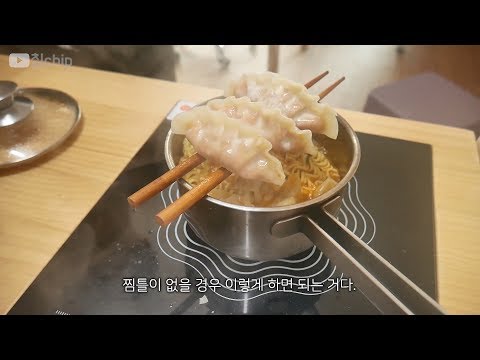
The chopstick rack is not a parlor trick. Frozen mandu boiled directly in ramyeon broth absorb sodium at an accelerating rate, lose structural integrity, and end up waterlogged. Two chopsticks balanced across the pot rim turn the pot into a makeshift steamer — the dumplings hang above the broth in a steam environment that cooks them gently and keeps their filling intact. The timing works out to exactly one ramyeon cook cycle, which means you pull everything out simultaneously.
Nurungji as Foundation
The bowl matters. Placing nurungji at the base before ladling ramyeon over it creates a textural gradient that doesn't exist in the noodles alone. The scorched rice absorbs hot broth from the top while its bottom surface stays dry, producing a material that is simultaneously crispy, chewy, and beginning to dissolve into something approaching congee. It is the textural contrast that makes a simple bowl feel constructed.
The Seaweed Flake Question
김자반 (seaweed flakes) dissolved into finished ramyeon broth do something that seems too simple to be true: they add a concentrated marine umami that amplifies every savory element already in the bowl without adding a competing flavor. This is because dried seaweed is high in glutamates — the same compounds that make MSG effective, delivered through a whole food with texture and color. Two minutes of steeping is all it takes. The flakes hydrate, soften, and integrate into the broth without requiring any technique.
The Second Course
The broth left after you finish the noodles is not dishwater. It is seasoned, starchy, still hot, and it has been enriched by whatever you added — egg, sausage fat, seaweed umami. Cracking a raw egg into it, stirring to create ribbons, and adding a scoop of cooked rice produces a loose congee in under two minutes. This is not a recipe hack. It is how the bowl was designed to end.
Where Beginners Mess This Up
Before we start, read this. These are the 4 reasons your perfect korean ramyeon (stop cooking it wrong) will fail:
- 1
Adding the noodles before the broth is at a full boil: Dropping noodles into water that hasn't reached a rolling boil produces uneven hydration and a gummy, clumped result. The water must be violently boiling — not simmering — before the noodles go in. Adding the seasoning packet first raises the boiling point slightly and gets the broth flavor built before the noodles absorb any liquid.
- 2
Cracking the egg in too early: Eggs added at the start dissolve into the broth and vanish. Eggs added when the noodles are 90% done and then covered poach gently, giving you a custardy yolk floating in clean broth. Timing the egg is the single highest-return move in ramyeon cookery.
- 3
Using low-quality Vienna sausages: Cheap Vienna sausages are processed paste that turns rubbery in broth. Quality sausages have visible fat speckling on the cut surface and a 'wood-grain' texture noted on the packaging — these have actual meat structure and release fat into the broth rather than just sitting there. The difference is immediate and visible.
- 4
Skipping the nurungji base: Placing nurungji (scorched rice) at the bottom of the bowl before ladling ramyeon over it sounds like a novelty. It is not. The nurungji absorbs broth, softens unevenly, and creates a crispy-chewy-porridgey texture layer underneath the noodles that changes the entire eating experience.
The Video Reference Library
Want to see it in action? Here are the exact videos we analyzed and combined to build this foolproof recipe translation:
🛠️ Core Equipment
- Heavy-bottomed small potThin-bottomed pots create uneven heat and scorch spots on the bottom. A [small saucepan](/kitchen-gear/review/saucepan) with some mass holds temperature when the noodles drop in, keeping the boil consistent throughout the cook.
- Tight-fitting lidEssential for the egg-poaching technique and for the mandu steaming method. A [lid](/kitchen-gear/review/pot-lid) that seals well traps the steam that finishes both the egg and the dumplings.
- Fine chopsticks or small tongsFor the mandu-steaming hack — two chopsticks balanced across the pot rim act as a steamer rack for frozen dumplings, letting them steam above the boiling water while the noodles cook below.
Perfect Korean Ramyeon (Stop Cooking It Wrong)
🛒 Ingredients
- ✦1 package ramyeon (any variety)
- ✦water, amount per package instructions
- ✦1 egg
- ✦nurungji (scorched rice), optional but recommended
- ✦2-3 frozen mandu (dumplings), preferably Gohyang brand
- ✦2-3 Vienna sausages, quality-graded (see tips)
- ✦1 tablespoon seaweed flakes (김자반)
- ✦1 spoonful ketchup, optional
- ✦ssamjang, gochujang, or doenjang to taste, optional
- ✦minced garlic or sliced green onions, optional
- ✦small amount soy sauce, for dry ramyeon variation
- ✦cooked rice, for finishing (optional)
👨🍳 Instructions
01Step 1
Bring water to a hard, rolling boil in a heavy-bottomed small pot.
02Step 2
Add the seasoning packet first and stir to dissolve before adding the noodles.
03Step 3
Add the noodles. Cook according to package timing, stirring once or twice to separate the brick.
04Step 4
When the noodles are about 90% done — still slightly firm at the center — add the egg whole. Do not stir. Cover with a lid and let it poach for 60-90 seconds.
05Step 5
If using mandu, balance two chopsticks across the pot rim before the noodles go in. Set the frozen dumplings on top of the chopsticks, cover, and steam for 5 minutes. Then add the noodles below and cook as normal.
06Step 6
If using Vienna sausages, add them directly to the boiling broth 2 minutes before the noodles finish. They don't need long — just enough to heat through and release some fat into the broth.
07Step 7
Place a handful of nurungji at the bottom of your bowl before serving.
08Step 8
Ladle the ramyeon over the nurungji in the bowl. Add seaweed flakes on top and let them steep into the broth for 1-2 minutes before eating.
09Step 9
Optional finish: after finishing the noodles, crack a raw egg into the remaining broth, stir vigorously to create ribbons, and simmer for 30 seconds. Add rice directly to this egg broth and mix. This is a complete second course from the same pot.
Nutrition Per Serving
Estimates based on standard preparation. Adjustments alter macros.
🔄 Substitutions
Instead of Gohyang mandu (고향만두)...
Use Any frozen water dumpling from a local market
Gohyang is recommended because it has the most neutral flavor profile and doesn't compete with the ramyeon broth. Cheaper budget brands often have an artificial seasoning note that clashes. More premium brands like Bibigo taste fine but are redundant — the broth dominates anyway.
Instead of Nurungji...
Use Cooked short-grain rice, pan-toasted until lightly crisped
Not the same texture but achieves a similar starchy base. Toast in a dry pan for 3-4 minutes until the bottom layer develops a crust. The crust absorbs broth while the inner grains stay chewy.
Instead of Seaweed flakes (김자반)...
Use Crumbled gim (roasted seaweed sheets)
Slightly less umami intensity but same ocean-forward flavor. Crumble directly into the bowl. The flakes will hydrate faster than standard gim pieces, which is what you want.
Instead of Fresh egg...
Use Pre-boiled soft-boiled egg, mashed into broth
Works especially well with miyeok-guk ramyeon. The mashed yolk disperses into the broth and creates a richer, slightly creamy base. Different from a poached egg — not better or worse, just a different texture register.
🧊 Storage & Reheating
In the Fridge
Ramyeon does not store well once cooked — the noodles continue absorbing broth and become bloated. If you must store it, keep noodles and broth separate in airtight containers for up to 1 day.
In the Freezer
Not recommended. Cooked ramyeon noodles do not survive freezing — the texture collapses completely on thaw.
Reheating Rules
Add a splash of water to the broth before reheating on the stovetop over medium heat. Microwave reheating causes uneven heat and steams the noodles into mush. Stovetop only.
❓ Frequently Asked Questions
Does adding the seasoning packet first actually make a difference?
Marginally, but consistently. Adding the powder to boiling water before the noodles builds a seasoned broth that the noodles hydrate directly into, rather than seasoning water that is already occupied with cooking the starch. The practical difference is a slightly more even salt distribution through the noodles and a very minor boiling point elevation. It is not transformative, but there is no reason not to do it.
Why does the chopstick mandu-steaming method work?
Because dumplings that are boiled in ramyeon broth absorb sodium aggressively and become bloated and fragile. Steaming above the boiling water cooks them through gentle indirect heat — they finish tender but intact, with their own filling flavor preserved. The 5-minute steam time aligns precisely with standard ramyeon cook time, so both finish together.
What is nurungji and where do I find it?
Nurungji is the crust of scorched rice left at the bottom of a rice cooker or pot after cooking. It is sold dried and packaged at Korean grocery stores and online. It keeps for months in an airtight container. If you cook rice in a pot on the stove and let it sit 2-3 minutes after the water evaporates, you make your own.
Is the egg-broth-rice finish actually a second meal or just a trick?
It is genuinely a second course. After finishing the noodles, the remaining broth is still hot, deeply seasoned, and has absorbed some starch from the noodles. Beaten egg ribbons enrich it further. Rice turns it into a loose congee. Most people who try this once eat it every time thereafter. It adds 2 minutes and uses ingredients already in the bowl.
Can I use any ramyeon brand for these techniques?
Yes, with one exception: the chopstick mandu method requires a pot with enough surface area for the chopsticks to span stably. Narrow pots don't work. For everything else — egg timing, nurungji base, seaweed flakes, Vienna sausages — the techniques are brand-agnostic. The video specifically recommends Shin Ramyeon Black for microwave cup preparation, noting it outperforms all other microwave options significantly.
How do I know which Vienna sausages to buy?
Look at the package photo of the cross-section. Quality sausages show visible fat speckling — irregular white flecks distributed through the meat. The surface of the sausage itself should have a slightly uneven, textured appearance rather than a smooth, uniform exterior. Packaging that notes 'wood-grain texture' or 'natural casing' is also a reliable quality indicator. Uniformly smooth, pale sausages with no cross-section shown are processed paste — they go rubbery in broth.
The Science of
Perfect Korean Ramyeon (Stop Cooking It Wrong)
We turned everything on this page into a beautiful, flour-proof PDF cheat sheet. Print it out, stick it to your fridge, and never mess up your perfect korean ramyeon (stop cooking it wrong) again.
*We'll email you the high-res PDF instantly. No spam, just perfectly cooked meals.
AlmostChefs Editorial Team
We translate the internet's most popular cooking videos into foolproof, beginner-friendly written recipes. We analyze multiple methods, test them in our kitchen, and engineer a single "Master Recipe" that gives you the best possible result with the least possible stress.