Homemade Ramen (Tare + Broth System, Soft-Boiled Egg, Chashu Pork)
A simplified but correct approach to homemade ramen — built on the tare (concentrated seasoning) + broth system, with a soft-boiled marinated egg and pan-braised chashu pork. Understanding the tare concept unlocks ramen.

“Most home cooks approach ramen the wrong way — they try to build all the flavor into the broth and end up with something that tastes like underseasoned chicken soup with noodles in it. The reason restaurant ramen hits the way it does is the tare: a concentrated seasoning paste or liquid added to each bowl individually. The broth is clean, neutral, and deeply savory. The tare is punchy, salty, and complex. Together, they produce a bowl where every element is calibrated. This recipe teaches you that system.”
Why This Recipe Works
Ramen is not a complicated dish. It is a precise one. The reason home ramen tastes wrong — thin, flat, like an underpowered soup — has almost nothing to do with technique and almost everything to do with a misunderstanding of the architecture. Restaurant ramen is built on two separate components: the broth, and the tare. Once you internalize that structure, everything else follows.
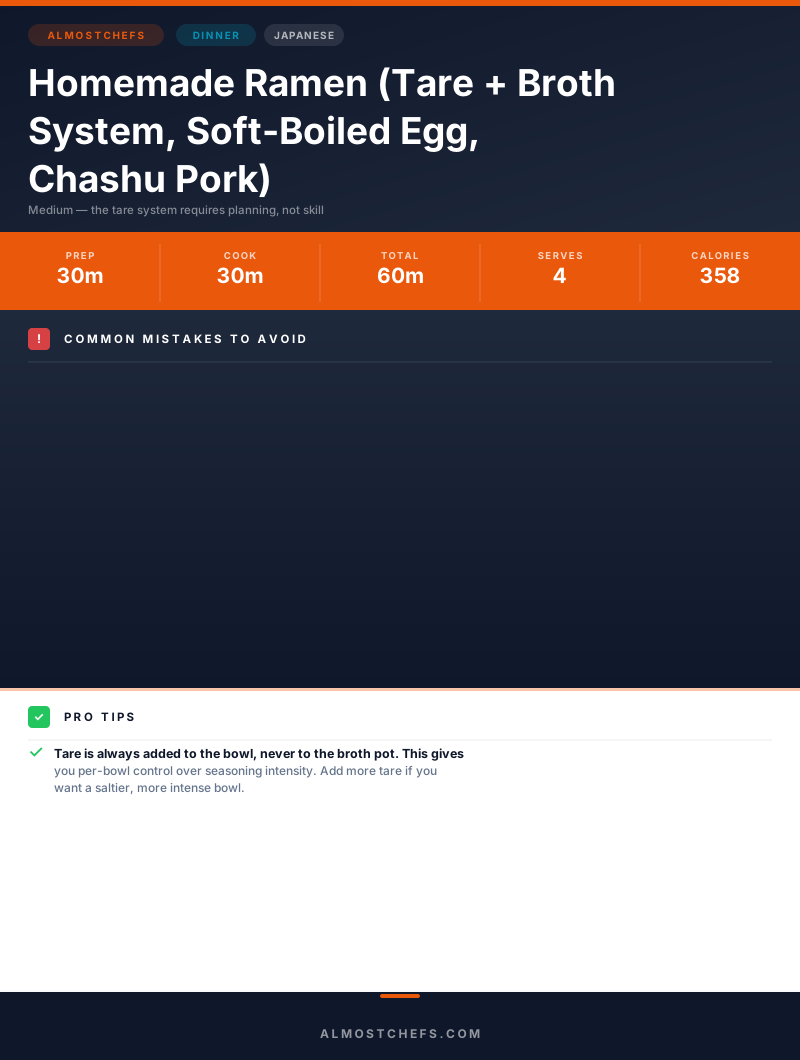
The tare system is what separates ramen from noodle soup. Tare is a concentrated seasoning liquid added directly to each bowl before the broth is poured in. It never goes into the broth pot. At most ramen restaurants, a ladleful of broth goes in first to warm the bowl, the tare is added, and then the full pour of hot broth follows. This structure exists for a specific reason: it gives the cook per-bowl control over salt level, flavor intensity, and character. The broth is deliberately underseasoned on its own. It provides the body — collagen from bones, glutamates from aromatics, fat from pork or chicken — but not the sharp, punchy salinity that makes ramen satisfying. That comes from the tare at the moment of service. If you season the whole pot to taste, the broth is correct when it's first made, but it will be too salty as it reduces further, impossible to adjust, and you lose the ability to calibrate each bowl. The tare-and-broth separation is an elegant engineering solution.
Shoyu tare specifically is not just soy sauce. A shoyu tare is soy sauce cooked briefly with mirin and sake. This matters because raw soy sauce has a sharp, slightly harsh edge from its fermentation acids and alcohol compounds. Heating the tare drives off the harsh alcohol notes from the sake and mirin, caramelizes some of the sugars in the mirin, and concentrates the savory glutamates in the soy. The result is rounder, less aggressive, and more complex than soy sauce straight from the bottle. The 3-minute simmer is not about reduction — it's about flavor transformation. You can taste the difference directly: raw tare is sharp and one-dimensional; cooked tare has depth and a subtle sweetness.
The 6.5-minute soft-boiled egg is a protein denaturation problem. Egg proteins — specifically ovalbumin and conalbumin in the white, and multiple lipoproteins in the yolk — denature (unfold and set) at different temperatures. Egg whites begin setting around 145°F; the yolk's texture changes progressively from runny (130°F) to jammy and orange (145°F) to fully set (158°F+). At 6.5 minutes in boiling water, the yolk core temperature reaches approximately 145-150°F — hot enough to set the edges into a creamy, almost custard-like consistency while the center remains molten and deeply orange. The immediate ice bath stops the cooking by dropping the egg's surface temperature below the setting threshold within seconds. Every 30 seconds past 6.5 minutes pushes the interior temperature further toward fully cooked. The window for the jammy, layered yolk texture is narrow — roughly 6 to 7.5 minutes at a full boil, depending on egg size. Use large eggs and a timer.
Chashu is a cold-braising technique that requires patience. Pork belly is a tough, fatty cut — roughly 50% fat by weight, with significant connective tissue running between the muscle and fat layers. Collagen, the protein that makes connective tissue tough, begins converting to gelatin around 160°F and the conversion accelerates between 170°F and 185°F. Gelatin is what makes the braised pork silky and yielding rather than chewy. Braising at a full boil (212°F) overshoots the optimal collagen-conversion window and causes the muscle fibers to contract tightly, expelling moisture and producing dry, fibrous meat even as the collagen converts. A bare simmer — small, lazy bubbles, not a rolling boil — keeps the pork at around 180-190°F, which is the optimal range for collagen conversion without protein tightening. The sear before braising serves two purposes: it creates Maillard compounds (browned flavors) that enrich the braising liquid, and it renders some of the exterior fat layer, preventing the outer surface from being greasy in the final bowl.
The broth temperature at service is not a minor detail. Flavor perception in food is temperature-dependent. Glutamate compounds — the primary umami-carriers in ramen broth — are perceived more intensely at higher temperatures. A bowl of ramen served at 160°F tastes noticeably less savory and complex than the same bowl served at 180°F. More practically: ramen noodles are served in an enormous volume of liquid relative to their mass, and cold noodles or toppings drop the bowl temperature rapidly. Serving the broth as close to a boil as possible compensates for this. In professional ramen shops, bowls are often warmed with hot water before assembly. A simple home approximation is to fill the serving bowls with hot tap water for 60 seconds while you cook the noodles, then dump the water just before assembling.
Bowl layering is functional, not aesthetic. The order of assembly affects the final bowl in real ways. Tare at the bottom mixes with the broth as it's poured in — this produces even distribution rather than a concentrated salty patch at the bowl's edge if the tare were added last. Noodles go in before the broth so they don't splash or cool the liquid. Toppings go on top last so they're visible and, critically, so the nori doesn't become completely saturated and dissolve into the broth before the bowl reaches the table.
The braising liquid from the chashu is one of the most useful things this recipe produces. After the pork is removed and the liquid is strained, you have an intensely savory, slightly sweet, deeply brown concentrate. Use it as additional tare — a teaspoon in a bowl that needs more depth — or thin it with water and use it to marinate the soft-boiled eggs. Nothing gets wasted.
Using a proper heavy pot like a Dutch oven for the broth is worth noting: thin-bottomed pots fluctuate in temperature with each addition of cold ingredients, which disrupts the steady simmer needed for clean, clear broth. The thermal mass of a heavy pot maintains a stable temperature. The difference shows up in the clarity of the broth — a thin pot at an erratic boil produces cloudy, emulsified broth; a heavy pot at a steady simmer produces clear, clean stock.
Where Beginners Mess This Up
Before we start, read this. These are the 4 reasons your homemade ramen (tare + broth system, soft-boiled egg, chashu pork) will fail:
- 1
Flat, underseasoned broth: You added all the soy sauce directly to the broth pot instead of treating it as tare. The tare goes into each bowl individually — typically 2-3 tablespoons per serving — and the broth is ladled hot on top. Pre-seasoning the entire pot makes it impossible to adjust per bowl and dulls the bright, punchy quality of the soy.
- 2
Rubbery chashu pork: The pork belly was braised at a full rolling boil rather than a gentle simmer. Collagen in pork belly converts to gelatin at around 160-180°F over time. A rapid boil overshoots this window and causes the proteins to tighten and squeeze out moisture before the collagen fully dissolves. Keep the braising liquid at a bare simmer — small bubbles, not a rolling boil.
- 3
Soft-boiled eggs with overcooked yolks: Timing is non-negotiable. 6.5 minutes in boiling water, then immediately into an ice bath. The yolk temperature at 6.5 minutes is around 145-150°F — set at the edges, jammy and orange in the center. Every 30 seconds past that moves the yolk texture noticeably toward fully cooked. Use a timer, not a guess.
- 4
Soggy noodles: The noodles were cooked in the broth instead of separately. Ramen noodles release starch and become soft rapidly. Cook them in a separate pot of boiling water, drain, and add to the bowl just before ladling the broth. This preserves their texture and keeps the broth clear.
The Video Reference Library
Want to see it in action? Here are the exact videos we analyzed and combined to build this foolproof recipe translation:
Weissman's full tare-and-broth breakdown with shoyu tare construction, chashu technique, and bowl assembly. The best single reference for understanding how the components layer together.
A science-forward take on the tare system with a good breakdown of the differences between shoyu, shio, and miso tare and when to use each. Essential for understanding the flavor architecture.
Professional ramen chef Ivan Orkin demonstrating the layered broth system. Watch this to understand why the tare is never mixed into the broth at the pot stage.
🛠️ Core Equipment
- Large pot (6+ quart)For the broth. Ramen broth benefits from volume — a larger pot holds more bones or aromatics and maintains a more stable temperature during the simmer.
- Small saucepan for braisingChashu pork needs a tight, deep vessel so the braising liquid can partially submerge the pork belly roll. A skillet won't work — you need walls.
- Dutch oven or heavy-bottomed potIf you're making a proper pork or chicken broth from scratch, a [Dutch oven](/kitchen-gear/review/dutch-oven) provides even heat distribution and retains temperature during the long simmer better than a thin-bottomed pot.
- Instant-read thermometerFor verifying chashu pork internal temperature (around 185-190°F when done) and for checking broth temperature before ladling. Ramen broth should be served very hot — around 180°F.
- Kitchen twineTo tie the pork belly roll so it holds its shape during braising. A loose roll unravels in the liquid and produces uneven slices.
Homemade Ramen (Tare + Broth System, Soft-Boiled Egg, Chashu Pork)
🛒 Ingredients
- ✦4 servings fresh or dried ramen noodles
- ✦6 cups chicken or pork broth (store-bought or homemade)
- ✦1/4 cup soy sauce (shoyu tare base)
- ✦2 tablespoons mirin
- ✦1 tablespoon sake
- ✦1 lb pork belly, skin-on, for chashu
- ✦1/4 cup soy sauce (chashu braising liquid)
- ✦2 tablespoons mirin (chashu braising liquid)
- ✦2 tablespoons sake (chashu braising liquid)
- ✦1 tablespoon sugar (chashu braising liquid)
- ✦4 large eggs, for soft-boiling
- ✦4 sheets nori
- ✦2 cups bean sprouts, blanched
- ✦4 green onions, thinly sliced
- ✦1 tablespoon sesame oil
- ✦Sesame seeds for garnish
👨🍳 Instructions
01Step 1
Make the shoyu tare: combine 1/4 cup soy sauce, 2 tablespoons mirin, and 1 tablespoon sake in a small saucepan. Bring to a simmer over medium heat and cook for 3 minutes until slightly reduced. Remove from heat and cool. Store in a jar — this is your tare.
02Step 2
Make the chashu: roll the pork belly tightly, skin-side out, and tie with kitchen twine at 1-inch intervals. Sear in a hot skillet on all sides until browned, about 6 minutes total.
03Step 3
Combine chashu braising liquid ingredients (soy sauce, mirin, sake, sugar) in a small saucepan. Add 1/2 cup water. Add the seared pork belly. Bring to a simmer, cover, and braise on low heat for 45 minutes to 1 hour until a skewer meets no resistance.
04Step 4
Soft-boil the eggs: bring a pot of water to a full boil. Lower eggs in gently. Cook exactly 6.5 minutes. Transfer immediately to an ice bath for 5 minutes. Peel carefully.
05Step 5
Heat the broth to a near-boil (around 180°F). Keep it hot.
06Step 6
Cook ramen noodles in a separate pot of boiling water according to package instructions. Drain well.
07Step 7
Assemble each bowl: add 2-3 tablespoons of tare to the bottom of the bowl. Ladle 1.5 cups of hot broth on top. Add drained noodles. Arrange sliced chashu (2-3 slices per bowl), halved soft-boiled egg, bean sprouts, green onions, nori, and a drizzle of sesame oil. Finish with sesame seeds.
Nutrition Per Serving
Estimates based on standard preparation. Adjustments alter macros.
🔄 Substitutions
Instead of Pork belly (chashu)...
Use Chicken thighs
Braise skin-on chicken thighs in the same liquid for 35-40 minutes. The result is less rich but still excellent. Don't use chicken breast — it dries out.
Instead of Shoyu tare (soy sauce base)...
Use Shio tare (salt base)
Replace soy sauce with 1.5 teaspoons fine salt dissolved in mirin and sake. Shio tare produces a cleaner, paler broth that lets the natural broth flavor come through.
Instead of Chicken broth...
Use Pork broth or dashi
Pork broth is richer and fattier — closer to tonkotsu territory. Dashi (kombu + bonito) produces a lighter, more delicate bowl. Mix equal parts chicken broth and dashi for a middle-ground umami-forward base.
Instead of Fresh ramen noodles...
Use Dried ramen, soba, or udon noodles
All will work in a pinch. Soba adds a nutty buckwheat flavor. Udon produces a thicker, chewier bowl that pairs better with a lighter broth.
🧊 Storage & Reheating
In the Fridge
Store all components separately. Broth keeps 5 days. Chashu pork keeps 5 days in the braising liquid. Soft-boiled marinated eggs keep 3 days. Tare keeps 2 weeks.
In the Freezer
Broth freezes well for up to 3 months in airtight containers. Chashu pork can be frozen in the braising liquid for 1 month. Do not freeze assembled bowls.
Reheating Rules
Reheat broth to a near-boil. Slice chashu cold and lay slices on top of the assembled bowl — the hot broth and noodles will warm the pork sufficiently. Cook fresh noodles each time.
❓ Frequently Asked Questions
What is tare and why does it matter?
Tare is a concentrated seasoning liquid — typically soy sauce (shoyu), salt (shio), or miso — that is added to the bottom of each bowl before the broth. It's the primary flavoring agent for ramen. The broth provides body and umami; the tare provides salt and sharp flavor. Keeping them separate allows each bowl to be seasoned individually. This is why restaurant ramen tastes more complex than home attempts where everything goes in one pot.
What is the difference between shoyu, shio, and miso ramen?
The difference is the tare, not the broth. Shoyu tare is soy sauce-based — dark, salty, with umami depth. Shio tare is salt-based — clear, clean, and lets the broth flavor dominate. Miso tare is fermented soybean paste — thick, savory, slightly earthy, and rich. The same broth can produce three completely different bowls by swapping the tare.
Why does chashu pork need to be sliced cold?
Pork belly is around 50% fat. At braising temperature that fat is liquid. When the pork is sliced warm, the fat layer doesn't hold structure — the slices compress and fall apart. Refrigerating overnight firms the fat back into a solid, making clean, intact slices possible. The slices are then placed on the bowl cold and warmed by the hot broth.
Can I use store-bought broth?
Yes. A good-quality low-sodium chicken or pork broth works. The tare does the heavy seasoning work, so a neutral broth is acceptable. Add a piece of kombu to the broth while it heats to increase umami depth without making homemade stock from scratch.
How do I get the marbled egg look?
After peeling the soft-boiled eggs, marinate them in a 2:1 mixture of soy sauce and mirin diluted with water for 4-12 hours. Longer marination produces a darker exterior. The soy sauce penetrates only the surface — the interior stays jammy and golden. The exterior marbling develops naturally as the liquid works into the whites.
Why did my broth taste flat?
Two likely causes: underseasoning (add more tare per bowl) or a broth with insufficient depth. For store-bought broth, add a splash of fish sauce, a piece of kombu while heating, and a teaspoon of white miso whisked in to build umami layers. Also make sure the broth is very hot when served — flavor perception drops significantly in warm but not hot liquids.
The Science of
Homemade Ramen (Tare + Broth System, Soft-Boiled Egg, Chashu Pork)
We turned everything on this page into a beautiful, flour-proof PDF cheat sheet. Print it out, stick it to your fridge, and never mess up your homemade ramen (tare + broth system, soft-boiled egg, chashu pork) again.
*We'll email you the high-res PDF instantly. No spam, just perfectly cooked meals.
AlmostChefs Editorial Team
We translate the internet's most popular cooking videos into foolproof, beginner-friendly written recipes. We analyze multiple methods, test them in our kitchen, and engineer a single "Master Recipe" that gives you the best possible result with the least possible stress.