38g Protein Overnight Oats (The Muscle-Building Breakfast Formula)
High-protein overnight oats built on a triple-threat base of Greek yogurt, collagen peptides, and almond butter — 38g of protein per jar, zero cooking, and four days of meal-prep done in 10 minutes. We broke down the technique to maximize protein absorption and texture so you're not choking down chalky, watery oats at 7am.
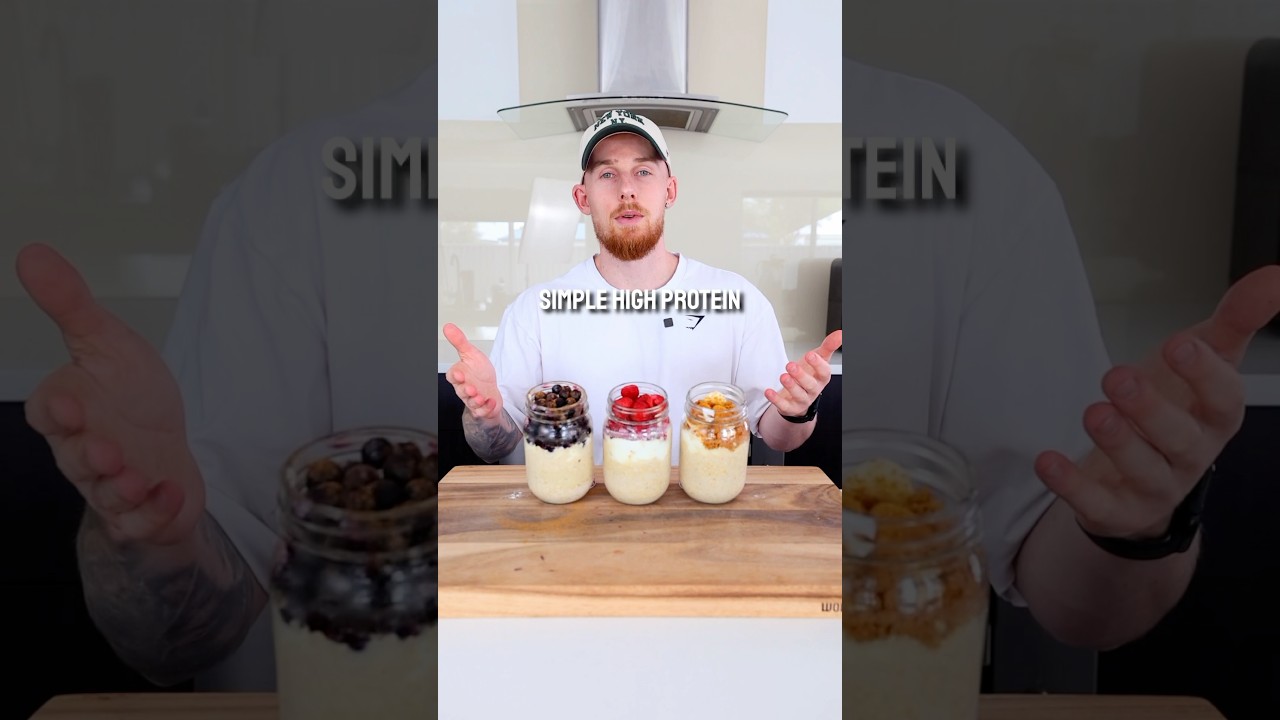
“Most overnight oats recipes top out at 15-18g of protein. That's a snack, not a muscle-building breakfast. This version stacks Greek yogurt, blended cottage cheese, and collagen peptides into a triple-layer protein architecture that hits 38g per jar — without tasting like a supplement shake. The trick is in how you layer each component and how long you let the oats hydrate. Get that right and you've got four days of breakfast done in one 10-minute Sunday session.”
Why This Recipe Works
Overnight oats is the most misrepresented category in high-protein meal prep. The standard version — oats plus milk, maybe a spoonful of nut butter — clocks in around 15-18g of protein per serving. That's enough protein to keep a moderately sedentary person from being hungry for an hour. It is not a muscle-building breakfast. It is not a serious athlete's breakfast. It is a light snack wearing breakfast's clothes.
This version is architecturally different. The 38g protein target is achieved through deliberate stacking — not by adding one protein source and calling it done, but by engineering three overlapping protein vectors into the same jar.
The Triple-Protein Architecture
Greek yogurt is the first layer: familiar, acidic, thick. At 13-15g of protein per cup, non-fat Greek yogurt outperforms most protein powders gram for gram. But it has a ceiling. Stack enough yogurt to hit 38g of protein alone and the oats become yogurt soup with some oat flotsam. You need the other two.
Cottage cheese is the second layer — and the most misunderstood ingredient in this recipe. Cup for cup, low-fat cottage cheese contains nearly as much protein as Greek yogurt, but its flavor is more neutral and its texture is grainier. The solution is the blending step. Thirty seconds in a high-powered blender with the yogurt and the curds disappear entirely. What remains is a smooth, thickened base that tastes like yogurt but contains twice the structural protein density. This is the technique that separates a 38g breakfast from an 18g one.
Collagen peptides are the third layer. Unlike whey or casein, hydrolyzed collagen dissolves completely in cold liquid without clumping or adding flavor — provided you whisk it into a room-temperature wet base before the jars get cold. It contributes approximately 9g of protein per serving here, plus documented joint-support benefits from glycine and proline that no other protein source in this recipe provides. The collagen doesn't make this a supplement shake. You won't taste it. It's infrastructure.
The Overnight Hydration Window
The 8-12 hour refrigeration period is not a convenience hack. It's chemistry. Old-fashioned rolled oats contain starches that gelatinize and soften when exposed to liquid over time. At 6 hours, the outer layers of each oat flake have softened but the centers remain slightly resistant — edible, but not the texture this recipe is built for. At 8-10 hours, full hydration is complete: the oats have absorbed the yogurt base into their structure, creating a thick, creamy mass where the boundary between oat and liquid has dissolved into something closer to porridge than cereal.
Instant oats skip this process by pre-processing the grain — they go mushy immediately. Quick oats fall somewhere in the middle. For the specific texture this recipe depends on, old-fashioned rolled oats at the full hydration window are the only option that delivers.
Almond Butter as a Fat Delivery System
The almond butter swirl isn't just flavor. Fat slows gastric emptying — the rate at which your stomach empties its contents into the small intestine. A breakfast with 14g of fat like this one creates a sustained satiety signal that extends the comfortable fullness window significantly beyond what a low-fat, high-carbohydrate breakfast produces.
The technique of spreading almond butter along the jar walls rather than pooling it in the center ensures every vertical layer of oats picks up fat during the overnight hydration. Pool it in the center and you get three bites of almond butter followed by a jar of plain oats. Spread it on the sides and the fat integrates evenly throughout.
A kitchen scale is worth using here. Collagen scoops vary by brand. Almond butter is calorie-dense. If you're tracking macros seriously, weighing these two ingredients is the difference between a jar that hits the nutrition label and one that doesn't.
What Makes This Meal Prep Work
The four-jar Sunday prep is the point of the entire recipe. Each jar stores cleanly for four days. The collagen stays dissolved. The oats don't over-soften. The almond butter redistributes with a firm shake. You invest 10 minutes on Sunday and you've solved breakfast through Thursday — a meal that hits 38g of protein, 418 calories, and 6g of fiber in the time it takes to pull a jar from the refrigerator.
That's the actual product here. Not the recipe. The time.
Where Beginners Mess This Up
Before we start, read this. These are the 4 reasons your 38g protein overnight oats (the muscle-building breakfast formula) will fail:
- 1
Not blending the cottage cheese: Cottage cheese stirred directly into oats leaves visible curds and a grainy, unpleasant texture. Blending it with the Greek yogurt for 30 seconds transforms it into a smooth, creamy base that's indistinguishable from thickened cream. This step is the entire reason the texture works.
- 2
Skipping the 8-hour minimum chill: Six hours is the floor, not the target. Rolled oats need 8-12 hours to fully hydrate and absorb the yogurt base. Pull the jars at 6 hours and you get chewy, resistant oats that haven't softened into the creamy texture the recipe is built around. Prep Sunday night, eat Monday morning.
- 3
Dumping collagen powder dry into the oats: Collagen peptides clump badly when they hit cold liquid. You need to whisk them into the wet yogurt-milk mixture at room temperature before it goes in the jar. Proper dissolution means the collagen integrates invisibly — no chalkiness, no texture, no detectable flavor.
- 4
Using instant oats instead of old-fashioned rolled: Instant oats turn to paste overnight. Old-fashioned rolled oats maintain structural integrity during the long hydration and give you that satisfying, slightly chewy texture. Quick oats are an acceptable middle ground. Instant oats are not.
The Video Reference Library
Want to see it in action? Here are the exact videos we analyzed and combined to build this foolproof recipe translation:
The source video for this recipe's technique. Clear demonstration of the cottage cheese blending method and layering order that makes this version different from standard overnight oats.
🛠️ Core Equipment
- BlenderNon-negotiable for the cottage cheese step. Pulsing the yogurt-cottage cheese blend for 30 seconds eliminates all curd texture. A fork will not achieve this. A [high-powered blender](/kitchen-gear/review/blender) makes this a 30-second job.
- 16-ounce wide-mouth mason jarsWide-mouth jars let you layer ingredients cleanly and eat directly from the jar without excavating with a spoon. The size accommodates a full 38g-protein serving with room for toppings. [Mason jars](/kitchen-gear/review/mason-jars) also seal well for four-day refrigerator storage.
- WhiskFor dissolving the collagen peptides and honey into the wet base. A spoon leaves dry pockets. A whisk distributes everything evenly in 20 seconds.
- Kitchen scaleCollagen peptides are measured in grams, not volume. Scoops vary by brand. If you're hitting the 38g protein target consistently, you need to weigh 40g of collagen accurately — not estimate it.
38g Protein Overnight Oats (The Muscle-Building Breakfast Formula)
🛒 Ingredients
- ✦2 cups old-fashioned rolled oats
- ✦1 1/2 cups plain Greek yogurt (non-fat or 2%)
- ✦1 cup low-fat cottage cheese
- ✦1 cup unsweetened almond milk
- ✦1/2 cup natural almond butter
- ✦4 scoops unflavored collagen peptides (about 40g)
- ✦2 tablespoons raw honey
- ✦1 teaspoon vanilla extract
- ✦1/2 teaspoon ground cinnamon
- ✦1/4 teaspoon sea salt
- ✦1/2 cup sliced fresh strawberries
- ✦1/4 cup raw sliced almonds
- ✦2 tablespoons unsweetened cocoa nibs
- ✦Pinch of ground nutmeg
👨🍳 Instructions
01Step 1
Divide the rolled oats evenly among four 16-ounce mason jars, using 1/2 cup per jar as your base layer.
02Step 2
Combine the Greek yogurt and cottage cheese in a blender. Pulse for 30 seconds until the mixture is completely smooth and creamy with no visible curds.
03Step 3
Pour the blended yogurt-cottage cheese mixture into a medium mixing bowl and whisk in the almond milk until fully combined.
04Step 4
Whisk in the collagen peptides, honey, vanilla extract, cinnamon, and sea salt until the collagen is completely dissolved and no dry clumps remain.
05Step 5
Swirl 2 tablespoons of almond butter into each jar, spreading it along the sides and bottom rather than pooling it in the center.
06Step 6
Divide the yogurt-collagen mixture evenly among the four jars, pouring it over the oats and almond butter until each jar is about three-quarters full.
07Step 7
Cover each jar with a lid and refrigerate for at least 6 hours, ideally 8-12 hours overnight.
08Step 8
Remove a jar from the refrigerator 5 minutes before eating and shake firmly to redistribute the almond butter and collagen throughout.
09Step 9
If the oats are too thick, stir in 2-3 tablespoons of almond milk until you reach your preferred consistency.
10Step 10
Top with fresh strawberry slices, raw almonds, cocoa nibs, and a light dusting of nutmeg just before eating.
Nutrition Per Serving
Estimates based on standard preparation. Adjustments alter macros.
🔄 Substitutions
Instead of Greek yogurt...
Use Icelandic skyr (2 cups)
Tangier flavor, denser mouthfeel, and slightly higher protein — roughly 20g per cup vs. 15g for Greek yogurt. Boosts total protein to approximately 42g per serving. Reduce almond milk by 2 tablespoons to account for skyr's lower water content.
Instead of Collagen peptides...
Use Vanilla protein powder (4 scoops)
Adds vanilla sweetness and similar protein density. Reduce honey to 1 tablespoon to avoid over-sweetening. Protein powder can clump more than collagen — whisk aggressively or use a shaker bottle for the mixing step.
Instead of Almond butter...
Use Natural peanut butter or powdered peanut butter
Peanut butter delivers a richer, earthier flavor and a more complete amino acid profile. Powdered peanut butter (1/4 cup mixed with 3 tablespoons water) cuts approximately 80 calories per serving while keeping the protein identical.
Instead of Almond milk...
Use Fairlife milk or another high-protein milk alternative
Adds 8-10g of additional protein per cup compared to standard almond milk, pushing total protein to 46-48g per serving. Minimal flavor change. Use the same quantity.
🧊 Storage & Reheating
In the Fridge
Store covered in mason jars for up to 4 days. Shake before each use to redistribute the almond butter and collagen layer. Flavor and texture actually improve between day one and day two.
In the Freezer
Not recommended. The blended yogurt-cottage cheese base separates unevenly after thawing and the oat texture degrades. These are a refrigerator-only prep.
Reheating Rules
Serve cold or at room temperature. If you prefer warm oats, microwave uncovered for 60-90 seconds and stir thoroughly. The collagen remains intact at normal microwave temperatures.
❓ Frequently Asked Questions
Why is my collagen powder clumping instead of dissolving?
The liquid is likely too cold. Collagen peptides dissolve best at 60-70°F. Let your almond milk sit out for 10 minutes before mixing, or warm it briefly in the microwave. Whisk continuously for 20 seconds — don't just stir.
Can I use protein powder instead of collagen?
Yes, but choose vanilla-flavored whey or plant protein and reduce the honey to 1 tablespoon. Protein powder doesn't dissolve as cleanly as collagen and can leave a slightly chalky texture if underwhisked. Blend the entire wet base — including the protein powder — for the smoothest result.
Why blend the cottage cheese? Can I just stir it in?
You can, but you'll taste it. Unblended cottage cheese leaves visible curds and a grainy, slightly sour texture that most people find unpleasant in oats. The 30-second blending step transforms it into an invisible, creamy protein source. It's the single most important technique in this recipe.
Is 38g of protein accurate per serving?
Yes, calculated from the modified recipe. Greek yogurt contributes approximately 13g, cottage cheese 14g, collagen peptides 9g, and almond butter 5g per serving. Oats contribute about 4g, bringing the total to approximately 38g. This assumes standard non-fat Greek yogurt and low-fat cottage cheese at the listed quantities.
Can I eat these warm?
Yes. Microwave uncovered for 60-90 seconds and stir thoroughly before adding toppings. The collagen is heat-stable at normal microwave temperatures. Warm oats have a slightly different texture — softer and more porridge-like — compared to the cold version.
How do I know when the oats are fully hydrated?
After 8 hours, the oat layer should have absorbed most of the yogurt base and swelled to fill the jar. There should be minimal pooled liquid at the top. If you see significant liquid separation, the oats need more time or the liquid ratio was slightly off. Stir and refrigerate for another 2 hours.
The Science of
38g Protein Overnight Oats (The Muscle-Building Breakfast Formula)
We turned everything on this page into a beautiful, flour-proof PDF cheat sheet. Print it out, stick it to your fridge, and never mess up your 38g protein overnight oats (the muscle-building breakfast formula) again.
*We'll email you the high-res PDF instantly. No spam, just perfectly cooked meals.
AlmostChefs Editorial Team
We translate the internet's most popular cooking videos into foolproof, beginner-friendly written recipes. We analyze multiple methods, test them in our kitchen, and engineer a single "Master Recipe" that gives you the best possible result with the least possible stress.