Foolproof Profiteroles (The French Dessert You've Been Afraid to Make)
Delicate choux pastry puffs filled with vanilla whipped cream and draped in warm chocolate sauce. We broke down the most common failure points in this classic French dessert to give you one bulletproof technique that works every time — no pastry school required.

“Profiteroles have a reputation for being fussy. That reputation is earned — but only because most recipes skip the two or three details that actually matter. Get the dough moisture right, add eggs at the correct temperature, and never open the oven early. Those three rules are the entire secret. Everything else is just following instructions.”
Why This Recipe Works
Choux pastry has exactly one moving part that matters: moisture. Get the moisture balance right and everything else — the puff, the hollow interior, the crispy shell — happens automatically through the physics of steam. Get it wrong and no amount of skill or technique will save you. This is not a recipe where you can improvise your way out of a mistake. It is a recipe where understanding two or three specific mechanics makes you competent on the first attempt.
The Dough Is a Steam Engine
Choux pastry rises because the water inside the dough converts to steam in the oven, and that steam has nowhere to go but up. There is no baking powder, no yeast, no chemical leavener. The entire lift comes from water vapor pressure, which means the ratio of water to fat to flour to egg must be precisely balanced or the steam escapes too early, too late, or not powerfully enough.
The moisture evaporation step — cooking the dough in the pan for 1-2 minutes after the flour is added — is where that balance gets set. You're cooking off excess surface moisture so the subsequent eggs can bind into the dough cleanly rather than slipping around on a wet surface. The tell is the thin dry film that forms on the bottom of the pan. That film is visual confirmation that you've hit the right moisture level. Skip it and the dough takes on too much egg before reaching the right consistency, resulting in flat, dense puffs that never inflate properly.
Egg Temperature Controls the Texture
Room temperature eggs integrate into warm dough without shocking it. Cold eggs — pulled straight from the refrigerator — drop the dough temperature rapidly and unevenly, causing the fat to partially solidify and creating a broken emulsion that doesn't pipe cleanly and doesn't bake evenly. This is not a theoretical concern. The difference in texture between a profiterole made with room temperature eggs and one made with cold eggs is visible and palpable.
The other egg variable is quantity. Four eggs is a starting point, not a guarantee. Choux dough's ideal consistency depends on how much moisture you evaporated, the size of your eggs, and the humidity in your kitchen. The ribbon test — the dough falls slowly from the spoon in a thick, continuous V-shape — is the only reliable indicator. Stop adding eggs when you hit it, even if you haven't used all four.
The Oven Is Doing the Heavy Work
At 400°F, the water in the dough reaches steam temperature within the first few minutes of baking. The puffs balloon rapidly in the first 10-15 minutes. At this stage the exterior is still soft — a skin has formed but hasn't fully set. This is the danger window. Open the oven door and the internal steam pressure equalizes with the room air instantly. The puff deflates. The shell, still soft, collapses under its own weight and sets in that collapsed position. There is no recovering from this.
After 20 minutes, the exterior is set enough to hold its shape even as internal steam continues to build and escape. The golden color you're looking for is deep — almost amber. A pale golden puff is an underdone puff, and it will be chewy and potentially still wet in the center.
A wire cooling rack after baking isn't just convention — it lets air circulate under the puffs and prevents the bottoms from steaming themselves soft while the shells are still hot.
The Chocolate Sauce Is About Chemistry, Not Chocolate
The corn syrup in this sauce does one specific job: it prevents crystallization. Pure melted chocolate cools into a solid, matte finish with a grainy texture. Add corn syrup and you introduce an invert sugar that disrupts the formation of sugar crystals as the sauce cools, keeping it glossy, smooth, and pourable long after it comes off the heat. It also lowers the sauce's melting point slightly, which means it flows gracefully over cold whipped cream instead of seizing on contact.
A double boiler gives you the most control over chocolate melting temperature — chocolate seizes if it exceeds about 120°F or encounters even a drop of water. The microwave method works but requires discipline: short intervals, full stirring between each, and stopping before it looks completely melted.
Assembly Is the Last Place People Rush
Fill profiteroles cold, serve them immediately, and don't compromise on either end of that sequence. Whipped cream begins weeping within an hour in a filled shell. The choux begins absorbing moisture from the cream within two hours and turns from crisp to spongy. The window between "perfect" and "disappointing" is genuinely narrow. This is a dessert that rewards guests who sit down to eat it, not hosts who assemble it and leave it on the counter while they finish the main course.
That narrowness is also what makes profiteroles feel like an occasion. They demand to be eaten now, at the table, while the chocolate is still warm and the shell still has its snap. That urgency is not a flaw in the recipe. It is the point.
Where Beginners Mess This Up
Before we start, read this. These are the 4 reasons your foolproof profiteroles (the french dessert you've been afraid to make) will fail:
- 1
Adding eggs to dough that's still too hot: If the dough hasn't cooled to around 140°F before you add the first egg, the heat will begin cooking the egg proteins on contact. You'll end up with lumpy, scrambled-egg dough that won't pipe properly and won't puff in the oven. Wait a full 5 minutes after taking the dough off heat. It should feel warm, not hot, to the touch.
- 2
Skipping the moisture-evaporation step: After adding flour, you return the dough to low heat for 1-2 minutes of active stirring. This step is not optional. It evaporates excess moisture from the dough so the eggs can do their job — emulsifying into a smooth, glossy batter that holds its shape when piped. Skip it and your puffs will be dense, wet, and flat.
- 3
Opening the oven door before the puffs are set: Choux pastry is a steam-leavened product. The water in the dough converts to steam inside the oven and inflates the puffs. If you crack the oven door before the exterior is fully set — roughly the 20-minute mark — the steam escapes and the puffs collapse immediately and permanently. Set the timer. Stay out.
- 4
Filling too far in advance: Whipped cream weeps and the choux shell softens rapidly once filled. Profiteroles filled more than 2 hours ahead will be soggy by the time they reach the table. Fill as close to serving time as possible, and keep them refrigerated until the moment you plate.
The Video Reference Library
Want to see it in action? Here are the exact videos we analyzed and combined to build this foolproof recipe translation:
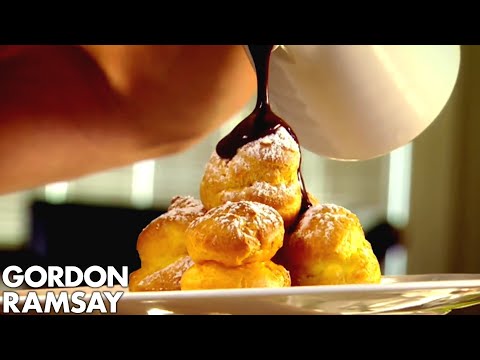
The reference video for this recipe. Clear demonstration of proper choux consistency, piping technique, and the tell-tale signs of a correctly baked puff.
2. Choux Pastry Fundamentals
Deep dive into the science of steam leavening and why choux behaves differently from every other pastry dough. Essential context if this is your first time working with the technique.
3. Chocolate Sauce TechniquesCovers ganache ratios, double boiler vs. microwave methods, and how to keep chocolate sauce pourable at serving temperature without seizing.
🛠️ Core Equipment
- Pastry bag with 1/2-inch round tip ↗Piping uniform mounds ensures even baking across the batch. Spoon-dropped puffs are irregular in size and some will underbake while others overbake in the same tray.
- Heavy-bottomed saucepan ↗Even heat distribution prevents the water-butter mixture from scorching before the butter fully melts. A thin pan creates hot spots that can partially cook the flour unevenly when it hits the liquid.
- Stand mixer or electric hand mixer ↗Whipping cream to stiff peaks by hand is technically possible and completely miserable. An electric mixer gets the job done in 2-3 minutes and gives you more control over the final consistency.
- Parchment-lined baking sheets ↗Choux sticks aggressively to unlined pans. Parchment also insulates the bottom of the puffs slightly, preventing over-browning on the base before the top has set.
Foolproof Profiteroles (The French Dessert You've Been Afraid to Make)
🛒 Ingredients
- ✦1 cup water
- ✦1/2 cup unsalted butter
- ✦1 cup all-purpose flour
- ✦4 large eggs, room temperature
- ✦1/4 teaspoon salt
- ✦1/4 teaspoon granulated sugar
- ✦2 cups heavy cream
- ✦1/2 cup whole milk
- ✦1/4 cup powdered sugar
- ✦2 teaspoons pure vanilla extract
- ✦6 ounces semi-sweet chocolate, chopped
- ✦1/4 cup unsalted butter (for chocolate sauce)
- ✦3 tablespoons light corn syrup
- ✦1/4 teaspoon sea salt for topping
👨🍳 Instructions
01Step 1
Heat water and butter together in a heavy-bottomed saucepan over medium-high heat until the butter melts completely and the mixture reaches a rolling boil, approximately 3-4 minutes.
02Step 2
Remove from heat and stir in all the flour, salt, and granulated sugar in one addition until a smooth dough ball forms and pulls away from the sides of the pan.
03Step 3
Return the saucepan to low heat and cook the dough, stirring constantly, for 1-2 minutes to evaporate excess moisture. The dough should leave a thin dry film on the bottom of the pan.
04Step 4
Transfer the dough to a mixing bowl and let it cool for 5 minutes. It should feel warm but not hot — around 140°F.
05Step 5
Beat in the eggs one at a time using a wooden spoon or stand mixer on medium speed, ensuring each egg is fully incorporated before adding the next. The finished dough should be smooth, glossy, and fall from a spoon in a thick ribbon.
06Step 6
Preheat oven to 400°F and line two baking sheets with parchment paper.
07Step 7
Transfer the choux dough to a pastry bag fitted with a 1/2-inch round tip. Pipe mounds approximately 1.5 inches in diameter, spaced 1 inch apart on the prepared baking sheets.
08Step 8
Bake for 25-30 minutes until deep golden brown and firm when lightly pressed. Do not open the oven before 20 minutes.
09Step 9
Transfer puffs to a wire rack and cool completely before filling. Rushing this step condenses steam inside the shells and makes them soggy.
10Step 10
Whip heavy cream, powdered sugar, and vanilla extract with an electric mixer on medium-high speed for 2-3 minutes until stiff peaks form.
11Step 11
Slice each cooled puff horizontally with a small serrated knife, creating a top and bottom.
12Step 12
Fill each puff bottom with approximately 1 tablespoon of whipped cream, then replace the top.
13Step 13
Combine chopped chocolate, butter, and corn syrup in a heat-safe bowl. Melt over a double boiler or microwave in 30-second intervals, stirring between each, until smooth.
14Step 14
Arrange the filled profiteroles on a serving platter and drizzle warm chocolate sauce generously over each puff.
15Step 15
Finish with a pinch of sea salt over the chocolate sauce. Serve immediately or refrigerate for up to 2 hours.
Nutrition Per Serving
Estimates based on standard preparation. Adjustments alter macros.
🔄 Substitutions
Instead of Heavy cream...
Use Greek yogurt mixed with whipped coconut cream
Slightly tangy flavor with creamy texture. Reduces saturated fat by roughly 40%. The coconut cream needs to be the solid portion from a refrigerated can — liquid coconut milk won't whip.
Instead of Semi-sweet chocolate...
Use 70% dark chocolate
More intense, less sweet. Reduces refined sugar by 25-30%. The sauce will be slightly thicker — add a tablespoon of warm cream if you want it more pourable.
Instead of Powdered sugar in cream filling...
Use Honey or monk fruit sweetener
Honey adds subtle floral notes and slight moisture; monk fruit has zero glycemic impact and zero aftertaste. Use 3 tablespoons honey or 2 tablespoons monk fruit per 2 cups cream.
Instead of All-purpose flour...
Use Whole wheat pastry flour with 1/4 cup almond flour
Nuttier flavor, slightly denser crumb, 3g more fiber per serving. The puffs won't rise quite as dramatically but still work. Avoid regular whole wheat flour — it's too heavy.
🧊 Storage & Reheating
In the Fridge
Unfilled puffs keep in an airtight container at room temperature for up to 2 days. Filled profiteroles must be refrigerated and eaten within 2 hours — the cream softens the shell rapidly.
In the Freezer
Unfilled, fully cooled puffs freeze well for up to 1 month in an airtight bag. Do not freeze filled profiteroles — the cream breaks and the shell turns to mush on thawing.
Reheating Rules
Re-crisp frozen or room-temperature unfilled puffs in a 350°F oven for 5 minutes. Cool for 2 minutes before filling. The chocolate sauce reheats well in 15-second microwave intervals — stir between each.
❓ Frequently Asked Questions
Why did my choux puffs collapse after coming out of the oven?
Almost always caused by underbaking or opening the oven too early. The puffs need to be fully set before any steam can escape — if the exterior is still soft, it can't hold the structure once the steam pressure drops. Bake until deep golden brown and firm to a light press, then crack the oven door for 5 minutes before removing to let the internal steam release gradually.
My choux dough is too runny to pipe. What happened?
You added all 4 eggs to dough that needed only 3.5. Egg quantity in choux is not a fixed number — it depends on how much moisture you evaporated in step 3 and ambient humidity. The dough should form a thick ribbon when lifted. If you've added too much egg, unfortunately there's no fix — start a fresh batch and stop adding eggs earlier.
Can I fill profiteroles with ice cream instead of whipped cream?
Yes, and it's arguably the more traditional French preparation. Fill them frozen and serve immediately with warm chocolate sauce. The temperature contrast between the cold ice cream and warm sauce is the point. Don't fill them ahead and let the ice cream melt — soggy shells are the result.
Why is my chocolate sauce grainy or seized?
Chocolate seizes when it comes into contact with even a small amount of water during melting. Make sure your bowl, spatula, and any equipment are completely dry. If the sauce seizes, add a tablespoon of warm heavy cream and stir vigorously — this usually rescues it.
Can I make profiteroles a day ahead for a dinner party?
You can bake the shells a day ahead and store them uncovered at room temperature. Make the chocolate sauce ahead and refrigerate it. Fill and assemble no more than 2 hours before serving. Fully assembled profiteroles stored overnight become soft and unpleasant.
What's the difference between profiteroles and cream puffs?
Mostly geography and filling. Profiteroles are the French version, classically filled with ice cream or crème pâtissière and topped with chocolate sauce. American cream puffs typically use whipped cream or pastry cream with powdered sugar on top. The choux dough is identical.
The Science of
Foolproof Profiteroles (The French Dessert You've Been Afraid to Make)
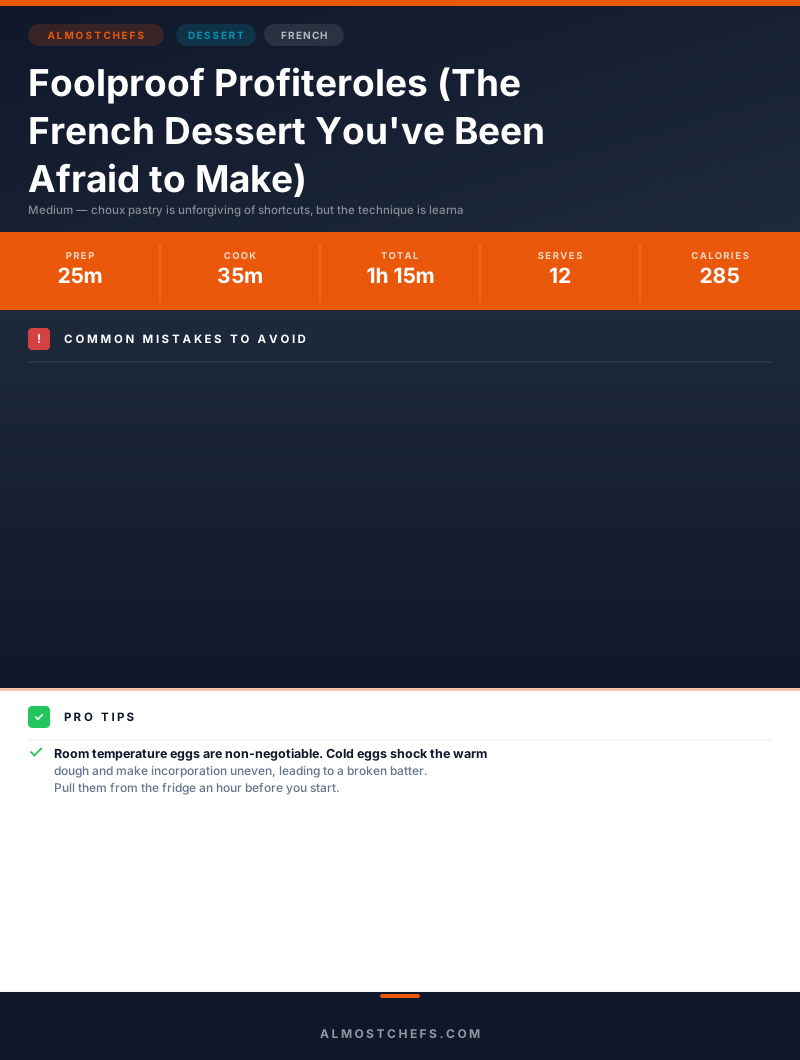
We turned everything on this page into a beautiful, flour-proof PDF cheat sheet. Print it out, stick it to your fridge, and never mess up your foolproof profiteroles (the french dessert you've been afraid to make) again.
*We'll email you the high-res PDF instantly. No spam, just perfectly cooked meals.
AlmostChefs Editorial Team
We translate the internet's most popular cooking videos into foolproof, beginner-friendly written recipes. We analyze multiple methods, test them in our kitchen, and engineer a single "Master Recipe" that gives you the best possible result with the least possible stress.