Foolproof Pavlova (The Meringue Secret Nobody Tells You)
A showstopping meringue dessert with a shattering crisp shell, marshmallow-soft interior, and billowing whipped cream piled with fresh berries. We broke down the most common failure points so you can nail it first try — no cracks, no weeping, no collapse.

“Pavlova looks intimidating because it's white, architectural, and fragile. It is none of those things in the kitchen — it's egg whites and sugar, and the only thing standing between you and a perfect one is understanding two rules: no fat touches the egg whites, and you never open the oven door. Every other pavlova failure traces back to violating one of those two laws.”
Why This Recipe Works
Pavlova is a study in controlled failure. The entire dessert is structurally fragile — a foam of air bubbles stabilized by protein, filled with sugar, dried into a shell — and almost every shortcut collapses that structure. Understanding why each step exists is the difference between a pavlova that shatters dramatically on the first spoon and one that deflates into a sticky puddle the moment it hits room temperature.
The Fat Problem
Egg whites are protein dissolved in water. When you beat them, you're forcing air bubbles into that protein solution, which then reorganizes itself into a mesh that traps those bubbles permanently. The entire structural integrity of the meringue depends on those protein bonds forming correctly.
Fat physically disrupts those bonds. It coats the protein molecules before they can link to each other. A single drop of egg yolk — roughly 30% fat by weight — in your bowl will prevent the whites from ever reaching stiff peaks, no matter how long you run the mixer. This is why you wipe the bowl with vinegar first, why you use glass or stainless steel (not plastic, which retains microscopic fat residue in surface scratches), and why you separate eggs individually over a small bowl rather than directly into the mixing bowl. One yolk break ruins the entire batch.
The Sugar Architecture
Sugar in pavlova is not just sweetener — it's structural. When dissolved into the protein foam, sugar molecules increase the viscosity of the liquid phase between bubbles, which slows drainage and makes the foam more stable. This is why you can leave a finished meringue sitting on the counter for hours and it holds its shape. Without sugar, the foam drains and collapses within minutes.
The dissolution step is critical. Undissolved sugar crystals remain hygroscopic — they actively pull moisture from the air and from the protein structure itself, which is what causes weeping after baking. The amber droplets you see on a weeping meringue are essentially liquefied sugar that never made it into stable solution. A stand mixer running on high for 8-10 minutes with gradual sugar addition is the only reliable way to fully dissolve caster sugar into the foam.
The Oven Geometry
Three hundred degrees Fahrenheit sounds low. It is low, deliberately. Pavlova is not baking in the conventional sense — it's drying. You want the outer shell to harden and dry while the interior remains soft and slightly underset. High heat drives moisture out too quickly, causing rapid steam expansion that cracks the shell and sets the interior rubbery rather than marshmallow-soft.
The cornstarch added to the batter plays a specific role here. It gelatinizes at around 180°F, creating a gel matrix in the interior that holds moisture in place rather than letting it evaporate. The result is that characteristic chewy, almost molten center that defines pavlova and distinguishes it from regular meringue. Skip the cornstarch and you get a meringue cookie, not a pavlova.
The white vinegar serves a different function: it stabilizes the protein network by slightly lowering the pH, which causes the egg white proteins to unfold and bond more readily. More bonds means a stronger, more elastic foam that holds its dome shape through baking and cooling.
The Cooling Protocol
The oven door stays closed during baking. After baking, it opens a crack. This is not arbitrary ceremony — it's controlled depressurization. The interior of a hot pavlova contains steam. If that steam escapes rapidly (door opens suddenly, pavlova moved to a cold surface), the meringue contracts faster than the rigid outer shell can accommodate, and it cracks or collapses. Leaving it in the oven with the door propped lets the temperature drop slowly over 30 minutes, allowing steam to escape gradually without structural shock.
Assembly as Last Act
The cream goes on at the last possible moment. Not an hour before. Not 30 minutes before. Immediately before the pavlova reaches the table. The porous sugar shell begins absorbing moisture from the cream the second they make contact, softening from the inside out. This is not a failure state — a slightly softened rim of meringue meeting cold cream is actually the best texture this dessert offers. But it evolves quickly. The difference between a pavlova assembled 5 minutes before serving and one assembled 45 minutes before is the difference between architecture and porridge.
Pile the berries high. Drizzle the honey in slow arcs. Bring it to the table whole so people see what it is before the first spoon breaks it open. The drama is the point.
Where Beginners Mess This Up
Before we start, read this. These are the 4 reasons your foolproof pavlova (the meringue secret nobody tells you) will fail:
- 1
Any trace of fat in the bowl or on the beaters: Egg whites are a foam structure held together by protein networks. A single drop of egg yolk — which is roughly 30% fat — physically prevents those proteins from linking up. The foam will never reach stiff peaks no matter how long you beat it. Wipe your bowl and beaters with white vinegar on a paper towel before you start. This is not optional.
- 2
Adding sugar too fast: Dumping all the caster sugar in at once collapses the foam structure before it has developed enough protein scaffolding to support the weight. Add it one tablespoon at a time over 8-10 minutes. The meringue should look glossy and dense, not frothy. When you rub a little between your fingers, you should feel zero graininess — any grit means undissolved sugar, which will weep liquid during baking.
- 3
Opening the oven door during baking: Pavlova sets through slow, even, dry heat. A sudden drop in oven temperature causes the steam inside the meringue to contract rapidly, cracking the shell and collapsing the interior. The door stays closed for the full 1 hour 15 minutes. After that, you turn the oven off and leave the pavlova inside to cool gradually.
- 4
Assembling too early: The meringue must be completely cool and at room temperature before any cream goes on top. Even faint warmth causes whipped cream to melt into liquid and soak into the crust. Assemble immediately before serving — not 30 minutes before, not an hour before. Immediately.
The Video Reference Library
Want to see it in action? Here are the exact videos we analyzed and combined to build this foolproof recipe translation:
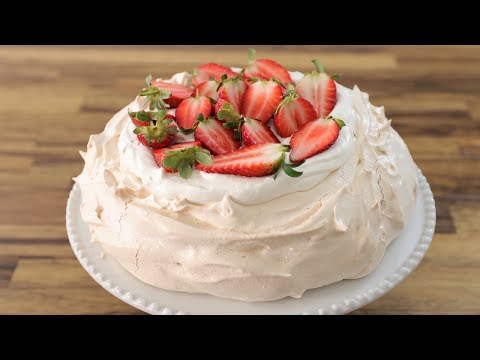
The primary reference for this recipe. Clear demonstration of the stiff peak test, the sugar addition cadence, and the slow oven-cooling technique that prevents cracks.
2. Why Your Meringue Weeps (and How to Fix It)
Deep dive into the science of meringue failure — undissolved sugar, humidity, fat contamination — with side-by-side comparisons of correct and incorrect texture at each stage.
3. Pavlova Variations and ToppingsExplores seasonal fruit combinations, flavored cream variations, and how to adapt the base recipe for individual mini pavlovas versus one large showpiece.
🛠️ Core Equipment
- Stand mixer or hand mixer with whisk attachment ↗Beating egg whites to stiff peaks by hand is technically possible and practically miserable. You need sustained high speed for 8-10 minutes. A stand mixer lets you add sugar with both hands while the machine runs.
- Spotlessly clean glass or stainless steel mixing bowl ↗Plastic bowls retain microscopic fat residue in surface scratches even after washing. Glass and stainless are non-porous. This directly determines whether your meringue succeeds or fails.
- Parchment paper ↗Pavlova will bond permanently to an unlined baking sheet. Parchment releases cleanly. Trace a circle on the underside of the parchment as a size guide — the ink won't touch the food.
- Instant-read thermometer (optional) ↗Oven temperatures lie. A 300°F setting on an aging oven can run 325°F or 275°F. Too hot and the outside browns and cracks before the inside sets. Too cool and the meringue never dries out. Know your oven.
Foolproof Pavlova (The Meringue Secret Nobody Tells You)
🛒 Ingredients
- ✦4 large egg whites, room temperature
- ✦1 cup superfine caster sugar
- ✦1 teaspoon cornstarch
- ✦1 teaspoon white vinegar
- ✦1 teaspoon vanilla extract
- ✦Pinch of salt
- ✦1 cup heavy whipping cream
- ✦2 tablespoons powdered sugar
- ✦1 teaspoon vanilla extract for cream
- ✦2 cups fresh strawberries, hulled and halved
- ✦1 cup fresh blueberries
- ✦1 cup fresh raspberries
- ✦2 tablespoons honey for drizzling
- ✦2 tablespoons fresh mint leaves, optional
👨🍳 Instructions
01Step 1
Preheat your oven to 300°F. Line a large baking sheet with parchment paper. Wipe your mixing bowl and whisk attachment with a paper towel dampened in white vinegar, then dry completely.
02Step 2
Begin beating the egg whites and pinch of salt on medium speed until soft peaks form, about 2-3 minutes. The foam should look white and opaque, holding a gentle curve when the beater is lifted.
03Step 3
With the mixer running, add the caster sugar one tablespoon at a time, waiting 20-30 seconds between additions. This should take 8-10 minutes total.
04Step 4
Remove the bowl from the mixer. Add the cornstarch, white vinegar, and vanilla extract. Fold in gently with a spatula using 8-10 deliberate strokes. Stop the moment everything is just combined.
05Step 5
Spoon the meringue onto the parchment in one large mound, or divide into four individual rounds. Use the back of a spoon to create a shallow well in the center — this is where the cream will sit.
06Step 6
Bake for 1 hour and 15 minutes. The exterior should be pale cream-colored and feel dry and crisp to a light touch. Do not open the oven door during baking.
07Step 7
Turn off the oven. Prop the door slightly open with a wooden spoon. Leave the pavlova inside for 30 minutes to cool gradually.
08Step 8
Transfer the pavlova to a serving platter and allow it to cool completely to room temperature before adding any toppings.
09Step 9
In a chilled bowl, whip the heavy cream on medium-high speed until soft peaks form. Fold in the powdered sugar and vanilla extract.
10Step 10
Immediately before serving, spread the whipped cream generously over the top of the pavlova, leaving a half-inch border at the edge.
11Step 11
Pile the strawberries, blueberries, and raspberries over the cream. Drizzle with honey and scatter mint leaves if using. Serve within 10 minutes.
Nutrition Per Serving
Estimates based on standard preparation. Adjustments alter macros.
🔄 Substitutions
Instead of Heavy whipping cream...
Use Greek yogurt mixed with a splash of honey
Tangier, less rich, and considerably more nutritious. Reduces saturated fat significantly. The texture difference is noticeable but not worse — just different. Good choice if the dessert needs to feel slightly less indulgent.
Instead of Superfine caster sugar...
Use Monk fruit sweetener or erythritol blend (1:1 ratio)
Nearly identical sweetness with zero calories. The meringue behaves almost identically — erythritol dissolves cleanly and holds stiff peaks. Some people detect a faint coolness on the palate. Best to test with your preferred brand first.
Instead of Four large egg whites...
Use Aquafaba — 3/4 cup liquid from canned chickpeas
The vegan solution that actually works. Aquafaba contains saponins and proteins that mimic egg white behavior under agitation. Expect slightly denser peaks and a marginally less dramatic rise. Beat for an extra 2-3 minutes beyond soft peaks before adding sugar.
Instead of Honey drizzle...
Use Pure maple syrup or fresh lemon juice
Maple adds subtle earthiness that pairs particularly well with blueberries. Lemon juice cuts the sweetness and brightens every element on the plate — one tablespoon is enough.
🧊 Storage & Reheating
In the Fridge
The untopped meringue base keeps at room temperature, uncovered, for up to 2 days in a dry environment. Once topped with cream and fruit, pavlova must be served immediately — it does not store.
In the Freezer
Not recommended. The meringue structure collapses on thawing and the texture becomes rubbery and wet.
Reheating Rules
Not applicable. Pavlova is a cold dessert. If the crust has softened, it cannot be crisped back up — assemble and serve fresh every time.
❓ Frequently Asked Questions
Why did my pavlova crack on top?
Cracking is almost always caused by one of two things: the oven temperature was too high, or the door was opened during baking. Both cause rapid temperature changes that make the meringue expand and contract unevenly. A 300°F oven and a closed door for the full bake time prevents this. Some surface cracking is also normal and purely cosmetic — it hides completely under cream and fruit.
Why is my meringue weeping liquid?
Weeping (also called syneresis) happens when sugar hasn't fully dissolved into the foam. You'll see amber droplets on the surface after baking. The fix: add sugar more slowly, beat longer after all sugar is added, and test by rubbing a small amount between your fingers — it should feel completely smooth, not gritty at all.
Can I make pavlova ahead of time?
The meringue base can be made up to 2 days ahead and stored at room temperature, uncovered, in a low-humidity environment. Do not refrigerate it — moisture softens the crust irreversibly. Add the cream and fruit immediately before serving, never before.
Why didn't my egg whites reach stiff peaks?
Fat contamination. Any trace of egg yolk, oil, or soap residue on the bowl or beaters prevents the protein networks from forming. Start over with a clean bowl wiped with white vinegar, freshly separated whites (check each one for yolk), and clean beaters.
What's the difference between pavlova and meringue?
Standard meringue is baked all the way through to a uniform crisp. Pavlova is intentionally underbaked in the center to create a soft, marshmallow-like interior beneath the crispy shell. The cornstarch and vinegar added to pavlova are what produce that characteristic chewy center — they're absent from traditional meringue.
Can I use regular granulated sugar instead of caster sugar?
You can, but it dissolves more slowly and incompletely. If using granulated sugar, pulse it in a food processor for 30 seconds to approximate the finer texture of caster sugar. Add it even more slowly than you would caster sugar, and extend your beating time by 2-3 minutes to ensure full dissolution.
The Science of
Foolproof Pavlova (The Meringue Secret Nobody Tells You)
We turned everything on this page into a beautiful, flour-proof PDF cheat sheet. Print it out, stick it to your fridge, and never mess up your foolproof pavlova (the meringue secret nobody tells you) again.
*We'll email you the high-res PDF instantly. No spam, just perfectly cooked meals.
AlmostChefs Editorial Team
We translate the internet's most popular cooking videos into foolproof, beginner-friendly written recipes. We analyze multiple methods, test them in our kitchen, and engineer a single "Master Recipe" that gives you the best possible result with the least possible stress.