Pasta with Eggs (The 15-Minute Technique That Actually Works)
A simple, silky Italian-style pasta coated in a rich egg sauce that clings to every strand without scrambling. We broke down the most-watched YouTube techniques to isolate the one variable that separates a glossy, cohesive sauce from a plate of chewy noodles and rubbery egg chunks.
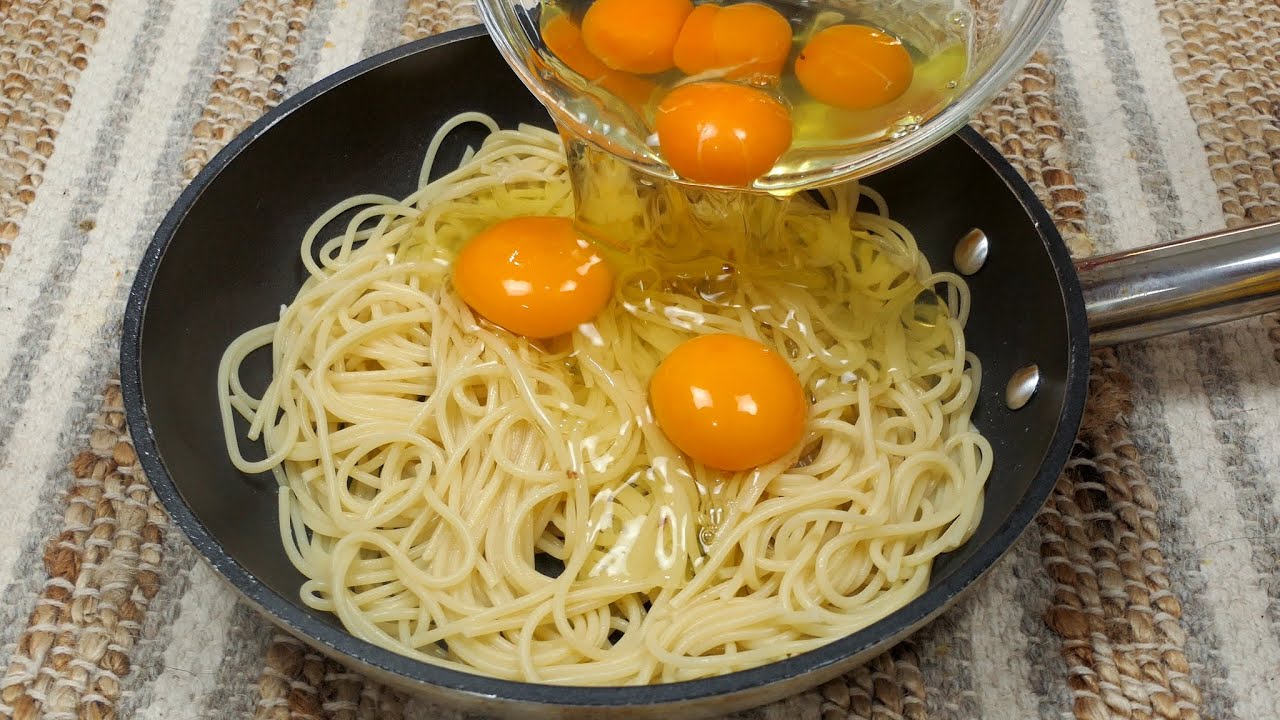
“Pasta with eggs sounds like a broke college student's fallback. It's not. Done correctly, it's one of the most technically elegant dishes in Italian cooking — a sauce built entirely from emulsification, residual heat, and timing. Done wrong, it's a bowl of clumped noodles with rubbery egg scrambled across the top. The margin between those two outcomes is about 45 seconds and one degree of temperature.”
Why This Recipe Works
Pasta with eggs is the dish that tells you everything you need to know about Italian cooking philosophy in a single skillet. There are no exotic ingredients. There is no long marinade, no braising time, no specialty equipment. There is only technique — and the gap between a cook who understands the technique and one who doesn't is the gap between a restaurant plate and a sad pile of noodles with chunks of cooked egg lodged between them.
The Emulsification Problem
Everything about this dish depends on one concept: emulsification. An emulsion is a stable mixture of two substances that don't naturally combine — in this case, fat (olive oil) and water (pasta water and egg white). The egg yolk contains lecithin, a natural emulsifier that bridges these two phases and holds them together into a unified sauce. When it works, the result is glossy, fluid, and clingy. When it fails — usually because the temperature was wrong — the proteins in the egg white cook too fast and you get solid chunks suspended in greasy water.
The fix is temperature management, and it's ruthless in its specificity. Eggs begin to set at around 145°F and are fully cooked by 160°F. Your pasta will come out of boiling water at 212°F. Your pan will be somewhere above 300°F. Both of these temperatures will destroy your sauce on contact. This is why you remove the pan from heat and wait. This is why you toss continuously — motion distributes the heat from the noodles and prevents any one spot on the egg from hitting the critical coagulation threshold while the rest is still liquid.
What Pasta Water Actually Does
Every recipe tells you to reserve pasta water. Almost no recipe explains why in sufficient depth to make you actually care. Here is the real explanation: as pasta cooks, it leaches surface starch into the boiling water. That starch-laden water acts as a natural thickener and emulsifier when added to the egg and oil mixture in the pan. It gives the sauce body without heaviness, loosens it without making it watery, and helps it cling to the noodles rather than pooling at the bottom of the bowl.
One cup reserved is your insurance policy. You will likely only use three to six tablespoons, but having the excess means you can adjust on the fly. Add too little pasta water and the sauce tightens into a dry paste on the noodles. Add too much and it goes thin and soupy. Add it incrementally — tablespoon by tablespoon, tossing between additions — and you can dial in the consistency with precision rather than luck.
The Role of the Cheese
Pecorino Romano or Parmigiano-Reggiano are not interchangeable with pre-shredded supermarket blends, and this is not snobbery. Pre-shredded cheeses contain cellulose — an anti-caking agent — that prevents the cheese from melting smoothly into the sauce. Instead of dissolving and binding with the egg, it sits in gritty particles that never fully incorporate. A Microplane or fine grater produces feather-light shavings that melt on contact with the warm noodles, becoming indistinguishable from the sauce itself. The difference is visible, textural, and immediate.
The cheese also contributes salt, umami, and structural protein. Mixed with the egg before it hits the pan, the cheese proteins begin their own emulsification process, pre-loading the sauce with flavor compounds that distribute evenly once heat is applied. Finely grated cheese is not a finishing garnish in this dish — it is a functional ingredient in the sauce architecture.
Why Pasta Shape Is a Technical Decision
Long, thin pasta — spaghetti, linguine, tonnarelli — is not traditional here by accident. These formats have a high surface-area-to-volume ratio, which maximizes the contact between noodle and sauce. They also flex easily during tossing, which is the mechanical action that drives emulsification in the pan. Tubular pastas like rigatoni trap sauce in their interior and present a different emulsification challenge: the sauce pools inside the tube and can't be continuously redistributed the same way. For a first attempt at this technique, use a large heavy-bottomed skillet and the longest, thinnest pasta you have. Master the movement, then adapt to other formats.
This is a fifteen-minute dinner. The technique takes ten seconds to learn and a few attempts to execute reliably. Once it locks in, you will never look at eggs in a different way again.
Where Beginners Mess This Up
Before we start, read this. These are the 4 reasons your pasta with eggs (the 15-minute technique that actually works) will fail:
- 1
Adding eggs to a pan that's too hot: Eggs set at around 160°F. If your pan is still on active heat when you add the egg mixture, you get scrambled eggs — not sauce. The pan must be off the heat, and the pasta must be tossed immediately and continuously so the residual warmth from the noodles gently cooks the egg into a clinging emulsion rather than solid curds.
- 2
Not reserving enough pasta water: Pasta water is the binding agent. Its starchy, salted content allows the egg to loosen and coat without breaking. If you add too little, the sauce seizes into a dry paste. If you drain all of it before thinking about the sauce, the dish is already compromised. Reserve at least a full cup — you'll likely only use a few tablespoons, but you need the buffer.
- 3
Using cold eggs straight from the fridge: Cold eggs shock the pan and drop the surface temperature unevenly, making it harder to achieve a smooth emulsion. Bring your eggs to room temperature for 15-20 minutes before cooking. This alone dramatically improves sauce consistency.
- 4
Under-seasoning the pasta water: The pasta itself should taste seasoned before the sauce ever touches it. Under-salted noodles taste flat regardless of what you put on top. The water should taste like mild seawater — most cooks use far less salt than they should.
The Video Reference Library
Want to see it in action? Here are the exact videos we analyzed and combined to build this foolproof recipe translation:
The source video for this technique — clean close-ups of the emulsification process and the exact moment to pull the pan off heat. The demonstration of proper pasta water addition is the clearest version available.
A detailed breakdown of why pasta water starch matters for sauce adhesion, with side-by-side comparison of properly emulsified egg sauce versus scrambled. Useful for understanding the chemistry before your first attempt.
Covers the broader principle of building sauce from eggs and pasta water across multiple dish variations. Good context for adapting this technique once you've mastered the base recipe.
🛠️ Core Equipment
- Large heavy-bottomed skillet or sauté panRetains heat evenly and cools slowly once removed from the burner — critical for the off-heat emulsification step. A thin pan drops temperature too fast and stalls the sauce before it coats.
- Pasta pot with high sidesYou need enough water volume to cook the pasta properly and generate starchy pasta water. Underfilling produces overly starchy cooking water that turns the sauce gluey instead of silky.
- Microplane or fine graterFinely grated hard cheese melts instantly into the egg mixture. Pre-shredded cheese contains anti-caking agents that resist emulsification and leave grainy texture in the finished sauce.
- Tongs or pasta forkContinuous tossing is the entire technique. You need something that grips the noodles and keeps them moving through the sauce without stopping.
Pasta with Eggs (The 15-Minute Technique That Actually Works)
🛒 Ingredients
- ✦200g dried spaghetti or linguine
- ✦3 large eggs, room temperature
- ✦1 egg yolk, room temperature
- ✦60g Pecorino Romano or Parmigiano-Reggiano, finely grated, plus more for serving
- ✦3 cloves garlic, thinly sliced
- ✦2 tablespoons extra virgin olive oil
- ✦1/2 teaspoon freshly cracked black pepper, plus more to taste
- ✦1/4 teaspoon red pepper flakes (optional)
- ✦Kosher salt, for pasta water
- ✦2 tablespoons flat-leaf parsley, finely chopped (optional)
👨🍳 Instructions
01Step 1
Bring a large pot of water to a rolling boil. Salt it aggressively — the water should taste faintly of the sea. Cook the pasta according to package directions until just al dente.
02Step 2
While the pasta cooks, whisk together the whole eggs, egg yolk, and grated cheese in a bowl until fully combined. Season with cracked black pepper. Set aside.
03Step 3
Reserve at least 1 cup of pasta water before draining. Drain the pasta and set aside.
04Step 4
Heat olive oil in a large skillet over medium heat. Add the sliced garlic and cook for 2-3 minutes until golden and fragrant, pressing lightly with a spatula. Add red pepper flakes if using.
05Step 5
Remove the pan completely from the heat. Add the drained pasta directly to the pan and toss to coat in the garlic oil.
06Step 6
Wait 20 seconds for the pan to cool slightly. Then pour the egg and cheese mixture over the pasta. Toss continuously with tongs, keeping the pasta in constant motion.
07Step 7
Add pasta water one tablespoon at a time, tossing between additions, until the sauce reaches a loose, creamy consistency that coats each strand. You may need 3-6 tablespoons total.
08Step 8
Taste and adjust salt. Divide between two warmed bowls immediately.
09Step 9
Finish with extra grated cheese, a heavy grind of black pepper, and parsley if using. Serve at once — this dish waits for no one.
Nutrition Per Serving
Estimates based on standard preparation. Adjustments alter macros.
🔄 Substitutions
Instead of Pecorino Romano...
Use Parmigiano-Reggiano
Milder and less salty. Works well but produces a slightly less assertive sauce. Avoid pre-grated — it contains cellulose that prevents proper melting.
Instead of Spaghetti...
Use Bucatini or linguine
Bucatini's hollow center traps sauce inside as well as outside, which is genuinely great. Linguine is the safest swap — same technique, same timing.
Instead of Extra virgin olive oil...
Use Unsalted butter
Adds richness and changes the flavor profile toward French rather than Italian. Still produces a silky emulsion. Use 1.5 tablespoons — butter carries more fat than oil at the same volume.
Instead of Garlic...
Use Shallots
Sweeter and less pungent. Slice thinly and cook slightly longer — 3-4 minutes. Produces a more delicate flavor that lets the egg and cheese dominate.
🧊 Storage & Reheating
In the Fridge
Store leftovers in an airtight container for up to 2 days. The sauce will firm significantly as it chills.
In the Freezer
Not recommended. Egg-based sauces break upon freezing and thawing, producing a grainy, separated result.
Reheating Rules
Add the cold pasta to a pan over low heat with a splash of water. Toss gently until just warmed through — do not use high heat or the eggs will scramble again. Microwave reheating turns the eggs rubbery.
❓ Frequently Asked Questions
Why did my eggs scramble instead of making a sauce?
The pan was too hot when you added the egg mixture. Remove the skillet from heat entirely and wait 20 seconds before adding the eggs. Then toss continuously — motion is what prevents curdling. If you see it starting to seize, immediately add a tablespoon of cold pasta water and keep moving.
Do I need to use pasta water or can I just use regular water?
Pasta water is meaningfully different. The starch released by the pasta during cooking acts as an emulsifier — it binds the fat from the oil and the protein from the eggs into a cohesive sauce. Plain water lacks this starch and produces a thinner, less adhesive result.
Can I add meat to this dish?
Pancetta or guanciale are the traditional additions — render them first in the olive oil before the garlic step, then proceed as written. The rendered fat replaces some of the olive oil. Bacon works as a substitute but adds smokiness that changes the flavor profile considerably.
Why does my sauce taste flat even though I used good cheese?
Almost certainly under-salted pasta water. The noodles themselves need to carry seasoning — cheese and salt in the sauce cannot retroactively season bland pasta. Salt the water until it tastes like mild seawater, not like a faint memory of salt.
Can I make this without cheese?
Technically yes, but the cheese serves two functions: flavor and emulsification. Without it, the sauce will be looser and less stable. If you need a dairy-free version, finely ground cashews blended with nutritional yeast approximate the texture and some of the savory depth.
How do I know when the sauce is done?
The sauce is ready when it coats the back of a spoon and the noodles look glossy rather than wet. It should flow slightly when you tilt the pan — not set solid, not runny. This happens fast, usually within 60-90 seconds of continuous tossing.

The Science of
Pasta with Eggs (The 15-Minute Technique That Actually Works)
We turned everything on this page into a beautiful, flour-proof PDF cheat sheet. Print it out, stick it to your fridge, and never mess up your pasta with eggs (the 15-minute technique that actually works) again.
*We'll email you the high-res PDF instantly. No spam, just perfectly cooked meals.
AlmostChefs Editorial Team
We translate the internet's most popular cooking videos into foolproof, beginner-friendly written recipes. We analyze multiple methods, test them in our kitchen, and engineer a single "Master Recipe" that gives you the best possible result with the least possible stress.