Copycat Panera Bread Bowl (Better Than the Original)
A crispy, golden-brown edible vessel made from a whole wheat–blended dough, baked hollow with a crunchy exterior and pillowy interior. We analyzed the most popular YouTube methods and Panera's own technique to build one foolproof shaping method that holds soup without going soggy.

“Most homemade bread bowls fail the same way: they collapse under the soup, turn into a gummy mess, or bake up too thick to be useful. The difference between a structural bread bowl and a decorative disappointment comes down to two things — how far you let the dough rise, and how you shape the bowl before it goes in the oven. We tested the method until the crust stayed crisp through a full serving of broccoli cheddar.”
Why This Recipe Works
Panera's bread bowl has a design problem that most copycat recipes ignore: it has to be edible architecture. The bowl is not just bread. It is a structural vessel that must hold a full serving of hot, wet soup without collapsing, softening, or leaking — and then get eaten. That engineering requirement changes every decision in the recipe.
The Flour Ratio
Pure all-purpose flour produces a softer, more uniform crumb. That sounds desirable until you fill the bowl and the walls compress under the weight and moisture of the soup. Introducing 25% whole wheat flour adds gluten-building bran proteins and a denser cell structure to the crumb, which resists compression better. The bowl walls stay upright longer after filling.
The trade-off is handling. Whole wheat doughs are tackier and less elastic than white flour doughs. First-time bakers tend to overcompensate by adding flour until the dough feels "normal," which tightens the gluten structure and produces a brick instead of a bread bowl. Trust the hydration in this recipe. A slightly sticky dough is correct.
The Fat Combination
This recipe uses both butter and olive oil, and the distinction matters. Butter contributes flavor and aids crust browning via the Maillard reaction — it contains milk solids that brown at high heat, producing that deep golden color Panera is known for. Olive oil contributes to crumb tenderness and extends the bread's shelf life by coating gluten strands with fat. Together they produce a richer result than either does alone, while keeping saturated fat below the original.
A stand mixer with a dough hook handles the slightly stiffer whole wheat blend better than hand kneading, but neither is mandatory. The gluten development window is the same — it's just easier to judge by feel when you're not the one doing the kneading.
The Shaping Logic
The oval depression pressed into each dough disc before baking is not just cosmetic. It creates a thinner zone in the center of the disc that bakes through fully, producing a dry, firm base. The uncompressed border — that 1-inch ring you leave untouched — rises dramatically in the oven through a process called oven spring, forming natural walls without any manual construction.
The cornmeal dusting on the baking sheet is structural, not flavoring. It creates tiny air pockets between the bottom of the dough and the pan surface, preventing the base from steaming against the hot metal. Steam from beneath makes the bottom crust soft and gummy — the opposite of what you need when the bowl is going to hold liquid.
The Egg Wash Function
Egg wash is a protein-rich liquid that, when exposed to high oven heat, denatures and sets into a rigid, lacquered film over the entire surface. This film is what gives the bread bowl its signature crackle and — critically — its moisture barrier. Without it, the crust stays permeable. Hot soup sitting against uncoated bread turns the walls limp within three minutes.
The inside of the bowl depression needs egg wash just as much as the exterior. Most recipes forget this. The exterior crust protects against ambient moisture; the interior coating is what protects against direct liquid contact from the soup itself.
The Temperature Hold
Cooling bread completely before filling is not patience theater. As the loaf cools, the internal structure sets — the crumb firms up, moisture redistributes from the center toward the exterior, and the crust fully dries. A bowl filled while still warm is a bowl with walls that are 15% higher in moisture content than a cooled bowl, which means they absorb soup faster and lose structural integrity sooner.
Ten minutes of waiting buys you ten additional minutes of usable bowl. That is the entire meal.
Where Beginners Mess This Up
Before we start, read this. These are the 4 reasons your copycat panera bread bowl (better than the original) will fail:
- 1
Under-proofing the dough: If the dough hasn't fully doubled in size before shaping, the interior won't have developed enough structure to support a hollow center. You'll end up with a dense, bready wall that soaks through within minutes. Give it the full 1 to 1.5 hours in a genuinely warm spot — not a lukewarm counter.
- 2
Pressing the bowl shape too deep: The instinct is to press down hard to create maximum interior volume. The problem: thinning the base below about half an inch means the bottom tears when you fill it. Press gently, leave a full 1-inch border, and let the oven do the hollowing work through oven spring.
- 3
Skipping the egg wash: The egg wash is not decorative. It creates the lacquered, crackly crust that gives the bowl structural integrity. Without it, the exterior stays matte and soft — it will absorb soup immediately. Coat every surface, including the inside of the bowl depression.
- 4
Cutting too soon: Pulling the bowls off the sheet while hot causes the crust to steam itself soft from the inside. Five minutes on the sheet, then transfer to a wire rack. The carryover heat finishes the crust. If you fill them while still warm, the steam trapped inside turns the walls limp.
The Video Reference Library
Want to see it in action? Here are the exact videos we analyzed and combined to build this foolproof recipe translation:
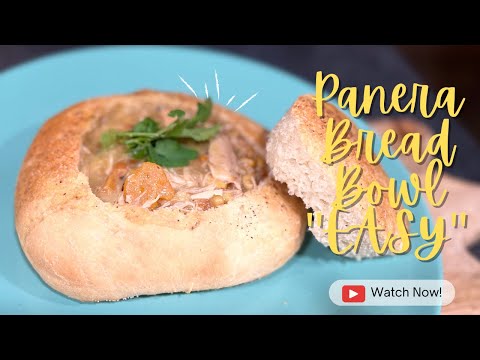
The source video for this recipe. Covers dough consistency, shaping technique, and the baking window that produces the signature Panera crust-to-crumb ratio.
2. Homemade Bread Bowl Technique
A detailed walkthrough of the shaping and pressing method, with close-ups of correct dough depth and egg wash coverage.
3. Whole Wheat Bread Baking FundamentalsCovers how whole wheat flour behaves differently from all-purpose in enriched doughs — essential context for understanding why this blend works.
🛠️ Core Equipment
- Stand mixer with dough hook ↗Develops gluten thoroughly in 5-6 minutes versus 8-10 by hand. The whole wheat flour in this blend is less elastic than all-purpose, so consistent mechanical kneading produces a more even, strong dough structure.
- Heavy baking sheet ↗Thin baking sheets warp at 425°F and create uneven bottom browning. A heavy rimmed sheet keeps the base flat and distributes heat evenly so the crust sets before the interior overbakes.
- Wire cooling rack ↗Allows air circulation under the bowl as it cools. Leaving the bowls on the baking sheet traps steam under the base, softening the very crust you just worked to build.
- Pastry brush ↗For applying the egg wash evenly, including the recessed interior. Finger-coating leaves uneven patches that bake inconsistently.
Copycat Panera Bread Bowl (Better Than the Original)
🛒 Ingredients
- ✦3 cups all-purpose flour
- ✦1 cup whole wheat flour
- ✦2 teaspoons instant yeast
- ✦1.5 teaspoons salt
- ✦1.5 tablespoons sugar
- ✦2 tablespoons unsalted butter, melted
- ✦1 tablespoon extra virgin olive oil
- ✦1.25 cups warm water (100–110°F)
- ✦1 egg yolk beaten with 1 tablespoon water, for egg wash
- ✦1 teaspoon cornmeal, for dusting
- ✦1 teaspoon Italian seasoning
- ✦0.5 teaspoon garlic powder
👨🍳 Instructions
01Step 1
In a large mixing bowl, whisk together the all-purpose flour, whole wheat flour, instant yeast, salt, and sugar until evenly combined.
02Step 2
Add the melted butter, olive oil, and warm water to the dry ingredients. Mix until a shaggy dough forms.
03Step 3
Knead for 8–10 minutes by hand on a lightly floured surface, or 5–6 minutes in a stand mixer on medium speed with the dough hook, until the dough is smooth, elastic, and pulls cleanly from the sides of the bowl.
04Step 4
Shape the dough into a ball and place in a lightly oiled bowl. Cover with plastic wrap or a damp kitchen towel and let rise in a warm place for 1 to 1.5 hours until doubled in size.
05Step 5
Preheat the oven to 425°F. Line a heavy baking sheet with parchment paper and dust with cornmeal.
06Step 6
Punch down the risen dough to release gas, then divide into 4 equal portions. Roll each into a tight, smooth ball by cupping your hand over the dough and using circular pressure against the work surface.
07Step 7
Flatten one dough ball into a 6-inch disc. Place on the prepared baking sheet. Using your fingertips or the bottom of a measuring cup, gently press an indentation into the center, creating a shallow bowl shape with a 1-inch border of uncompressed dough around the entire edge.
08Step 8
Repeat with the remaining dough balls, spacing them at least 3 inches apart on the sheet.
09Step 9
Brush the entire surface of each bowl — including the inside of the depression — with the egg wash. Apply a thorough, even coat.
10Step 10
Sprinkle Italian seasoning and garlic powder over the tops if using.
11Step 11
Bake for 18–22 minutes until deep golden brown and the edges are visibly crisp, rotating the baking sheet 180 degrees at the halfway point.
12Step 12
Remove from oven and let cool on the baking sheet for 5 minutes, then transfer to a wire rack to cool completely before filling.
13Step 13
If the interior still has some doughy crumb after cooling, hollow it out gently with a small spoon to create more space for your filling.
Nutrition Per Serving
Estimates based on standard preparation. Adjustments alter macros.
🔄 Substitutions
Instead of All-purpose flour (portion)...
Use 75% all-purpose, 25% whole wheat (this recipe's default)
If you want a lighter crumb closer to Panera's original white bread bowl, use 100% all-purpose. The bowl will be less chewy and have less fiber but will be more structurally neutral-flavored.
Instead of Butter...
Use All olive oil (3 tablespoons total)
Dairy-free alternative. The crust will be slightly less rich but still achieves good browning. Adds a subtle savory note.
Instead of Egg wash...
Use Whole milk or oat milk brushed on top
Produces a softer, less glossy crust. The bowl will still brown, but won't achieve the same lacquered crunch. A cornstarch-water slurry (1 tsp cornstarch to 2 tbsp water) is a closer vegan approximation.
Instead of Instant yeast...
Use Active dry yeast (same quantity)
Active dry yeast needs to bloom in warm water with a pinch of sugar for 5–10 minutes before adding to the flour. Skip this step and you may end up with a dough that doesn't rise.
🧊 Storage & Reheating
In the Fridge
Store unfilled bread bowls in an airtight bag for up to 2 days. They will soften — re-crisp in a 350°F oven for 5 minutes before filling.
In the Freezer
Freeze fully baked, cooled, unfilled bowls for up to 1 month. Wrap individually in plastic wrap, then foil. Thaw at room temperature and warm in a 350°F oven for 8–10 minutes.
Reheating Rules
Do not microwave — it destroys the crust entirely. Oven-only at 350°F, uncovered, for 5–8 minutes. Fill immediately after reheating.
❓ Frequently Asked Questions
Why did my bread bowl collapse when I added soup?
Two likely causes: the walls were pressed too thin during shaping (less than half an inch), or the bowl was filled while still warm. Warm bread walls are soft and absorb liquid immediately. Cool the bowls completely on a wire rack before filling.
Can I make these without a stand mixer?
Yes. Hand kneading works — it just takes 8–10 minutes of sustained effort instead of 5–6 in a machine. The dough is ready when it's smooth, springs back when poked, and passes the windowpane test: stretch a small piece thin enough to see light through without it tearing.
How do I get a crispier crust?
Three levers: egg wash coverage (get every surface), oven temperature (425°F is the floor, not the ceiling — 450°F works if your oven runs cool), and steam in the first 10 minutes (pan of hot water on the bottom rack). All three together produce a crust that stays crisp for 20+ minutes after filling.
Can I use this dough for regular bread or rolls?
Yes. This is a standard enriched dough. Skip the shaping step and bake as a standard boule at 400°F for 25–30 minutes, or divide into 8 portions for dinner rolls at 375°F for 15–18 minutes.
Why does my dough feel sticky after kneading?
The whole wheat flour and olive oil combination makes this dough tackier than all-white-flour doughs. Resist adding more flour — doing so tightens the gluten structure and makes the bread dense. A dough scraper is more useful here than more flour.
What soups work best in bread bowls?
Thick, creamy soups hold up best — broccoli cheddar, clam chowder, tomato bisque, potato soup. Thin broth-based soups soak through the walls too quickly. The rule: if the soup can coat the back of a spoon, it can go in a bread bowl.
The Science of
Copycat Panera Bread Bowl (Better Than the Original)
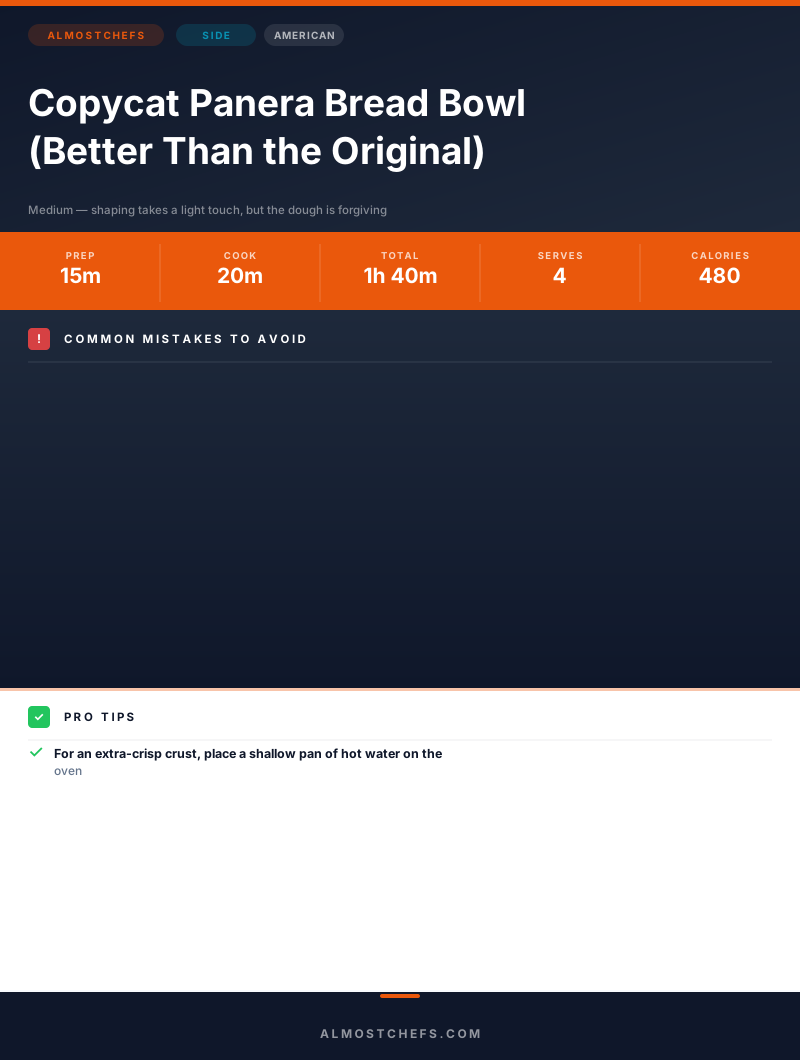
We turned everything on this page into a beautiful, flour-proof PDF cheat sheet. Print it out, stick it to your fridge, and never mess up your copycat panera bread bowl (better than the original) again.
*We'll email you the high-res PDF instantly. No spam, just perfectly cooked meals.
AlmostChefs Editorial Team
We translate the internet's most popular cooking videos into foolproof, beginner-friendly written recipes. We analyze multiple methods, test them in our kitchen, and engineer a single "Master Recipe" that gives you the best possible result with the least possible stress.