Oi Sobagi (The Stuffed Cucumber Kimchi That Outshines the Rest)
Crisp Korean white cucumbers packed with garlic chives, radish, and a spicy gochugaru yangnyeom — then left to ferment into a punchy, probiotic-rich banchan. We broke down the traditional technique to nail the brine timing and stuffing ratio every time.

“Most cucumber kimchi recipes tell you to just salt and stuff. What they skip is why the salt concentration matters, why the flour paste exists in the yangnyeom, and why the cucumber variety you choose determines whether your oi sobagi is crunchy for three days or turns limp by tomorrow. We pulled apart the traditional method to explain every step so you can execute it with confidence, not guesswork.”
Why This Recipe Works
Oi sobagi is not kimchi's simpler cousin. It's a precision fermentation exercise in a smaller package — and the technique failures are faster, less forgiving, and more irreversible than anything you'll encounter making cabbage kimchi. The cucumber gives you a narrow window of correct brine time, a specific stuffing density requirement, and a fermentation timeline measured in hours rather than days. Understand why each step exists and you'll execute it cleanly every time.
The Salt Problem
Most kimchi recipes tell you to use "Korean sea salt" without explaining that not all sea salt is equivalent. Bittern (간수) is the magnesium-rich liquid remaining after sodium chloride crystallizes from seawater. Unprocessed sea salt retains bittern, which contributes bitterness and can interfere with lactobacillus fermentation. Properly processed sun-dried salt (천일염) has had the bittern pressed out — it's the standard across Korean kimchi production for a reason.
The concentration ratio matters too. Five tablespoons to one liter produces an approximately 6% salt solution, which is calibrated for thin-skinned baek-oi cucumbers. This concentration draws enough moisture out of the cucumber cells to make them pliable for stuffing without collapsing their structure. More salt accelerates cell damage. Less salt produces cucumbers that crack when you try to stuff them.
The Flour Paste Architecture
The yangnyeom in oi sobagi contains an ingredient that confuses first-time makers: flour paste. It looks wrong. It feels wrong. It's not wrong.
A fine-mesh sieve or small saucepan is all you need to cook the paste — one tablespoon of flour in 200ml of water, stirred over medium heat until it thickens and clears. What you've made is a low-concentration starch gel that acts as a film-forming binder. When mixed with gochugaru, saeujeot, and fish sauce, it creates a paste with physical cohesion — it sticks to wet cucumber flesh and coats every strand of buchu uniformly. Without it, the fat-soluble capsaicin compounds in the gochugaru separate from the water-based liquid during fermentation. You end up with a two-phase system: oily red liquid pooling at the bottom of the container and under-seasoned vegetables sitting on top.
The Stuffing Ratio
The buchu-to-radish ratio is 200g to 150g — roughly 4:3 by weight. This isn't arbitrary. Buchu (garlic chives) is delicate, collapses quickly during fermentation, and contributes the primary aromatic note. Radish is structural — it maintains crunch, adds body, and ferments more slowly than the chives. Together, they create a filling that starts firm, seasons evenly, and doesn't turn to mush within the first 48 hours.
The onion is a minor player here — a quarter of one onion spread across ten cucumbers — but its sulfur compounds contribute to fermentation activity and round out the gochugaru's heat. Don't skip it, but don't scale it up thinking more is better. Too much onion dominates the filling and the flavor becomes sharp rather than complex.
Fermentation Physics
Oi sobagi ferments by the same mechanism as all kimchi: lactobacillus bacteria, already present on the vegetable surfaces, consume sugars and produce lactic acid, which lowers pH and creates the characteristic sour fermented flavor. The difference from cabbage kimchi is speed. Cucumbers have higher water content and thinner cell walls, which means bacterial activity proceeds rapidly and the acceptable fermentation window is dramatically shorter.
At room temperature in summer, four hours may bring you to peak. In winter, you may need eight. The only reliable test is tasting: the filling should smell sharp and pleasantly funky, the cucumber should still have snap, and the overall flavor should be balanced between spicy, salty, and sour. If it smells aggressively acidic, you've passed peak. Refrigerate immediately and consume within a day.
An airtight container is non-negotiable. Oxygen exposure encourages yeast and mold growth over lactobacillus. The good bacteria thrive in anaerobic conditions — sealed tight, cold or room temperature, undisturbed. Pack the stuffed cucumbers snugly so they're not floating in air, and press a piece of plastic wrap directly against the surface before sealing the lid if there's significant headspace.
This is a dish that rewards the people who understand its constraints. Respect the brine timing. Cool the paste before mixing. Pack the stuffing with intent. Then walk away and let the bacteria do the rest.
Where Beginners Mess This Up
Before we start, read this. These are the 4 reasons your oi sobagi (the stuffed cucumber kimchi that outshines the rest) will fail:
- 1
Using the wrong salt — or the wrong concentration: Bittern-free sun-dried salt (간수 뺀 천일염) draws moisture out of cucumber cells without making them taste bitter or chemically sharp. Table salt and regular sea salt contain additives and impurities that interfere with fermentation and leave a metallic edge. The 5 tablespoons to 1 liter ratio is calibrated for baek-oi cucumbers — too little salt and the cucumbers stay flaccid; too much and they brine into mush.
- 2
Over-brining the cucumbers: Baek-oi are thin-skinned with high water content. They reach the correct flexibility — pliable enough to stuff without cracking, firm enough to provide crunch — in about 30-45 minutes in the brine. Leave them longer and the cell walls collapse completely. You cannot reverse an over-brined cucumber. Set a timer.
- 3
Skipping the flour paste in the yangnyeom: The flour paste (밀가루 풀) is not filler. It acts as a binder that holds the gochugaru seasoning paste against the cucumber flesh and the stuffing vegetables. Without it, the paste slides off during fermentation and you get naked cucumbers sitting in a pool of liquid instead of evenly seasoned kimchi.
- 4
Under-packing the stuffing: Each cucumber cavity needs to be packed firmly. Air pockets in the stuffing create uneven fermentation — some sections develop flavor faster, others stay raw-tasting. Press the filling in with your fingers until there's no give. The buchu, radish, and onion should be dense and uniform from end to end.
The Video Reference Library
Want to see it in action? Here are the exact videos we analyzed and combined to build this foolproof recipe translation:

🛠️ Core Equipment
- Large mixing bowlFor the brine and for tossing the stuffing vegetables with yangnyeom. Wide enough to coat every strand of buchu and radish without compressing them.
- Sharp knife and cutting boardPrecision matters here. The radish needs uniform matchsticks so it ferments evenly with the buchu. Uneven cuts mean some pieces turn soft while others stay raw.
- Airtight fermentation containerGlass or food-grade plastic containers with tight lids allow controlled anaerobic fermentation. Wide-mouth containers make packing the stuffed cucumbers much easier without breaking them.
- Food-safe glovesGochugaru stains and the saeujeot has a strong, persistent odor. Gloves let you mix the yangnyeom and stuff the cucumbers by hand without regret.
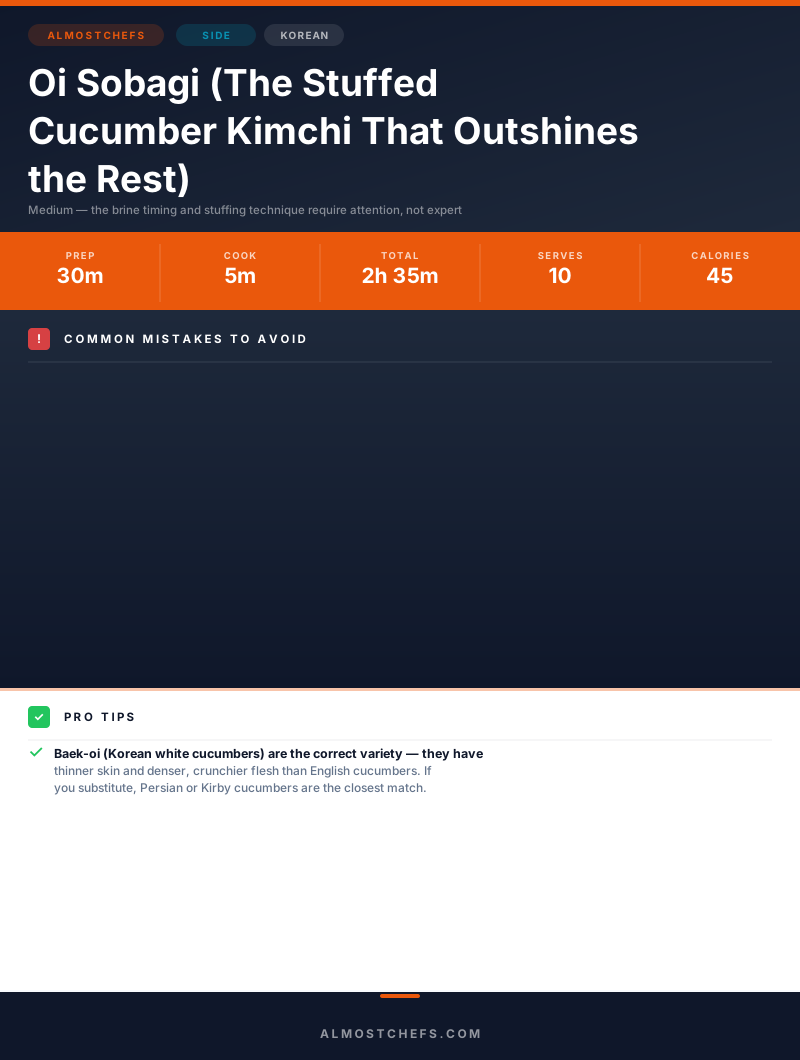
Oi Sobagi (The Stuffed Cucumber Kimchi That Outshines the Rest)
🛒 Ingredients
- ✦10 baek-oi (백오이, Korean white cucumbers)
- ✦200g buchu (부추, garlic chives), cut into bite-sized pieces
- ✦150g mu (무, Korean radish), cut into matchsticks
- ✦1/4 yangpa (양파, onion), thinly sliced
- ✦5 tablespoons cheonillyeom (천일염, sun-dried salt), bittern removed
- ✦1 liter water, for brining
- ✦1 cup flour paste (밀가루 풀) — 1 tablespoon flour cooked with 200ml water
- ✦8 tablespoons gochugaru (고추가루, Korean red pepper flakes)
- ✦2 tablespoons saeujeot (새우젓, salted fermented shrimp)
- ✦2 tablespoons kkanari or myeolchi aekjeot (까나리/멸치액젓, anchovy fish sauce)
- ✦2 tablespoons white sugar (백설탕)
- ✦3 tablespoons minced garlic (간마늘)
- ✦1 teaspoon minced ginger (간생강)
👨🍳 Instructions
01Step 1
Dissolve 5 tablespoons of bittern-free sun-dried salt in 1 liter of water to make the brine.
02Step 2
Score each cucumber: cut a cross slit lengthwise down the center, stopping about 1.5cm from each end. The cucumber should open like a book but stay connected at both ends.
03Step 3
Submerge the scored cucumbers in the brine. Weigh them down with a plate if they float. Brine for 30-45 minutes until pliable.
04Step 4
While the cucumbers brine, make the flour paste. Whisk 1 tablespoon flour into 200ml cold water, then heat in a small saucepan over medium heat, stirring constantly, until it thickens into a smooth, translucent paste. Cool completely.
05Step 5
Combine the cooled flour paste with gochugaru, saeujeot, anchovy fish sauce, white sugar, minced garlic, and minced ginger. Mix until uniform.
06Step 6
Cut the buchu into 3-4cm pieces. Cut the radish into thin matchsticks. Slice the onion thinly.
07Step 7
Add the buchu, radish, and onion to the yangnyeom. Using gloved hands, mix thoroughly until every piece is evenly coated.
08Step 8
Remove the cucumbers from the brine. Rinse briefly under cold water and gently squeeze out excess moisture.
09Step 9
Hold each cucumber open and pack the seasoned vegetable filling firmly into the cavity. Press with your fingers to eliminate air pockets. The filling should be dense and flush with the cut surface.
10Step 10
Arrange the stuffed cucumbers snugly in an airtight container, cut side up.
11Step 11
For fresh consumption: serve immediately or refrigerate for 1-2 hours to let flavors meld. For fermented oi sobagi: leave at room temperature for 4-6 hours, then refrigerate.
Nutrition Per Serving
Estimates based on standard preparation. Adjustments alter macros.
🔄 Substitutions
Instead of Baek-oi (Korean white cucumbers)...
Use Persian cucumbers or Kirby pickling cucumbers
Similar skin thickness and crunch. Use 15-18 Persian cucumbers to approximate the volume of 10 baek-oi. English cucumbers are not a good substitute — too much seed cavity, skin too thick.
Instead of Buchu (garlic chives)...
Use Regular chives plus 1 extra teaspoon minced garlic
Regular chives lack the garlicky, savory backbone of buchu. The added garlic compensates partially but the texture is thinner and the flavor is noticeably lighter.
Instead of Saeujeot (salted fermented shrimp)...
Use Additional anchovy fish sauce plus a pinch of salt
Loses the distinctive fermented sweetness and complex umami that saeujeot provides. The kimchi will still be good but will ferment differently and taste less rounded.
Instead of Gochugaru (Korean red pepper flakes)...
Use No direct substitute
Gochugaru has a specific mildly sweet, smoky heat profile that standard chili flakes do not replicate. Using regular chili flakes will produce a sharper, more one-dimensional heat. If you must substitute, use 5 tablespoons of mild paprika mixed with 2-3 tablespoons of cayenne and accept that the result will be different.
🧊 Storage & Reheating
In the Fridge
Store in an airtight container for up to 5 days. Best flavor between 12-48 hours after making. Cucumbers soften progressively after day 3.
In the Freezer
Not recommended. Freezing destroys the cell structure of the cucumber and produces a waterlogged, mushy result on thawing.
Reheating Rules
Oi sobagi is served cold or at room temperature — never heated. Remove from the refrigerator 10 minutes before serving for best flavor expression.
❓ Frequently Asked Questions
Why are my cucumbers limp instead of crunchy?
Over-brining is the most likely cause. After 45 minutes in the brine, the cell walls begin to break down. The other cause is over-fermentation — cucumbers left at room temperature too long or stored in the fridge for more than 4-5 days lose structural integrity. Make smaller batches and eat them within 2 days of peak fermentation.
Do I have to use baek-oi, or can I use regular cucumbers?
Baek-oi are optimal because of their thin skin, dense flesh, and low seed content. Persian and Kirby cucumbers are the best substitutes. English and American cucumbers have too much seed cavity — the filling has nowhere to anchor and the skin is too tough to eat comfortably.
Why is there a flour paste in the yangnyeom? That seems unusual.
The flour paste acts as a binder that helps the gochugaru and seasoning paste adhere to the cucumber flesh and the filling vegetables. Without it, the paste separates during fermentation and you end up with bare vegetables sitting in a pool of red liquid rather than evenly coated kimchi. It also slightly mellows the initial heat, which helps with the flavor balance.
Can I make this vegan?
Yes, but with significant flavor impact. Replace saeujeot with additional salt and replace anchovy fish sauce with soy sauce or a kelp-based sauce. The fermentation will proceed but the umami depth will be substantially flatter. Some Korean households make a fully vegetarian version using only soy sauce — it's a legitimate variation, not a compromise.
How long should I ferment it before eating?
For fresh, crunchy oi sobagi: eat immediately or after 1-2 hours in the fridge. For fermented oi sobagi with developed sour notes: 4-6 hours at room temperature, then refrigerate and eat within 1-2 days. Peak flavor window is 12-48 hours after initial fermentation. Unlike cabbage kimchi, oi sobagi does not improve with weeks of fermentation.
My filling keeps falling out when I serve it. What am I doing wrong?
Two causes: the cucumber slit is too wide, or the filling wasn't packed densely enough. When you score the cucumber, leave at least 1.5cm uncut at each end to create a natural bracket that holds the filling. Press the stuffing in firmly with your fingers — it should require some force to pack. If the filling still falls out, the cucumbers were over-brined and the flesh is too soft to hold the slit closed.
The Science of
Oi Sobagi (The Stuffed Cucumber Kimchi That Outshines the Rest)
We turned everything on this page into a beautiful, flour-proof PDF cheat sheet. Print it out, stick it to your fridge, and never mess up your oi sobagi (the stuffed cucumber kimchi that outshines the rest) again.
*We'll email you the high-res PDF instantly. No spam, just perfectly cooked meals.
AlmostChefs Editorial Team
We translate the internet's most popular cooking videos into foolproof, beginner-friendly written recipes. We analyze multiple methods, test them in our kitchen, and engineer a single "Master Recipe" that gives you the best possible result with the least possible stress.