Authentic Mul Naengmyeon (The Icy Korean Cold Noodle Soup You've Been Missing)
A refreshing Korean cold noodle soup with chewy buckwheat noodles submerged in a crystal-clear, tangy beef broth served at near-freezing temperature. We decoded a professional Korean recipe instructor's precise broth formula — every gram measured — to give you restaurant-quality mul naengmyeon at home.

“Most people encounter naengmyeon at a Korean BBQ restaurant as an afterthought — a small bowl of cold noodles at the end of the meal. That version barely hints at what this dish actually is. A proper mul naengmyeon broth is a calculated balance of savory, sweet, sour, and cold, served just above the freezing point with ice crystals forming on the surface. The noodle texture, the broth temperature, the vinegar-to-sugar ratio — everything is engineered. This recipe gives you the exact gram-level formula from a Korean professional instructor who has sold this broth to restaurants.”
Why This Recipe Works
Naengmyeon is not a simple dish that happens to be served cold. It is a cold dish by engineering — every element calculated to function at temperatures that would make most food taste like nothing. Understanding that principle is what separates a mul naengmyeon that makes people stop talking mid-bite from a bowl of noodles in cold water.
The Broth Is a Precision Formula
The source recipe for this broth comes from a Korean professional instructor who supplies it to meat restaurants and commercial kitchens. This context matters. The broth is not home cooking adjusted for professional scale — it is a commercial product formula, documented to the gram, designed to be consistent across batches and settings.
The sweetness level will surprise you. 150g of brown sugar plus 40g of white sugar in a single batch is not a typo. Naengmyeon broth is engineered to taste balanced when served at near-freezing temperatures — conditions under which your taste receptors are measurably less sensitive to sweetness and salt. At room temperature, this broth tastes sweet. At 0°C with ice crystals forming on the surface, it tastes right. Trust the formula.
The two-sugar system is also intentional. Brown sugar contributes molasses depth and a slight caramel note; white sugar provides clean sweetness without competing flavors. Together they create a rounded sweetness with complexity rather than the flat one-dimensionality of a single sugar source.
The Cold Chain Matters
The broth's quality degrades with every minute it spends hot after cooking. Fat continues to render, proteins continue to interact, and the clean clarity of a properly made naengmyeon broth clouds into something more like generic beef soup. The solution is speed: the moment you turn off the heat, the chilling process begins.
Professional kitchens use commercial blast chillers. At home, an ice bath is the functional equivalent. A large pot submerged in a bowl of ice water drops temperature fast enough to lock in clarity. From there, the freezer takes over, pushing the broth into slushy territory where ice crystals form throughout the liquid.
This slushy state is not optional presentation — it is the dish's defining temperature condition. At this temperature, the sharp acid from the vinegar and lemon juice (added only after the broth is fully cold) reads as bright and clean rather than harsh. The sweetness retreats into the background. The savory beef base anchors everything. The balance point is only available when the broth is cold enough to shock you when you pick up the bowl.
Noodle Technique Is Underrated
Naengmyeon noodles are buckwheat-based and extremely dense compared to wheat noodles. They cook fast and deteriorate faster — going from perfectly chewy to gummy in under a minute. Package directions are not suggestions.
The rinse step after cooking removes the surface starch that would otherwise cloud the broth on contact and cause the noodles to stick together into a mass. Rinse under running cold water until the water runs clear, then one final pass under ice water to firm the texture. The noodles should have noticeable resistance when you bite through them — not soft, not rubbery, but genuinely chewy in the way that only buckwheat achieves.
Assembly Is Architecture
The garnishes in mul naengmyeon are not decorative. Korean pear adds sweetness and crunch that breaks the monotony of noodle texture. Cucumber julienne adds fresh bitterness. Pickled radish contributes a sharp, fermented counterpoint that cuts through the broth's sweetness. The halved boiled egg provides richness and protein density. Every element is load-bearing.
The mustard served on the side — gyeoja, a sharp yellow mustard — is the adjustment tool. A small amount stirred into the broth before eating adds a sinus-clearing heat that recalibrates the entire flavor balance. Not everyone uses it. Every serious naengmyeon eater does.
Where Beginners Mess This Up
Before we start, read this. These are the 4 reasons your authentic mul naengmyeon (the icy korean cold noodle soup you've been missing) will fail:
- 1
Not cooling the broth fast enough: Speed of cooling determines broth clarity. Every minute the cooked broth sits hot, it continues developing off-flavors and the fat emulsifies into the liquid, producing a murky result. Submerge the pot in a cold water bath immediately after turning off the heat and transfer to the freezer as soon as it reaches room temperature.
- 2
Adding vinegar and lemon to hot broth: Acid added while the broth is still warm cooks off and loses its brightness. The vinegar and lemon juice go in only after the broth is fully chilled. This is what gives naengmyeon its signature sharp, clean tang — not a cooked-down sourness.
- 3
Serving at the wrong temperature: Naengmyeon broth must be served with visible ice crystals — a slushy, partially frozen consistency. Room-temperature or merely cold broth loses the entire point of the dish. If you don't have a commercial cooling setup, freeze the broth until slushy and serve immediately from the freezer.
- 4
Overcooking the noodles: Naengmyeon noodles are dense and chewy by design. Overcooked, they turn gummy and collapse under the broth. Follow package directions precisely and rinse immediately in ice water to stop cooking and firm up the texture.
The Video Reference Library
Want to see it in action? Here are the exact videos we analyzed and combined to build this foolproof recipe translation:
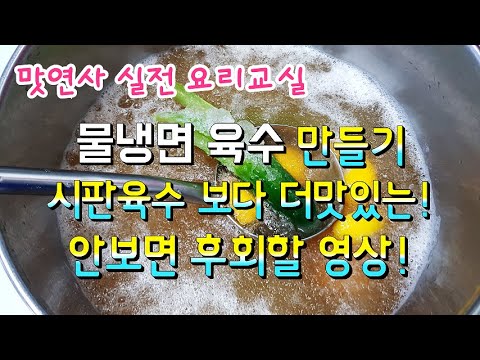
🛠️ Core Equipment
- Large heavy-bottomed potEven heat distribution prevents scorching during the long broth simmer. A thin pot creates hot spots that burn the sugar-heavy seasoning to the bottom.
- Fine-mesh sieve or cheeseclothFor straining out the beef and daepa after simmering, leaving a clear, clean broth. Clarity is a quality marker in naengmyeon.
- Large bowl and ice bathRapid chilling is essential. A large bowl packed with ice water cools the broth fast enough to preserve flavor clarity. This is the professional method when a commercial chiller isn't available.
- Kitchen scaleThis broth is built on precise gram measurements — 150g brown sugar, 49g vinegar, 80g lemon juice. Volume measurements introduce error. Use the scale.
Authentic Mul Naengmyeon (The Icy Korean Cold Noodle Soup You've Been Missing)
🛒 Ingredients
- ✦200g beef (any cut)
- ✦1 stalk daepa (large green onion), approximately 125g
- ✦50g beef dashida (CJ brand recommended)
- ✦1g kelp dashida
- ✦17g soy sauce
- ✦5g sesame oil
- ✦150g brown sugar
- ✦40g white sugar
- ✦20g flower salt (or fine sea salt)
- ✦49g rice vinegar (approximately 1/4 cup)
- ✦80g fresh lemon juice
- ✦4 servings naengmyeon noodles (buckwheat cold noodle packs)
- ✦2 boiled eggs, halved
- ✦1 Korean pear, julienned
- ✦1 cucumber, julienned
- ✦Pickled radish (danmuji), sliced
- ✦White sesame seeds, for garnish
- ✦Yellow mustard, for serving
👨🍳 Instructions
01Step 1
Place 200g beef and 1 stalk of daepa in a pot with enough cold water to cover. If the daepa is very thick, split it lengthwise before adding.
02Step 2
Bring to a boil over high heat, then reduce to medium-low once boiling begins.
03Step 3
Once the broth is simmering, add the beef dashida, kelp dashida, soy sauce, sesame oil, brown sugar, white sugar, and flower salt. Stir to combine.
04Step 4
Let the broth return to a boil. Skim off any foam from the surface, then immediately turn off the heat.
05Step 5
Transfer the pot to a large bowl of ice water. Stir occasionally to speed cooling. Once the broth reaches room temperature, strain out the beef and daepa through a fine-mesh sieve.
06Step 6
Transfer the strained broth to the freezer. Once fully chilled, add the vinegar and lemon juice and stir well. Return to the freezer until a slushy consistency with visible ice crystals forms.
07Step 7
Boil the naengmyeon noodles according to package directions. Drain and rinse immediately and thoroughly under cold running water, then briefly under ice water if available.
08Step 8
Divide the noodles among serving bowls. Top each with pear julienne, cucumber julienne, pickled radish, and a boiled egg half.
09Step 9
Sprinkle white sesame seeds over each bowl.
10Step 10
Ladle the ice-cold slushy broth over the noodles and serve immediately. Offer vinegar and yellow mustard on the side for individual adjustment.
Nutrition Per Serving
Estimates based on standard preparation. Adjustments alter macros.
🔄 Substitutions
Instead of Beef dashida...
Use Homemade beef stock concentrate or dashi powder
Dashida is a seasoned beef soup stock powder. If substituting, reduce additional salt since dashida contains sodium. The flavor will be slightly less intense.
Instead of Naengmyeon noodles...
Use Soba noodles (100% buckwheat)
Texture will be softer and less chewy than authentic naengmyeon noodles, which contain a mix of buckwheat and starch. Use as a last resort — naengmyeon packs are widely available at Korean grocery stores.
Instead of Korean pear...
Use Asian pear or firm Fuji apple
Asian pear is the closest match in texture and sweetness. Fuji apple works in a pinch but adds a different flavor profile.
Instead of Flower salt...
Use Fine sea salt or kosher salt
Flower salt (kkot sogeum) is a fine, mild Korean sea salt. Fine sea salt is a direct substitute at the same weight. Avoid iodized table salt — it adds a metallic note.
🧊 Storage & Reheating
In the Fridge
Store broth separately from noodles for up to 3 days. Noodles clump quickly — store dressed lightly in sesame oil in an airtight container for up to 1 day.
In the Freezer
Freeze broth only (not assembled bowls) for up to 2 months. The acid and sugar help prevent off-flavors during freezing. Thaw in the fridge and return to slushy consistency before serving.
Reheating Rules
This dish is served cold by design. Do not reheat. Remove from freezer, allow to reach slushy consistency, and serve immediately.
❓ Frequently Asked Questions
What's the difference between mul naengmyeon and bibim naengmyeon?
Mul naengmyeon is served in a cold, clear broth — mul means water. Bibim naengmyeon is served dry, tossed in a spicy gochujang-based sauce. The noodles are the same; the preparation and flavor profile are completely different. This recipe is mul naengmyeon.
Why does the broth have so much sugar?
Naengmyeon broth is calibrated to taste balanced at near-freezing temperatures, where your taste buds are less sensitive. At room temperature, the broth would taste noticeably sweet. At serving temperature — slushy and icy — the sweetness recedes and the balance between sweet, sour, and savory comes into proper focus.
Can I use chicken instead of beef?
Technically yes, but you'll lose the deep savory baseline that makes mul naengmyeon taste distinctly itself. Beef is a structural ingredient here, not just a protein. If you must use chicken, increase the dashida slightly to compensate.
Why add vinegar and lemon only after chilling?
Acid is volatile — it cooks off at high temperatures and loses its brightness. Adding vinegar and lemon to hot broth gives you cooked sourness, which is flat and dull. Adding them cold preserves the sharp, fresh tang that defines this dish.
My broth froze solid. Did I ruin it?
No. Let it thaw partially in the fridge until slushy, then stir and serve. The quality is unchanged — you just need to bring it back to the right consistency. In the future, check it every 30 minutes during the freezing phase.
Do I need a kitchen scale for this recipe?
Yes. The instructor's formula is built on precise gram measurements that volume equivalents approximate poorly — especially for the sugar and vinegar. A basic digital kitchen scale costs under $15 and is the single tool that makes this recipe reproducible.
The Science of
Authentic Mul Naengmyeon (The Icy Korean Cold Noodle Soup You've Been Missing)
We turned everything on this page into a beautiful, flour-proof PDF cheat sheet. Print it out, stick it to your fridge, and never mess up your authentic mul naengmyeon (the icy korean cold noodle soup you've been missing) again.
*We'll email you the high-res PDF instantly. No spam, just perfectly cooked meals.
AlmostChefs Editorial Team
We translate the internet's most popular cooking videos into foolproof, beginner-friendly written recipes. We analyze multiple methods, test them in our kitchen, and engineer a single "Master Recipe" that gives you the best possible result with the least possible stress.