Classic New Orleans Muffuletta (Olive Salad, Pressed Overnight)
The New Orleans muffuletta built on a house-made olive salad, four Italian meats and cheeses, and mandatory pressing time. Pressing is not a suggestion — it is the technique that makes this sandwich different from a cold cut sub.
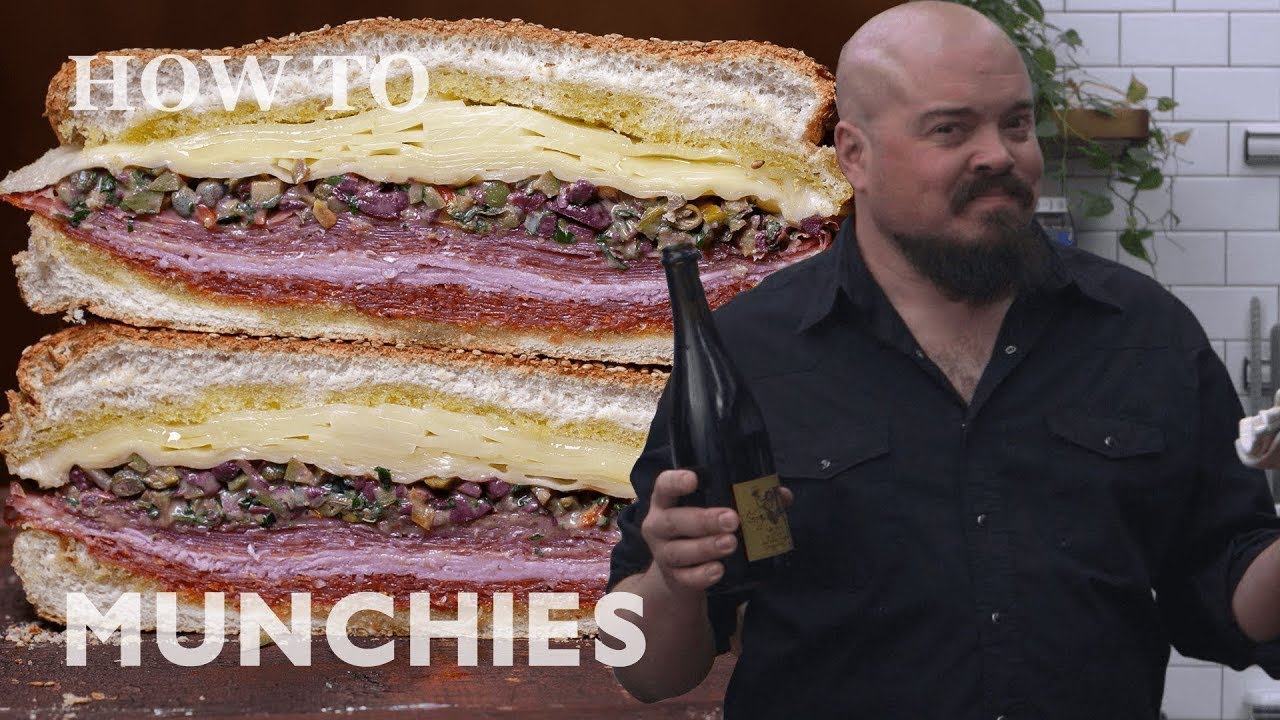
“The muffuletta is a pressed sandwich built around an olive salad that is aggressive, acidic, and oily in the best possible way. It was invented at Central Grocery in New Orleans in 1906 and has been misunderstood as a glorified Italian sub ever since. The difference is the pressing. Without pressing time — four hours minimum, overnight preferred — you have cold cuts on bread. With pressing, you have a unified object where the olive oil has saturated the interior of the bread, the meat and cheese layers have compressed into a single stratum, and every slice delivers the same proportioned bite.”
Why This Recipe Works
The muffuletta is one of the most misunderstood sandwiches in American food. On its surface, it looks like an Italian cold cut sandwich dressed with an olive condiment. That description is accurate and insufficient. The critical distinction is that a muffuletta is assembled and then left alone for hours — pressed under weight while refrigerated — and during that time the sandwich undergoes a physical transformation that produces a result categorically different from its ingredients assembled and served immediately.
Understanding why pressing time matters requires understanding what olive oil does to bread when given sufficient time and pressure to work.
Oil Migration and Bread Structure
Bread crumb is composed of a network of gluten protein and gelatinized starch with significant air pockets throughout. When pressed against an olive oil-saturated olive salad under weight, the initial contact is topical — oil on crumb surface. As pressure is applied and maintained, that oil is forced into the outermost pores of the crumb structure. When the pressure releases, those pores are partially filled with oil and do not return to their original air-filled state. Over a 4–8 hour pressing period, capillary action continues to draw the oil deeper into the crumb by wicking — the same mechanism that draws water up a paper towel. The oil is not just on the bread at the end of pressing; it is distributed through the crumb's interior structure.
This has two consequences. The first is flavor: the olive oil carries the garlic, vinegar, oregano, and olive flavor compounds into the bread itself, so that every bite of the bread tastes of the olive salad rather than just the contact surfaces. The second is texture: oil-saturated bread does not become soggy in the way that water-saturated bread does. Oil displaces air in the crumb pores without breaking down the gluten structure, producing a bread that is dense and cohesive — slightly chewy, with a richer flavor — rather than the structural collapse you get from a wet ingredient applied to bread over time.
Compression and Layer Integration
The second thing that happens during pressing is mechanical compression of the filling layers. A freshly assembled muffuletta has air gaps between each layer — between the meat slices, between the meat and cheese layers, between the cheese and the olive salad. These air gaps mean that every bite may or may not include all components depending on where in the cross-section the bite falls.
Under 10–15 lbs of sustained pressure for 4+ hours, these air gaps are eliminated. The filling layers compress into a single cohesive stratum with no internal voids. When the sandwich is sliced, that stratum holds its shape at the cut face because the layers are adhered to each other by the combination of fat from the meats, fat from the cheeses, and oil from the olive salad that has migrated into every interface. The sliced cross-section of a properly pressed muffuletta shows distinct, clearly defined layers that do not slide or separate — a visual and textural indicator of correct execution.
An uncompressed Italian cold cut sandwich cut in half shows layers that slide independently because there is no adhesive between them. This is why the same ingredients assembled and eaten immediately taste like component parts rather than a unified dish.
The Olive Salad as Structural Element
The olive salad in a proper muffuletta is not a condiment. It is structural. The oil and vinegar it contains are the agents that transform the bread over pressing time. The solid olive and pepper pieces provide textural contrast that holds up under compression. The garlic macerates into the oil during resting, which then carries the garlic flavor into the bread crumb during pressing. A thin application of olive salad produces a sandwich that tastes like good Italian cold cuts on good bread. A generous application produces a sandwich where the olive flavor is present in every component simultaneously.
The instruction to hollow the bread is related to the same structural logic. The muffuletta round's interior crumb, if left intact, creates too much bread mass relative to filling. The filling-to-bread ratio in a properly made muffuletta should lean toward filling — visible thick layers of meat, cheese, and olive salad in every cross-section, with the bread providing a frame rather than a majority of the bite.
The Pressing Weight and Refrigerator Temperature
Pressing at room temperature would accelerate oil migration but would also allow the meats and cheeses to come out of the safe temperature zone for an extended period. Refrigerator temperature slows the oil migration but keeps the sandwich food-safe. Four hours at refrigerator temperature is the practical minimum because this is the time required for meaningful oil penetration to occur at the lower temperature.
A cast iron skillet loaded with canned goods is the ideal pressing apparatus for home use because cast iron's flat bottom distributes weight evenly across the entire diameter of the sandwich. An uneven pressing weight — a curved-bottom skillet, a pot with a smaller base than the sandwich diameter — produces uneven compression, with the center of the sandwich receiving more pressure than the edges. The edges, with less compression, retain air gaps that the center does not. A properly weighted cast iron skillet or a flat, heavy cutting board pressed with additional weight produces even compression from circumference to circumference.
Serving Temperature and Flavor Release
A muffuletta served cold directly from the refrigerator has muted flavors. The olive oil has congealed slightly and lost its fluidity. The fat from the mortadella has firmed. The cheeses have hardened to a texture that resists cohesion rather than holding the filling layers together. Fifteen to twenty minutes at room temperature before slicing allows the oils to return to liquid fluidity, the fats in the meats and cheeses to soften, and the garlic and oregano aromatics suppressed by cold temperature to become volatile and accessible again. The muffuletta's flavor is designed for room temperature. It is worth the wait.
The ceremonial act of cutting the pressed round into four wedges — a single confident stroke per cut with a sharp serrated knife, no sawing — reveals the compressed cross-section that is the evidence of correct execution. Distinct, intact, adhered layers of mortadella and salami, firm mozzarella and provolone, and the olive salad pressed into and against the hollowed bread faces. That cross-section is what the pressing time builds.
The Garlic Maceration Window
The olive salad's 30-minute resting time before use — or ideally overnight — is a transformation step, not a waiting step. Raw minced garlic contains allicin and related sulfur compounds in their unmodified forms. These are harsh, pungent, and one-dimensional on the palate. In contact with red wine vinegar over 30+ minutes, these compounds hydrolyze and convert into softer, more complex aromatic molecules. The garlic flavor that results from this maceration period is still clearly garlic but is savory and rounded rather than sharp and attacking. The same transformation does not occur during the pressing period because the garlic in the olive salad is embedded within the oil-saturated bread crumb where vinegar contact is limited. The pre-assembly resting time is the only window in which the maceration chemistry can occur. Skip it and the olive salad tastes of raw garlic regardless of how long the sandwich subsequently presses.
Where Beginners Mess This Up
Before we start, read this. These are the 4 reasons your classic new orleans muffuletta (olive salad, pressed overnight) will fail:
- 1
Not pressing long enough: The pressing time is the active ingredient in this recipe, not the olive salad recipe or the meat selection. During pressing, two things happen simultaneously: the olive oil and vinegar from the olive salad migrate by capillary action into the interior crumb structure of the bread, and the compression force eliminates air pockets between the meat and cheese layers, consolidating them into a unified filling. At one hour of pressing, you have partially flavored bread and partially compressed filling. At four hours, the oil has penetrated the crumb substantially and the filling has set. At overnight, the sandwich slices cleanly, holds its shape, and every bite contains fully integrated flavors rather than ingredients that taste separately of themselves.
- 2
Skimping on the olive salad: The olive salad is the defining element of a muffuletta. It is not a condiment in a thin layer — it is a structural component applied in a thick, aggressive layer on both cut faces of the bread. Both halves. Not one half with the other half left dry for crunch. The oil from the olive salad that soaks into both bread faces during pressing is what differentiates the muffuletta from every other Italian cold cut sandwich. If the olive salad is applied sparingly, the sandwich will taste good but not like a muffuletta.
- 3
Not hollowing the bread: A muffuletta round is a dense Italian loaf with significant interior crumb. If you place the filling directly on the full crumb of each half, the filling-to-bread ratio tilts heavily toward bread and the sandwich is dry and bready regardless of pressing time. Removing the excess interior crumb from both halves creates a cavity that the filling occupies fully, ensures the olive salad contacts the interior crumb rather than the surface crust, and produces a balanced bite in the final sandwich.
- 4
Using the wrong bread: Muffuletta bread is a specific round Sicilian-style sesame loaf — dense crumb, firm crust, approximately 8–10 inches in diameter. Sourdough or ciabatta are poor substitutes: sourdough's tang competes with the vinegar in the olive salad, and ciabatta's large air pockets give the olive oil nowhere coherent to go during pressing. A round Italian loaf with sesame seeds, if you cannot source actual muffuletta bread, is the closest approximation.
The Video Reference Library
Want to see it in action? Here are the exact videos we analyzed and combined to build this foolproof recipe translation:
Primary technique reference for this recipe. Demonstrates olive salad construction, bread hollowing, layering sequence, and pressing setup. Pay attention to the olive salad quantity — most home versions use half the amount shown and wonder why the result is dry.
🛠️ Core Equipment
- Cast iron skillet or heavy pan for pressingThe pressing weight needs to be heavy, flat, and stable. A [cast iron skillet](/kitchen-gear/review/cast-iron-skillet) placed on top of the wrapped sandwich and loaded with a few cans provides approximately 10–15 lbs of consistent, even pressure across the entire sandwich surface. The weight must be flat — a rounded bottom distributes pressure unevenly. Cast iron is ideal because it is both flat and heavy enough without requiring additional ballast.
- Sharp serrated bread knifeA pressed muffuletta is a dense, compact object. A dull knife compresses it instead of cutting through it, disturbing the layers you've spent hours setting. A sharp serrated knife cuts through the sesame crust cleanly and carries through the compressed filling layers without displacement. Cut with a single forward stroke, not a sawing motion, for the cleanest cross-section.
- Plastic wrapThe sandwich must be wrapped tightly before pressing to hold the olive salad against the bread surfaces as the oil migrates. Loose wrapping allows the olive salad to shift away from the bread face under the pressure of the weight, concentrating it in the center of the sandwich rather than distributing it through the bread crumb. Wrap tightly, several layers, and press immediately while the wrapping is snug.
Classic New Orleans Muffuletta (Olive Salad, Pressed Overnight)
🛒 Ingredients
- ✦1 round Italian sesame loaf or muffuletta bread, approximately 8 inches in diameter
- ✦1 cup green olives, pitted and roughly chopped
- ✦0.5 cup roasted red peppers, diced small
- ✦0.25 cup fresh Italian flat-leaf parsley, minced
- ✦3 cloves garlic, minced
- ✦2 tablespoons red wine vinegar
- ✦2 tablespoons extra-virgin olive oil
- ✦1 teaspoon dried oregano
- ✦0.25 teaspoon red pepper flakes
- ✦0.5 teaspoon black pepper
- ✦0.25 teaspoon sea salt
- ✦4 oz mortadella or Italian ham, thinly sliced
- ✦4 oz Genoa salami or capicola, thinly sliced
- ✦3 oz fresh mozzarella or low-moisture mozzarella, thinly sliced
- ✦2 oz provolone, thinly sliced
- ✦2 tablespoons fresh basil, thinly sliced (optional)
👨🍳 Instructions
01Step 1
Make the olive salad: combine the chopped green olives, roasted red peppers, parsley, garlic, red wine vinegar, olive oil, oregano, red pepper flakes, black pepper, and salt in a bowl. Stir to combine. Let rest for at least 30 minutes — the resting time allows the garlic to mellow and the vinegar to begin macerating the olive flesh.
02Step 2
Slice the loaf horizontally through its equator. Using your fingers or a spoon, hollow out some of the interior crumb from both halves, leaving a 1/2-inch shell of bread on all sides. Do not remove the crumb entirely — you want structure remaining, but significantly less of it than the loaf contains natively.
03Step 3
Spread the olive salad generously and evenly on both cut faces of the bread, pressing it firmly into the crumb with the back of a spoon. Use all of it — most of what you're tempted to reserve belongs on the bread. Both halves.
04Step 4
Layer the bottom half in order: mortadella, salami, mozzarella, provolone, basil if using. The meat layers go down first because they are heavier and will compress more uniformly under the weight. Cheese layers on top.
05Step 5
Close the sandwich by pressing the top half firmly down onto the filling layers. The olive salad on the top face will make contact with the cheese surface.
06Step 6
Wrap the entire sandwich tightly in plastic wrap — multiple layers, pulled snug around the entire circumference and over both flat faces. The wrap must maintain contact with the bread surfaces to keep the olive salad pressed against the crumb during oil migration.
07Step 7
Place the wrapped sandwich on a flat surface in the refrigerator. Set a [cast iron skillet](/kitchen-gear/review/cast-iron-skillet) or heavy cutting board on top, then load it with additional weight — canned goods, heavy pots. The goal is 10–15 lbs of even pressure. Press for a minimum of 4 hours; overnight is strongly preferred.
08Step 8
Remove from the refrigerator 15 minutes before serving. Unwrap. Cut into 4 wedges with a sharp serrated knife using a single firm forward stroke per cut.
Nutrition Per Serving
Estimates based on standard preparation. Adjustments alter macros.
🔄 Substitutions
Instead of Mortadella...
Use Italian ham or prosciutto
Mortadella is the traditional choice — it is mild, fatty, and its texture compresses well under pressing. Prosciutto is significantly thinner and saltier; if substituting, use less of it and adjust the overall salt level.
Instead of Capicola / Genoa salami...
Use Soppressata or dry-cured Italian sausage
Any dry-cured Italian salame works. The important characteristic is that the meat is fully cured and dry — not a cooked deli meat, which contains more moisture and will make the bread soggy rather than oil-saturated.
Instead of Provolone...
Use Sharp provolone or aged asiago
Regular mild provolone is the standard. Aged provolone (provolone piccante) has a sharper, slightly tangy flavor that is more assertive against the olive salad — an improvement for those who prefer a more complex cheese layer.
Instead of Red wine vinegar...
Use White wine vinegar or sherry vinegar
Red wine vinegar is traditional and appropriate. White wine vinegar produces a lighter olive salad with less color tint. Sherry vinegar is richer and slightly oxidized — it produces a more complex flavor but is also more expensive and less traditional.
🧊 Storage & Reheating
In the Fridge
Store the uncut, pressed sandwich wrapped tightly in plastic for up to 3 days. Quality improves over the first 48 hours as the oil continues to penetrate. After 3 days the bread begins to over-saturate and loses structural integrity.
In the Freezer
Not recommended. The olive salad components — particularly the parsley and roasted peppers — freeze and thaw with significant texture degradation. The bread crumb structure also becomes soggy upon thawing.
Reheating Rules
This sandwich is not reheated. It is a cold or room-temperature preparation. If you want a warm version, cut a wedge and press it briefly in a [cast iron skillet](/kitchen-gear/review/cast-iron-skillet) over medium heat — 2 minutes per side — which melts the cheese and crisps the crust while warming the interior.
❓ Frequently Asked Questions
Why does a muffuletta need to be pressed and a regular sandwich doesn't?
The olive salad contains a significant quantity of olive oil and vinegar. Without pressing time, this liquid sits on the bread surface without penetrating the crumb, and the sandwich falls apart when cut. Pressing forces the oil into the bread by capillary action — the pressure compresses the crumb pores and when the pressure is released, those pores draw the oil inward by wicking action. The result is bread that holds together because the oil is structural, not just topical. It also compresses the filling layers so that every cross-section bite contains every layer proportionally rather than the top layers sliding out separately.
Can I substitute black olives for green?
You can use a mixture or all black olives, but the flavor profile changes significantly. Green olives are brine-cured and have a sharp, firm, slightly bitter flavor. Black olives (if using ripe canned olives rather than oil-cured) are softer and more mild. For the most complex olive salad, use a mix of green Sicilian olives and oil-cured black olives. Avoid canned ripe black olives — their bland, soft character disappears entirely in the assembled sandwich.
What if I can't find muffuletta bread or a proper round Italian loaf?
A large round sourdough is the last-resort substitute, but the tannic acid in sourdough actively competes with the wine vinegar in the olive salad and muddies the flavor. A better workaround is a focaccia round, which has a more neutral flavor and an open crumb that accepts the olive oil readily. Or buy a round Italian sesame roll from a bakery and scale the recipe down by half.
Do I need to include all four meats and both cheeses?
No. The minimum functional muffuletta requires two cured meats and one cheese. The four-component version (mortadella, salami, mozzarella, provolone) is traditional and balanced because each component contributes a different fat and salt level. Removing mozzarella makes the cheese layer saltier and denser from the provolone alone. Removing mortadella makes the filling more intensely flavored and less creamy. The sandwich still works with fewer components — the olive salad is the non-negotiable element.
Can I make a warm muffuletta?
Yes. After pressing, cut into wedges, place on a foil-lined sheet pan, and bake at 375°F for 8–10 minutes until the cheese is melted and the exterior is lightly crisped. This is a common variation in New Orleans. The pressing step remains mandatory even for a warm version — the baking time is too short to achieve what overnight pressing accomplishes with the oil and bread structure.
The Science of
Classic New Orleans Muffuletta (Olive Salad, Pressed Overnight)
We turned everything on this page into a beautiful, flour-proof PDF cheat sheet. Print it out, stick it to your fridge, and never mess up your classic new orleans muffuletta (olive salad, pressed overnight) again.
*We'll email you the high-res PDF instantly. No spam, just perfectly cooked meals.
AlmostChefs Editorial Team
We translate the internet's most popular cooking videos into foolproof, beginner-friendly written recipes. We analyze multiple methods, test them in our kitchen, and engineer a single "Master Recipe" that gives you the best possible result with the least possible stress.