Authentic Greek Moussaka (The Layered Casserole You've Been Doing Wrong)
A show-stopping Greek casserole of golden eggplant, cinnamon-spiced lamb and beef ragù, and a silky béchamel that crisps into a custard crown. We broke down every component — the salt purge, the tempering, the rest — so your layers hold and your flavors hit deep.

“Moussaka is one of those dishes that looks intimidating and tastes transcendent when someone else makes it. The reason yours didn't land is almost always one of three things: eggplant that leaked water all over the layers, béchamel that curdled or turned grainy, or a dish you cut into too soon and watched collapse into a sloppy mess. Every failure has a fix. We built this recipe around preventing all three.”
Why This Recipe Works
Moussaka is not a weeknight dish pretending to be approachable. It is three separate preparations — eggplant, ragù, béchamel — assembled in a specific order and baked into something that is fundamentally better than any of its parts. The reason it intimidates home cooks is also the reason it rewards them: the components are interdependent. Fail one and the whole structure suffers.
The Eggplant Problem
Eggplant is mostly water — about 92% by weight. That water has to leave the vegetable at some point, and the question is whether you control when and how, or whether the oven decides for you. When raw eggplant hits high heat in a casserole, that moisture releases directly into the surrounding layers, flooding the meat sauce, steaming the bottom of the dish, and turning what should be a tight, architectural stack into something closer to soup with ambitions.
The fix is the salt purge: arrange sliced eggplant on paper towels, salt generously, and wait 30 minutes. You will see the liquid bead on the surface. Then pat it completely dry before it goes near heat. This step removes roughly 30% of the vegetable's moisture content before you cook a single thing, and it's the difference between layers that hold and layers that slide.
The frying matters too. Each eggplant slice should be deep golden brown — collapsed slightly, tender all the way through, with the kind of caramelization that adds flavor rather than just removing water. Pale, rubbery eggplant is the result of not enough heat or not enough oil. A wide braiser at medium-high with adequate oil handles this without drama.
The Ragù Architecture
Most Greek-American moussaka recipes treat the meat sauce as an afterthought — browned beef, canned tomatoes, done. The authentic version is closer to a long-cooked Italian ragù than a quick tomato sauce. It simmers for 20-25 minutes after the wine reduces, concentrating the tomato, deepening the spices, and thickening to the point where a wooden spoon dragged through it leaves a visible channel.
The cinnamon is not an accident and not optional. It is the defining aromatic of Greek meat cookery — present in moussaka, pastitsio, and stifado across centuries of cooking. It doesn't read as sweet in this context; it reads as warm, complex, and distinctly Mediterranean. The nutmeg amplifies it. The bay leaves anchor the whole thing. Together they do something that oregano and basil simply cannot.
The Béchamel Equation
French mother sauce in a Greek casserole is not a contradiction. The béchamel in moussaka serves a structural purpose that no other topping can replicate: it sets during baking into a firm, custardy layer that holds the entire stack together. A thin béchamel produces a flowing, unstable top. A properly made one creates a crust that lets you cut clean portions.
Three things determine whether your béchamel succeeds. First, warm milk — cold milk causes the starch to seize and lump in ways that cannot be whisked out. Second, a full two minutes cooking the butter-flour roux before adding anything — this cooks out the raw flour flavor and ensures the starch is ready to absorb liquid evenly. Third, tempering the egg yolks — slowly ladling hot sauce into the yolks before combining them prevents scrambling and produces the silky, enriched texture that separates a great moussaka béchamel from a grainy one. A heavy-bottomed saucepan keeps the heat even enough to make all three steps manageable.
The Rest Is Not Optional
Two rests. One before baking — 15 minutes at room temperature after assembly, which lets the layers settle and the béchamel stabilize before heat hits it. One after — 10 to 15 minutes out of the oven before the knife goes in. The béchamel is liquid-adjacent when it comes out. It sets as it cools. Cut it hot and you have a beautiful mess. Cut it rested and you have moussaka.
The overnight rest is the secret the recipe doesn't advertise loudly enough: this dish is categorically better the next day. The layers compress, the cinnamon and nutmeg mellow into the meat, the béchamel firms into something almost terrine-like. Make it the day before you need it. Reheat in a covered dish at 325°F. Take credit.
Where Beginners Mess This Up
Before we start, read this. These are the 4 reasons your authentic greek moussaka (the layered casserole you've been doing wrong) will fail:
- 1
Skipping the salt purge on the eggplant: Raw eggplant contains roughly 92% water. When it hits the oven, that water releases and floods your meat layer, diluting the ragù, steaming the bottom instead of baking it, and destroying any hope of clean layers. The 30-minute salt rest draws out excess moisture before the eggplant ever touches heat. Do not skip it.
- 2
Adding cold milk to the béchamel: Cold milk hitting a hot butter-flour roux causes the starch granules to seize unevenly, producing lumps that no amount of whisking can undo. Warm your milk before you start. This is the single most important technique in French sauce-making and it applies here exactly the same way.
- 3
Skipping the egg yolk tempering step: If you add egg yolks directly to hot béchamel, you get scrambled eggs suspended in white sauce. Tempering — ladling a small amount of hot sauce into the yolks first — raises their temperature gradually so they enrich the sauce rather than cook in it. One extra bowl. Three extra minutes. Non-negotiable.
- 4
Cutting into the moussaka immediately out of the oven: The béchamel needs 10-15 minutes to set after baking. Cut it hot and the layers slide apart into a landscape of beautiful chaos. Rest it. The reward is clean, tall, architectural slices that hold together on the plate.
The Video Reference Library
Want to see it in action? Here are the exact videos we analyzed and combined to build this foolproof recipe translation:
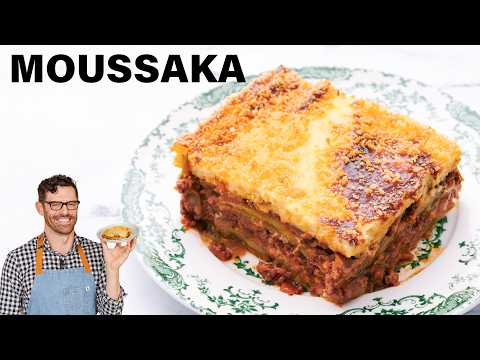
The foundational video this recipe was built around. Covers the salt purge, proper eggplant browning, and the béchamel tempering technique with clear close-ups of each critical stage.
2. How to Make Perfect Béchamel Every Time
A focused deep-dive on the butter-flour-milk ratio and the tempering technique that prevents scrambled béchamel. Essential viewing if this is your first time making a French mother sauce.
3. Greek Casseroles and Make-Ahead Mediterranean CookingBroader context on Mediterranean casserole logic — why dishes like moussaka are designed to be made a day ahead and how the overnight rest dramatically improves the flavor and texture.
🛠️ Core Equipment
- 9x13-inch baking dish ↗The exact dimensions matter for even layer depth. A smaller dish pushes the béchamel too thick; a larger one spreads everything too thin. Standard ceramic or glass is ideal — both retain heat well during the rest period.
- Heavy-bottomed saucepan ↗For the béchamel. Thin pans develop hot spots that scorch the milk solids on the bottom while the surface stays cold. A [heavy-bottomed saucepan](/kitchen-gear/review/heavy-bottomed-saucepan) gives you even, gentle heat throughout — essential for a smooth, lump-free sauce.
- Large skillet or braiser ↗The meat ragù needs room to brown properly. Crowding the pan drops the temperature and steams the meat instead of searing it. A [wide braiser](/kitchen-gear/review/braiser) or 12-inch skillet handles both the browning and the 20-minute simmer without switching pans.
- Offset spatula ↗For spreading the béchamel in an even, unbroken layer over the top. A regular spoon drags and tears. An offset spatula glides.
Authentic Greek Moussaka (The Layered Casserole You've Been Doing Wrong)
🛒 Ingredients
- ✦3 medium eggplants, sliced into 1/4-inch rounds
- ✦8 tablespoons olive oil, divided
- ✦12 ounces ground lamb
- ✦12 ounces ground beef
- ✦2 large yellow onions, finely diced
- ✦4 cloves garlic, minced
- ✦1 can (15 ounces) tomato sauce
- ✦3 tablespoons tomato paste
- ✦1/2 cup dry red wine
- ✦2 bay leaves
- ✦1/2 teaspoon ground cinnamon
- ✦1/4 teaspoon freshly grated nutmeg
- ✦5 tablespoons unsalted butter
- ✦5 tablespoons all-purpose flour
- ✦3.5 cups whole milk, warmed
- ✦3 egg yolks
- ✦1 cup freshly grated Parmesan cheese
- ✦Salt and freshly ground black pepper to taste
👨🍳 Instructions
01Step 1
Arrange eggplant slices on paper towels and sprinkle generously with salt. Let them rest for 30 minutes to release excess moisture and bitterness.
02Step 2
Pat the eggplant slices completely dry with fresh paper towels, pressing firmly to remove all moisture and salt residue.
03Step 3
Heat 4 tablespoons of olive oil in a large skillet over medium-high heat until shimmering. Working in batches, pan-fry eggplant slices for 3-4 minutes per side until golden brown and tender, adding remaining oil as needed.
04Step 4
Transfer the cooked eggplant to a paper towel-lined plate to drain excess oil.
05Step 5
In the same skillet, brown the ground lamb and beef over medium-high heat, breaking up the meat for 5-7 minutes until no pink remains.
06Step 6
Add the diced onions to the meat and sauté for 3-4 minutes until softened, then stir in the minced garlic and cook for 1 minute more.
07Step 7
Pour in the red wine and scrape up any browned bits from the bottom of the skillet. Let the wine reduce by half, about 3-4 minutes.
08Step 8
Stir in the tomato sauce, tomato paste, bay leaves, cinnamon, and nutmeg. Reduce heat to low and simmer for 20-25 minutes, stirring occasionally, until the sauce thickens and flavors meld.
09Step 9
Season the meat sauce with salt and pepper, then remove from heat and discard the bay leaves.
10Step 10
Melt butter in a heavy-bottomed saucepan over medium heat. Sprinkle in the flour while whisking constantly to form a smooth paste and cook for 2 minutes, stirring frequently.
11Step 11
Gradually whisk in the warm milk in small additions, whisking vigorously after each pour to prevent lumps, until all milk is incorporated and the sauce is smooth.
12Step 12
Continue cooking the béchamel for 8-10 minutes, stirring constantly, until it thickens enough to coat the back of a spoon. Remove from heat.
13Step 13
Whisk the egg yolks in a small bowl. Temper them by slowly ladling a small amount of hot béchamel into the yolks while whisking continuously, then pour this mixture back into the saucepan while whisking gently.
14Step 14
Stir 1/2 cup of Parmesan into the béchamel and season lightly with salt, pepper, and a pinch of nutmeg.
15Step 15
Preheat your oven to 350°F and lightly oil a 9x13-inch baking dish. Spread a thin layer of meat sauce across the bottom.
16Step 16
Arrange half the eggplant slices over the meat sauce in a slightly overlapping pattern. Spread half the remaining meat sauce over the eggplant.
17Step 17
Layer the remaining eggplant slices over the meat sauce, then top with the last of the meat sauce in an even layer.
18Step 18
Pour the béchamel over the top, spreading gently with an offset spatula to cover all exposed areas. Sprinkle the remaining Parmesan across the top.
19Step 19
Let the assembled moussaka rest at room temperature for 15 minutes before baking.
20Step 20
Bake for 45-50 minutes, until the top is deep golden brown and a knife inserted into the center comes out clean with the béchamel pulling slightly from the edges.
21Step 21
Remove from the oven and let the moussaka rest for 10-15 minutes before cutting. The layers need this time to set.
Nutrition Per Serving
Estimates based on standard preparation. Adjustments alter macros.
🔄 Substitutions
Instead of Ground lamb and beef...
Use All ground beef or all ground lamb
All beef is milder and more accessible. All lamb intensifies the Mediterranean flavor profile considerably. The 50/50 split is calibrated for balance — pure lamb can be polarizing.
Instead of Dry red wine...
Use Low-sodium beef broth or additional tomato sauce
Broth gives depth without alcohol. Extra tomato sauce adds sweetness and acidity. Neither fully replicates the complexity wine contributes, but both produce a solid ragù.
Instead of All-purpose flour in béchamel...
Use Rice flour or cornstarch (use 4 tablespoons instead of 5)
Gluten-free adaptation. Rice flour produces a slightly silkier mouthfeel. Cornstarch results in a more delicate, slightly less stable sauce — handle gently.
Instead of Parmesan cheese...
Use Feta cheese or sharp cheddar (3/4 cup)
Feta brings authentic Greek tang and crumbles into the béchamel beautifully. Cheddar increases sharpness and reduces sodium. Both work; neither mimics Parmesan exactly.
🧊 Storage & Reheating
In the Fridge
Store covered in the baking dish or in an airtight container for up to 4 days. Flavor peaks on day two.
In the Freezer
Freeze in individual portions for up to 3 months. Wrap each piece tightly in plastic wrap before placing in a freezer bag.
Reheating Rules
Reheat covered at 325°F for 20-25 minutes from refrigerated, or 40-45 minutes from frozen. Do not microwave — it breaks the béchamel texture and makes the eggplant rubbery.
❓ Frequently Asked Questions
Why is my moussaka watery?
The eggplant released moisture during baking because it wasn't properly salted and dried before cooking. The 30-minute salt rest and thorough pat-dry are not optional steps. Water in eggplant is the enemy of clean layers.
Can I make moussaka ahead of time?
Yes — and you should. Assembled moussaka can be refrigerated unbaked for up to 24 hours. Pull it from the fridge 30 minutes before baking. The finished dish tastes significantly better on day two once the layers have compressed and the flavors have melded.
My béchamel is lumpy. Can I fix it?
Yes, if caught early. Pour the lumpy sauce through a fine-mesh sieve while it's still hot and whisk it back together over low heat. If the lumps have set, blend with an immersion blender. Prevention is easier: always use warm milk, add it gradually, and whisk constantly.
Do I have to use both lamb and beef?
No. All beef is accessible and mild. All lamb is traditional and intense. The 50/50 blend is a deliberate balance — you get the richness of lamb without the gaminess overpowering the cinnamon and tomato. Start here your first time.
Why does the recipe use cinnamon in a savory dish?
Cinnamon is fundamental to Greek meat cookery — it appears in moussaka, pastitsio, and stifado alike. It doesn't read as sweet; it reads as warm and complex. The small amount here deepens the ragù without announcing itself. Leave it out and the dish tastes flat.
How do I know when the moussaka is done baking?
The top should be deep golden brown — mahogany at the edges, not just lightly tan in the center. A knife inserted into the middle should come out clean and hot. The béchamel should be pulling slightly away from the sides of the dish. If the top is browning too fast, tent with foil and continue baking.
The Science of
Authentic Greek Moussaka (The Layered Casserole You've Been Doing Wrong)
We turned everything on this page into a beautiful, flour-proof PDF cheat sheet. Print it out, stick it to your fridge, and never mess up your authentic greek moussaka (the layered casserole you've been doing wrong) again.
*We'll email you the high-res PDF instantly. No spam, just perfectly cooked meals.
AlmostChefs Editorial Team
We translate the internet's most popular cooking videos into foolproof, beginner-friendly written recipes. We analyze multiple methods, test them in our kitchen, and engineer a single "Master Recipe" that gives you the best possible result with the least possible stress.