Loaded Baked Potato Casserole (The One That Beats the Original)
All the flavors of a fully loaded baked potato — sharp cheddar, sour cream, crispy bacon, and chives — layered into a bubbling casserole that feeds a crowd without babysitting ten individual potatoes. We broke down the most-watched YouTube versions to build one technique that gets the texture right every time.
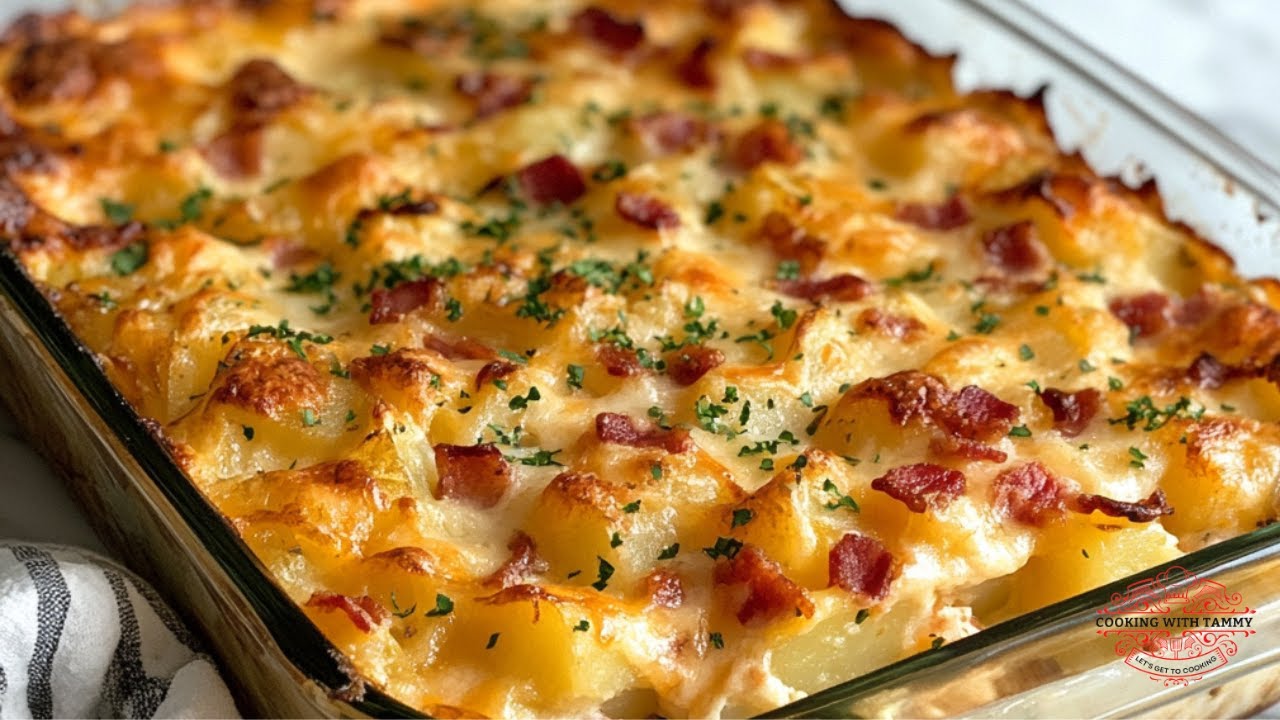
“The loaded baked potato is one of the greatest things American cooking ever produced. The casserole version should be even better — more surface area, more topping coverage, feeds a whole table without juggling individual foil packets. Most versions fail because the potatoes either turn gluey or stay undercooked in the center. The difference comes down to how you pre-cook the potatoes and how much dairy you add. We found the ratio.”
Why This Recipe Works
The loaded baked potato has survived every food trend of the last fifty years because it is structurally perfect. Fat, starch, salt, smoke, and acid in one package. The casserole version is supposed to take that perfection and scale it — one dish, one oven session, eight servings, zero babysitting. The problem is that most casserole versions betray the original by getting the texture wrong in one of two directions: too stiff and dense, or loose and watery. Both failures share the same root cause, which is that people treat this like a dump-and-bake recipe when it actually requires one precision step.
The Par-Boil Is Not Optional
The single biggest upgrade you can make to any loaded potato casserole is pre-cooking the potatoes before they go into the dish. Raw potato cubes in a casserole require sustained high heat to soften, and by the time the center reaches tenderness, the exterior has turned into a cohesive paste and the cheese on top has gone from golden to burned. Par-boiling gives you a 10-minute window of control — you stop the cooking the moment a fork enters with light resistance, and from that point forward the oven's job is flavors and crust, not raw starch.
The detail that most recipes skip is the drying step after par-boiling. Freshly drained potatoes are waterlogged. Every square centimeter of surface area is holding water that will, under oven heat, migrate into your sour cream mixture and dilute it into a thin, soupy mess. Two minutes in the dry pot over low heat, shaking occasionally, evaporates that surface moisture before it becomes your problem. It is genuinely the least glamorous step in this recipe and also the one that separates a tight, creamy casserole from a soggy one.
The Dairy Architecture
Sour cream is the backbone, but cream cheese is the structure. Where sour cream provides tang and creaminess, cream cheese provides body — a thick, stable emulsion that holds the casserole together through the full bake without breaking or weeping. The ratio matters: one cup sour cream, four ounces cream cheese, half a cup of whole milk, and three tablespoons of butter for every three pounds of potatoes. Deviate significantly in any direction and you're either eating loaded mashed potatoes or a loose gratin.
The cream cheese must be softened before mixing. Cold cream cheese does not incorporate smoothly into the sour cream and milk — it leaves lumps that never fully dissolve, creating uneven pockets of dense dairy in the finished dish. Pull it from the refrigerator thirty minutes before you start. Room temperature cream cheese folds in seamlessly.
The Cheese Timing Problem
Every version of this recipe that calls for mixing all the cheese directly into the potato base is giving you baked mac and cheese, not a loaded potato casserole. The distinction matters texturally and visually. Cheese mixed into the base and baked for forty minutes loses its identity entirely — it melts into the potatoes, coats them, and then separates back out as an oily layer when the proteins overcook. The result looks greasy and tastes flat.
The correct approach: one cup of freshly grated cheddar folded into the potato base before baking, which provides interior richness and binding, and one full cup reserved and scattered across the top for the final fifteen minutes of the bake. The topping cheese melts fast, stays distinct, and develops the blistered golden patches that tell you the casserole is ready. For the most dramatic top crust, a two-minute pass under the broiler after the cheese melts produces spectacular results — caramelized edges, deep spots of char, the kind of surface that makes people reach for the corner piece first. Use a 9x13 baking dish in ceramic or glass for the most even heat distribution across the base.
The Bacon Question
Rendering your own bacon from strips rather than using pre-cooked crumbles is a non-negotiable call if you care about the final flavor. Strip bacon rendered slowly in a cast iron skillet produces two things: crispy, deeply savory pieces for the topping, and rendered fat that carries more concentrated smokiness than the solid bacon itself. That tablespoon of reserved fat drizzled over the casserole top before baking penetrates the potato layer beneath and builds a smoke note throughout the dish that no amount of crumbled bacon on the surface can replicate.
The smoked paprika in the dairy mixture serves the same function — it establishes a low bass note of smokiness that makes every bite taste like there is more bacon present than there actually is. Think of it as a flavor scaffold: the paprika sets the expectation, and the real bacon delivers the payoff.
Where Beginners Mess This Up
Before we start, read this. These are the 4 reasons your loaded baked potato casserole (the one that beats the original) will fail:
- 1
Using raw potatoes without par-cooking: Diced raw potatoes take far longer to soften than most recipes account for. By the time the center is tender, the edges are mush and the cheese on top has burned. Par-boiling or baking the potatoes first gives you control — the casserole phase becomes about melding flavors and building the top crust, not cooking potatoes from scratch.
- 2
Overdoing the sour cream: Sour cream is the secret weapon, but it also causes the #1 texture failure. Too much and the casserole turns into a dense, gluey paste as it bakes. The ratio that works: one cup sour cream for every three pounds of potatoes. Any more and you've made mashed potato casserole, which is a different dish entirely.
- 3
Adding cheese too early: Cheddar mixed directly into the potato base before a long bake breaks down, leaches grease into the casserole, and loses its stretch. Reserve most of the cheese for the last 10-15 minutes. This gives you that visually perfect, fully melted, slightly blistered top rather than a greasy puddle buried in the potatoes.
- 4
Skipping the bacon fat: If you're rendering bacon for the topping — and you should be — do not drain all the fat. One tablespoon reserved in the pan and drizzled over the top layer adds smokiness that pre-cooked bacon crumbles alone can never replicate. It's the difference between bacon flavor and bacon presence.
The Video Reference Library
Want to see it in action? Here are the exact videos we analyzed and combined to build this foolproof recipe translation:
The source recipe that nails the layering technique and cheese timing. Clear demonstration of what the potato texture should look like before it goes into the casserole dish.
Covers the sour cream ratio problem in depth and shows the visual cues for when the casserole is done — specifically, the edges pulling away from the dish and the top achieving that spotted golden color.
Useful breakdown of the individual loaded baked potato technique translated to casserole scale, including how to adjust seasoning when cooking in bulk.
🛠️ Core Equipment
- 9x13 inch baking dishThe standard size for even heat distribution across eight portions. A smaller dish piles the potatoes too deep, meaning the center stays cold while the edges overcook. Glass or ceramic works best for gentle, even heat.
- Large pot for par-boilingYou need enough water volume that the potato pieces cook evenly without crowding. A cramped pot lowers the water temperature and leads to uneven cooking — some cubes soft, some still raw.
- Cast iron skilletFor rendering the bacon. A [cast iron skillet](/kitchen-gear/review/cast-iron-skillet) renders fat slowly and evenly, producing bacon that's crispy throughout rather than burnt on the edges and chewy in the center. The retained heat also keeps the rendered fat liquid for easy drizzling.
- Box grater or food processorFreshly grated cheddar melts in ribbons. Pre-shredded cheese is coated in anti-caking starch that prevents clean melting and adds a slightly chalky texture to the finished top. Grate it yourself.
Loaded Baked Potato Casserole (The One That Beats the Original)
🛒 Ingredients
- ✦3 pounds russet potatoes, peeled and cut into 1-inch cubes
- ✦8 strips thick-cut bacon
- ✦1 cup sour cream, full-fat
- ✦1/2 cup whole milk
- ✦3 tablespoons unsalted butter, melted
- ✦2.5 cups sharp cheddar cheese, freshly grated and divided
- ✦1/2 cup cream cheese, softened
- ✦4 green onions (scallions), thinly sliced and divided
- ✦3 cloves garlic, minced
- ✦1.5 teaspoons kosher salt
- ✦1/2 teaspoon freshly ground black pepper
- ✦1/2 teaspoon smoked paprika
- ✦1/4 teaspoon garlic powder
- ✦Fresh chives, chopped, for garnish
- ✦Additional sour cream for serving
👨🍳 Instructions
01Step 1
Preheat your oven to 375°F. Peel and cube the potatoes into roughly 1-inch pieces — uniform size is important for even cooking.
02Step 2
Place the potato cubes in a large pot, cover with cold salted water, and bring to a boil. Cook for 10-12 minutes until just fork-tender — they should yield with light pressure but not fall apart.
03Step 3
While the potatoes boil, cook the bacon in a [cast iron skillet](/kitchen-gear/review/cast-iron-skillet) over medium heat until crispy, about 8-10 minutes. Transfer to a paper towel-lined plate. Reserve 1 tablespoon of the bacon fat in the pan. Once cooled, crumble the bacon and set aside.
04Step 4
Drain the par-boiled potatoes and return them to the pot for 1-2 minutes over low heat, shaking occasionally, to steam off excess moisture.
05Step 5
In a large bowl, combine the sour cream, cream cheese, whole milk, melted butter, garlic, garlic powder, smoked paprika, salt, and pepper. Stir until smooth.
06Step 6
Add the drained potatoes to the bowl and gently fold everything together. Add 1.5 cups of the grated cheddar and half the sliced green onions. Fold until just combined — do not mash.
07Step 7
Transfer the mixture to a greased 9x13 inch baking dish and spread into an even layer. Drizzle the reserved bacon fat over the top.
08Step 8
Bake uncovered at 375°F for 25 minutes until the edges are bubbling and the center is heated through.
09Step 9
Remove from the oven, scatter the remaining 1 cup of cheddar evenly over the top, and return to the oven for 10-15 minutes until the cheese is fully melted, bubbling, and developing golden spots.
10Step 10
Remove from oven and let rest for 5 minutes. Top with the crumbled bacon, remaining green onions, and chopped chives.
11Step 11
Serve hot with additional sour cream on the side.
Nutrition Per Serving
Estimates based on standard preparation. Adjustments alter macros.
🔄 Substitutions
Instead of Sour cream...
Use Full-fat plain Greek yogurt
One-to-one swap with very similar tang and creaminess. Slightly higher protein. Do not use low-fat — the water content throws off the ratio and makes the casserole watery.
Instead of Sharp cheddar...
Use Gruyère or smoked gouda
Gruyère melts more cleanly and adds a nuttier depth. Smoked gouda leans into the bacon flavor profile. Either works, but keep at least half the cheese as something sharp for contrast.
Instead of Bacon...
Use Turkey bacon or smoked ham
Turkey bacon works but renders less fat — compensate by adding a tablespoon of butter or olive oil to the drizzle. Smoked ham gives a different but excellent flavor profile with zero rendering required.
Instead of Russet potatoes...
Use Yukon Gold potatoes
Yukon Golds hold their shape better and won't get as fluffy. The casserole will be denser and slightly creamier. Reduce par-boiling time by 2-3 minutes since Yukons cook faster.
🧊 Storage & Reheating
In the Fridge
Store covered in the baking dish or in an airtight container for up to 4 days. The flavors consolidate overnight and the next-day version is arguably better.
In the Freezer
Freeze portions in airtight containers for up to 2 months. Thaw overnight in the refrigerator before reheating. The texture softens slightly after freezing but remains entirely acceptable.
Reheating Rules
Cover with foil and reheat at 325°F for 15-20 minutes until warmed through. Add a fresh handful of cheese on top before the last 5 minutes. Avoid the microwave — it makes the potatoes rubbery.
❓ Frequently Asked Questions
Can I use a different type of potato?
Russets are strongly preferred for their high starch content, which creates the fluffy, absorbent texture that holds the dairy mixture without becoming gluey. Yukon Golds work as a substitute but stay firmer and produce a denser casserole. Red potatoes are too waxy and will resist absorbing the sour cream mixture.
Why does my casserole come out watery?
Two culprits: too much dairy (measure your sour cream, don't eyeball it) or potatoes that weren't properly dried after par-boiling. The steam-off step — returning the drained potatoes to a dry pot over low heat — is essential for removing surface moisture before adding the creamy components.
Can I make this casserole vegetarian?
Yes. Skip the bacon entirely and replace the reserved bacon fat drizzle with a tablespoon of melted butter and a pinch of smoked paprika. You maintain the smoky dimension without the pork. The rest of the recipe is unchanged.
How far ahead can I assemble it?
You can fully assemble the casserole (without the final cheese topping) up to 24 hours ahead. Cover tightly with plastic wrap and refrigerate. Add the reserved cheese before baking and increase the initial bake time by 10 minutes to account for the cold start.
Why isn't my cheese melting properly on top?
Almost certainly pre-shredded cheese. The anti-caking coating on bagged shredded cheese prevents clean melting and leaves a slightly grainy, dull surface. Grate a block of sharp cheddar yourself — it takes three minutes and makes a visible difference.
Can I double the recipe for a larger crowd?
Yes. Use two 9x13 dishes rather than one deeper dish. A single deeper vessel prevents even heat distribution and you'll end up with a properly cooked top half and undercooked bottom. Two standard dishes bake at the same temperature and time as the original recipe.

The Science of
Loaded Baked Potato Casserole (The One That Beats the Original)
We turned everything on this page into a beautiful, flour-proof PDF cheat sheet. Print it out, stick it to your fridge, and never mess up your loaded baked potato casserole (the one that beats the original) again.
*We'll email you the high-res PDF instantly. No spam, just perfectly cooked meals.
AlmostChefs Editorial Team
We translate the internet's most popular cooking videos into foolproof, beginner-friendly written recipes. We analyze multiple methods, test them in our kitchen, and engineer a single "Master Recipe" that gives you the best possible result with the least possible stress.