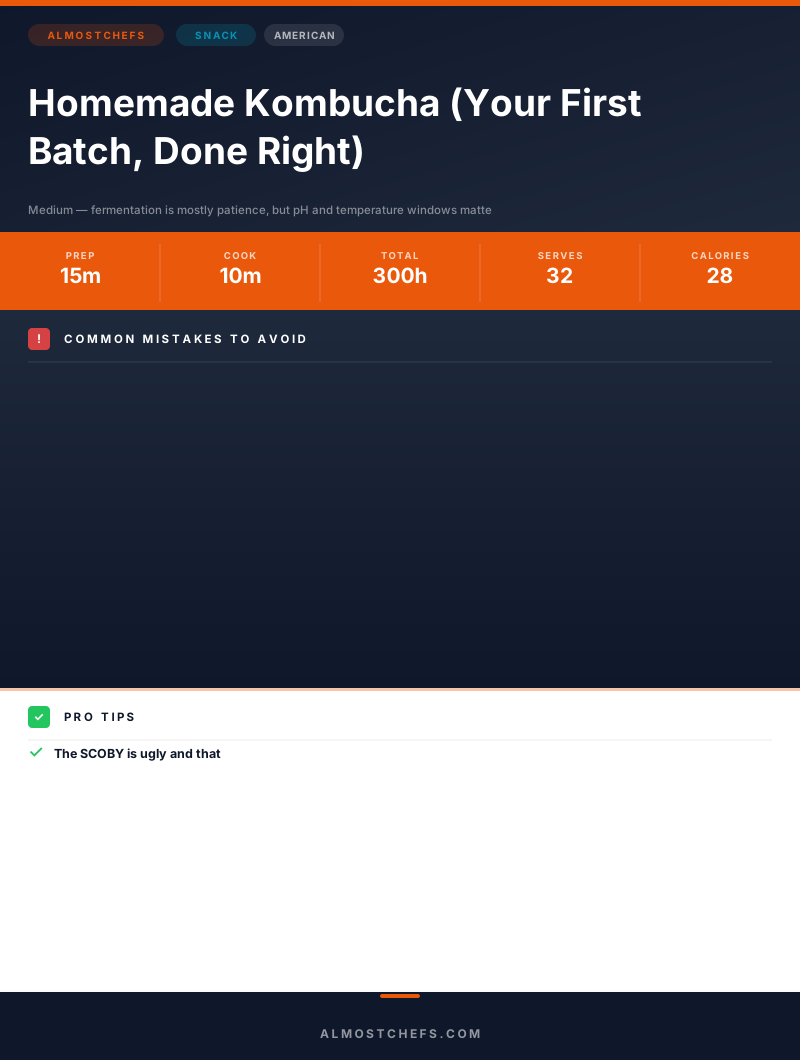
Homemade Kombucha (Your First Batch, Done Right)
A naturally carbonated fermented tea beverage made with a SCOBY, sweetened black tea, and a slow room-temperature ferment. We broke down the most common beginner mistakes and built one clear, repeatable method so your first batch tastes like something you'd actually want to drink again.

“Kombucha looks complicated because of the SCOBY. It isn't. The SCOBY is just the delivery vehicle. The real work is the tea — how strong you brew it, how completely you dissolve the sugar, and how consistently you maintain temperature during the first ferment. Get those three right and the SCOBY does the rest. Get them wrong and you get flat, vinegary liquid that no amount of fruit juice will save.”
Why This Recipe Works
Kombucha has an intimidating reputation it doesn't deserve. The SCOBY looks alien, the process takes weeks, and the word "fermentation" makes people picture something that could go very wrong. In practice, kombucha is one of the more forgiving fermentation projects you can attempt at home — the culture is self-protecting, the process is mostly hands-off, and the failure modes are usually visible and obvious before you drink anything.
What actually goes wrong is almost never the SCOBY. It's the setup around it.
The Tea Is the Foundation
Kombucha starts as sweetened tea, and the quality of that tea determines the ceiling of your final product. Steep for the full 7-10 minutes. Under-steeped tea is thin and low in tannins — the polyphenols that feed the bacterial colonies and give the finished kombucha structural body. Strong tea isn't just about flavor; it's about giving the culture the raw material it needs to do its job.
Sugar dissolves completely in hot water, which is the one functional reason you add it while the tea is still hot. Undissolved sugar doesn't ferment evenly — it sits in pockets, creates inconsistent sweetness, and confuses your fermentation timeline. Stir until you see nothing in the bottom of the pot.
Why the Starter Tea Matters More Than the SCOBY
First-time brewers obsess over the SCOBY and treat the starter tea as an afterthought. This is backwards. The SCOBY is just the physical carrier for the bacterial culture. The starter tea is the acidic environment that immediately lowers the pH of your new batch to around 4.0 — hostile territory for harmful bacteria and mold, but ideal conditions for Acetobacter and Lactobacillus to thrive.
Without enough starter tea, you're leaving a window of vulnerability in the first 48 hours when the new batch hasn't yet acidified itself. Most contamination failures — including mold — happen in that window. Two cups is the minimum. Using 3 cups makes your first few batches significantly more reliable.
Temperature Is the Variable Nobody Controls
Every kombucha guide gives you a day range for fermentation. None of them can tell you exactly how long your batch will take because they don't know your kitchen temperature. A batch in a 75°F kitchen ferments in 7-10 days. The same recipe in a 65°F kitchen takes 14-21 days. A kitchen that drops to 60°F at night will produce sluggish, under-carbonated kombucha with confused yeast.
Find the warmest stable spot in your kitchen — often the top of the refrigerator — and commit to it. Then taste starting at day 7, regardless of what any recipe tells you. Your palate is the only accurate fermentation timer you have.
The Two-Stage Logic
Most beverages are made in one step. Kombucha requires two, and understanding why makes the whole process feel less arbitrary.
First fermentation (F1) is aerobic: the jar is covered with breathable cloth, the SCOBY consumes the sugar and produces organic acids, and the liquid transforms from sweet tea into tart, lightly effervescent kombucha. You need oxygen here. A sealed lid during F1 creates pressure and starves the aerobic bacteria.
Second fermentation (F2) is anaerobic: the kombucha goes into sealed swing-top glass bottles, yeast consumes the remaining sugar and produces CO2, and the trapped gas carbonates the liquid. You need the seal here. An open container during F2 vents all the carbonation you're trying to build.
Reversing the logic — sealing during F1, breathing during F2 — produces flat, sometimes contaminated kombucha and great confusion about what went wrong. The two stages exist for opposite reasons. Treat them accordingly.
On Patience as a Technical Requirement
Fermentation can't be rushed and it can't be meaningfully monitored by looking at it. The SCOBY is doing its work whether you check every hour or check once a week. What you can do is taste intelligently, maintain a stable temperature, and resist the urge to intervene.
The brewers who produce the best kombucha are not the ones who are most attentive. They're the ones who set up the conditions correctly at the start and then leave it alone. Get the tea strong, the sugar dissolved, the starter tea in, the temperature stable — then walk away and let the culture do what it's been doing for centuries.
Where Beginners Mess This Up
Before we start, read this. These are the 4 reasons your homemade kombucha (your first batch, done right) will fail:
- 1
Adding the SCOBY to hot tea: The sweetened tea must cool completely to room temperature — ideally 75-85°F — before the SCOBY goes in. Even mildly hot liquid (above 90°F) kills or damages the delicate bacterial colonies. A damaged SCOBY ferments unevenly and can introduce mold. Wait the full 45-60 minutes. Use a thermometer if you're impatient.
- 2
Skipping or skimping on starter tea: The 2 cups of starter tea (liquid from a previous batch or store-bought plain kombucha) acidifies the new batch immediately. This low pH environment prevents harmful bacteria and mold from taking hold during the critical first 24-48 hours. Without it, you're leaving the door open to contamination. Never skip this step.
- 3
Sealing the jar during first fermentation: The first ferment is aerobic — it needs oxygen. Cover the jar with breathable cheesecloth or a coffee filter, not a lid. A sealed jar during F1 traps CO2, creates pressure, and suffocates the culture. The cloth also keeps out fruit flies, which are attracted to the vinegary smell and can ruin an entire batch.
- 4
Not tasting during fermentation: Every kitchen runs at a different temperature. The 7-30 day window is a range, not a prescription. Start tasting at day 7. You're looking for a balance of sweet and tart — not sugary, not face-puckering vinegar. If you ignore the batch for three weeks assuming it needs more time, you'll almost certainly over-ferment.
The Video Reference Library
Want to see it in action? Here are the exact videos we analyzed and combined to build this foolproof recipe translation:
The clearest walkthrough of the full two-stage fermentation process, with specific guidance on SCOBY health, starter tea ratios, and how to judge readiness by taste and appearance.
🛠️ Core Equipment
- 1-gallon glass jar with wide mouthGlass is non-reactive and won't leach chemicals into your acidic brew the way plastic does over repeated batches. Wide mouth makes SCOBY transfer easy without tearing the culture.
- Cheesecloth or coffee filtersAllows oxygen exchange during first fermentation while blocking dust, fruit flies, and debris. Multiple layers of cheesecloth are more effective than a single layer — fold it at least four times.
- Swing-top glass bottles for second fermentationAirtight swing-top or screw-cap glass bottles trap CO2 during the second ferment, building the carbonation. Never use regular mason jars for F2 — they're not rated for the pressure and can crack.
- Instant-read thermometerThe SCOBY thrives between 68-85°F. A few degrees outside this range dramatically slows or kills fermentation. Guessing by touch is inaccurate — a thermometer removes the uncertainty.
Homemade Kombucha (Your First Batch, Done Right)
🛒 Ingredients
- ✦1 SCOBY (mother culture), about 1/4 inch thick
- ✦2 cups starter tea from previous batch or plain unflavored store-bought kombucha
- ✦1 gallon filtered water
- ✦8-10 black tea bags or 2 tablespoons loose black tea leaves
- ✦1 cup organic cane sugar
- ✦2 tablespoons raw apple cider vinegar with mother
- ✦1 teaspoon dried ginger root, crushed
- ✦3-4 fresh lemon slices
- ✦1/2 teaspoon sea salt
- ✦2 tablespoons fresh ginger juice (optional, for second fermentation)
- ✦1/4 cup fresh fruit juice for flavoring (optional, for second fermentation)
- ✦Cheesecloth or coffee filter for covering jar
- ✦Rubber band for securing cloth
👨🍳 Instructions
01Step 1
Bring the filtered water to a boil in a large kettle. Add the tea bags or loose leaf tea and steep for 7-10 minutes until deeply infused.
02Step 2
Remove the tea bags or strain the loose leaves. Stir in the organic cane sugar while the liquid is still hot, mixing until completely dissolved with no visible granules.
03Step 3
Allow the sweetened tea to cool completely to room temperature — 68-85°F — approximately 45-60 minutes. Use a thermometer to verify before proceeding.
04Step 4
Transfer the cooled tea to your clean 1-gallon glass jar. Pour in the starter tea and apple cider vinegar, stirring gently to combine.
05Step 5
Add the crushed dried ginger to the jar and stir to distribute.
06Step 6
Carefully lower the SCOBY into the jar. It will likely sink initially — that's normal. A new SCOBY layer will form on the surface within a few days.
07Step 7
Cover the jar opening with 4 layers of cheesecloth or 2 coffee filters. Secure tightly with a rubber band so there are no gaps.
08Step 8
Place the jar in a warm, dark spot away from direct sunlight and temperature fluctuations. Ideal range: 68-85°F.
09Step 9
Begin tasting after 7 days. Lift the cloth and use a clean spoon to draw a small sample. You're looking for a balance of sweet and tart, with light effervescence.
10Step 10
Continue fermenting 1-3 more weeks to your preferred tartness, tasting every 2-3 days. Warmer rooms ferment faster; cooler rooms ferment slower.
11Step 11
Once the flavor is right, remove the SCOBY with clean hands and place it in a clean bowl. Reserve 2 cups of the finished kombucha as starter for your next batch.
12Step 12
Pour the remaining kombucha through a fine-mesh strainer into swing-top glass bottles, leaving 1 inch of headspace. Add optional ginger juice or fruit juice flavorings now.
13Step 13
Seal the bottles and leave at room temperature for 2-4 days for second fermentation to build carbonation. Burp each bottle once daily by cracking the cap briefly to release excess pressure.
14Step 14
Once carbonation is at your preferred level, transfer bottles to the refrigerator. Serve cold over ice with fresh fruit or herbs.
Nutrition Per Serving
Estimates based on standard preparation. Adjustments alter macros.
🔄 Substitutions
Instead of Black tea...
Use Green tea or white tea
Lighter, more floral flavor profile with lower caffeine. Both ferment successfully. Avoid herbal teas — most contain oils that can damage the SCOBY.
Instead of Organic cane sugar...
Use Organic coconut sugar
Adds a subtle caramel undertone. Lower glycemic index. The SCOBY ferments it effectively, though the final kombucha will be slightly darker in color.
Instead of Apple cider vinegar...
Use Raw unpasteurized miso paste diluted in water
Adds umami depth and additional probiotic strains. Use sparingly — the flavor is more complex and can overpower lighter teas.
Instead of Dried ginger root...
Use Fresh turmeric root plus a pinch of black pepper
Earthy, warming, anti-inflammatory. The piperine in black pepper dramatically increases curcumin absorption. Turns the kombucha a vivid golden color.
🧊 Storage & Reheating
In the Fridge
Finished kombucha keeps in sealed glass bottles in the refrigerator for up to 1 month. Flavor continues to develop slowly even when cold — it will become slightly more tart over time.
In the Freezer
Do not freeze kombucha. Freezing kills the probiotic cultures and damages the carbonation structure. The SCOBY itself should never be frozen.
Reheating Rules
Kombucha is a cold beverage. Do not heat it — sustained heat above 90°F kills the live cultures that make it valuable. Serve cold, directly from the fridge.
❓ Frequently Asked Questions
Where do I get a SCOBY if I'm starting from scratch?
Three options: buy one from a homebrew supply store or online, get one from a friend who brews (they grow a new layer every batch and usually have extras), or grow one yourself from a bottle of plain store-bought raw kombucha. The DIY method takes 2-4 weeks but works reliably.
My SCOBY sank to the bottom. Is the batch ruined?
No. SCOBYs sink, float, or drift sideways based on CO2 production and liquid density. A new SCOBY will form on the surface regardless of where the original one ends up. Both old and new are healthy and usable.
How do I know if my kombucha has mold versus normal growth?
Normal SCOBY growth is tan, cream, or light brown. Normal yeast strands hanging from the SCOBY are brown and stringy. Mold looks fuzzy — soft, raised, and distinctly green, black, blue, or pink. If you see fuzzy spots, discard everything including the SCOBY and start fresh. Do not try to save a moldy batch.
My kombucha isn't fizzy after the second fermentation. What went wrong?
Either the bottles weren't sealed airtight, the fermentation temperature was too cold (below 65°F), or the kombucha was over-fermented in F1 (too little residual sugar left for the yeast to carbonate). Try adding a small amount of fruit juice before sealing to give the yeast more sugar to work with.
Can I use tap water?
Technically yes, but filtered water is strongly recommended. Chlorine and chloramine in tap water inhibit the SCOBY's bacterial cultures. A standard carbon pitcher filter removes both. If you only have tap water, let it sit uncovered for 30 minutes before brewing to off-gas the chlorine.
How much kombucha should I actually drink per day?
4-8 ounces is a reasonable daily amount for most people. Kombucha is acidic and contains trace alcohol from fermentation (typically 0.5-3% ABV). Drinking large quantities on an empty stomach can cause bloating or digestive discomfort, especially when you're first introducing it to your diet.
The Science of
Homemade Kombucha (Your First Batch, Done Right)
We turned everything on this page into a beautiful, flour-proof PDF cheat sheet. Print it out, stick it to your fridge, and never mess up your homemade kombucha (your first batch, done right) again.
*We'll email you the high-res PDF instantly. No spam, just perfectly cooked meals.
AlmostChefs Editorial Team
We translate the internet's most popular cooking videos into foolproof, beginner-friendly written recipes. We analyze multiple methods, test them in our kitchen, and engineer a single "Master Recipe" that gives you the best possible result with the least possible stress.