Kkakdugi (Cubed Radish Kimchi)
Crunchy cubed Korean radish in a bold gochugaru-garlic-ginger paste. The essential pairing for soups, stews, and Korean BBQ.
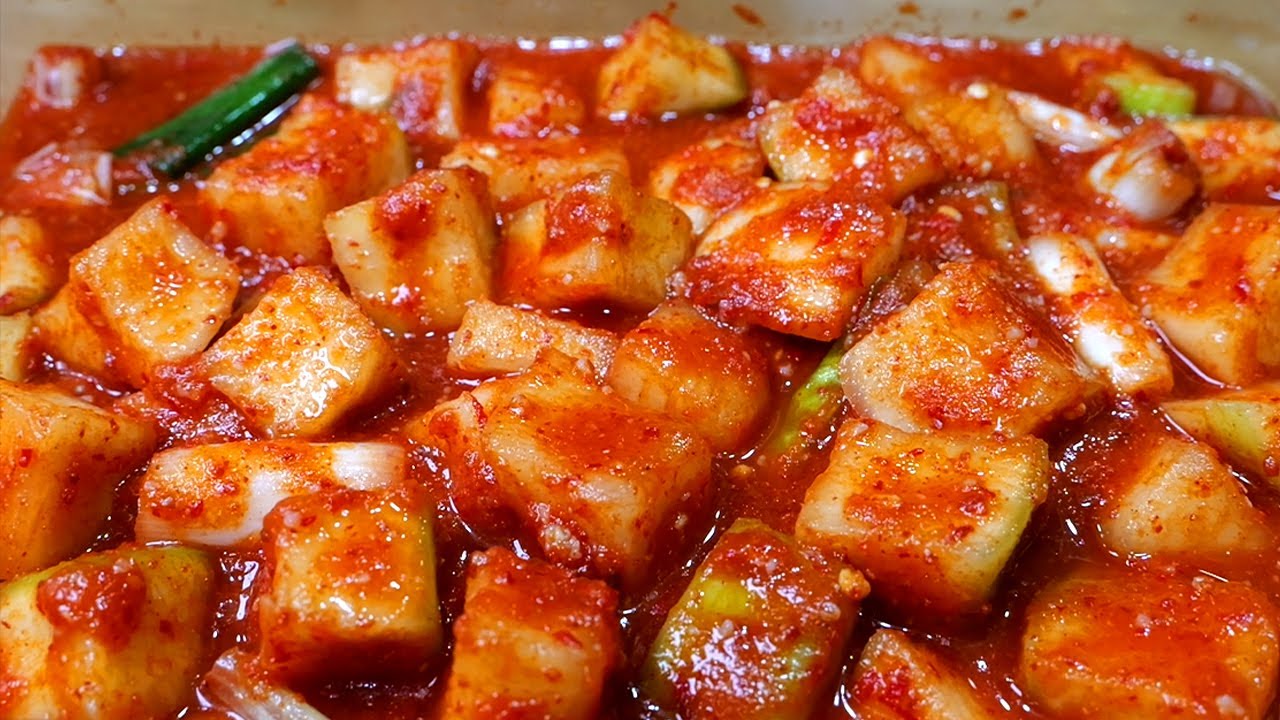
Why This Recipe Works
Kkakdugi is not complicated. That is not a compliment — it is a statement of precision. Every step in this recipe exists because fermentation is a microbial process, not a culinary art project, and the margin for structural failure is wider than most home cooks assume. You are not cooking. You are building conditions. The bacteria do the work. Your job is to not get in the way.
Here is what is actually happening, and why it matters.
Salt and Sugar: The Moisture Extraction System
The opening salting step is the most underestimated variable in this recipe. Two tablespoons of coarse sea salt draws moisture from the radish cells through osmosis — a mechanism that is elementary chemistry, not kitchen magic. The addition of one tablespoon of sugar alongside the salt is not about sweetness. Sugar accelerates moisture extraction through a secondary osmotic gradient and, more critically, it provides an immediate carbohydrate source for Lactobacillus strains already present on the radish surface. You are not seasoning the radish. You are pre-loading the fermentation substrate.
The thirty-minute rest is non-negotiable. Cutting it short means insufficient moisture extraction, which means your radish cubes will continue to weep liquid into the paste after packing, which means diluted gochugaru coating and an uneven salt environment. Rushed salting is the single most common cause of mediocre kkakdugi. Set a timer. Toss every ten minutes. Do not improvise.
Uniform Geometry Is a Fermentation Control Parameter
The instruction to cut uniform ¾-inch cubes is not aesthetic. Surface area determines how quickly the brine penetrates the radish cell walls, and surface area is a function of geometry. Irregular cubes mean irregular penetration rates: some pieces ferment aggressively while others lag. The result is a jar where half the radish tastes sharp and sour by day three and the other half still tastes raw. Use a chef's knife that you trust, on a cutting board that does not slip, and make uniform cuts. This is not a test of knife skill — it is a test of patience.
The Liquid Stays In
Step three instructs you not to drain. This will feel wrong. The bowl holds a significant amount of cloudy, slightly pink liquid by the time the salting step is done. Conventional cooking instincts say drain it. Do not. That liquid is already lightly saline and lightly sweet, it carries soluble compounds from the radish interior, and it is going to integrate into the paste as the primary brine medium for the entire ferment. Discard it and you discard the foundation of your kimchi brine. You would be diluting the finished product with water later anyway — this is better.
The Paste Arithmetic
Gochugaru, fish sauce, salted shrimp (saeujeot), garlic, and ginger. The fish sauce and shrimp are not interchangeable with each other — they are cumulative. Fish sauce delivers glutamic acid. The salted shrimp delivers glutamic acid plus additional amino acids from the fermented shellfish protein matrix. Together they create an umami density that neither produces alone. The garlic and ginger are present for antimicrobial and flavor reasons simultaneously — allicin in garlic selectively suppresses competing pathogens while allowing Lactobacillus to dominate. The ginger contributes gingerols that complement the capsaicin heat curve from the gochugaru without flattening it.
Combine everything in a large mixing bowl. Grate the ginger fresh with a microplane grater — pre-ground ginger has reduced volatile aromatic compounds and will produce a noticeably flat result. Mince the garlic fine enough that no raw chunk survives to dominate an individual bite.
Packing: Headspace Is Physics
Fermentation produces CO₂. This is known. What fewer people account for is the rate at which CO₂ production accelerates at room temperature in the first 24 hours. Your jar needs one inch of headspace at minimum. Less than that and you will find your lid pried upward by gas pressure, brine on your countertop, and oxidized top-layer radish. Pack the kkakdugi firmly into glass jars or sealed airtight containers, pressing out all air pockets below the paste surface, but leave that headspace. Burp the lid at 12 and 24 hours if you are using a sealed lid rather than a clip-top fermentation jar.
Use food-safe gloves during mixing and packing. Gochugaru will stain your hands a persistent rust-orange that does not wash off with soap. This is not a suggestion.
The Fermentation Window
Room temperature fermentation runs for one to two days. The target indicator is visible CO₂ activity — small bubbles rising through the paste when you press the surface or tilt the jar. This means your lactic acid bacteria are active and dominant. Move the jars to the refrigerator immediately. Cold fermentation slows the process by an order of magnitude and gives you control over the final acidity level. Kkakdugi eaten at three days is crunchy and mildly sour. Kkakdugi eaten at three weeks is sharper, more complex, and superior in almost every cooking application.
The Soup Pairing Is Not Accidental
Every Korean soup restaurant defaults to kkakdugi as banchan, not baechu kimchi. This is not tradition for tradition's sake. The dense, snappy texture of Korean radish cubed and fermented holds structural integrity against hot broth in a way that napa cabbage does not. A cube of aged kkakdugi placed in a bowl of seolleongtang (ox bone broth) provides textural contrast, spice, and acidity that cuts through the fat content of the milky collagen-rich broth. The pairing is a flavor engineering solution. The crunch is load-bearing.
Do it correctly once. You will never go back to the bulletpoint version.
Kkakdugi (Cubed Radish Kimchi)
🛒 Ingredients
- ✦1 large Korean radish (mu), about 2 lbs
- ✦2 tablespoons coarse sea salt (for salting)
- ✦1 tablespoon sugar (for salting)
- ✦3 tablespoons gochugaru (Korean red pepper flakes)
- ✦2 tablespoons fish sauce
- ✦1 tablespoon salted shrimp (saeujeot), minced
- ✦4 cloves garlic, minced
- ✦1 teaspoon fresh ginger, grated
- ✦3 green onions, cut into 1/2-inch pieces
- ✦1 teaspoon sugar for paste
👨🍳 Instructions
01Step 1
Peel the Korean radish and cut into 3/4-inch cubes. Uniformity matters — even cubes ferment evenly.
02Step 2
Toss the cubes with coarse salt and 1 tablespoon sugar. Let sit for 30 minutes, tossing every 10 minutes, until the radish has released liquid and is slightly flexible.
03Step 3
Don't drain the liquid — combine gochugaru, fish sauce, salted shrimp, garlic, ginger, and 1 teaspoon sugar in the same bowl. Mix well.
04Step 4
Add green onions and toss everything together until every cube is evenly coated in the red paste.
05Step 5
Pack tightly into glass jars or airtight containers. Press down to eliminate air pockets. Leave 1 inch of headspace for expansion.
06Step 6
Leave at room temperature for 1-2 days until bubbles appear. Refrigerate. Best after 3-5 days, good for months.
Nutrition Per Serving
Estimates based on standard preparation. Adjustments alter macros.
🔄 Substitutions
Instead of Korean radish (mu)...
Use Daikon radish
Milder, softer texture — works but won't have the same snappy crunch
Instead of Fish sauce + salted shrimp...
Use Soy sauce (3 tablespoons) + kelp powder
For vegan kkakdugi — increase garlic to compensate for lost umami
Instead of Gochugaru...
Use Aleppo pepper flakes
Milder heat, less Korean-specific flavor — use same amount
🧊 Storage & Reheating
In the Fridge
Keeps for 3-6 months. Gets more sour over time — ideal for cooking after 2 months.
In the Freezer
Freeze in portions for up to 6 months. Texture softens but good for stews.
Reheating Rules
Serve cold. No heating needed for banchan. For cooking, add directly to hot soups.
❓ Frequently Asked Questions
How is kkakdugi different from regular kimchi?
Same fermentation technique, different vegetable and cut. Regular kimchi uses napa cabbage in large leaves. Kkakdugi uses Korean radish in cubes. The radish provides a completely different texture — crunchy, dense, and snappy. They're often made together during kimjang and served as complementary banchan.
Why is my kkakdugi mushy?
Three possible causes: (1) not enough salt during the initial salting step, (2) cubes cut too small, or (3) fermented too long at room temperature. The salt draws out moisture and firms the radish. Larger cubes stay crunchier. Move to the fridge sooner if your kitchen is warm.

The Science of
Kkakdugi (Cubed Radish Kimchi)
We turned everything on this page into a beautiful, flour-proof PDF cheat sheet. Print it out, stick it to your fridge, and never mess up your kkakdugi (cubed radish kimchi) again.
*We'll email you the high-res PDF instantly. No spam, just perfectly cooked meals.
AlmostChefs Editorial Team
We translate the internet's most popular cooking videos into foolproof, beginner-friendly written recipes. We analyze multiple methods, test them in our kitchen, and engineer a single "Master Recipe" that gives you the best possible result with the least possible stress.