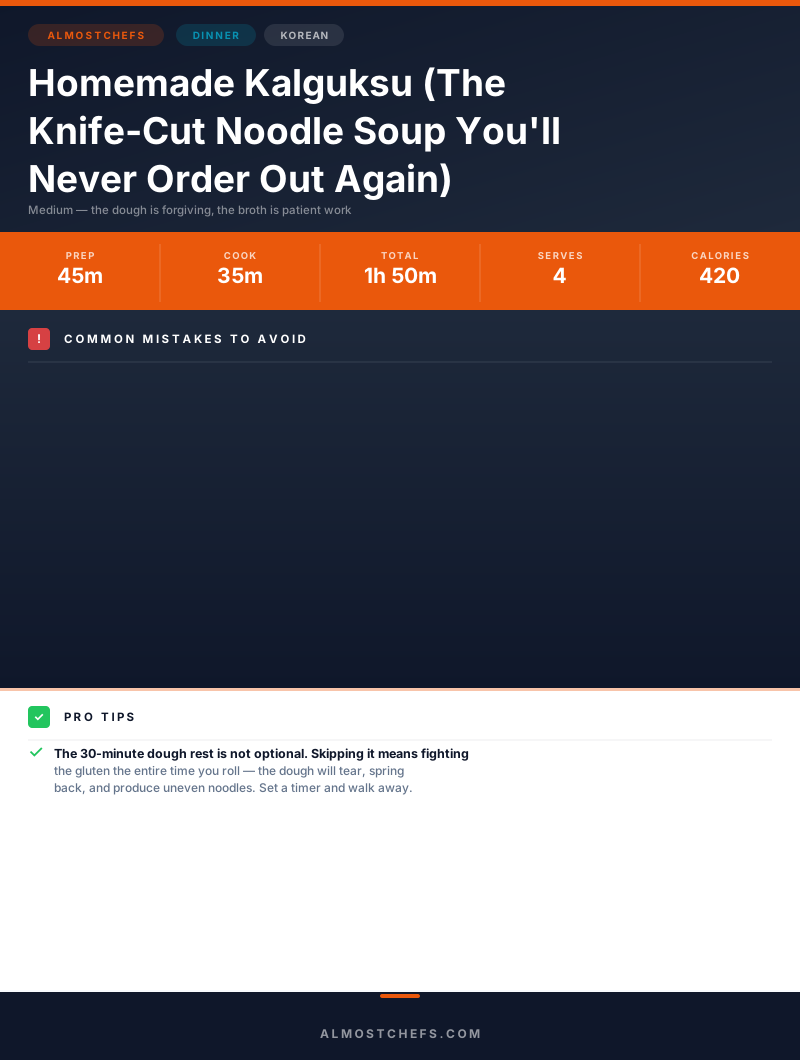
Homemade Kalguksu (The Knife-Cut Noodle Soup You'll Never Order Out Again)
A Korean knife-cut wheat noodle soup built on a slow-simmered anchovy-kelp broth, hand-rolled noodles, zucchini, and manila clams. We broke down every step — from dough hydration to broth clarity — so your first bowl comes out cleaner, silkier, and more deeply flavored than anything from a restaurant.

“Kalguksu is one of those dishes that costs almost nothing to make and tastes like it costs a fortune — if you get the broth right. The problem is that most recipes treat the anchovy stock like an afterthought: two minutes in water, done. That shortcut produces a flat, fishy liquid with none of the deep umami roundness that makes restaurant kalguksu worth returning for. The noodles are the other failure point. Too thick and they gum up. Too thin and they disintegrate. We nailed both.”
Why This Recipe Works
Kalguksu is the sleeper dish of Korean home cooking. It doesn't have bulgogi's profile or bibimbap's visual drama. It's a bowl of white noodles in clear broth — and in the hands of someone who understands the architecture, it is one of the most satisfying things Korean cuisine produces. In the hands of someone who doesn't, it's bland starchy soup with rubbery clams.
The Broth Is the Dish
Every serious Korean noodle soup starts with myeolchi-dashima stock, and the failure mode is always the same: cooks treat it like an afterthought, not a foundation. Dried anchovies simmered for three minutes produce something that tastes vaguely of the sea. Dried anchovies simmered for twenty minutes at a controlled medium-low heat produce glutamate-rich stock with depth, clarity, and a clean finish that makes every other ingredient in the bowl taste more like itself.
Two rules determine broth quality. First: toast the anchovies. Two to three minutes in a dry pan over medium heat drives off the volatile fishy compounds that make untoasted anchovy broth smell aggressive and taste bitter. What remains after toasting is sweeter, rounder, and more complex. Second: the kelp goes in cold and comes out before the boil. Kombu (dashima) dissolved in hot water contributes glutamic acid — pure umami — but left in a boil it releases polysaccharides that make the broth cloudy and bitter. Cold start, pull early. The entire technique is thermal discipline.
The Noodle Science
Kalguksu dough is a minimalist formula: flour, salt, water, time. The hydration ratio — roughly 55-60% water to flour by weight — produces a firm, workable dough that rolls thin without tearing and holds its texture in hot broth for several minutes before softening into mush. That window is your serving window.
The 30-minute rest transforms the dough more than any technique will. Freshly mixed dough has tight, contracted gluten strands that fight you when you roll — they spring back the moment you lift the rolling pin. Rested dough has relaxed gluten that stretches uniformly and holds its shape after cutting. Skip the rest and you spend ten minutes rolling, accomplishing nothing. Respect the rest and the dough rolls to even thickness in four passes.
Cutting width matters more than most recipes admit. At 2-3mm, noodles cook through in 4-5 minutes with a tender, slightly chewy center. At 5mm — the default when beginners cut cautiously — you get noodles with a chalky, undercooked core by the time the broth surface shows done. A sharp chef's knife and a steady hand produce strips the width of a pencil line. That's the target.
The Clam Variable
Manila clams are not mandatory in kalguksu — many versions omit them entirely. But when they're in season and in the pot, they transform the broth. Clams release saline, mineral-rich liquid as they open, enriching the anchovy stock with a second layer of oceanic depth that no seasoning can replicate. They also provide the only moment of textural drama in an otherwise texturally uniform bowl.
The timing rule is simple: clams and noodles go in together. Both take 4-5 minutes. Both finish at the same time. Offset the timing in either direction and one element suffers.
Blood Sugar and the Handmade Advantage
Factory-extruded noodles are processed at high heat and pressure, which alters the starch structure and raises the glycemic index. Handmade kalguksu noodles — mixed cold, rested, and rolled without heat — retain a denser starch structure that digests more slowly. The protein from clams and the fiber from zucchini moderate the glucose curve further. This is not incidental to the dish. Kalguksu has been part of Korean convalescent and recovery cooking for centuries precisely because it's nourishing without being metabolically aggressive. Use a kitchen scale to measure flour by weight if you want consistency across batches — hydration percentages are more precise than volume measures for dough.
The result is a bowl that is, objectively, greater than the sum of its parts. Clear broth. Silky noodles. Tender clams. The kind of food that makes you wonder why you ever ordered it out.
Where Beginners Mess This Up
Before we start, read this. These are the 4 reasons your homemade kalguksu (the knife-cut noodle soup you'll never order out again) will fail:
- 1
Rushing the anchovy-kelp broth: The broth is the entire dish. Dried anchovies (myeolchi) need 20 minutes of gentle simmering — not boiling — to release their glutamates without turning bitter. Kelp (dashima) should be added cold and removed before the simmer starts; it turns slimy and bitter when cooked. Most home cooks do both steps wrong simultaneously.
- 2
Over-hydrating or under-hydrating the noodle dough: Kalguksu dough is a low-hydration flour-and-water dough — typically 55-60% hydration. Too much water and the noodles turn mushy in the broth within minutes. Too little and they crack when you roll them thin. The dough should feel like a firm earlobe when properly mixed: smooth, slightly resistant, not sticky.
- 3
Cutting the noodles too thick: Hand-cutting noodles without a pasta machine tempts people to go thick for safety margins. Kalguksu noodles should be 2-3mm wide and rolled to 2mm thick — not the chunky 5mm strips most beginners produce. Thick noodles never cook through evenly in the time it takes the broth to reduce, leaving a chalky core.
- 4
Adding vegetables too early: Zucchini takes 4-5 minutes in simmering broth to soften correctly. Add it when the noodles go in and it turns into mush. Add it 2 minutes before the noodles and it holds its shape while still absorbing broth flavor. Timing vegetables in noodle soups is chronological discipline, not cooking instinct.
🛠️ Core Equipment
- Rolling pinA long, thin rolling pin gives you leverage to roll the dough to an even 2mm thickness. A short French rolling pin works but requires more passes and more elbow pressure to avoid uneven spots.
- Heavy-bottomed stockpotYou need volume for the broth and space for the noodles to move freely without clumping. A [Dutch oven](/kitchen-gear/review/dutch-oven) or deep stainless pot at least 6 quarts keeps the broth at an even simmer without scorching.
- Fine-mesh strainerStraining the finished anchovy-kelp broth removes all solids cleanly. A murky, particle-heavy broth is visually unappetizing and carries bitter sediment from the anchovy heads. Clarity is part of the dish.
- Sharp chef's knifeThe dish is literally named after the knife — kal means knife, guksu means noodles. A dull blade drags and crushes the dough instead of cutting through it cleanly, which deforms the noodle cross-section and causes uneven cooking.
Homemade Kalguksu (The Knife-Cut Noodle Soup You'll Never Order Out Again)
🛒 Ingredients
- ✦2 cups all-purpose flour, plus extra for dusting
- ✦1/2 teaspoon fine sea salt
- ✦2/3 cup cold water, plus 1-2 tablespoons as needed
- ✦20 large dried anchovies (myeolchi), heads and guts removed
- ✦1 piece dried kelp (dashima), roughly 4x4 inches
- ✦8 cups cold water (for broth)
- ✦1 medium zucchini, halved and sliced into half-moons
- ✦1 pound manila clams or littleneck clams, scrubbed
- ✦4 green onions, cut into 1-inch segments
- ✦2 teaspoons soy sauce
- ✦1 teaspoon fish sauce
- ✦1/4 teaspoon ground white pepper
- ✦Sea salt to taste
- ✦1 tablespoon sesame oil (for finishing)
- ✦2 eggs, beaten (optional, for egg drop finish)
👨🍳 Instructions
01Step 1
Combine flour and salt in a large bowl. Add 2/3 cup cold water gradually, mixing with a fork until shaggy. Turn out onto a lightly floured surface and knead for 8-10 minutes until smooth and firm.
02Step 2
Wrap the dough tightly in plastic wrap and rest at room temperature for 30 minutes. This is non-negotiable — the gluten needs to relax or the dough will spring back when you roll it.
03Step 3
Place the kelp in 8 cups cold water and bring slowly to a near-simmer over medium heat. Remove kelp just before the water boils (small bubbles forming at the base).
04Step 4
Add the cleaned dried anchovies to the kelp water. Simmer gently over medium-low heat for 20 minutes. Do not boil — a hard boil extracts bitter oils from the anchovy bones.
05Step 5
Strain the broth through a fine-mesh strainer, discarding all solids. Return the clear broth to the pot. Season with soy sauce, fish sauce, and white pepper.
06Step 6
On a generously floured surface, roll the rested dough into a thin sheet approximately 2mm thick. Dust the top surface with flour and fold the sheet over itself 4-5 times like a letter.
07Step 7
Using a sharp chef's knife, cut the folded dough into strips 2-3mm wide. Shake the cut noodles gently to unfurl them and dust off excess flour.
08Step 8
Bring the broth to a medium simmer. Add zucchini and cook for 2 minutes.
09Step 9
Add the noodles and clams simultaneously. Cook for 4-5 minutes, stirring gently to prevent noodles from clumping, until noodles are tender and all clams have opened.
10Step 10
If using eggs, drizzle the beaten eggs in a slow, thin stream around the edges of the pot while gently stirring. They will cook into silky ribbons in 30 seconds.
11Step 11
Add green onions, drizzle with sesame oil, and taste for salt. Serve immediately in deep bowls.
Nutrition Per Serving
Estimates based on standard preparation. Adjustments alter macros.
🔄 Substitutions
Instead of All-purpose flour...
Use 00 flour or a 70/30 blend of all-purpose and whole wheat
00 flour produces silkier noodles with a more delicate texture. Whole wheat blend adds fiber and a slightly nutty flavor while slowing digestion — ideal for blood sugar management.
Instead of Dried anchovies (myeolchi)...
Use Dried sardines or a combination of kombu and bonito flakes
Dried sardines produce a slightly fishier, bolder broth. Kombu-bonito is more delicate and closer to Japanese dashi — still excellent but less distinctly Korean.
Instead of Manila clams...
Use Frozen shrimp or sliced squid
Both work well. Add shrimp in the last 2 minutes only — they overcook faster than clams. Squid should be added with the noodles and will be perfectly tender by the time they're done.
Instead of Fish sauce...
Use Additional soy sauce with a drop of rice vinegar
Loses some of the oceanic depth but keeps the umami profile intact. Suitable for those avoiding shellfish-derived ingredients.
🧊 Storage & Reheating
In the Fridge
Store noodles and broth separately for up to 2 days. Combined, the noodles absorb the broth overnight and become bloated. Reheat broth separately and add noodles fresh or reheat them in the broth for 2 minutes.
In the Freezer
Freeze the broth alone for up to 3 months. Uncooked cut noodles can be frozen flat on a sheet pan, then transferred to a bag — cook directly from frozen, adding 2 extra minutes to cook time.
Reheating Rules
Reheat broth to a full simmer before adding stored noodles. Never microwave the combined dish — the noodles turn rubbery and the broth becomes uneven.
❓ Frequently Asked Questions
Why are my kalguksu noodles mushy?
Either the dough was overhydrated, the noodles were cut too thick, or they sat in the broth too long before serving. Kalguksu noodles continue cooking and absorbing liquid even off heat. Serve immediately after the noodles are tender — do not let the pot sit.
Can I make the noodles ahead of time?
Yes. Cut noodles can be dusted generously with flour, loosely bundled, and refrigerated for up to 24 hours or frozen flat for up to 1 month. Cook directly from cold — they may need an extra 30 seconds in the broth.
My broth tastes flat. What went wrong?
Most likely the anchovies weren't toasted beforehand, the broth boiled too hard and extracted bitter compounds, or the fish sauce was skipped. Season in layers — soy sauce for base salinity, fish sauce for depth, and a final taste adjustment at the end. Flat broth almost always just needs more fish sauce.
Is kalguksu good for blood sugar management?
Handmade noodles made from flour and water have a lower glycemic index than refined factory noodles because the dough structure is denser and digests more slowly. The protein from clams and the fiber from zucchini further moderate the glucose response. Substituting 30% of the flour with whole wheat flour improves this further.
Why did some of my clams not open?
Clams that remain closed after cooking were dead before they went into the pot. Discard them — they are unsafe to eat. This is not a cooking failure; it's a sourcing issue. Buy clams the day you plan to cook and store them in a bowl covered with a damp towel, never in standing water.
What is the difference between kalguksu and sujebi?
Both are Korean wheat-based soups using the same anchovy-kelp broth. Kalguksu uses rolled and knife-cut noodles with a consistent shape. Sujebi uses hand-torn irregular dough pieces that are thicker, chewier, and more rustic. Sujebi is faster to make since there's no rolling — but kalguksu has more refined texture.
The Science of
Homemade Kalguksu (The Knife-Cut Noodle Soup You'll Never Order Out Again)
We turned everything on this page into a beautiful, flour-proof PDF cheat sheet. Print it out, stick it to your fridge, and never mess up your homemade kalguksu (the knife-cut noodle soup you'll never order out again) again.
*We'll email you the high-res PDF instantly. No spam, just perfectly cooked meals.
AlmostChefs Editorial Team
We translate the internet's most popular cooking videos into foolproof, beginner-friendly written recipes. We analyze multiple methods, test them in our kitchen, and engineer a single "Master Recipe" that gives you the best possible result with the least possible stress.