Spicy Korean Jjolmyeon (Get the Sauce Right or Don't Bother)
Thick, springy wheat noodles tossed in a fiery-sweet gochujang sauce with crunchy vegetables and a jammy egg. We broke down every sauce variable — sugar ratio, vinegar balance, sesame oil timing — to give you the formula that makes jjolmyeon taste like the street stall version, not a sad desk lunch.

“Jjolmyeon is deceptively simple: boil noodles, make sauce, toss. But somewhere between the packet and the bowl, most home versions end up cloyingly sweet, or aggressively vinegary, or flat. The noodles matter less than you think. The sauce is everything. Once you understand what each ingredient is doing in that sauce — and in what order you add them — you stop guessing and start nailing it every time.”
Why This Recipe Works
Jjolmyeon is Korean street food logic applied to noodles: maximum flavor, minimum technique, no margin for sloppiness. The dish has exactly four moving parts — noodles, sauce, vegetables, egg — and because there's nowhere to hide, every single one of them has to perform. Most home versions fail not because the recipe is wrong but because the cook doesn't understand what they're actually trying to achieve at each step. They eyeball the sauce ratios, they let the noodles sit, they use whatever pot is already on the stove. Then they wonder why the bowl tastes flat and sad compared to the street stall version they're chasing. This is why.
The Noodle Problem
Jjolmyeon (쫄면) translates literally to "chewy noodles," which is the entire brief stated plainly. These are thick wheat flour strands extruded under high pressure to create an almost rubbery density — the same elastic resistance you get in a properly cooked udon, but tighter and denser. This texture is not incidental. It is the reason the dish exists. The chew is structural. Lose the chew and you have spicy pasta, which is a different and lesser thing.
Preserving that chew requires two conditions: the right pot and the right rinse. For the pot: use a large pot with enough water that the noodles have room to move freely. Jjolmyeon noodles release a significant amount of surface starch as they hydrate and cook. In a pot that's too small, that starch concentration in the water turns the noodles gummy and causes them to clump into a mass you will never fully separate. Plenty of water dilutes the starch fast enough that the noodles cook individually. This is basic noodle physics, not a suggestion.
For the rinse: jjolmyeon has no al dente phase. You cook them fully through — test by pressing a noodle between your fingers, it should be uniformly soft with a springy bounce-back — then get them immediately into ice-cold water in a fine-mesh colander or sieve. The cold water stops the cooking instantly by contracting surface proteins and locking the gelatinized starch in place. Hot noodles sitting in residual heat keep cooking past their window. Cold water stops the clock precisely. The window between perfectly chewy and disappointingly soft is measured in under a minute. Treat it accordingly. After rinsing, shake the colander hard, repeatedly. Residual water on the noodles is sauce dilution you cannot recover from.
Sauce Architecture
The sauce is five load-bearing components: gochujang for fermented depth and sweetness, gochugaru for bright surface heat, rice vinegar for acid structure, soy sauce for salt and savory foundation, and sugar to pull the whole system into balance. Every single one is doing a distinct and irreplaceable job. When jjolmyeon sauce tastes wrong — and amateur versions almost always taste wrong in one of three specific ways — the failure is always traceable to a single component that's out of proportion.
The diagnostic sequence is: sweetness first, acid second, salt third, heat last. Taste the sauce before the sesame oil is added. Fix it in that order. More sugar if it's sharp and aggressive. More vinegar if it's cloying. More soy sauce if it tastes flat. More gochugaru only after the base is already right — adding more heat to a sauce that's structurally broken just masks the problem while making it hotter.
Once the base is correct, add the sesame oil last, right before tossing. Sesame oil is an aromatic finisher, not a base ingredient. The volatile compounds responsible for its distinctive fragrance begin dissipating the moment they're exposed to the other acidic components in the sauce. Build it in early and you'll get negligible sesame flavor by the time the noodles reach the table. Add it at the end and you get the full aromatic hit. This is not a subtle difference. It is immediately, unambiguously detectable in the bowl.
The mandatory five-minute rest between mixing and use is not optional patience theater. Gochujang is a fermented paste with raw, sharp edges when it first meets vinegar and sugar. Those five minutes allow the acid to begin softening the gochujang's fermented bite and for the sugar to fully dissolve and integrate into the liquid components. Sauce applied immediately after mixing delivers flavor in disconnected, sequential waves — you taste the vinegar pop, then the chili heat, then the sweetness chasing behind. Rested sauce collapses those layers into a single, coherent profile that hits all at once. Identical ingredients. Five minutes of difference. The cost is nothing.
The Mixing Bowl Problem Nobody Talks About
Tossing jjolmyeon properly requires a large mixing bowl — at minimum twice the volume of the noodles you're dressing. This is not about convenience. It is about sauce distribution, which is the only thing that matters once the sauce is correctly made.
In an undersized bowl, the noodles pile up on themselves. The sauce pools at the bottom and saturates the lower noodles while the upper half stays dry and inadequately coated. You toss, you redistribute, you toss again, and the sauce still never reaches equilibrium because there's no room for the noodles to actually move. By the time the bowl reaches the table, you have a gradient from overdressed at the bottom to underseasoned at the top. A properly sized bowl gives every strand of noodle equal access to the sauce. Toss aggressively for sixty to ninety seconds, use tongs or chopsticks, and don't stop until the color is uniform.
Vegetable Function
Cucumber, cabbage, and carrot are canonical jjolmyeon toppings, and their presence is not decorative or nutritional. They are performing specific mechanical functions in the bowl. All three provide textural counterpoint to the dense, chewy noodles — the cool crunch interrupts the monotony that would otherwise build by the third bite. They also moderate sauce absorption. Cold vegetables slow the rate at which the gochujang sauce bleeds further into the noodles, preserving sauce intensity throughout the meal rather than front-loading all the flavor in the first few bites.
Both of these functions require the vegetables to be cold, dry, and cut thin. Room-temperature vegetables wilt under the sauce and release their internal moisture into the bowl, diluting everything. Thick-cut vegetables sit inertly on top of the noodles instead of integrating with them. Julienned, refrigerated, and drained: this is the specification. Comply with it.
The Egg Is Not Optional
A 7-minute soft-boiled egg — halved, placed alongside, yolk still jammy — is not a garnish. As you eat, the yolk breaks and bleeds into the sauce. It adds fat and richness that rounds the heat without dulling it, and provides a creaminess that no other ingredient in this bowl can replicate. The yolk becomes a secondary sauce. Eat the bowl with the egg folded in actively, not set aside. The experience of the dish depends on it.
The technique is precise: 7 minutes in simmering water, then immediately into an ice bath until the egg is cold all the way through. An egg that sits at room temperature for 5 minutes after cooking continues cooking from residual heat. Your 7-minute egg is now a 9-minute egg, and the yolk has firmed from jammy to chalky. Ice bath, immediately, full stop.
Jjolmyeon is proof that minimal food has no tolerance for approximation. The technique load is low. The margin for error is not. Every shortcut you take shows up directly in the bowl.
Where Beginners Mess This Up
Before we start, read this. These are the 4 reasons your spicy korean jjolmyeon (get the sauce right or don't bother) will fail:
- 1
Rinsing the noodles with warm water: Jjolmyeon noodles must be rinsed under ice-cold running water immediately after boiling, then drained hard and shaken. Warm water keeps residual heat in the noodles, which causes them to keep cooking and lose the signature chew. Cold water stops the cook instantly and sets the texture. Use the coldest tap water you have, or add ice to your rinse.
- 2
Adding sesame oil to the sauce too early: Sesame oil is volatile. Mix it into the sauce base minutes before you need it and the aromatic compounds start dissipating. Add it last, right before tossing — or better, drizzle it directly onto the dressed noodles at the table. The difference in fragrance is not subtle.
- 3
Skipping the sauce rest: Gochujang is a fermented paste with sharp edges when raw. Mixing the sauce and letting it sit for even 5 minutes allows the vinegar, sugar, and gochujang to mellow into each other. Sauce applied immediately after mixing tastes spiky and one-dimensional. Five minutes costs nothing.
- 4
Under-draining the noodles: Residual water on the noodles dilutes the sauce by 20-30% and turns the whole bowl watery by the time you're halfway through. After rinsing, shake the colander vigorously, press the noodles gently, and shake again. The noodles should feel tacky, not wet.
🛠️ Core Equipment
- Large potJjolmyeon noodles are thick and expand significantly during boiling. Too small a pot causes uneven cooking and noodles that clump and stick together. Use the biggest pot you have and salt the water well.
- Fine-mesh colander or sieveEssential for the ice-water rinse. The fine mesh catches the noodles completely so none slip through, and allows fast, even cold-water drainage. A standard colander with large holes can miss noodle bundles and trap water in pools.
- Large mixing bowlTossing jjolmyeon requires room. In a bowl that's too small, the sauce doesn't distribute evenly — the bottom noodles get overdressed and the top stays dry. Use a bowl that's at least twice the volume of the noodles.
Spicy Korean Jjolmyeon (Get the Sauce Right or Don't Bother)
🛒 Ingredients
- ✦200g dried jjolmyeon noodles (or thick wheat noodles)
- ✦2 tablespoons gochujang (Korean red chili paste)
- ✦1 tablespoon gochugaru (Korean red chili flakes)
- ✦2 tablespoons rice vinegar
- ✦1.5 tablespoons soy sauce
- ✦1.5 tablespoons sugar
- ✦1 tablespoon toasted sesame oil
- ✦1 teaspoon minced garlic
- ✦1 teaspoon toasted sesame seeds
- ✦1 cup cucumber, julienned
- ✦1 cup cabbage, thinly shredded
- ✦1 medium carrot, julienned
- ✦4 perilla leaves, thinly sliced (optional)
- ✦2 large eggs
- ✦1 tablespoon mayonnaise (optional, for richness)
- ✦Ice water for rinsing
👨🍳 Instructions
01Step 1
Combine gochujang, gochugaru, rice vinegar, soy sauce, sugar, and minced garlic in a bowl. Stir until the sugar fully dissolves.
02Step 2
Set the sauce aside and let it rest for at least 5 minutes.
03Step 3
Bring a large pot of water to a rolling boil. Add the jjolmyeon noodles and cook according to package directions, usually 4-5 minutes, stirring occasionally to prevent clumping.
04Step 4
Drain the noodles immediately and rinse under ice-cold running water for 30-45 seconds, tossing the noodles continuously. Drain thoroughly and shake the colander hard several times.
05Step 5
Prepare your soft-boiled eggs: lower eggs into simmering water, cook for 7 minutes, then transfer immediately to an ice bath for 5 minutes. Peel and halve.
06Step 6
Add the sesame oil to the sauce and stir to combine. Pour the sauce over the drained noodles.
07Step 7
Toss the noodles aggressively using tongs or chopsticks for 60-90 seconds until every strand is evenly coated. Add mayonnaise if using and toss again.
08Step 8
Divide into bowls. Arrange the julienned cucumber, cabbage, carrot, and perilla leaves over the top. Place the halved eggs alongside.
09Step 9
Finish with a scatter of toasted sesame seeds and an optional extra drizzle of sesame oil. Serve immediately.
Nutrition Per Serving
Estimates based on standard preparation. Adjustments alter macros.
🔄 Substitutions
Instead of Jjolmyeon noodles...
Use Thick udon noodles or bucatini
Udon is the closest substitute in texture — thick, chewy, and forgiving. Bucatini works in a pinch but lacks the same springy resistance. Do not use spaghetti or regular ramen noodles; they're too thin and will turn to mush under the sauce.
Instead of Gochujang...
Use Doenjang (soybean paste) plus gochugaru
Mix 1 tablespoon doenjang with 1.5 tablespoons gochugaru and a half teaspoon of sugar. You lose the fermented chili sweetness but keep the depth. The flavor profile shifts toward earthier and saltier.
Instead of Rice vinegar...
Use Apple cider vinegar or distilled white vinegar
Rice vinegar is mellow and slightly sweet. Apple cider vinegar is sharper with fruity undertones — reduce the quantity by 20%. White vinegar is the sharpest; use 25% less and add a pinch more sugar.
Instead of Perilla leaves...
Use Fresh basil or shiso
Perilla has an anise-mint quality that basil approximates reasonably well. Shiso is botanically the same plant as Korean perilla — use it as a one-for-one swap with zero compromise.
🧊 Storage & Reheating
In the Fridge
Store undressed noodles and sauce separately in airtight containers for up to 2 days. Dressed noodles do not store well — the sauce absorbs into the noodles and they lose their chew.
In the Freezer
Not recommended. Jjolmyeon noodles turn grainy and fall apart after freezing and thawing.
Reheating Rules
If you must reheat, briefly dip the noodles in boiling water for 30 seconds to loosen them, then rinse cold and re-dress with fresh sauce. Do not microwave — it destroys the noodle texture entirely.
❓ Frequently Asked Questions
Where do I find jjolmyeon noodles?
Any Korean grocery store will carry them in the dry noodle aisle, usually in a yellow or orange package. Online Korean grocery retailers also stock them reliably. If you cannot find them, thick fresh udon noodles from the refrigerated section are the best substitute.
Why are my noodles clumping together?
Two causes: you didn't use enough water when boiling, or you didn't rinse fast enough after draining. Jjolmyeon noodles release a lot of starch and stick aggressively if they sit in residual heat. Get them into cold running water within 10 seconds of draining.
How do I control the heat level?
Gochujang contributes most of the heat. Gochugaru adds a brighter, drier spice on top. Reduce gochugaru first if you want less heat — it has less impact on flavor complexity than gochujang. For a milder version, halve the gochugaru and add a tablespoon of tomato paste to maintain color.
Is jjolmyeon served hot or cold?
Cold or at room temperature. The cold noodles against the spicy sauce is the point — the contrast is structural, not optional. If you want a hot version, look at budae jjigae or rabokki, which use similar flavors in a broth-based hot format.
Can I make this vegan?
Yes, with minor adjustments. Skip the egg. Replace soy sauce with tamari for a gluten-free option. Check your gochujang label — most are vegan, but some brands add anchovy extract. The dish is naturally dairy-free.
What does jjolmyeon taste like compared to bibim naengmyeon?
Both are cold spicy noodle dishes with gochujang-based sauces, but the textures are very different. Naengmyeon uses thin buckwheat noodles that are slippery and slightly elastic. Jjolmyeon uses thick wheat noodles that are dense and springy. Jjolmyeon sauce also tends to be sweeter and less vinegar-forward than naengmyeon's.
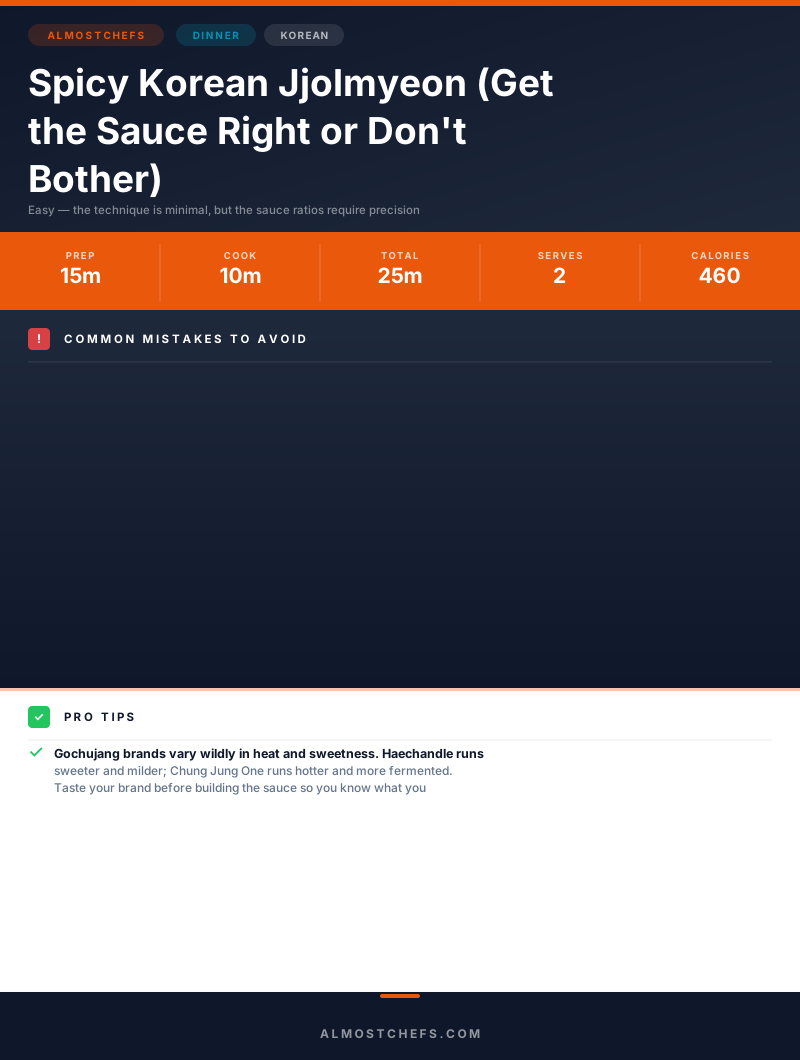
The Science of
Spicy Korean Jjolmyeon (Get the Sauce Right or Don't Bother)
We turned everything on this page into a beautiful, flour-proof PDF cheat sheet. Print it out, stick it to your fridge, and never mess up your spicy korean jjolmyeon (get the sauce right or don't bother) again.
*We'll email you the high-res PDF instantly. No spam, just perfectly cooked meals.
AlmostChefs Editorial Team
We translate the internet's most popular cooking videos into foolproof, beginner-friendly written recipes. We analyze multiple methods, test them in our kitchen, and engineer a single "Master Recipe" that gives you the best possible result with the least possible stress.