Japchae (Glass Noodle Stir-Fry)
Sweet potato glass noodles stir-fried with colorful vegetables, beef, and a savory-sweet soy-sesame sauce. Korea's favorite celebration dish.
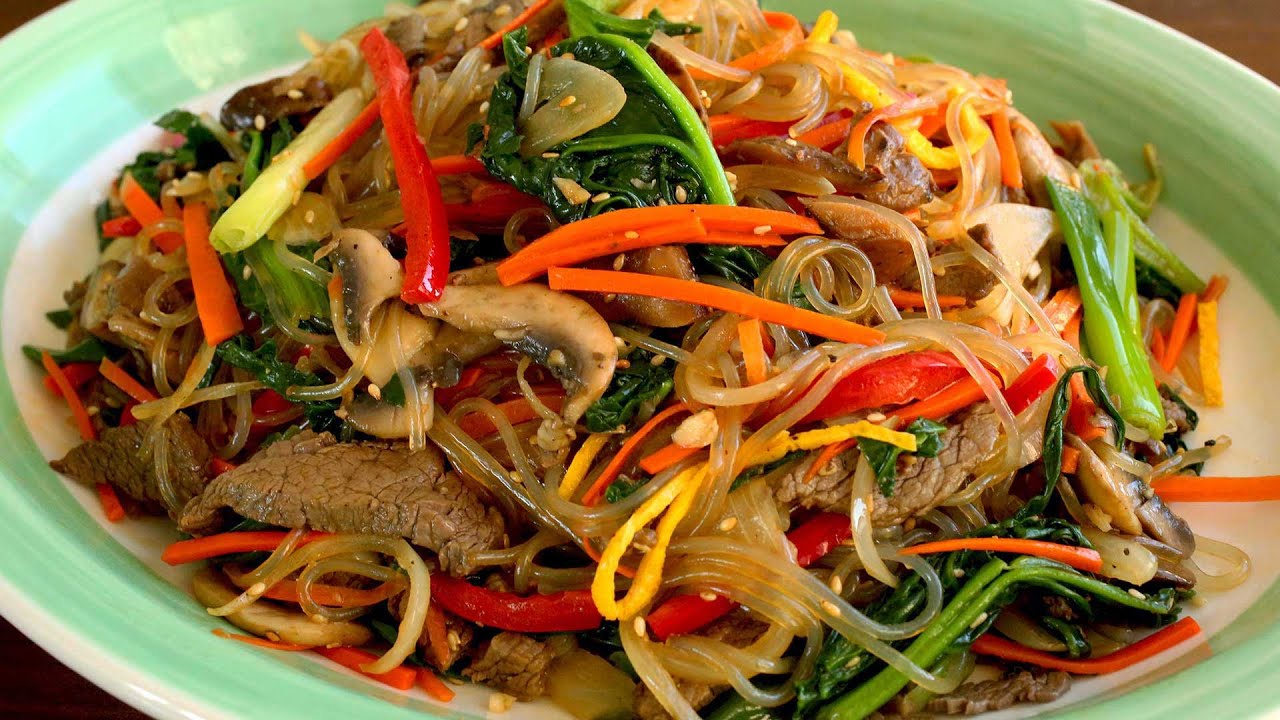
Why This Recipe Works
Most stir-fry recipes fail for the same reason: impatience dressed up as efficiency. The home cook dumps everything into a single pan, congratulates themselves on a one-pot dinner, and produces a steaming pile of uniformly limp vegetables suspended in diluted sauce. Japchae does not work that way. Japchae cannot work that way. The dish is, structurally, a study in controlled separation — a methodology refined over centuries in Korean court kitchens where imprecision was not a personality trait but a professional failure.
Here is the science behind why every single step of this recipe is non-negotiable.
The Dangmyeon Noodle Is Not a Substitution
Korean sweet potato starch noodles — dangmyeon — are made from a single ingredient: the starch extracted from sweet potatoes. When hydrated and cooked, the starch chains form a dense, elastic gel network that produces a chew nothing else replicates. The texture under the tooth is described in Korean as 쫄깃 (jjolgit) — a springy, almost rubbery resistance that signals structural integrity. It is not soft. It is not slippery. It holds.
Compare this to mung bean glass noodles, which collapse under the same sauce volume, or shirataki, which are 97% water and have the structural integrity of wet paper. The choice of dangmyeon is not a cultural formality — it is a material specification. Substituting it fundamentally changes the load-bearing capacity of the dish, because these noodles are the vehicle through which the sauce travels and the element around which everything else organizes.
Cook them in rolling boiling water for exactly 6-7 minutes. Not 5. Not 9. Pull them at the outer edge of chewy, not the inner edge of soft. Drain immediately, rinse with cold water to halt the gelatinization process, then cut with kitchen scissors into 6-8 inch lengths. This is not optional. At full length, dangmyeon are structurally unmanageable — you will not toss them evenly, you will not coat them uniformly, and you will not eat them without wearing the sauce on your shirt.
The Rule of Separate Components
The cornerstone of Korean namul philosophy — the idea that each vegetable should be seasoned and cooked as an individual entity — is not a tradition preserved for sentimental reasons. It is a direct response to the biological reality that different plant tissues have different thermal tolerances and moisture contents.
Spinach is 91% water by weight. At high heat, it collapses in under 30 seconds. A 30-second blanch followed by thorough squeezing removes excess liquid while preserving chlorophyll structure. Cook it with carrots, which require 2 full minutes of dry heat before their cell walls begin to soften, and you get one of two outcomes: raw carrots or destroyed spinach. There is no third option.
Shiitake mushrooms operate on a third timeline entirely. They need sustained high heat in a dry pan to drive off surface moisture and trigger Maillard browning. This is what gives them their meaty, savory depth. Add them to a wet pan crowded with onions and you get steamed mushrooms — technically cooked, entirely pointless.
This is why you use a wok. A wok's curved high walls and concentrated bottom heat allow rapid stir-frying of individual components at genuine high temperature, with enough surface area to keep each batch from steaming itself. A standard flat skillet will work in a technical sense, but the temperature recovery between batches is slower and the steep sides are absent, meaning ingredients pile and steam rather than sear. Each vegetable gets its own 2-3 minutes in the pan, with salt added individually so moisture is drawn out on its own terms rather than pooled with everything else.
The Sauce Architecture
Three ingredients. That's it. Soy sauce, sesame oil, sugar — applied in ratios that have been calibrated over generations of Korean home cooking for one specific purpose: to coat glass noodles without overpowering them.
The soy sauce provides sodium and glutamates. The sugar does two jobs: it counterbalances the salt's sharpness and, critically, it accelerates the Maillard reaction when the dressed noodles hit residual heat in the bowl — creating micro-caramelization on the noodle surface that locks the sauce to the strand rather than letting it pool at the bottom. The sesame oil is an emulsifier and an aromatic delivery system. Its fat molecules bind the aqueous soy sauce to the noodle surface and carry toasted sesame volatiles — pyrazines, furans — that constitute the dish's signature smell.
The final toss happens in a large mixing bowl, not the wok, and it happens by hand. This is not a rustic affectation. Tongs and spatulas create point pressure that shreds glass noodles and bruises vegetables. Hands distribute pressure evenly across the full surface area of the mixture, coating every strand from multiple angles simultaneously. Wear gloves if you need to. Do not skip this step.
Why It Works Cold
Japchae is one of the only stir-fry dishes that improves at room temperature, and the reason is chemical. The sesame oil — which is mostly unsaturated fat — solidifies slightly when chilled, binding the sauce more tightly to the noodle surface. At room temperature, it becomes glossy and fluid again, giving the dish a lacquered appearance and a sauce-coating that hot cooking destroys. The heat that initially develops the beef's Maillard crust and the mushrooms' caramelization is no longer needed once those reactions are complete. The flavors are already there. They just need time — 20-30 minutes of rest — to equalize across the bowl.
This is also why japchae has been the default Korean celebration dish for centuries. It was prepared ahead in large quantities, served without constant reheating, and held up across the duration of a multi-hour gathering without degrading. In a court context, that was operational necessity. In a modern kitchen, it means you can make it two hours before guests arrive and it will be better for the wait.
Storage Reality
Glass noodles are hydrophilic. They will absorb the sesame oil in the bowl over time, which is why stored japchae looks dry and dull by day two. The fix is a small drizzle of sesame oil before serving — not reheating, not extra soy sauce. Just oil. This restores surface lubrication and revives the glossy coating that makes the dish look as good as it tastes. Do not freeze it. Freezing collapses the starch gel network that gives dangmyeon its chew. What thaws is a bowl of soft, starchy rope with no structural integrity and nothing worth eating.
Follow the process. Separate every component. Use the right noodle. Rest before serving. The dish rewards the discipline.
Japchae (Glass Noodle Stir-Fry)
🛒 Ingredients
- ✦8 oz Korean sweet potato glass noodles (dangmyeon)
- ✦6 oz beef sirloin, thinly sliced into strips
- ✦2 tablespoons soy sauce for beef
- ✦1 tablespoon sesame oil for beef
- ✦1 teaspoon sugar for beef
- ✦2 cloves garlic, minced
- ✦1 medium carrot, julienned
- ✦1 medium onion, thinly sliced
- ✦5 oz fresh spinach
- ✦4 shiitake mushrooms, thinly sliced
- ✦1/2 red bell pepper, julienned
- ✦3 green onions, cut into 2-inch pieces
- ✦3 tablespoons soy sauce for sauce
- ✦2 tablespoons sesame oil for sauce
- ✦1 tablespoon sugar for sauce
- ✦Toasted sesame seeds for garnish
- ✦Vegetable oil for cooking
👨🍳 Instructions
01Step 1
Marinate beef strips with 2 tablespoons soy sauce, 1 tablespoon sesame oil, 1 teaspoon sugar, and garlic. Set aside for 15 minutes.
02Step 2
Cook glass noodles according to package directions — typically boil for 6-7 minutes until chewy but not mushy. Drain, rinse with cold water, and cut with scissors into manageable lengths.
03Step 3
Blanch spinach for 30 seconds, squeeze dry, and season with 1 teaspoon sesame oil and a pinch of salt.
04Step 4
Stir-fry carrot in a hot wok with oil for 2 minutes. Season with a pinch of salt. Remove and set aside.
05Step 5
Stir-fry mushrooms until golden, about 3 minutes. Remove.
06Step 6
Stir-fry onion and bell pepper together for 2 minutes. Remove.
07Step 7
Cook marinated beef over high heat until browned, about 3 minutes.
08Step 8
Combine noodles, all vegetables, and beef in a large bowl. Add 3 tablespoons soy sauce, 2 tablespoons sesame oil, and 1 tablespoon sugar. Toss thoroughly until everything is evenly coated.
09Step 9
Garnish with toasted sesame seeds. Serve warm or at room temperature.
Nutrition Per Serving
Estimates based on standard preparation. Adjustments alter macros.
🔄 Substitutions
Instead of Beef...
Use Shiitake mushrooms (double amount)
Traditional Buddhist temple japchae is entirely vegetarian
Instead of Sweet potato noodles...
Use Shirataki noodles
Much lower calorie but different texture — works for keto
Instead of Spinach...
Use Watercress or perilla leaves
Perilla (kkaennip) adds a distinctly Korean herbal note
🧊 Storage & Reheating
In the Fridge
Store for up to 3 days. Toss with a drizzle of sesame oil before serving to refresh.
In the Freezer
Not recommended — glass noodles change texture after freezing.
Reheating Rules
Best at room temperature. If reheating, microwave briefly or toss in a hot pan with a splash of sesame oil.
❓ Frequently Asked Questions
Why cook each vegetable separately?
This is fundamental to Korean cooking — each ingredient has different cooking times and should be seasoned individually. Mushrooms need high heat for browning. Spinach only needs 30 seconds. Carrots need 2 minutes. Cooking them together means some are overcooked while others are raw.
Can I make japchae ahead of time?
Yes — it's one of the best make-ahead Korean dishes. It tastes great at room temperature, which is why it's served at every Korean party and holiday. Just toss with extra sesame oil before serving as the noodles absorb it over time.
What are dangmyeon noodles?
Dangmyeon are Korean sweet potato starch noodles — thick, chewy, and translucent when cooked. They're different from Chinese glass noodles (mung bean) or Japanese shirataki. The unique bouncy chew is what makes japchae special.
The Science of
Japchae (Glass Noodle Stir-Fry)
We turned everything on this page into a beautiful, flour-proof PDF cheat sheet. Print it out, stick it to your fridge, and never mess up your japchae (glass noodle stir-fry) again.
*We'll email you the high-res PDF instantly. No spam, just perfectly cooked meals.
AlmostChefs Editorial Team
We translate the internet's most popular cooking videos into foolproof, beginner-friendly written recipes. We analyze multiple methods, test them in our kitchen, and engineer a single "Master Recipe" that gives you the best possible result with the least possible stress.