Japchae (Chef Kim's Non-Soggy Method)
Glass noodle stir-fry that stays chewy for days — Chef Kim Daiseok's viral technique that prevents the noodles from clumping and absorbing all the sauce.
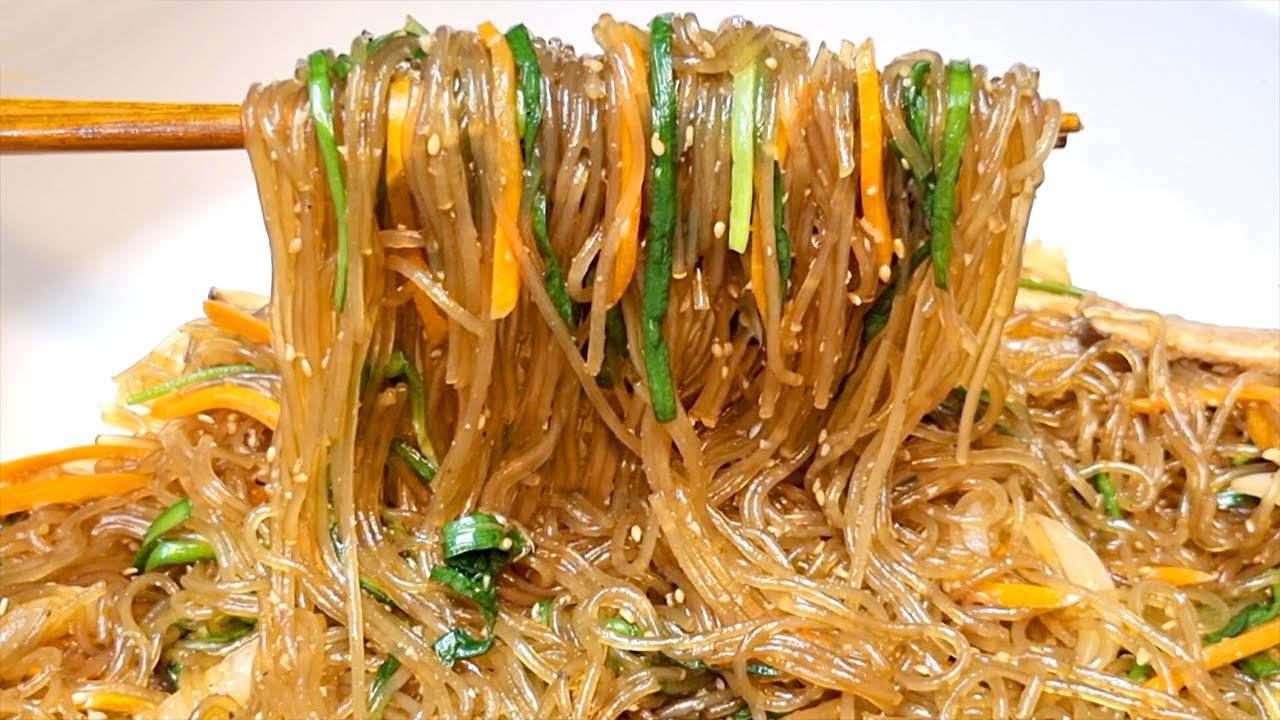
Why This Recipe Works
Most japchae fails the same way. You make it, it looks perfect for forty-five minutes, and then the noodles absorb every drop of sauce, fuse into a grey mass, and the whole thing becomes something you apologize for at the potluck. This is not a skill issue. It is a chemistry issue — and chemistry does not care about your feelings or your grandmother's reputation.
Chef Kim Daiseok's method is not magic. It is applied food science, executed in a specific sequence, with no room for improvisation. Here is what is actually happening at the molecular level, and why each step is non-negotiable.
The Starch Problem Is Real and It Is Aggressive
Korean sweet potato glass noodles — dangmyeon — are made from sweet potato starch. When you boil them, the starch granules hydrate and swell in a process called gelatinization. The outer surface of each cooked noodle is coated in a thin layer of free amylose and amylopectin — the same molecules responsible for thickening sauces and gluing things together. As the noodles cool, those molecules begin to recrystallize through a process called retrogradation. Retrograded starch is sticky, dense, and hygroscopic — meaning it actively pulls water (and sauce) inward. Left unchecked, your japchae becomes a noodle brick within two hours.
The cold rinse step in Chef Kim's method is a direct intervention against retrogradation. Thirty seconds under cold running water, using a colander, removes the majority of free surface starch before it has the chance to recrystallize. This is not optional. This is the entire technique. Without it, everything else is theater.
The Oil Coating Is a Physical Barrier, Not a Flavor Decision
Immediately after rinsing, the noodles are cut with kitchen scissors into 3-to-4-inch lengths and tossed with sesame oil in a mixing bowl. The timing matters. The noodles must still be wet when the oil goes on. Sesame oil is hydrophobic — it physically coats each strand and displaces surface water, creating an emulsion barrier that separates noodle from noodle and noodle from sauce. This is the same principle used in pasta finishing: fat on the surface prevents starch-to-starch adhesion. The result is a noodle that holds its structure for 48 hours post-cook, refrigeration included.
If you skip the cold rinse and go straight to oiling, you are sealing retrograding starch under the oil. The noodles will still clump. Sequence matters.
Why You Stir-Fry Everything Separately
The vegetables are cooked one at a time in a wok over high heat. Carrots, mushrooms, onion, bell pepper — each in isolation. This is not a time management error. It is texture preservation through controlled moisture management. Cooking vegetables together drops the wok temperature rapidly, trapping steam, and you end up braising instead of searing. Braised vegetables are soft and wet. Wet vegetables dump liquid into the final dish and destabilize the oil coating on the noodles. The extra fifteen minutes of separate cooking is not fussiness — it is the difference between a dish with textural contrast and one that collapses into homogeneity.
The Shiitake Soaking Liquid Carries More Weight Than You Think
Dried shiitake rehydration is not just a softening step. When mushrooms dry, glutamate and guanylate concentrations increase significantly compared to their fresh counterparts. The soaking liquid becomes a dilute umami stock — free glutamates, free guanylates, small peptide fragments. This liquid goes directly into the sauce. It rounds the soy-sesame backbone with a savory depth that fresh mushrooms, cooked in a wok without the rehydration step, cannot replicate. Do not discard it. It is the most efficient flavor compound in this entire recipe, produced passively during your 30-minute soak.
Bring the Right Equipment to the Finish
The final assembly happens in the mixing bowl, not back in the wok. Heat at this stage is your enemy — it would melt the oil coating and re-activate starch swelling. Room temperature assembly, tossed by hand so every strand gets coated evenly, is the correct move. The stockpot used for boiling the noodles and blanching the spinach should be large enough to give the noodles room to move freely — cramped noodles snap and tangle, which undoes the scissor-cut portion control.
The garnish of toasted sesame seeds is not decoration. It is textural punctuation — the one element in this dish with genuine crunch, providing contrast against the chewy noodles and tender vegetables. Include it.
The Verdict
Chef Kim's japchae went to 4.5 million views because it fixed a real problem that home cooks had accepted as inevitable. The technique is reproducible, grounded in basic food chemistry, and the results hold up under refrigeration. If you follow the sequence — cold rinse, immediate oil coating, separate vegetable searing, room temperature assembly — you get japchae that tastes as good on day two as it does in the first hour. That is not a small thing. That is the whole point.
Japchae (Chef Kim's Non-Soggy Method)
🛒 Ingredients
- ✦8 oz Korean sweet potato glass noodles (dangmyeon)
- ✦6 oz beef sirloin, sliced into thin strips
- ✦2 tablespoons soy sauce for beef
- ✦1 tablespoon sesame oil for beef
- ✦1 teaspoon sugar for beef
- ✦2 cloves garlic, minced
- ✦1 medium carrot, julienned
- ✦1 medium onion, thinly sliced
- ✦5 oz fresh spinach
- ✦4 dried shiitake mushrooms, rehydrated and sliced
- ✦1/2 red bell pepper, julienned
- ✦3 green onions, cut into 2-inch pieces
- ✦3 tablespoons soy sauce for sauce
- ✦2 tablespoons sesame oil for sauce
- ✦1 tablespoon sugar for sauce
- ✦1 tablespoon vegetable oil
- ✦Toasted sesame seeds for garnish
👨🍳 Instructions
01Step 1
Soak dried shiitake mushrooms in warm water for 30 minutes. Reserve 1/4 cup soaking liquid. Slice mushrooms thinly.
02Step 2
Marinate beef strips in 2 tablespoons soy sauce, 1 tablespoon sesame oil, 1 teaspoon sugar, and garlic for 15 minutes.
03Step 3
Boil glass noodles for 6 minutes until chewy but cooked through. Drain and immediately rinse under cold running water for 30 seconds.
04Step 4
While noodles are still wet, cut with scissors into manageable lengths (3-4 snips). Toss with 1 tablespoon sesame oil to coat every strand.
05Step 5
Blanch spinach for 30 seconds, squeeze dry, and season with 1 teaspoon sesame oil and a pinch of salt.
06Step 6
Stir-fry each vegetable separately: carrot (2 min with salt), mushrooms (3 min with splash of soy sauce), onion and bell pepper together (2 min). Set aside individually.
07Step 7
Cook marinated beef over high heat until browned, about 3 minutes. Set aside.
08Step 8
In a large bowl, combine noodles, all vegetables, and beef. Add sauce (3 tablespoons soy sauce, remaining sesame oil, 1 tablespoon sugar, and reserved mushroom liquid). Toss thoroughly with hands until evenly coated.
09Step 9
Garnish with sesame seeds. Serve warm or at room temperature.
Nutrition Per Serving
Estimates based on standard preparation. Adjustments alter macros.
🔄 Substitutions
Instead of Beef...
Use Shiitake mushrooms (double amount)
Traditional Buddhist temple japchae is fully vegetarian
Instead of Sweet potato noodles...
Use Shirataki noodles
Much lower calorie, different texture — keto-friendly option
Instead of Dried shiitake...
Use Fresh shiitake or oyster mushrooms
Use fresh — skip the soaking step, sauté until golden
🧊 Storage & Reheating
In the Fridge
Store for up to 3 days. Chef Kim's cold-rinse method keeps the noodles from getting soggy — tested up to 48 hours.
In the Freezer
Not recommended — glass noodle texture changes after freezing.
Reheating Rules
Best at room temperature. If cold, toss in a hot pan with a drizzle of sesame oil for 2 minutes.
❓ Frequently Asked Questions
Why does regular japchae get soggy?
Sweet potato glass noodles release starch as they cool. This starch acts like glue — it makes noodles stick together and absorb all the surrounding sauce, turning the dish mushy. Chef Kim's method of cold-rinsing removes surface starch, and oil-coating creates a barrier against absorption.
How is this different from Maangchi's japchae?
The ingredients and seasoning are nearly identical — japchae is japchae. The difference is in the noodle handling technique. This version adds a cold rinse and immediate oil-coating step that dramatically improves the make-ahead quality. If you're eating japchae immediately, either method works. If you're making it ahead, Chef Kim's method is superior.

The Science of
Japchae (Chef Kim's Non-Soggy Method)
We turned everything on this page into a beautiful, flour-proof PDF cheat sheet. Print it out, stick it to your fridge, and never mess up your japchae (chef kim's non-soggy method) again.
*We'll email you the high-res PDF instantly. No spam, just perfectly cooked meals.
AlmostChefs Editorial Team
We translate the internet's most popular cooking videos into foolproof, beginner-friendly written recipes. We analyze multiple methods, test them in our kitchen, and engineer a single "Master Recipe" that gives you the best possible result with the least possible stress.