Janchi Guksu (Korean Banquet Noodles)
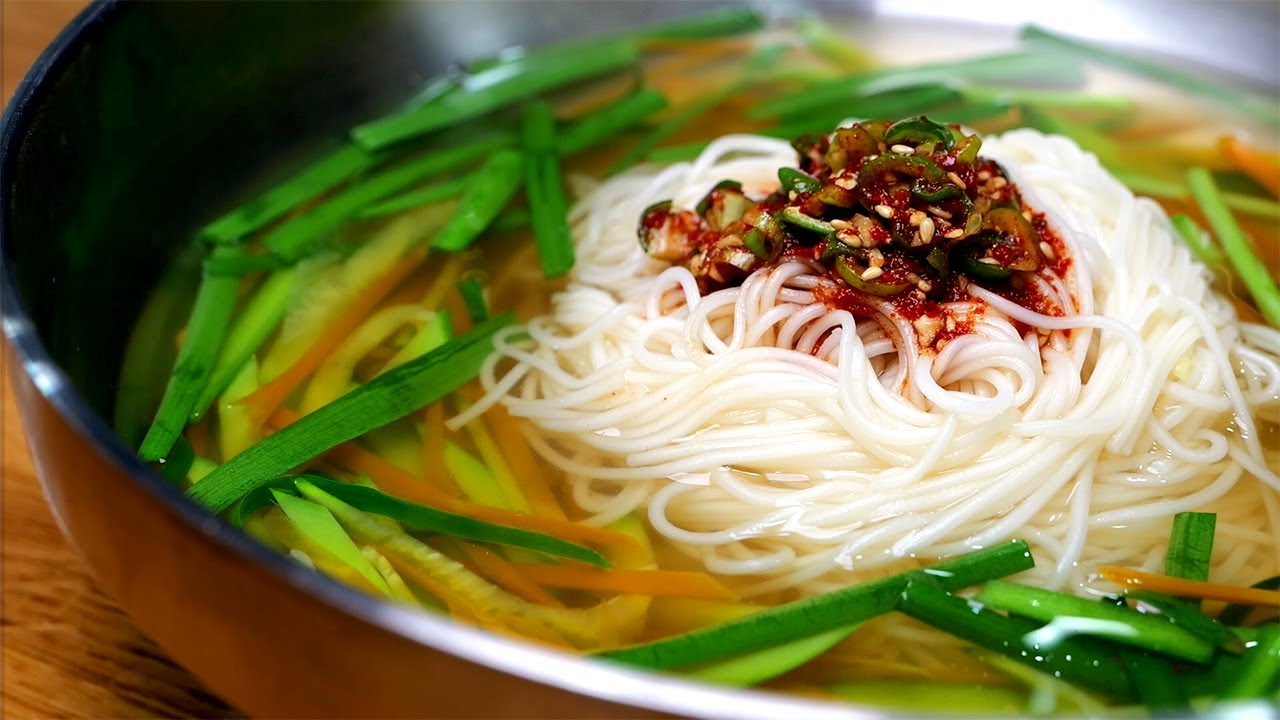
Thin wheat noodles in a clear, savory anchovy broth topped with seasoned vegetables and a fried egg. Korea's traditional celebration noodle soup.
Why This Recipe Works
Most noodle soups fail at the broth. Not because the cook lacks skill — but because they misunderstand what they're actually building. Janchi guksu is not a vehicle for a rich, aggressive stock. It is, by design, a study in restraint. The broth exists to support the noodle, not to announce itself. That single philosophical distinction separates a bowl worth eating from one that's merely warm and wet.
Chef Kim's anchovy-dashima stock is the correct call, and the science backs it up completely. Dried anchovies (myeolchi) are loaded with free glutamates — the same compounds responsible for the "moreish," savory depth that cooks elsewhere chase through hours of bone reduction. Dried dashima (kelp) contributes inosinate and guanylate, two additional umami nucleotides that synergize with glutamate in a well-documented biochemical phenomenon called umami synergy. When these two ingredients hit water together at medium heat, you are triggering a controlled extraction. Fifteen minutes. No more. The moment you push past that window, the anchovies begin releasing bitter, fishy compounds that no amount of salt can fix. The saucepan you use matters more than you think here — thin-bottomed pots create hot spots that accelerate bitterness. Use something with even heat distribution and treat it like a precision instrument, not a soup pot.
Strain immediately. Discard the solids without sentiment. Season with soy sauce and salt in that order — soy first for depth and color, salt to calibrate the finish. The broth should taste clean, slightly oceanic, and almost too delicate. That is exactly correct. Trust it.
Now: the noodles. Somyeon is a fine-diameter wheat noodle with almost no margin for error. Two and a half minutes in aggressively boiling water — use a large pot with ample volume so the water temperature doesn't crash when you add the noodles — and then get them out. The error most cooks make is passive: they drop the noodles and walk away. Somyeon doesn't negotiate. At three minutes they're sliding toward soft. At four, they've become paste wrapped in more paste. Set a timer. Treat the clock as gospel.
The cold rinse that follows is not optional and it is not a style preference. It is a functional step with two distinct purposes. First, rinsing halts the cooking process instantaneously, locking in the noodle's structural integrity. Second — and this is where most home cooks leave performance on the table — aggressively rubbing the noodles under cold water strips surface starch from the strands. That starch, if left in place, will leach into your broth the moment you ladle it into the bowl, turning your pristine, carefully constructed stock into a cloudy, pasty liquid. Rinse until the water runs clear. Rub the strands between your palms like you're washing something valuable.
The toppings follow Korean obangsaek — the five-color principle organizing much of Korean cuisine around five symbolic hues: green, red, yellow, white, and black. Here it manifests as green zucchini, orange-red carrot, yellow egg, white noodle, dark sesame oil. This is not decoration for its own sake. It is a cultural encoding of balance — elemental, nutritional, visual — applied to food with the same logic a compositor applies to a page. The vegetables are sautéed separately in a nonstick skillet, each with their own pinch of salt, because zucchini and carrot release moisture at different rates and require different attention. Cooking them together produces a compromise — which is to say, a failure belonging equally to both.
The egg becomes jidan: beaten, poured thin into a lightly oiled pan, cooked without browning, rolled tight, and sliced into strips. It is the most time-consuming element for what amounts to a garnish. Do it anyway. The visual restraint of jidan — thin yellow ribbons against white noodle — is the difference between a bowl that reads as considered and one that reads as assembled.
Assembly is a deliberate act. Noodles go in cold. Broth goes on hot. This is not an accident. The temperature differential means the bowl arrives at the table at a perfect eating temperature rather than scalding and then cooling to lukewarm within sixty seconds. The sesame oil goes on last, a few drops only, because sesame oil is aromatic first and fat second — added too early it cooks off, added too generously it dominates everything you've spent twenty-five minutes calibrating.
Serve with kimchi. Not because the recipe needs more acid — the broth is already clean — but because janchi guksu has always been served alongside fermented vegetables at every celebration table from wedding feasts to hwangap birthday ceremonies. In Korea, long noodles are longevity made edible. Eating them means something. That cultural weight doesn't show up on a nutrition label, but it is present in every bowl, and it is part of why this recipe works.
When Are You Eating Janchi Guksu?
In Korean, this question is a social shorthand that has nothing to do with your lunch schedule. Janchi (잔치) means feast, celebration, occasion. The noodle is inseparable from the event. When someone asks eonje janchi guksu meogeo? — "when are you eating janchi guksu?" — they are asking when you are getting married. It is one of the most culturally loaded dishes in Korean cuisine: a bowl of thin wheat noodles that carries the accumulated symbolism of unions, milestone birthdays, village festivals, and the universal Korean belief that eating something long makes your life longer in return.
The dish's simplicity is not a limitation. It is the point. At a wedding banquet feeding hundreds, you need a dish that can be scaled, plated quickly, and delivered hot. Janchi guksu does all three without drama. Its elegance is logistical as much as culinary — and understanding that is the final thing that makes this recipe work.
Janchi Guksu (Korean Banquet Noodles)
🛒 Ingredients
- ✦6 oz Korean thin wheat noodles (somyeon)
- ✦8 dried anchovies (large, guts removed)
- ✦1 piece (5 inch) dried dashima (kelp)
- ✦4 cups water
- ✦1 tablespoon soy sauce
- ✦1 teaspoon salt
- ✦2 eggs
- ✦1 small zucchini, julienned
- ✦1 medium carrot, julienned
- ✦2 green onions, sliced
- ✦1 teaspoon sesame oil
- ✦Kimchi for serving
👨🍳 Instructions
01Step 1
Make the broth: simmer anchovies and dashima in 4 cups water over medium heat for 15 minutes. Strain and discard solids. Season with soy sauce and salt.
02Step 2
While broth simmers, prep toppings: sauté julienned zucchini and carrot separately in a drop of oil with a pinch of salt (2 minutes each). Set aside.
03Step 3
Beat eggs and cook as a thin omelette. Roll up and slice into thin strips (jidan).
04Step 4
Cook somyeon noodles in a large pot of boiling water for 2.5-3 minutes. They cook fast — taste at 2.5 minutes.
05Step 5
Divide rinsed noodles between bowls. Ladle hot broth over the noodles.
06Step 6
Top with sautéed vegetables, egg strips, and green onions. Drizzle with sesame oil. Serve with kimchi on the side.
Nutrition Per Serving
Estimates based on standard preparation. Adjustments alter macros.
🔄 Substitutions
Instead of Somyeon (thin wheat noodles)...
Use Angel hair pasta or somen
Angel hair is the closest Western substitute — very similar thickness
Instead of Anchovy-dashima stock...
Use Light chicken broth
Less traditional but produces a clean broth. Avoid heavy beef broth — it overpowers the delicate noodles.
🧊 Storage & Reheating
In the Fridge
Store broth and noodles separately for up to 2 days. Noodles absorb liquid if stored together.
In the Freezer
Freeze broth for up to 2 months. Cook noodles fresh — they don't freeze well.
Reheating Rules
Heat broth in a pot. Add noodles to warm through briefly. Don't boil the noodles again.
❓ Frequently Asked Questions
Why is it called 'banquet noodles'?
Janchi (잔치) means feast or celebration. These noodles were traditionally served at weddings, 60th birthday parties (hwangap), and village festivals. The long noodles symbolize long life, making them auspicious. In Korea, asking someone 'when are you eating janchi guksu?' is actually asking 'when are you getting married?'
What makes the broth clear?
Two techniques: (1) the anchovy-dashima stock is naturally clear when strained properly, and (2) rinsing the noodles removes starch so they don't cloud the broth. These are both fundamental Korean noodle soup techniques.

The Science of
Janchi Guksu (Korean Banquet Noodles)
We turned everything on this page into a beautiful, flour-proof PDF cheat sheet. Print it out, stick it to your fridge, and never mess up your janchi guksu (korean banquet noodles) again.
*We'll email you the high-res PDF instantly. No spam, just perfectly cooked meals.
AlmostChefs Editorial Team
We translate the internet's most popular cooking videos into foolproof, beginner-friendly written recipes. We analyze multiple methods, test them in our kitchen, and engineer a single "Master Recipe" that gives you the best possible result with the least possible stress.