Honghap Tang (Korean Mussel Soup That Actually Tastes Like the Sea)
A clean, deeply savory Korean mussel soup built on a broth that extracts every drop of oceanic flavor from fresh mussels in under 30 minutes. No stock, no shortcuts — the mussels make their own.

“Most mussel soup fails the same way: the broth tastes like hot water with a seafood accident in it. The difference between a flat, thin soup and a broth so intensely oceanic you want to drink it straight from the bowl comes down to one thing — you have to let the mussels open slowly, not blast them on high heat until they panic and release nothing. This recipe respects the mussel. The mussel rewards you.”
Why This Recipe Works
Honghap tang is a lesson in restraint. The ingredient list is short, the technique is simple, and the result — when you do it right — is a broth so clean and oceanic that the first spoonful stops conversation. Get it wrong and you have salty dishwater with rubbery shellfish in it. The difference between those two outcomes is almost entirely about respecting what mussels actually are.
Mussels Are the Stock
Most soups start with broth you built in a previous step. Honghap tang is different: the mussels build the broth live, in real time, as they cook. Inside each shell is concentrated mussel liquor — a saline, mineral-rich liquid that, when released gradually into the cooking water, creates one of the most naturally complex stocks in Korean cuisine. No dashi. No bone broth. No MSG. The mussel does the work.
This is why the cleaning step is not optional prep work — it's quality control for your broth. A poorly cleaned mussel dumps sand and grit directly into the stock you're trying to build. The cold-water soak forces the mussels to expel trapped sediment before it reaches the pot. The debearding removes the fibrous byssus threads that turn bitter under heat. Skipping either step is choosing bad broth before the burner even comes on.
Medium Heat Is the Technique
Korean home cooks understand something that Western shellfish recipes frequently ignore: mussels open on a spectrum, not all at once. Gentle, rising heat allows each mussel to relax and open in its own time, releasing its liquor gradually and enriching the broth continuously throughout the cook. Blasting them on high heat forces them all to snap open simultaneously under thermal shock — they release far less liquid, what they do release is more dilute, and the meat contracts to the texture of a pencil eraser.
Medium heat, covered pot, six minutes. This is the entire technique.
Garlic as a Structural Flavor
The garlic in honghap tang doesn't play a supporting role — it's the aromatic backbone of the broth. Starting it in cold water rather than toasting it in oil is a deliberate choice. Cold-water extraction is slow and gentle; it draws out the allicin compounds that give garlic its savory depth without triggering the aggressive, sharp flavor that comes from high-heat browning. The result is a broth where you taste garlic as a sustained bass note rather than a dominant shout.
The sake or rice wine serves a similar softening function. The alcohol volatilizes quickly during cooking, but it pulls fat-soluble flavor compounds out of the shells and garlic that water alone can't reach. Two tablespoons is enough to do the work invisibly.
Finishing with Restraint
Fish sauce, sesame oil, and green onion hit the pot in the last 90 seconds of cooking. This is not arbitrary timing — fish sauce added early can turn sharp and overpowering as it concentrates. Added at the finish, it integrates cleanly, amplifying the brininess already in the mussel liquor without announcing itself.
The sesame oil goes in last, off the heat if possible. Heat destroys sesame oil's aromatic compounds fast. A drizzle over the finished soup gives you fragrance before flavor — the thing that hits your nose before the spoon reaches your mouth.
A fine-mesh sieve between the pot and the serving bowl is the final edit. Strain the broth, ladle it clean and clear into deep bowls, and let the color tell the story: pale gold, faintly shimmering, the smell of the sea in winter. That is a correct bowl of honghap tang.
Where Beginners Mess This Up
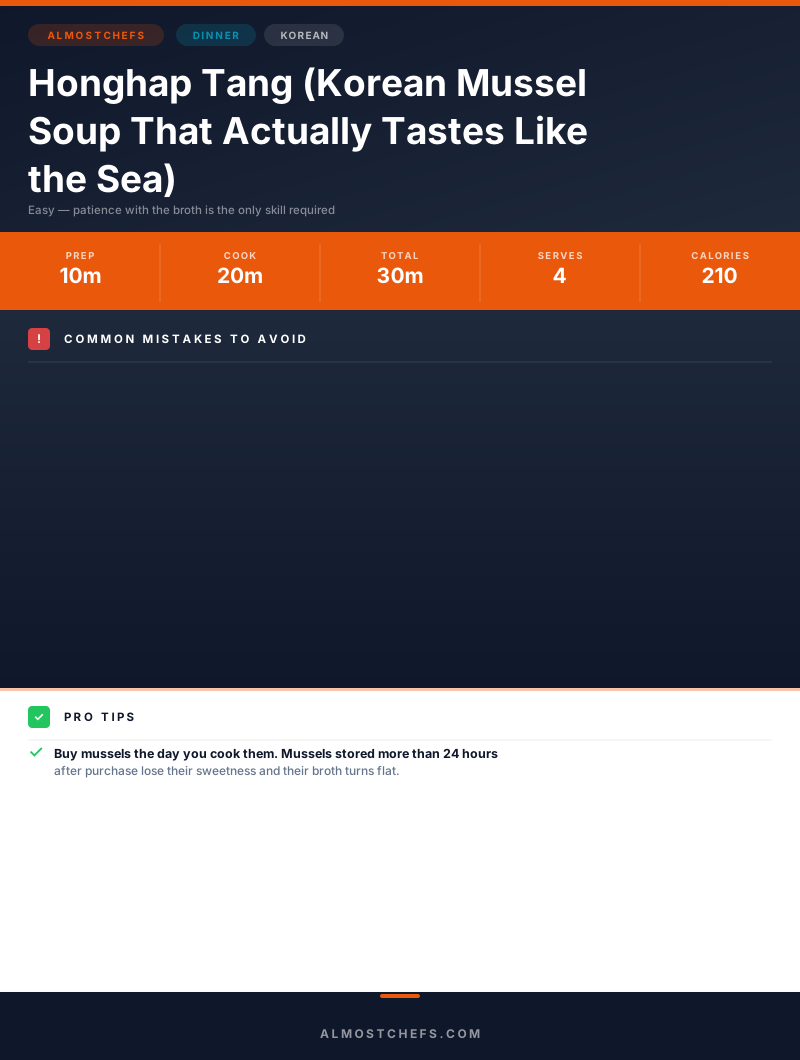
Before we start, read this. These are the 4 reasons your honghap tang (korean mussel soup that actually tastes like the sea) will fail:
- 1
Starting with dead mussels: Any mussel that stays open when tapped before cooking, or stays closed after cooking, is dead and must be discarded. Cooking a dead mussel poisons the entire pot. This is not optional — check every single one before and after cooking.
- 2
High heat from the start: Cranking the heat immediately causes mussels to seize and snap shut before they can release their liquor into the broth. Start on medium and let the heat rise gradually. You want them to relax open, not explode open.
- 3
Overcrowding the pot: Mussels need room to open fully. A packed pot steams unevenly — outer mussels overcook while inner ones stay closed. Use a wide pot and work in batches if needed. One layer deep is the target.
- 4
Skipping the debearding: The beard — the fibrous strands the mussel uses to anchor itself — turns chewy and bitter if left on during cooking. Pull it toward the hinge and rip it clean. Takes ten seconds per mussel. Worth every second.
🛠️ Core Equipment
- Wide heavy-bottomed pot or Dutch ovenWidth allows mussels to open in a single layer. A [Dutch oven](/kitchen-gear/review/dutch-oven) retains heat evenly so the broth temperature stays consistent throughout cooking — no hot spots that overcook the mussels on one side.
- Fine-mesh sieveMussel broth contains fine sand and grit from inside the shells. Straining the finished broth through a [fine-mesh sieve](/kitchen-gear/review/fine-mesh-sieve) before serving is non-negotiable unless you enjoy the texture of beach in your soup.
- Large bowl of cold salted waterSoaking mussels in cold water for 20 minutes causes them to expel any trapped sand inside the shell. This is your only chance to purge that grit before it ends up in the broth.
Honghap Tang (Korean Mussel Soup That Actually Tastes Like the Sea)
🛒 Ingredients
- ✦2 pounds fresh live mussels, scrubbed and debearded
- ✦5 cups cold water
- ✦6 garlic cloves, thinly sliced
- ✦3 green onions, cut into 2-inch pieces
- ✦2 Korean green chilies (cheongyang), sliced on the bias
- ✦1 tablespoon fish sauce
- ✦1 teaspoon sesame oil
- ✦1/2 teaspoon sea salt, plus more to taste
- ✦1/2 teaspoon ground black pepper
- ✦1/2 block firm tofu (about 7 oz), cut into 1-inch cubes (optional)
- ✦Fresh enoki mushrooms, trimmed (optional)
- ✦2 tablespoons sake or dry rice wine (mirim)
👨🍳 Instructions
01Step 1
Place mussels in a large bowl of cold salted water (1 tablespoon salt per 4 cups water) for 20 minutes. Drain and rinse under cold running water.
02Step 2
Debeard each mussel by gripping the fibrous strands between your thumb and forefinger and pulling firmly toward the hinge end. Rinse again.
03Step 3
Combine cold water, sliced garlic, and sake in a wide heavy-bottomed pot. Bring to a gentle simmer over medium heat.
04Step 4
Add the cleaned mussels in a single layer. Cover the pot and cook over medium heat for 5-7 minutes, shaking the pot gently once or twice.
05Step 5
As soon as all mussels are open, add fish sauce, green onions, and green chilies. Stir gently once.
06Step 6
If using tofu and enoki mushrooms, add them now. Cook uncovered for 2 minutes until tofu is heated through.
07Step 7
Taste the broth and adjust with salt and black pepper. Discard any mussels that did not open.
08Step 8
Drizzle sesame oil over the top. Serve immediately in deep bowls with steamed rice and banchan.
Nutrition Per Serving
Estimates based on standard preparation. Adjustments alter macros.
🔄 Substitutions
Instead of Fresh mussels...
Use Frozen half-shell mussels
Convenient but the broth will be noticeably less flavorful — frozen mussels have already released much of their liquor during processing. Add a splash of clam juice to compensate.
Instead of Fish sauce...
Use Soy sauce (soup soy sauce / guk ganjang preferred)
Guk ganjang is the traditional Korean choice. Regular fish sauce works but adds more funk. Use half the amount and adjust to taste.
Instead of Cheongyang green chilies...
Use Serrano or Thai green chili
Cheongyang has a clean, bright heat. Serrano is slightly fruitier. Thai chili is hotter — use half as much.
Instead of Sake / mirim...
Use Dry white wine or omit entirely
The alcohol cooks off and leaves only a subtle sweetness that rounds the broth. Dry white wine is a solid substitute. Omitting it loses depth but the soup still works.
🧊 Storage & Reheating
In the Fridge
Store broth and mussels separately in airtight containers for up to 2 days. Mussels continue cooking in hot liquid — keep them out of the broth until reheating.
In the Freezer
Strain and freeze the broth alone for up to 1 month. Cooked mussels do not freeze well — the texture turns rubbery. Start with fresh mussels when reheating.
Reheating Rules
Bring broth to a gentle simmer and add mussels for 1-2 minutes to warm through. Do not boil — already-cooked mussels overcook in seconds at high heat.
❓ Frequently Asked Questions
Why is my mussel broth cloudy?
Cloudy broth usually means the mussels weren't properly cleaned before cooking or the heat was too high, causing the proteins to agitate into the liquid. Cold-water soaking for 20 minutes, gentle medium heat, and a final strain through a fine-mesh sieve solves all three causes.
Do I need to add stock or use store-bought broth?
No. This is one of the few soups where the protein creates its own stock from scratch. The mussel liquor released during cooking is more intensely flavored than anything from a carton. Adding pre-made stock actually dilutes the natural brininess. Trust the mussels.
How do I know when the mussels are done?
When they're open. That's it. An open mussel is a cooked mussel. The moment the last one opens, pull the pot off the heat or add your final ingredients. Every extra minute after that point is overcooking.
Is honghap tang actually anti-inflammatory?
Mussels are one of the best natural sources of omega-3 fatty acids, particularly EPA and DHA, which have well-documented anti-inflammatory effects. They're also high in selenium, zinc, and B12. The green onions and garlic add their own polyphenols. This is a genuinely nutrient-dense soup, not just marketing.
Can I add gochugaru for a spicier version?
Yes — 1 teaspoon of gochugaru added with the garlic at the start makes a mild red-tinged broth. 1 tablespoon makes it properly spicy. This variation is common in Korean restaurants. It doesn't change the technique, just the heat level and color.
Why do some recipes add radish (mu) to the broth?
Radish is a natural flavor amplifier that adds subtle sweetness and helps clarify the broth. Peel and cut a 3-inch chunk of Korean radish into thick half-moons and simmer with the garlic from the start. It's optional but recommended if you want an even cleaner, more complex base.
The Science of
Honghap Tang (Korean Mussel Soup That Actually Tastes Like the Sea)
We turned everything on this page into a beautiful, flour-proof PDF cheat sheet. Print it out, stick it to your fridge, and never mess up your honghap tang (korean mussel soup that actually tastes like the sea) again.
*We'll email you the high-res PDF instantly. No spam, just perfectly cooked meals.
AlmostChefs Editorial Team
We translate the internet's most popular cooking videos into foolproof, beginner-friendly written recipes. We analyze multiple methods, test them in our kitchen, and engineer a single "Master Recipe" that gives you the best possible result with the least possible stress.