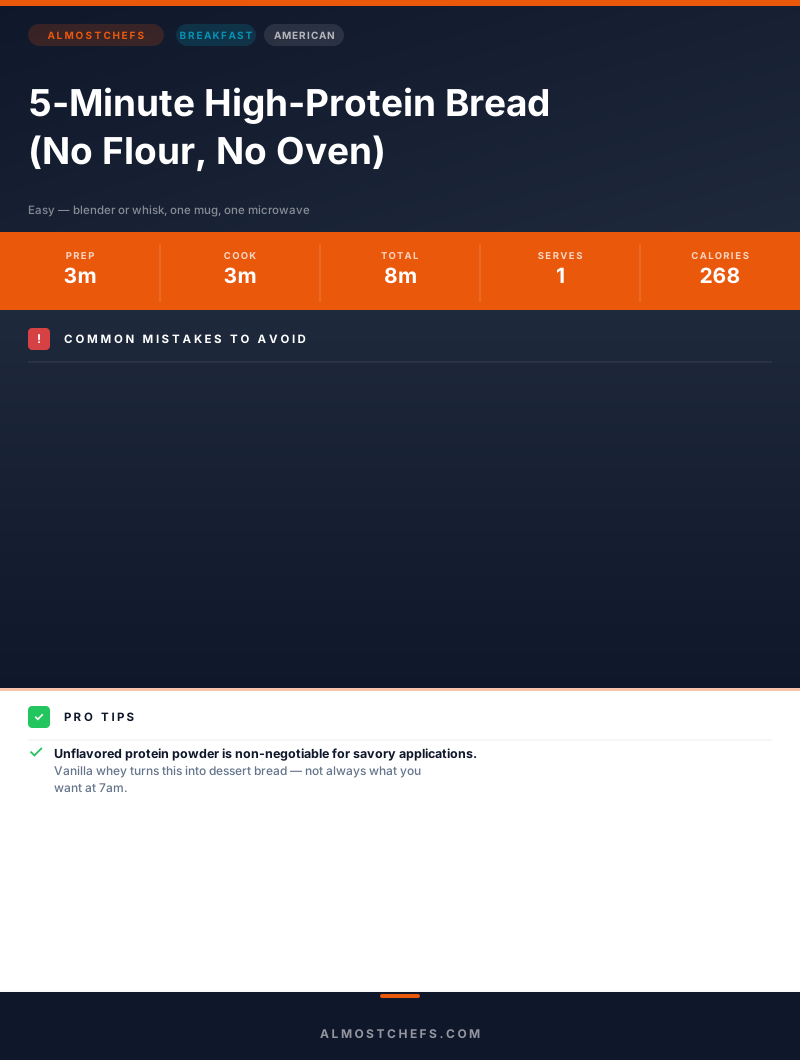
5-Minute High-Protein Bread (No Flour, No Oven)
A flourless microwave bread made with eggs, cottage cheese, and whey protein that hits 29g of protein in under 8 minutes total. We broke down the viral method and fixed the texture problems most people run into so you get a fluffy, sliceable result every time.

“Most 'high-protein bread' recipes on the internet are either lying about the macros or producing a rubbery, eggy disk that tastes like a protein bar melted in a coffee cup. This one works because the ratio of cottage cheese to egg to protein powder is actually calibrated — not just thrown together for a thumbnail. The result is dense enough to slice, fluffy enough to eat plain, and clocks 29g of protein before you've opened your laptop.”
Why This Recipe Works
Most viral microwave bread recipes exist to win an Instagram caption contest. They photograph well, the 5-minute hook sells the video, and the actual eating experience is somewhere between a protein bar and a sad cloud. This recipe is different because the ingredient ratios were actually thought through — not assembled for a thumbnail.
The Cottage Cheese Problem
Cottage cheese is the structural backbone of this bread, and it's also the most misunderstood ingredient in the recipe. The curds are composed primarily of casein protein — a slow-digesting, heat-stable protein that sets into a firm matrix when exposed to microwave heat. That's the good news. The bad news is that if you don't break down those curds completely before microwaving, the casein sets around individual lumps instead of throughout the batter, and you get a bread with the texture of scrambled eggs folded into a sponge.
The solution is non-negotiable: blend until completely smooth. A blender takes 30 seconds. A whisk takes 90. Either works. But a fork does not. Spend the extra 60 seconds and you get a uniform, fluffy crumb. Skip it and you get protein-laced cottage cheese in mug form.
The Protein Powder's Real Job
Whey protein in this recipe isn't just a macro boost — it's a structural binder. When whey proteins are exposed to heat, they denature and crosslink, forming a network that traps the air bubbles generated by the baking powder and apple cider vinegar reaction. This is what gives the bread its rise and prevents it from collapsing back into a dense disk the moment it cools.
The apple cider vinegar deserves more credit than it gets in most versions of this recipe. The acid reacts with the baking powder to produce CO₂ during mixing and again during microwaving — two separate lift events that result in a noticeably more open crumb. Skip the vinegar and the baking powder still works, but the lift is roughly 30% weaker.
Why Almond Flour Stays In
There is a contingent of protein bread enthusiasts who remove the almond flour in the name of lower fat macros. This is a mistake. The almond flour provides lipids that coat the developing gluten-analog network (such as it is in a gluten-free batter), keeping the crumb tender rather than tough. It also contributes to the golden exterior color. Remove it and the bread is structurally adequate but texturally disappointing — closer to a firm egg white omelette than bread.
Two tablespoons is the sweet spot. More than that and the fat content slows the microwave cooking, leading to undercooked centers even at extended cook times.
The Wattage Variable
The single biggest variable in this recipe is the one thing you cannot control: your microwave. Consumer units range from 700W to 1200W, and that 500W spread translates to a 40% difference in heat delivery at the same time setting. The recipe's 2:30 at high power was calibrated for a 1000W unit. If you own a high-powered 1200W microwave, start at 80% power. If you have an older 700W unit, add 30 seconds and check at 2:30.
The visual cue to look for: the top should be just set and slightly springy when gently pressed. If it looks wet, give it 15 more seconds. If it looks dry and pulling away from the mug sides, you've already gone too far — pull it immediately and let the residual heat finish the job during the rest period.
The Rest Period Is Passive Cooking
One minute in the mug after the microwave stops is not optional resting time — it's active cooking time. The ceramic holds significant residual heat, and the center of the bread, which receives the weakest microwave penetration, finishes setting during this window. Invert the mug immediately after beeping and the center collapses. Wait the two minutes and it firms into a cleanly sliceable cylinder.
Eight minutes total. Twenty-nine grams of protein. The math on this one actually works.
Where Beginners Mess This Up
Before we start, read this. These are the 4 reasons your 5-minute high-protein bread (no flour, no oven) will fail:
- 1
Not blending the cottage cheese smooth: Cottage cheese curds do not break down on their own in the microwave. If you skip the blending step or only stir with a fork, you end up with rubbery white lumps distributed through the bread. Blend or whisk aggressively for a full 1-2 minutes until the batter is completely homogeneous.
- 2
Overmixing after adding the dry ingredients: Once the protein powder and baking powder go in, the clock starts. Overmixing activates the baking powder too early and flattens the rise. Fold or pulse just until the dry ingredients disappear — 4-5 strokes maximum. Lumps are your enemy; overdevelopment is a bigger one.
- 3
Microwaving at full power without checking: Microwave wattage varies wildly — a 1200W unit will overcook this in 2 minutes flat. Check at the 2-minute mark and pull it when the center looks just set, not dry. Overcooked microwave bread goes from dense-and-fluffy to dense-and-rubbery in about 30 seconds.
- 4
Skipping the rest period: The bread needs 1-2 minutes in the mug after microwaving to finish setting. Pull it immediately and the center collapses. That rest period is passive cooking time — the residual heat in the mug finishes the job.
The Video Reference Library
Want to see it in action? Here are the exact videos we analyzed and combined to build this foolproof recipe translation:

The original viral video demonstrating the core technique. Best reference for the blending step and visual cues for doneness.
2. Flourless High-Protein Bread Methods Compared
Side-by-side comparison of microwave versus oven baked methods with macro breakdowns. Useful context for understanding texture trade-offs.
3. Microwave Mug Bread — Getting the Texture RightDeep dive into mug bread doneness cues, wattage adjustments, and common texture failures. Good companion to the main recipe.
🛠️ Core Equipment
- Blender or immersion blender ↗The only reliable way to eliminate cottage cheese curds completely. A whisk works but takes twice as long and leaves more texture. If you care about a clean crumb, blend.
- Microwave-safe mug or ceramic ramekin ↗Ceramic retains heat evenly and prevents the edges from overcooking before the center sets. Avoid thin-walled mugs — the rapid heat transfer burns the outside while the inside stays liquid.
- Thin-bladed knife or offset spatula ↗For releasing the bread cleanly from the mug. Run it around the full perimeter before inverting. Skip this and you leave a third of your bread stuck to the ceramic.
5-Minute High-Protein Bread (No Flour, No Oven)
🛒 Ingredients
- ✦3 large eggs
- ✦3 tablespoons unflavored whey protein powder
- ✦1/3 cup low-fat cottage cheese
- ✦1 tablespoon raw honey
- ✦1/2 teaspoon vanilla extract
- ✦3/4 teaspoon baking powder
- ✦1/4 teaspoon sea salt
- ✦2 tablespoons natural almond flour
- ✦1/4 teaspoon ground cinnamon
- ✦Pinch of ground nutmeg
- ✦1/2 teaspoon apple cider vinegar
👨🍳 Instructions
01Step 1
Crack 3 large eggs into a blender or large mixing bowl.
02Step 2
Add the cottage cheese, raw honey, and vanilla extract to the eggs.
03Step 3
Blend or whisk vigorously for 1-2 minutes until completely smooth with no visible cheese curds remaining.
04Step 4
Sprinkle in the protein powder, baking powder, sea salt, almond flour, cinnamon, and nutmeg over the wet ingredients.
05Step 5
Stir gently with a fork or pulse in the blender 4-5 times just until the dry ingredients disappear and no lumps remain. Do not overmix.
06Step 6
Pour the batter into a microwave-safe mug or small ceramic ramekin, filling it about two-thirds full.
07Step 7
Microwave on high for 2 minutes and 30 seconds, checking at the 2-minute mark to make sure it hasn't overflowed or dried out at the edges.
08Step 8
Remove carefully from the microwave using oven mitts. The mug will be very hot.
09Step 9
Let the bread rest in the mug for 1-2 minutes to allow the structure to fully set.
10Step 10
Run a thin knife around the full perimeter of the mug and gently invert onto a cooling rack or plate.
11Step 11
Slice into quarters or serve whole with your preferred toppings.
Nutrition Per Serving
Estimates based on standard preparation. Adjustments alter macros.
🔄 Substitutions
Instead of Unflavored whey protein powder...
Use Plant-based vanilla protein powder or pea protein isolate
Adds slight vanilla flavor. Texture stays fluffy and tender. Works cleanly for vegan and dairy-free adaptations.
Instead of Low-fat cottage cheese...
Use Non-fat Greek yogurt or Icelandic-style skyr
Creates a slightly denser crumb with more tang. Still blends smooth. Increases probiotic content and reduces saturated fat.
Instead of Raw honey...
Use Monk fruit sweetener or liquid stevia (1/2 teaspoon)
Nearly identical sweetness with zero added sugar. Texture is unchanged. Best choice for strict low-carb or keto macros.
Instead of Natural almond flour...
Use Ground flaxseed or hemp seeds (1 tablespoon) plus 1 tablespoon coconut flour
Adds subtle nuttiness and increases moisture retention. Slightly earthier flavor. Boosts omega-3 content considerably.
🧊 Storage & Reheating
In the Fridge
Store covered in the fridge for up to 2 days. Press plastic wrap directly onto the cut surface to prevent drying out.
In the Freezer
Wrap individual portions tightly in plastic wrap and freeze for up to 3 weeks. Thaw at room temperature for 20 minutes.
Reheating Rules
Microwave for 20-25 seconds covered with a damp paper towel to reintroduce moisture. Do not reheat uncovered — the exterior turns tough.
❓ Frequently Asked Questions
Why does my bread come out rubbery instead of fluffy?
Overcooking. Microwave wattage varies significantly — most home units run between 700W and 1200W. If your bread is rubbery, drop to 80% power and add 30 seconds to the cook time. Rubbery texture is almost never an ingredient problem; it's a heat problem.
Can I make this without protein powder?
You can, but the macro profile changes substantially and the structure weakens. The protein powder contributes both the binding protein and roughly 15-18g of the total protein count. Without it, increase the almond flour by 1 tablespoon to compensate for structure, but accept a lower protein yield.
Do I have to use a microwave, or can I bake this?
You can bake it. Pour the batter into an oven-safe ramekin and bake at 350°F for 18-22 minutes until a toothpick comes out clean. The texture is slightly less custardy and more uniform. The trade-off is obvious: it takes 15 times longer.
Why does the recipe include apple cider vinegar?
It reacts with the baking powder to produce carbon dioxide, which gives the bread its lift. Without it, the baking powder still works but produces less rise and a slightly flat, dense result. The vinegar flavor cooks off completely — you won't taste it.
Can I add mix-ins like blueberries or chocolate chips?
Yes, but fold them in last and keep the total volume under 2 tablespoons or the batter becomes too heavy to rise properly. Fresh or frozen blueberries work well. Chocolate chips add sugar but also add weight — expect a denser crumb.
Is this actually filling or will I be hungry in an hour?
29g of protein with fat from eggs and almond flour is a genuinely satiating combination. The fiber is modest at 2g, so if you want more staying power, top it with almond butter or serve it alongside a high-fiber fruit. On its own, most people find it holds 3-4 hours.
The Science of
5-Minute High-Protein Bread (No Flour, No Oven)
We turned everything on this page into a beautiful, flour-proof PDF cheat sheet. Print it out, stick it to your fridge, and never mess up your 5-minute high-protein bread (no flour, no oven) again.
*We'll email you the high-res PDF instantly. No spam, just perfectly cooked meals.
AlmostChefs Editorial Team
We translate the internet's most popular cooking videos into foolproof, beginner-friendly written recipes. We analyze multiple methods, test them in our kitchen, and engineer a single "Master Recipe" that gives you the best possible result with the least possible stress.