Haemul Pajeon (Seafood Scallion Pancake)
A crispy Korean seafood pancake loaded with whole scallions, shrimp, squid, and clams — golden and crunchy outside, tender and savory inside. Best enjoyed with makgeolli on a rainy day.
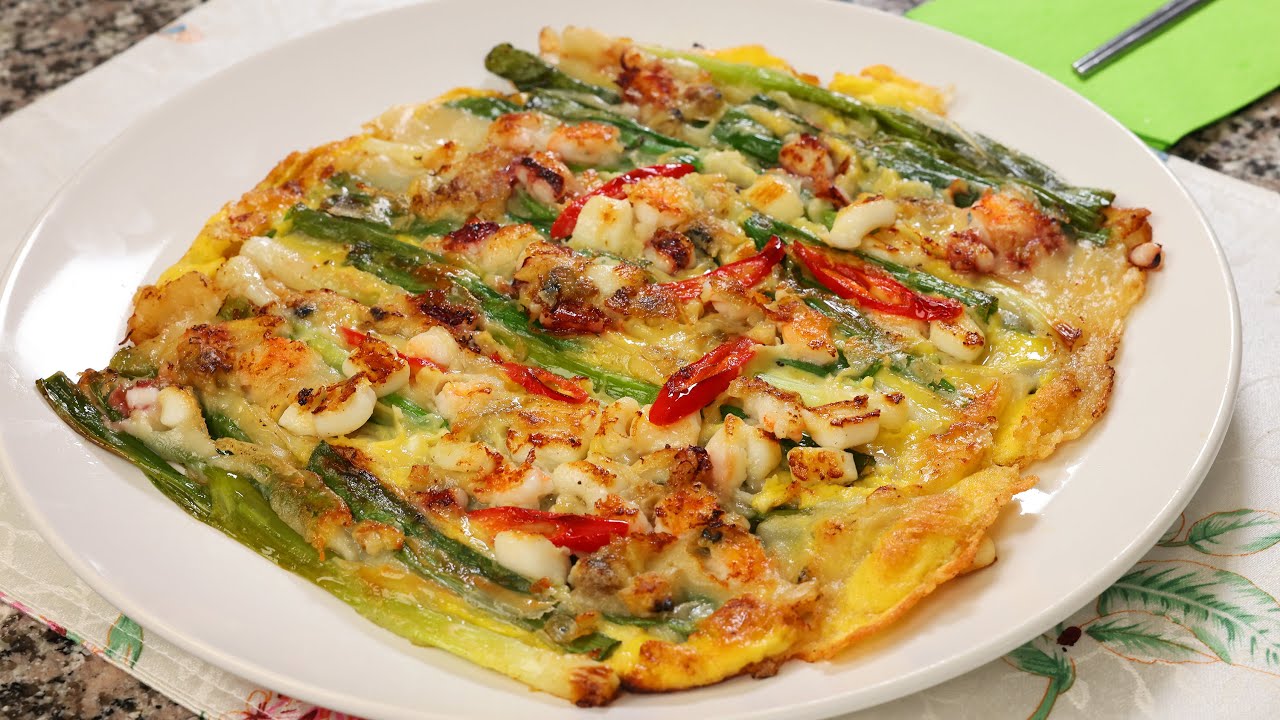
Why This Recipe Works
There is a particular kind of culinary frustration that comes from watching a pancake — something ostensibly simple — turn out pale, floppy, and structurally defeated. Haemul pajeon refuses to be simple. It is a precision instrument disguised as peasant food, and every variable in this recipe exists for a reason that has nothing to do with tradition and everything to do with physics.
Let's start with flour, because most Western cooks will instinctively reach for all-purpose and call it done. That is incorrect. The dual-flour system here — all-purpose flour combined with sweet rice flour (glutinous rice flour) — is not an accident of regional pantry habits. All-purpose flour provides structure through gluten development. Sweet rice flour provides chew through gelatinized amylopectin starch, a long-chain carbohydrate that behaves fundamentally differently under heat. The result is a pancake with two distinct textural identities happening simultaneously: a shatteringly crispy exterior crust and a dense, slightly elastic interior that holds the scallions and seafood in suspension rather than letting them sink and steam. Swap in cornstarch as a substitute if you must — but understand that you are trading the chewy interior for pure crispiness, a different but still defensible outcome.
The water temperature is not a suggestion. Ice-cold water retards gluten development in the all-purpose flour fraction of your batter. Gluten, formed when glutenin and gliadin proteins hydrate and cross-link, creates elasticity and structure — useful in bread, catastrophic in a pancake batter that needs to stay thin and shatter-crisp after frying. Cold water slows that protein hydration. The batter stays loose. The result is a lacy, open crumb structure rather than a dense, bready slab. Professional tempura batter uses the same principle — ice water, minimal mixing, immediate use. Haemul pajeon batter is Korean tempura logic applied to a flat format.
Now: the non-stick skillet. This is non-negotiable. A cast iron skillet will retain heat aggressively and cook the bottom too fast before the interior sets. Stainless will cause sticking at the edges where the thin batter contacts bare metal. Non-stick allows you to use the precise, moderate-high heat this recipe demands — hot enough to immediately begin crisping the bottom without scorching — and it allows the whole pancake to release cleanly when it's time to flip. The oil should shimmer but not smoke. Shimmering means the surface temperature is approximately 350–375°F. Smoking means you've overshot into acrolein territory, which is bad for the food and bad for your lungs.
The spatula is the most underrated tool in this recipe. Two separate spatula actions are doing meaningful work here. First: gentle spreading and pressing immediately after the batter hits the pan, which ensures even contact across the entire surface. Second, and more critically: firm downward pressure after the flip. This compression does two things. It forces residual steam out of the pancake interior, which would otherwise soften the crust from the inside. And it increases the surface area of the second side in contact with the hot pan, accelerating Maillard browning — the same non-enzymatic protein-sugar reaction that makes seared meat taste better than boiled meat.
The flip itself deserves methodological attention. Three to four minutes is the minimum for the first side. The edges should look lacy and set; the center should appear matte rather than wet when viewed from the side. A premature flip produces a pale, structurally compromised pancake because the batter hasn't fully set around the scallions and seafood. The whole thing folds and tears. Wait. The additional tablespoon of vegetable oil added around the edges after flipping is not optional — it wicks under the pancake via capillary action and crisps the perimeter into the characteristic crunchy border that distinguishes restaurant-quality pajeon from home attempts.
The seafood composition matters in a specific way. Shrimp, squid rings, and chopped clams are not interchangeable flavor vehicles — they are chosen because they cook fast under the batter without releasing excessive moisture. Squid in particular tightens quickly under heat and provides textural contrast against the soft-chewy batter interior. Clams bring brininess. Shrimp bring sweetness and a clean snap. If you use only shrimp, the flavor profile simplifies but the technique remains identical. What you must avoid is seafood with high water content — mussels in the shell, oversized chunks — because the moisture will steam the interior of your pancake rather than fry it.
The cutting board at the end is where presentation becomes function. Cutting into squares rather than wedges maximizes the number of pieces with exposed interior edge — each cut face shows the cross-section of scallion, seafood, and batter, and that edge will partially re-crisp when the hot pancake sits in the ambient air for thirty seconds. The dipping sauce — soy sauce, rice vinegar, gochugaru, sesame seeds — is acidic by design. The vinegar cuts through the oil and flour richness the same way lemon juice functions with fried fish. Without it, the pancake reads heavy. With it, you can eat half the pan without registering the caloric reality.
The Meteorological Pairing Problem
Korea has an empirically correct answer to rainy days. The sound of pajeon batter hitting a non-stick skillet full of hot oil — the sustained, wet sizzle Koreans transcribe as "jijijijiji" — is aurally similar enough to rainfall on a roof that the association became cultural infrastructure. Pajeon on a rainy day with makgeolli (unfiltered rice wine, lightly sweet, low-alcohol, with a yeasty funk) is not a recommendation. It is essentially a meteorological prescription. The slight acidity and effervescence of makgeolli performs the same palate-cleansing function as the dipping sauce — it resets between bites, makes the next piece of pancake taste as sharp as the first.
This is a thirty-minute recipe that produces something that tastes like it required considerably more effort and infrastructure. The non-stick skillet, the spatula, the cutting board, and a whisk for the batter are the entire equipment list. There is no reason this doesn't work the first time you make it, provided you observe the cardinal rule: do not flip early. Everything else is recoverable. A premature flip is not.
Haemul Pajeon (Seafood Scallion Pancake)
🛒 Ingredients
- ✦1 bunch green onions (about 8-10), trimmed to pan length
- ✦1/2 cup mixed seafood (shrimp, squid rings, chopped clams)
- ✦1 cup all-purpose flour
- ✦1/2 cup sweet rice flour (glutinous rice flour)
- ✦1 egg, beaten
- ✦1 cup ice-cold water
- ✦1/2 teaspoon salt
- ✦3 tablespoons vegetable oil (for frying)
- ✦1 fresh red chili, sliced diagonally (optional)
👨🍳 Instructions
01Step 1
Combine all-purpose flour, sweet rice flour, salt, beaten egg, and ice-cold water. Whisk into a thin batter — it should be thinner than American pancake batter.
02Step 2
Heat 2 tablespoons oil in a large non-stick skillet over medium-high heat. The oil should shimmer.
03Step 3
Lay green onions across the pan in a single layer, fanning them out. Scatter seafood on top.
04Step 4
Pour the batter evenly over the scallions and seafood. Spread to fill the pan. Press down gently with a spatula.
05Step 5
Cook for 3-4 minutes until the bottom is deeply golden and crispy. The edges should sizzle and look lacy.
06Step 6
Flip the pancake (use a plate to help if needed). Add the remaining tablespoon of oil around the edges. Press down firmly with the spatula.
07Step 7
Cook for another 3-4 minutes until the second side is equally crispy and golden.
08Step 8
Slide onto a cutting board. Cut into squares and serve with dipping sauce (2 tbsp soy sauce + 1 tbsp rice vinegar + 1 tsp gochugaru + sesame seeds).
Nutrition Per Serving
Estimates based on standard preparation. Adjustments alter macros.
🔄 Substitutions
Instead of Mixed seafood...
Use Just shrimp
Any combination works — shrimp alone is perfectly fine
Instead of Sweet rice flour...
Use Cornstarch
Different texture but still creates crispiness. Use half the amount
Instead of Green onions...
Use Chives or leeks
Korean chives (buchu) make a different but equally traditional pancake
🧊 Storage & Reheating
In the Fridge
Keeps 1-2 days but loses crispiness. Best eaten fresh.
In the Freezer
Not recommended — texture changes significantly.
Reheating Rules
Reheat in a dry skillet over medium-high heat to restore crispiness. Never microwave.
❓ Frequently Asked Questions
Why do Koreans eat pajeon on rainy days?
The sizzling sound of pajeon frying is said to resemble the sound of rain. This poetic connection became a cultural tradition — when it rains in Korea, people crave pajeon and makgeolli. It's one of Korea's most charming food customs.
What's the difference between pajeon and jeon?
Jeon is the general term for any Korean pan-fried food (like a fritter or pancake). Pajeon specifically features pa (green onions) as the main ingredient. Haemul pajeon adds seafood. Kimchijeon uses kimchi instead.

The Science of
Haemul Pajeon (Seafood Scallion Pancake)
We turned everything on this page into a beautiful, flour-proof PDF cheat sheet. Print it out, stick it to your fridge, and never mess up your haemul pajeon (seafood scallion pancake) again.
*We'll email you the high-res PDF instantly. No spam, just perfectly cooked meals.
AlmostChefs Editorial Team
We translate the internet's most popular cooking videos into foolproof, beginner-friendly written recipes. We analyze multiple methods, test them in our kitchen, and engineer a single "Master Recipe" that gives you the best possible result with the least possible stress.