Gyeran-mari (Korean Rolled Omelette)
A Korean lunchbox staple — eggs rolled into layers with vegetables and sometimes cheese, creating a beautiful spiral when sliced. Simple, satisfying, and endlessly customizable.
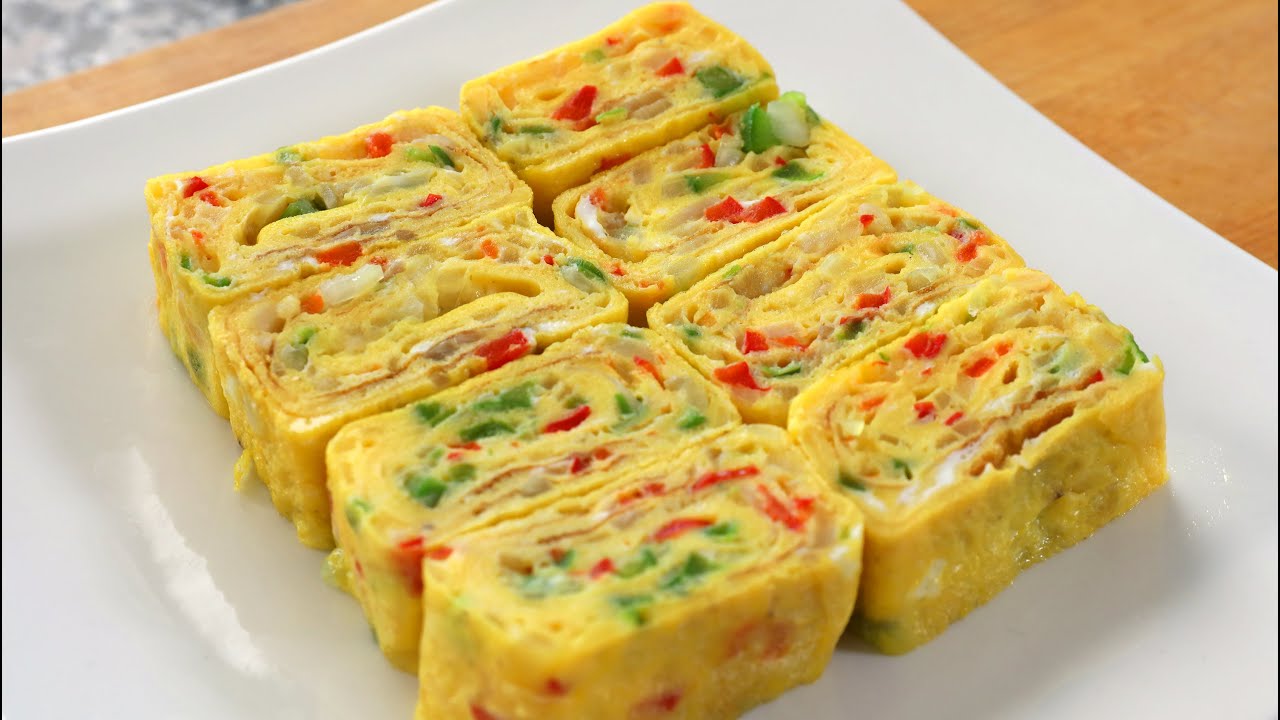
Why This Recipe Works
Let's be honest with each other. Most people make gyeran-mari badly. They crank the heat, pour in the eggs, and panic-roll a cracked, rubbery cylinder that collapses on the cutting board into something resembling a failed construction project. The internet calls this a "simple recipe." It is not simple. It is a technique recipe disguised as a simple recipe, and that distinction matters enormously if you want the cross-section spiral that makes this dish worth making.
Here is what is actually happening at a physical level, and why every variable in this preparation exists for a reason.
The Maillard Problem — and How Sugar Solves It
Raw egg whites coagulate at roughly 62°C (144°F). Yolks follow around 65–70°C. At medium-high heat, you blow past both thresholds before a spatula can even touch the pan, locking the protein matrix into a rigid, unrollable sheet. The sugar in this recipe is not a concession to sweetness. It is a deliberate intervention in browning kinetics. Sugar participates in the Maillard reaction at temperatures above 150°C, which is well above where the egg proteins denature — meaning you get gentle, even surface color on the exterior layers during subsequent rolls without pushing the interior past the point of rollability. The result: a golden exterior, a just-set interior, and a window of workable time measured in seconds rather than fractions of a second. Omit the sugar if you prefer, but understand that you are removing a thermal buffer, not just flavor.
The Heat Protocol
Medium-low. Not medium. Not medium-low-but-actually-medium because you were impatient. The target surface temperature of your pan should be around 160–170°C, low enough that egg sets from the bottom up slowly — giving you observable visual cues to work with. When the bottom is opaque and the top is still glossy and slightly mobile, that is your rolling window. It will last approximately 8–12 seconds depending on your pan's thermal mass. You need to have already decided which direction you are rolling before that window opens.
This is the core discipline of the dish. The pan is the instrument; you are the technician.
Equipment Is Not Optional
A gyeran-mari pan — the dedicated rectangular Korean egg pan — exists specifically to solve the geometry problem. The straight walls mean your roll has nowhere to go except forward, the layers stack evenly, and the final cylinder is uniform from end to end. Using a standard round skillet is entirely workable, but it requires actively folding the rounded edges inward during each roll to prevent the irregular geometry from compressing unevenly. Neither approach is wrong, but confusing one for the other is.
Your rolling tool matters more than most resources admit. Chopsticks are the traditional implement: their narrow cross-section lets you slip underneath the leading edge of the egg without trapping air or tearing the set layer. A spatula is a reasonable alternative, but choose a thin, flexible one — a stiff silicone spatula will crack the outer layer the moment you try to initiate the first fold. The goal is to coax the roll, not force it.
The Layering Logic
Three layers is the standard for a reason. Each layer adds structural integrity to the roll and adds a visible ring to the cross-section spiral. The first roll is your foundation and will inevitably be the least perfect — that's fine, because subsequent layers will wrap around it, correcting minor structural failures. Pouring new egg underneath the existing roll by lifting the completed cylinder allows the fresh egg to bond with the base of the roll rather than sitting beside it. This bonding is what prevents delamination when you slice.
Each layer should be thin — roughly one-third of your total egg volume. A thick first pour creates a dense core that cracks under the mechanical stress of rolling. Thin layers are flexible layers, and flexibility is the entire mechanical premise of this technique.
Why This Works Cold
Western omelettes are engineered for immediate consumption. The softness that makes them luxurious at 65°C becomes unpleasant rubbery gumminess at room temperature. Gyeran-mari inverts this. The layered structure distributes moisture more evenly through the roll, the slight sugar content retards moisture migration out of the protein matrix, and the compact cylinder geometry reduces surface-area-to-volume ratio — which means it holds temperature and texture longer than a flat omelette would. This is not an accident. This is centuries of dosirak culture engineering a dish for the exact conditions of a lunchbox: packed at 7am, eaten at noon, still excellent.
The Rest Is Just Practice
Dice the carrot and bell pepper finely — under 3mm where possible. Large vegetable pieces create structural voids in the egg matrix that become crack initiation sites during rolling. Finely diced vegetables distribute through the egg uniformly, creating a composite material rather than a matrix with embedded obstacles.
Oil the pan between every layer using a paper towel rather than pouring directly — controlled, thin lubrication. Too much oil and the egg slides rather than sets, producing an unrollable liquid situation. Too little and you get adhesion, tearing, and a spiral that looks nothing like the cross-section you are working toward.
Three layers. Medium-low heat. Fine dice. Roll on the window. Rest before slicing. Every step is load-bearing.
The Korean Lunchbox Calculus
Gyeran-mari appears in nearly every dosirak because it satisfies every constraint of the format simultaneously: compact, protein-dense, structurally stable at room temperature, visually appealing when sliced, and endlessly variable through the filling without altering the core technique. Ham, cheese, nori, spinach, corn — all valid. None of them change the physics. The technique is the recipe, and the recipe is the technique.
Master the roll. Everything else is filling.
Gyeran-mari (Korean Rolled Omelette)
🛒 Ingredients
- ✦5 large eggs
- ✦2 tablespoons finely diced carrot
- ✦2 tablespoons finely diced green onion
- ✦1 tablespoon finely diced red bell pepper (optional)
- ✦1/4 teaspoon salt
- ✦1 teaspoon sugar
- ✦1 tablespoon milk or water
- ✦Vegetable oil or butter for the pan
👨🍳 Instructions
01Step 1
Beat eggs in a bowl. Add salt, sugar, and milk. Mix well but don't over-beat — you don't want it foamy.
02Step 2
Add diced carrot, green onion, and bell pepper to the egg mixture. Stir to distribute evenly.
03Step 3
Heat a rectangular pan (or round skillet) over medium-low heat. Lightly oil the surface with a paper towel dipped in vegetable oil.
04Step 4
Pour a thin layer of egg mixture (about 1/3) into the pan, tilting to spread evenly. When the bottom is set but the top is still slightly wet, start rolling from one end to the other using chopsticks or a spatula.
05Step 5
Push the rolled egg to one end of the pan. Oil the empty surface again. Pour another 1/3 of the egg mixture, lifting the roll so the new egg flows underneath.
06Step 6
When the second layer is set on the bottom but still wet on top, roll the existing roll over the new layer. Push to the end again.
07Step 7
Repeat with the remaining egg mixture for the third and final layer. Roll tightly.
08Step 8
Remove from heat. Let the roll rest for 2-3 minutes, then slice into 3/4-inch rounds. Serve warm or at room temperature.
Nutrition Per Serving
Estimates based on standard preparation. Adjustments alter macros.
🔄 Substitutions
Instead of Carrot and bell pepper...
Use Any finely diced vegetable
Ham, cheese, spinach, corn, or seaweed all work beautifully
Instead of Milk...
Use Water or dashi stock
Dashi adds umami. Water keeps it simple
Instead of Sugar...
Use Omit entirely
Sugar is optional — it helps browning and adds subtle sweetness
🧊 Storage & Reheating
In the Fridge
Wrap tightly and store for 2-3 days. Great cold in lunchboxes.
In the Freezer
Not recommended — the texture becomes rubbery.
Reheating Rules
Best at room temperature. If heating, warm briefly in a pan over low heat.
❓ Frequently Asked Questions
Why does my gyeran-mari fall apart?
Two common reasons: (1) The heat is too high, so the egg sets too fast and cracks when you roll. Use medium-low heat. (2) You're trying to roll when the egg is too wet on top. Wait until the bottom is set and the top is still slightly glossy but not liquid.
Do I need a special pan?
No. A rectangular pan makes it easier, but any 8-10 inch skillet works. With a round pan, fold the irregular edges inward as you roll to create a more uniform shape.

The Science of
Gyeran-mari (Korean Rolled Omelette)
We turned everything on this page into a beautiful, flour-proof PDF cheat sheet. Print it out, stick it to your fridge, and never mess up your gyeran-mari (korean rolled omelette) again.
*We'll email you the high-res PDF instantly. No spam, just perfectly cooked meals.
AlmostChefs Editorial Team
We translate the internet's most popular cooking videos into foolproof, beginner-friendly written recipes. We analyze multiple methods, test them in our kitchen, and engineer a single "Master Recipe" that gives you the best possible result with the least possible stress.