Perfect Grilled Cheese (The Technique Most People Get Wrong)
A golden, crispy-exterior, fully-melted-interior grilled cheese sandwich built on three non-negotiable principles: the right fat, the right heat, and the right cheese pull. We broke down every major YouTube method to find the one technique that delivers a shattering crust and molten center every single time.
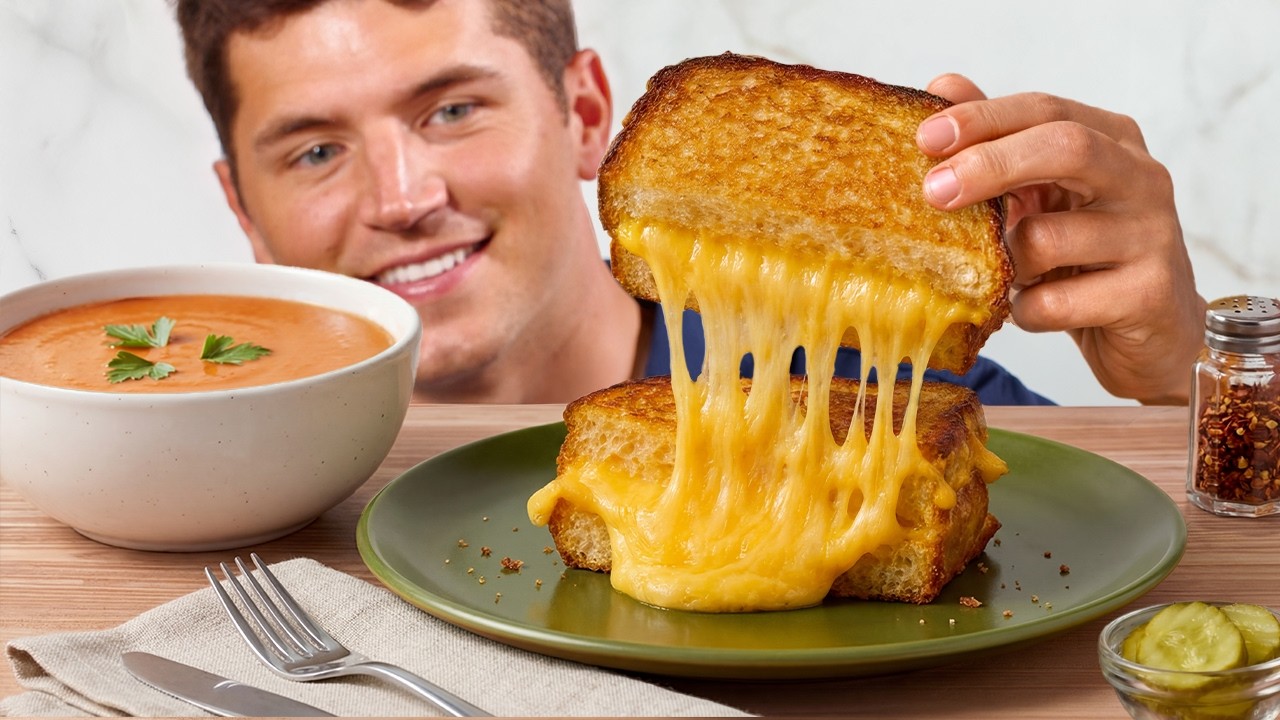
“Everyone has made a grilled cheese. Almost nobody has made a perfect one. The failure rate is staggering for a two-ingredient sandwich: burnt bread with cold cheese in the center, or pale soggy bread with cheese that pooled to one side. The difference between a forgettable grilled cheese and one with a lacquer-brown crust and a full, uniform melt comes down entirely to three things: how you apply the fat, what temperature you cook at, and which cheese you actually use. We tested every approach until the method was bulletproof.”
Why This Recipe Works
A grilled cheese sandwich should not be this difficult to get right. Two ingredients, one pan, fifteen minutes — and yet the average home cook produces it badly more often than not. Either the bread is scorched and the cheese is cold, or the bread is pale and the cheese has turned into a greasy puddle. The gap between those failure modes and a genuinely great grilled cheese is not a matter of skill. It is a matter of understanding the physics of what you are actually trying to accomplish.
The Heat Problem Is Not What You Think
The instinct to cook grilled cheese on medium or medium-high heat is almost universal, and it is almost universally wrong. High heat toasts bread through conduction — direct contact between the bread surface and the hot pan. The problem is that conductive heat does not travel efficiently through bread's porous, air-pocket-filled structure. By the time enough heat has migrated from the pan surface through the bottom bread slice to reach the cheese, the exterior is already dark. You have cooked the outside and nothing else.
The correct approach is medium-low heat, which slows the exterior browning while giving convective heat — the circulating warm air trapped under a lid — time to work on the cheese from all directions simultaneously. Covering the pan for the first half of cooking is not optional. It transforms the skillet into a miniature oven, and the cheese melts from above while the crust builds from below. Remove the lid for the second half to drive off the accumulated steam and set the crust's final texture.
Fat Application Is Architecture
The exterior fat layer is not just about flavor — it is the structural element that determines how the crust forms. Fat fills the surface pores of the bread, creating a continuous conductive layer between the bread and the pan. Where there is fat, there is browning. Where there is no fat, the bread remains pale and dry. This is why cold butter applied directly to bread is a technical failure: it tears the surface, leaves gaps, and produces an uneven, patchy crust.
Softened butter spreads into every pore of the bread's surface. Mayonnaise does the same at a lower effort cost and with a higher smoke point, which means more latitude on heat before you start burning. Either fat applied correctly produces a crust that browns uniformly from edge to edge — the kind of even, amber-gold surface that looks like it came off a commercial flat-top.
Cheese Selection Is Not Aesthetic
The two-cheese combination in this recipe is not food styling. It is engineering. Aged cheddar has outstanding flavor — sharp, complex, slightly tangy — but it contains residual moisture that can cause it to break during melting, separating into greasy fat and grainy protein if the heat is wrong. Gruyère has exceptional melt properties: smooth, stringy, cohesive. Together, the cheddar provides the flavor and the Gruyère provides the infrastructure. One cheese alone gives you half the result.
Grating both cheeses instead of slicing is the fastest path to a reliable melt. Grated cheese has dramatically more surface area exposed to heat than a solid slice, which means it begins melting the moment it hits pan temperature. If you insist on slices, let them reach room temperature before assembling — cold cheese straight from the refrigerator adds 3-4 minutes of thermal lag that all but guarantees overcooked bread.
The Rest Is Patience
After the flip, the hardest instruction in this recipe is the 60-second rest before cutting. Molten cheese is a liquid. Cut a sandwich at full melt temperature and the cheese flows out of the cut edge in a river, pooling on the board instead of staying in the sandwich. Sixty seconds is enough time for the cheese to thicken slightly — still molten, still stretchy, but controlled enough to stay in the sandwich when you pick it up. Use a wide, flat spatula for the flip and the same spatula for the transfer, and the sandwich arrives at the board intact.
The diagonal cut is the final variable. It is not nostalgia or presentation — a diagonal cut creates two structural wedges with a longer hypotenuse than a straight cut provides, and the bread-to-cheese ratio at the peak of each wedge is better. Eat the pointed end first. This is not optional.
Where Beginners Mess This Up
Before we start, read this. These are the 4 reasons your perfect grilled cheese (the technique most people get wrong) will fail:
- 1
Cooking on heat that's too high: High heat chars the bread before the cheese has any chance to melt. You end up with a carbon exterior and a slab of cold, rubbery cheese inside. Grilled cheese is a low-and-slow operation — medium-low heat gives the cheese time to become fully molten while the bread gradually builds its golden crust.
- 2
Using cold cheese straight from the fridge: Cold cheese has a significant thermal deficit to overcome. By the time the heat penetrates through the bread and begins melting cold cheese, the exterior is already overdone. Let sliced cheese come to room temperature for 10 minutes, or grate it — grated cheese melts in roughly half the time of sliced.
- 3
Spreading butter only on the outside: Butter applied to the exterior bread surface is correct, but the distribution method matters. Spreading cold butter tears the bread. Softened butter — or mayonnaise, which has a higher smoke point — spreads without damage and coats every square millimeter of the surface, producing uniform browning instead of dark spots where the butter pooled.
- 4
Not using a lid: An uncovered pan allows dry, ambient heat to toast the top bread surface while the cheese cooks. A lid traps steam and circulates heat around the entire sandwich, melting the cheese from above and below simultaneously. This is the single most underused technique in home grilled cheese production.
The Video Reference Library
Want to see it in action? Here are the exact videos we analyzed and combined to build this foolproof recipe translation:
A precise breakdown of the heat management and fat application technique. Best reference for understanding how low-and-slow transforms a basic sandwich into something exceptional.
Covers the cheese selection fundamentals and explains why mixing two cheeses — a high-melt and a high-flavor variety — produces the best results. Useful for understanding the science behind the melt.
Diner-style technique with the lid method explained in detail. Demonstrates the color progression from pale to golden to deep amber that you are targeting before the flip.
🛠️ Core Equipment
- Heavy-bottomed skillet or cast iron panEven heat distribution is everything here. A thin nonstick pan creates hot spots that produce dark patches on the bread while other areas stay pale. A [cast iron skillet](/kitchen-gear/review/cast-iron-skillet) retains and distributes heat evenly across the entire cooking surface.
- Flat spatula with a wide headYou need full contact under the sandwich when flipping to avoid losing the structural integrity of a molten cheese sandwich. A narrow spatula destabilizes the flip and dumps cheese into the pan.
- Lid or sheet of aluminum foilCovering the pan for the first 2-3 minutes traps steam and creates ambient heat that melts the cheese from above while the bottom crust forms. Without it, you are relying on conduction alone and fighting the thermal mass of cold cheese.
Perfect Grilled Cheese (The Technique Most People Get Wrong)
🛒 Ingredients
- ✦2 slices thick-cut white bread or sourdough (¾-inch thickness)
- ✦1.5 ounces aged cheddar, thinly sliced or grated
- ✦1 ounce Gruyère, thinly sliced or grated
- ✦1.5 tablespoons unsalted butter, softened to room temperature
- ✦Flaky sea salt, for finishing
👨🍳 Instructions
01Step 1
Remove butter from the refrigerator at least 15 minutes before cooking. Softened butter spreads without tearing bread.
02Step 2
Grate or slice the cheese and let it sit at room temperature for 10 minutes.
03Step 3
Spread a thin, even layer of softened butter across one entire face of each bread slice, edge to edge.
04Step 4
Place a heavy-bottomed skillet or [cast iron pan](/kitchen-gear/review/cast-iron-skillet) over medium-low heat. Allow the pan to preheat for 90 seconds — it should feel warm when you hold your hand 3 inches above the surface, not hot.
05Step 5
Place one bread slice butter-side-down in the pan. Layer the cheddar first, then the Gruyère on top. Place the second bread slice butter-side-up on top.
06Step 6
Cover the pan with a lid or a sheet of foil tented loosely over the top. Cook for 3-4 minutes until the bottom is deep golden brown.
07Step 7
Remove the lid. Slide the wide spatula fully under the sandwich and flip in one confident motion. Do not hesitate — a hesitant flip loses structural integrity.
08Step 8
Cook uncovered for 2-3 minutes until the second side reaches the same deep golden color and the cheese is visibly melted at the edges.
09Step 9
Transfer to a cutting board. Finish with a pinch of flaky sea salt on top. Rest for 60 seconds before cutting — this allows the molten cheese to stabilize slightly so it doesn't pour out on the first cut.
Nutrition Per Serving
Estimates based on standard preparation. Adjustments alter macros.
🔄 Substitutions
Instead of Unsalted butter...
Use Mayonnaise
Higher smoke point means more even browning. Neutral flavor with a slight tang. Produces a slightly thinner, lacquer-like crust rather than the soft-crisp texture of butter.
Instead of White bread...
Use Sourdough or rye
Sourdough adds tang that cuts through the fat of the cheese. Rye adds earthy depth. Both require slightly longer cooking due to denser structure.
Instead of Aged cheddar...
Use American cheese
American cheese is an emulsified product that melts with extreme uniformity and never breaks. It produces a glossy, smooth pull rather than the stringy natural-cheese pull. A legitimate choice, not a compromise.
Instead of Gruyère...
Use Fontina or Havarti
Both are high-melt cheeses with mild, buttery flavors that blend well with sharper varieties. Fontina is slightly nuttier; Havarti is creamier and more neutral.
🧊 Storage & Reheating
In the Fridge
Store wrapped in foil for up to 1 day. The texture degrades significantly — the crust softens as moisture redistributes. Best eaten immediately.
In the Freezer
Not recommended. Freezing causes the bread to become soggy upon thawing and the cheese texture changes unfavorably.
Reheating Rules
Reheat in a dry pan over medium-low heat for 2-3 minutes per side. Avoid the microwave entirely — it turns the crust rubbery and the cheese leathery.
❓ Frequently Asked Questions
Why is my cheese not melting by the time the bread is done?
Heat is too high. You're cooking at medium or above, which toasts the exterior before the thermal energy can penetrate to the cheese. Drop to medium-low and cover the pan for the first half of cooking. The lid traps steam and heats the cheese from above simultaneously.
Can I use pre-sliced American cheese singles?
Yes, and they produce a reliably smooth, uniform melt because of their emulsified structure. The trade-off is flavor complexity — American cheese is mild. Combine one slice of American with one slice of aged cheddar for both melt reliability and flavor depth.
What bread is best for grilled cheese?
Thick-cut white bread or sourdough in the ¾-inch range. Too thin and the bread toasts before the cheese melts; too thick and the thermal mass prevents the center from heating evenly. The thickness is more important than the variety.
Should I use salted or unsalted butter?
Unsalted, always. Salted butter has a lower smoke point due to the milk solids in the salt and can contribute bitterness at higher temperatures. You control the salt entirely with the finishing flakes.
Why does restaurant grilled cheese taste better?
Volume of fat and heat consistency. Short-order cooks use significantly more butter than home recipes suggest, and their flat-top griddles maintain a perfectly even medium-low temperature that home burners struggle to replicate. A cast iron skillet preheated for 5 full minutes gets you closest to that result.
Can I make grilled cheese in the oven?
Yes. Brush buttered sandwiches on both sides and bake at 425°F for 5-6 minutes per side on a sheet pan. This method scales well for feeding multiple people. The crust is excellent but lacks the direct-heat caramelization you get from a pan.

The Science of
Perfect Grilled Cheese (The Technique Most People Get Wrong)
We turned everything on this page into a beautiful, flour-proof PDF cheat sheet. Print it out, stick it to your fridge, and never mess up your perfect grilled cheese (the technique most people get wrong) again.
*We'll email you the high-res PDF instantly. No spam, just perfectly cooked meals.
AlmostChefs Editorial Team
We translate the internet's most popular cooking videos into foolproof, beginner-friendly written recipes. We analyze multiple methods, test them in our kitchen, and engineer a single "Master Recipe" that gives you the best possible result with the least possible stress.