Godeungeo Jorim (Braised Mackerel)
Mackerel fillets braised in a bold gochugaru-soy sauce with radish slices that soak up every drop. Korea's most beloved home-cooked fish dish.
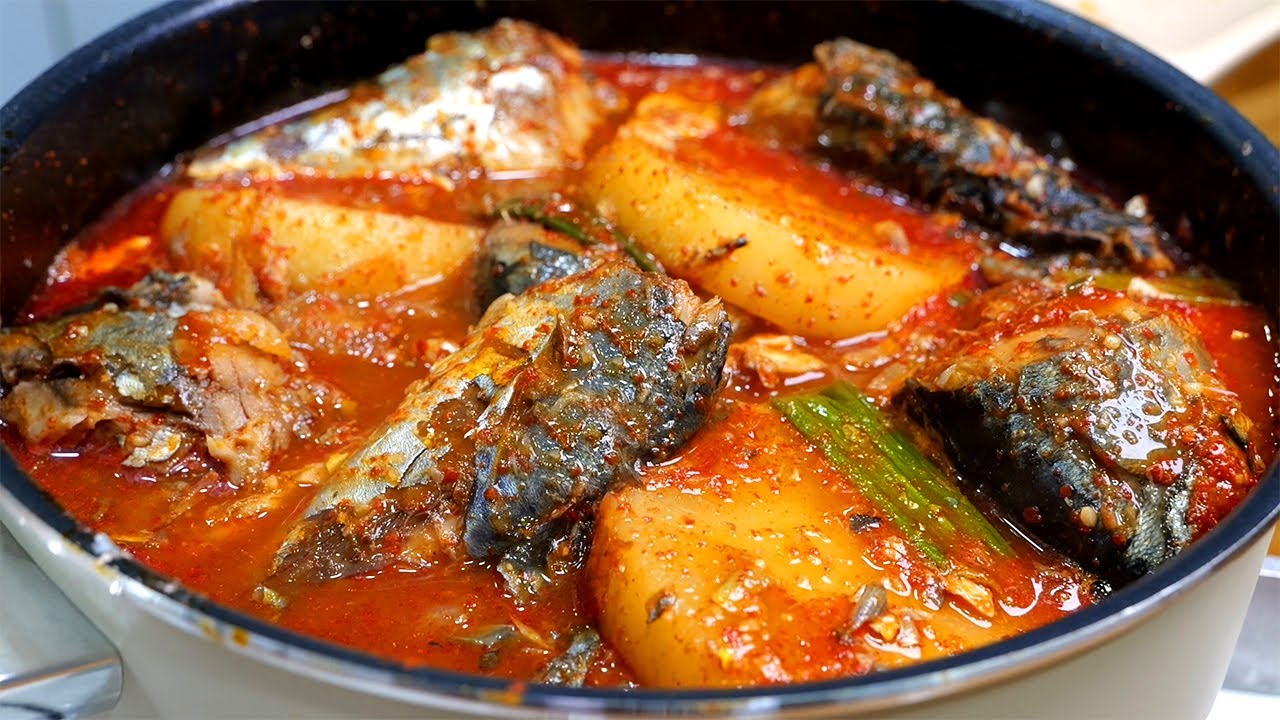
Why This Recipe Works
Most home cooks treat braised fish as a lesser discipline — throw something in a pan, add liquid, wait. That attitude is why most braised fish tastes like boiled regret. Godeungeo jorim refuses that trajectory. Every structural decision in this recipe exists for a reason, and those reasons are grounded in heat transfer, protein chemistry, and the particular physics of an oily, assertive fish. Follow the logic and the dish delivers. Ignore it and you have soggy mackerel swimming in diluted red water.
The Radish Bed Is Not Optional
The first instruction — lining the bottom of a wide, shallow pan with radish slices — reads like a flavor trick. It is, but it's primarily an engineering solution. Mackerel skin is thin and rich in surface fat. Direct contact with a hot pan during braising creates two problems: sticking that tears the fillet apart when you try to move it, and localized overheating that scorches the skin before the interior cooks through. The radish layer elevates the fish by roughly 5–6mm, which is enough to keep the skin out of direct contact with the pan surface while still allowing convective heat from the braising liquid to cook the fish evenly from below.
The secondary benefit — radish slices that become deeply saturated with braising sauce — is arguably the more important one from a culinary standpoint. Korean radish (mu) has a cellular structure that behaves like a sponge under heat and pressure. As it softens, it expels water and draws in the surrounding liquid. By the time the fish is done, those radish rounds hold a concentrated mixture of fish fat, gochugaru oil, soy, and caramelized sugars. Anyone who has made this dish and left the radish on the plate has made a critical error in judgment.
Scoring: Not Aesthetics, Actual Science
The diagonal cuts on each fillet are not decorative. Mackerel skin contracts significantly when exposed to heat — the proteins in the skin and the subcutaneous fat layer tighten at different rates than the flesh below, causing curling, uneven cooking, and a fish that looks like it's trying to escape the pan. Scoring severs those connective layers, allowing the fillet to lie flat throughout the braise.
The second function of scoring is diffusion. The braising sauce is thick — gochujang and gochugaru create a viscous liquid with limited penetration into dense protein. Surface flavor without interior flavor is the failure mode of most amateur fish dishes. Scored channels give the sauce a direct route into the flesh, so the mackerel absorbs heat and flavor from the outside in and through the cuts simultaneously. The result is uniform flavor at every depth of the fillet, not just the outer 2mm.
The Dual-Chili Architecture
Amateur versions of this dish use either gochugaru or gochujang. Using both is not redundant — it is the entire point. These two ingredients are not interchangeable versions of the same thing. They are chemically distinct and contribute different things.
Gochugaru is dried, coarsely ground Korean red pepper. It provides direct, clean capsaicin heat and — critically — brilliant red color. Its fat-soluble pigments (primarily capsanthin and capsorubin) dissolve into the braising liquid and coat every surface in the pan with that characteristic deep orange-red glaze. It contributes no fermented character. It is heat and pigment, full stop.
Gochujang is fermented chili paste. The fermentation process produces glutamates, organic acids, and complex aromatic compounds that gochugaru lacks entirely. It adds depth, umami, and a slightly sweet-sour background note that prevents the sauce from tasting flat or one-dimensional. It also acts as a mild thickener due to its starch content (most gochujang contains glutinous rice flour). The sauce's final body — that glossy, lacquer-like consistency that coats the fish — owes a significant debt to gochujang's starch and the reduction of sugars during the final uncovered braise.
Using only gochugaru: vivid color, sharp heat, thin sauce, no depth. Using only gochujang: thicker sauce, fermented complexity, dull brownish-red color, muddled heat. Using both: you get all of it.
Basting Is the Work
The uncovered final phase — 8 to 10 minutes of active reduction and repeated basting with a basting spoon — is not optional finishing work. It is the central cooking act. As liquid evaporates, sugar concentration in the sauce increases, raising the boiling point and intensifying Maillard-adjacent browning on the sauce surface. Each time you spoon the reduced liquid over the fish, you deposit a slightly more concentrated layer of glaze than the pass before. By the fifth or sixth basting, the fish surface carries a deep, rust-colored coating that is meaningfully different from what it looked like at minute one.
The sauce does not thicken itself. You thicken it through repeated reduction and application. Skip the basting and you end up with a fish sitting in a shallow puddle of slightly less watery liquid. Baste consistently and you end up with a lacquered fillet that holds its glaze all the way to the table.
Ginger and Garlic as Functional Chemistry
Three cloves of garlic and a teaspoon of fresh ginger are not in this recipe for flavor alone. Both contain sulfur compounds and aldehyde molecules that actively bond with the trimethylamine responsible for the characteristic smell of aged fish. This is not metaphorical — it is documented chemistry. Garlic's allicin and ginger's gingerols react with volatile fish amines during cooking, reducing the perceived fishiness of the dish. This is why Chef Kim recommends both, along with the boiling water pre-rinse that washes surface trimethylamine off the fillets before they enter the pan. None of these steps is precious or fussy. They are cause and effect.
Korea's Everyday Fish
Godeungeo jorim occupies the same position in Korean domestic cooking that roast chicken occupies in French bourgeois cuisine — the default, the reliable, the one every grandmother has an opinion about and every home cook gradually modifies over years of repetition. Mackerel is cheap, widely available, nutritionally dense (28 grams of protein and substantial omega-3 fatty acids per serving), and forgiving enough for weeknight execution without demanding weekend attention. The total active time is under fifteen minutes. The rest is controlled heat and patience.
The dish requires no special technique, no rare equipment, no extended preparation. What it requires is respecting the logic of the process: the radish goes down first, the fish scores before it enters the pan, the sauce balances fermented depth against fresh chili heat, and the final basting phase does not get skipped because you got bored. Execute those four things correctly and the result is a deeply satisfying Korean dinner that costs almost nothing and tastes like it took considerably more effort than it did.
Godeungeo Jorim (Braised Mackerel)
🛒 Ingredients
- ✦2 mackerel fillets (or 1 whole mackerel, gutted and halved)
- ✦1/2 Korean radish (mu), sliced into 1/4-inch rounds
- ✦2 tablespoons soy sauce
- ✦1 tablespoon gochugaru (Korean red pepper flakes)
- ✦1 tablespoon gochujang (Korean red pepper paste)
- ✦1 tablespoon mirin
- ✦1 tablespoon sugar
- ✦3 cloves garlic, minced
- ✦1 teaspoon fresh ginger, grated
- ✦1/2 small onion, sliced
- ✦1 Korean green chili, sliced diagonally
- ✦1 green onion, sliced
- ✦1/2 cup water
👨🍳 Instructions
01Step 1
Score the mackerel fillets with 2-3 diagonal cuts on each side — this helps the sauce penetrate and prevents curling.
02Step 2
Line the bottom of a wide, shallow pan with radish slices in a single layer. This serves as a bed for the fish.
03Step 3
Mix the braising sauce: combine soy sauce, gochugaru, gochujang, mirin, sugar, garlic, ginger, and water. Stir until smooth.
04Step 4
Place mackerel fillets skin-side up on the radish bed. Add onion slices around the fish. Pour the sauce evenly over everything.
05Step 5
Bring to a boil over medium-high heat. Reduce to medium, cover, and braise for 15 minutes.
06Step 6
Uncover and baste the fish with the sauce using a spoon. Add chili peppers. Continue braising uncovered for 8-10 more minutes until the sauce reduces and thickens.
07Step 7
Garnish with green onions. Serve in the pan with steamed rice.
Nutrition Per Serving
Estimates based on standard preparation. Adjustments alter macros.
🔄 Substitutions
Instead of Mackerel...
Use Spanish mackerel or bluefish
Both are oily fish that braise well — similar richness
Instead of Korean radish...
Use Daikon radish or potato slices
Daikon is milder. Potatoes absorb sauce similarly but different texture.
Instead of Gochujang...
Use Extra gochugaru (1 tablespoon) + extra soy sauce (1 teaspoon)
Keeps it simpler — gochujang adds fermented depth but isn't strictly necessary
🧊 Storage & Reheating
In the Fridge
Store for 1-2 days. The sauce thickens and the radish absorbs more flavor overnight.
In the Freezer
Not recommended — fish texture degrades.
Reheating Rules
Gentle reheat in a covered pan with a splash of water. Don't microwave — it dries out the fish.
❓ Frequently Asked Questions
How do I get rid of mackerel's fishy smell?
Three techniques: (1) pour boiling water over the fish before cooking, (2) add ginger and garlic to the braising sauce (both neutralize fishy compounds), and (3) add a splash of soju or mirin. Chef Kim uses all three. The gochugaru also masks any remaining fishiness.
Why is mackerel so popular in Korean cooking?
Mackerel is affordable, nutritious (high omega-3), and available year-round in Korea. It's the everyday fish — grilled for lunch at home (godeungeo gui) or braised for dinner (godeungeo jorim). In Korean school cafeterias, mackerel appears weekly.

The Science of
Godeungeo Jorim (Braised Mackerel)
We turned everything on this page into a beautiful, flour-proof PDF cheat sheet. Print it out, stick it to your fridge, and never mess up your godeungeo jorim (braised mackerel) again.
*We'll email you the high-res PDF instantly. No spam, just perfectly cooked meals.
AlmostChefs Editorial Team
We translate the internet's most popular cooking videos into foolproof, beginner-friendly written recipes. We analyze multiple methods, test them in our kitchen, and engineer a single "Master Recipe" that gives you the best possible result with the least possible stress.