Gamja Jeon (Korean Potato Pancakes)
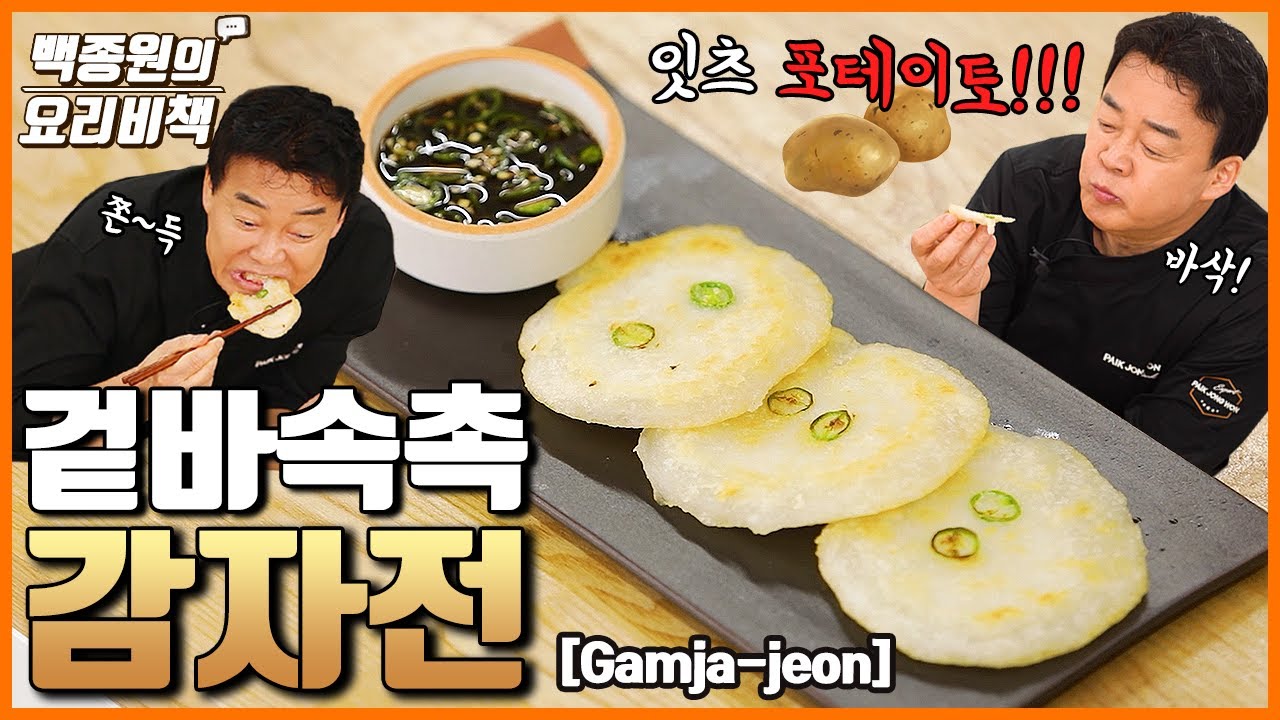
Crispy, lacy potato pancakes made from grated potato with no flour — just pure potato starch binding. Rainy day comfort food at its simplest.
Why This Recipe Works
Most potato pancake recipes are a quiet act of culinary cowardice. Flour added here, egg added there — a long list of binders and buffers that exist solely because the cook doesn't trust the potato to do its own job. Baek Jong Won's gamja jeon strips every one of those safety nets away. What you're left with is one of the most technically elegant recipes in the Korean home-cooking canon: a pancake held together by nothing but the potato's own extracted starch, fried until the edges are lacy, brittle, and ruthlessly golden. There is no margin for error. There is also no excuse for failure, because the science here is ironclad if you follow it precisely.
The Starch Extraction Principle
This is the entire recipe, mechanically speaking. When you grate raw potato directly into a box grater and then squeeze the shredded mass through a fine-mesh sieve, two things happen. First, you remove excess surface moisture that would otherwise steam the pancake from the inside out — the enemy of crispiness. Second, the expelled liquid contains dissolved potato starch in suspension. Left to settle for five minutes, that starch sinks to the bottom of the bowl like sediment. You pour off the clear water above it. The dense white paste that remains is pure amylose and amylopectin — the same compounds responsible for the binding action in commercial potato starch powder, extracted for free from the potato you were already using.
This is not a trick. It is basic food chemistry applied with the patience it deserves. When the reserved starch is folded back into the grated potato, it coats every shred. Under heat, the starch granules swell, gelatinize, and fuse the shreds into a cohesive network. The pancake holds. No flour. No egg. No apology.
Heat, Oil, and the Geometry of Thinness
The non-stick pan is non-negotiable here, not for convenience, but for control. Cast iron runs too hot at the edges, stainless steel requires more oil to compensate for adhesion. A flat non-stick surface with moderate, even heat gives you the 3–4 minutes per side that the starch network needs to fully set and brown without burning the outside before the interior cooks through.
Oil quantity matters more than most recipes admit. A generous layer — not a shallow film, not a deep fry — ensures the underside of the pancake makes full contact with hot fat. This produces the Maillard reaction across the entire surface, including the thin lacy edges where the batter has spread thinnest. Those edges are the point. They represent the intersection of maximum surface area, minimum moisture, and maximum fat contact. They brown first, they crisp hardest, and they are the part of gamja jeon that makes the whole exercise worthwhile.
Press the portions thin. Use the back of a spoon, the bottom of a measuring cup, whatever flat tool is available. A pancake pressed to 4mm will outperform a 10mm pancake on every crispiness metric. Thicker portions trap steam. Steam softens starch. Soft starch is not gamja jeon — it's a potato cake, and nobody is writing a 5.3-million-view video about a potato cake.
The Onion Variable
Grated onion is not a flavor afterthought. It contributes moisture during the mixing phase, which helps the batter come together, and its natural sugars caramelize under heat, adding a subtle sweetness that offsets the neutral starch flavor of the potato. One small onion is calibrated precisely — enough to function, not enough to dominate. Recipes that double the onion ratio end up with a wetter batter and softer results. Follow the ratio.
The green onion and Korean chili are structural additions in a different sense: they create visual contrast within the lacy matrix of the pancake, signaling freshness against the deep gold of the crust. The chili's capsaicin also provides a mild counterpoint to the oil richness. These are not decorative. Every component in this recipe has a function.
The Dipping Sauce Is Not Optional
Soy sauce, rice vinegar, sesame seeds. The acid in the rice vinegar cuts through the fat coating on the tongue, resetting the palate between bites. The sesame seeds add a secondary toasty note that bridges the sauce to the browned crust. Without it, repeated bites of gamja jeon become monotonous — the starch and oil accumulate without relief. The sauce is the mechanism that makes you eat the whole plate instead of stopping at two.
Temporal Decay and the Eating Window
Gamja jeon has a peak window of approximately five minutes from pan to plate. This is not hyperbole. The crispy outer starch network begins absorbing ambient moisture from the air immediately upon leaving the heat. Steam trapped beneath the pancake on a flat surface accelerates this process. Drain on paper towels, serve immediately, eat fast. This is not a recipe designed for meal prep, for packed lunches, or for reheated leftovers the next day. It is designed for one moment — the moment the rain starts and the pan hits the stove — and it executes that moment with complete precision.
Rainy Day Ritual
In Korea, the sound of rain is a sensory trigger with a specific culinary response. There is a cultural shorthand — Bi ga o-neun nal-en jeon — that translates roughly to "on rainy days, you eat jeon." The sizzle of batter hitting hot oil is said to sound like rain itself, a resonant feedback loop that makes the craving self-reinforcing. Families gather. Makgeolli — the milky, lightly effervescent rice wine — appears on the table. Gamja jeon stacks up on a plate lined with paper towels, each pancake slightly overlapping the last. The window fogs. Nobody talks much. The eating is the point.
Baek Jong Won did not invent this ritual. He codified it with the precision of someone who understands that the best recipes are the ones that contain nothing extra — only the exact minimum required to produce the exact right result. Five ingredients. One technique. One moment. That is what 5.3 million views actually represents: a collective recognition that someone finally explained, correctly, why this simple thing works.
Gamja Jeon (Korean Potato Pancakes)
🛒 Ingredients
- ✦3 large potatoes, peeled
- ✦1 small onion, grated
- ✦1 teaspoon salt
- ✦1 green onion, finely sliced
- ✦1 Korean green chili, finely sliced (optional)
- ✦Vegetable oil for pan-frying
- ✦Soy dipping sauce: 2 tablespoons soy sauce + 1 tablespoon rice vinegar + 1 teaspoon sesame seeds
👨🍳 Instructions
01Step 1
Grate potatoes on the fine side of a box grater directly into a large bowl. Work quickly — potatoes oxidize fast.
02Step 2
Grate onion into the same bowl. Add salt and mix. Let sit for 5 minutes.
03Step 3
Strain the mixture through a sieve, collecting the liquid in a separate bowl. Squeeze the grated potato to extract as much liquid as possible.
04Step 4
Add the reserved potato starch back to the grated potato. Add green onion and chili. Mix well. The batter should hold together when pressed.
05Step 5
Heat a generous layer of oil in a non-stick pan over medium heat. Scoop 1/4 cup portions and flatten into thin, wide pancakes.
06Step 6
Fry for 3-4 minutes per side until deeply golden and crispy. The edges should be lacy and brown.
07Step 7
Drain on paper towels. Serve hot with soy dipping sauce.
Nutrition Per Serving
Estimates based on standard preparation. Adjustments alter macros.
🔄 Substitutions
Instead of Potatoes...
Use Sweet potatoes
Sweeter, less crispy, but equally delicious — goguma jeon
Instead of Soy dipping sauce...
Use Gochujang + mayo (1:1)
Spicy-creamy dip popular at modern Korean restaurants
🧊 Storage & Reheating
In the Fridge
Best fresh. Leftovers lose crispness — store 1 day max.
In the Freezer
Not recommended.
Reheating Rules
Re-crisp in a dry pan over medium heat. Air fryer at 375°F for 4 minutes also works.
❓ Frequently Asked Questions
Why do Koreans eat jeon when it rains?
There's a cultural saying: 'When it rains, eat pajeon (or gamja jeon).' The sizzle of the pancake in oil supposedly sounds like rain, creating a cozy atmosphere. It's also comfort food — on gloomy days, Koreans gather with jeon and makgeolli (rice wine). It's one of Korea's strongest food associations.
Why no flour in this recipe?
The potato's own starch acts as the binder. Baek Jong Won's technique of settling out the starch from the grated potato liquid and adding it back creates a naturally gluten-free pancake that's crispier than flour-bound versions.

The Science of
Gamja Jeon (Korean Potato Pancakes)
We turned everything on this page into a beautiful, flour-proof PDF cheat sheet. Print it out, stick it to your fridge, and never mess up your gamja jeon (korean potato pancakes) again.
*We'll email you the high-res PDF instantly. No spam, just perfectly cooked meals.
AlmostChefs Editorial Team
We translate the internet's most popular cooking videos into foolproof, beginner-friendly written recipes. We analyze multiple methods, test them in our kitchen, and engineer a single "Master Recipe" that gives you the best possible result with the least possible stress.