Galbitang (Short Rib Soup)
Crystal-clear beef short rib soup with tender bone-in ribs, radish, and glass noodles. Korea's most elegant soup — pure, clean, and deeply beefy.
Why This Recipe Works
Galbitang is not a recipe for the impatient. It is a three-hour argument against shortcuts, a disciplined sequence of extraction and refinement that produces something almost offensively simple-looking — a clear bowl of beef broth with ribs in it — that tastes like it contains the entire memory of Korean culinary history. Every step in this process exists for a precise scientific reason. Violate any of them and you will know it immediately, because you will be staring at a murky, grey, fat-slicked bowl of mediocrity instead of the crystalline broth that has graced Korean wedding tables and Lunar New Year spreads for centuries.
Let's be honest about what galbitang actually is: it is a stress test for your technique. Unlike stews that forgive sloppy execution by hiding behind a sauce, galbitang is transparent — literally. The broth is supposed to be clear enough that you can read text through it. That clarity is not aesthetic preference. It is the direct, visible evidence of whether you did the work correctly. Cooks who understand this treat the recipe like a lab protocol, not a loose suggestion.
The Triple-Clean Method: Why Each Step Is Non-Negotiable
Cold soak — 2 to 3 hours, water changed every 30 minutes. Beef short ribs contain a significant quantity of myoglobin, heme iron, and general blood-borne protein material distributed throughout the muscle tissue. When exposed to cold water over time, osmotic pressure causes these compounds to migrate out of the meat and into the water. You are not doing this for flavor. You are doing this to remove the raw material that would coagulate into grey scum the moment the ribs hit boiling water. Skipping this step is not a time-saver — it is a deposit you will pay later in cloudiness you cannot reverse.
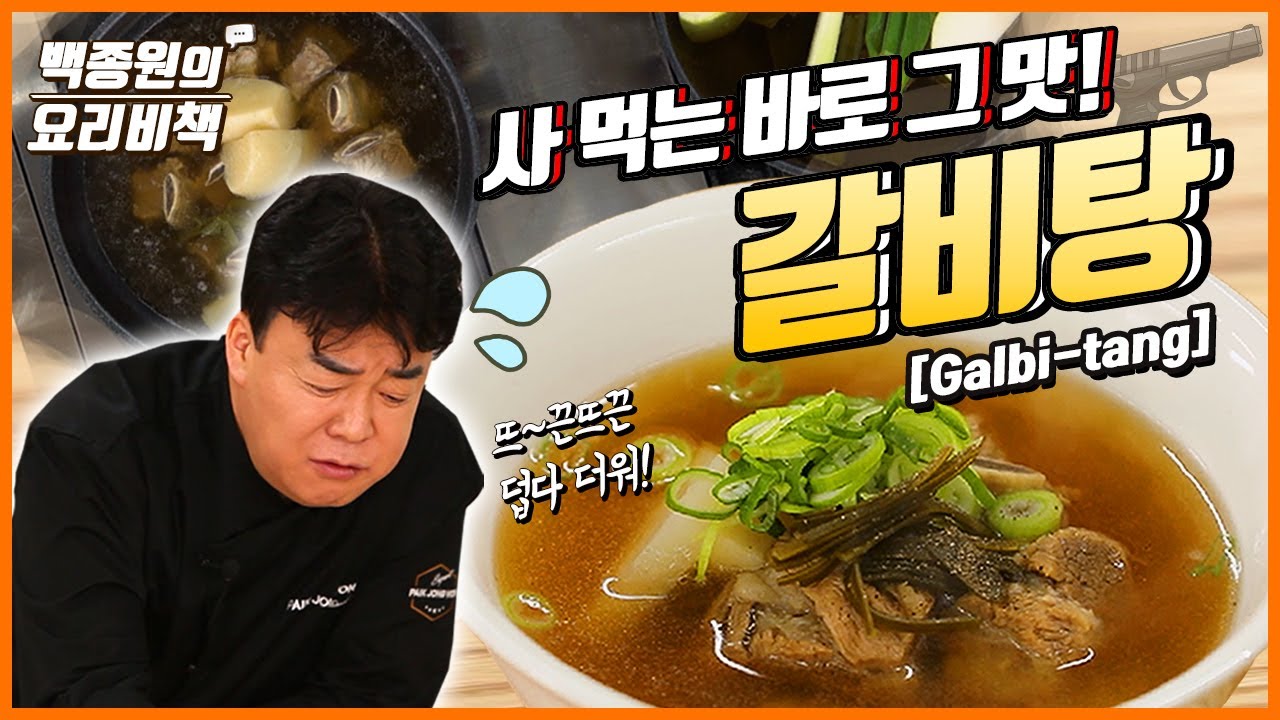
Blanching — boil for 5 minutes, then rinse under cold water. Once you have soaked the ribs, blanch them in a clean stockpot of cold water brought to a boil. The heat denatures the surface proteins at speed, causing any remaining impurities to coagulate and rise as grey foam. You then drain the entire pot, discard that water, and rinse each rib individually under cold running water to physically remove the coagulated scum. This is the step most home cooks skip because it feels redundant. It is not redundant. It is the difference between a clear broth and a cloudy one, and it cannot be replicated by skimming alone. Baek Jong Won identifies this single omission as the most common reason galbitang fails.
Skimming during the simmer. Even after soaking and blanching, a small amount of foam will rise during the first 15 minutes of the main simmer. Use a ladle or fine-mesh skimmer to remove it as it appears. After that initial window, if you are simmering correctly, foam production drops to near zero.
The Physics of Clarity: Simmer vs. Boil
This is where the science becomes critical. A rolling boil is mechanically violent. The turbulence physically breaks fat globules into microscopic droplets that become permanently suspended in the cooking liquid through a process identical to emulsification. Once fat emulsifies into a broth, you cannot un-emulsify it. You now have opaque, fatty broth. The only recovery is to strain the entire batch through cheesecloth and refrigerate it overnight so the fat solidifies and separates — which adds another 12 hours to your timeline.
A gentle simmer — small, lazy bubbles barely breaking the surface — keeps the fat in large globules that float intact and can be skimmed cleanly. The broth stays clear. The collagen from the bone-in short ribs dissolves slowly into the liquid, contributing body and a silky texture without adding cloudiness. This is why the instruction to reduce to a gentle simmer immediately after the initial boil is not optional phrasing. It is a load-bearing direction.
Use a stockpot with a heavy base that retains heat evenly and allows you to maintain a stable low simmer without constant adjustment. Thin-walled pots create hot spots that force localized boiling even when the burner is set low — exactly the condition you are trying to avoid.
The Radish: A Silent Sweetener You Will Never See in the Bowl
Korean radish (mu) is added to galbitang not because it contributes flavor you can identify by eating it — you remove it before serving — but because it releases natural sugars and mild sulfurous compounds during the long simmer that round the broth's edge and suppress the metallic, iron-forward note that beef soup can carry without it. It is background work. The radish serves the broth, then exits quietly. Do not skip it on the theory that it will not be missed. It will be missed. You just will not know why the broth tastes flatter than it should.
Glass Noodles: Timing Is Everything
Dangmyeon — sweet potato glass noodles — are added in the final 5 minutes only. They are pre-soaked to rehydrate, which means they require very little cooking time in the hot broth. Overcook them and they absorb too much liquid, swell, and become dense. They also continue cooking in residual heat after the pot comes off the burner. Add them late, cook them briefly, and serve immediately.
What You Are Actually Serving
Galbitang is not the boldest Korean beef preparation. That title belongs elsewhere. What it is, is the most technically demanding — a dish where the absence of interference is the skill. Weddings in Korea serve it because clear galbitang signals that someone spent the time. In a cuisine that has plenty of loud, complex flavors, galbitang's restraint is the point. It asks you to make something that looks simple and is not, and to make it with enough discipline that the clarity of the broth tells the story before anyone takes a bite.
Galbitang (Short Rib Soup)
🛒 Ingredients
- ✦2 lbs bone-in beef short ribs (English cut)
- ✦10 cups water
- ✦1/2 Korean radish (mu), cut into large chunks
- ✦5 cloves garlic, whole
- ✦1 small onion, halved
- ✦1 tablespoon soy sauce
- ✦1 bundle glass noodles (dangmyeon), soaked
- ✦2 green onions, sliced
- ✦1 egg, beaten (optional)
- ✦Salt and black pepper to taste
- ✦1 teaspoon sesame oil
👨🍳 Instructions
01Step 1
Soak short ribs in cold water for 2-3 hours, changing water every 30 minutes. This draws out blood and impurities for a clear broth.
02Step 2
Blanch ribs: Place in a pot of cold water, bring to a boil, boil for 5 minutes. Drain, rinse each rib under cold water, scrubbing off any scum.
03Step 3
In a clean pot, add blanched ribs, 10 cups fresh water, radish, garlic, and onion. Bring to a boil over high heat.
04Step 4
Reduce to a gentle simmer. Cook for 60-90 minutes until the meat is tender and pulls easily from the bone. Skim any remaining foam.
05Step 5
Remove radish, garlic, and onion. Season broth with soy sauce, salt, and pepper.
06Step 6
Add soaked glass noodles to the pot. Cook for 5 minutes until transparent.
07Step 7
Drizzle beaten egg into the simmering soup if desired. Ladle into bowls with ribs and noodles. Garnish with green onions and sesame oil.
Nutrition Per Serving
Estimates based on standard preparation. Adjustments alter macros.
🔄 Substitutions
Instead of Beef short ribs...
Use Beef shank or oxtail
Oxtail makes an even richer version (kkori gomtang) — increase cooking time to 2+ hours
Instead of Korean radish...
Use Daikon radish
Similar sweetening effect — cut into large chunks so it doesn't disintegrate
Instead of Glass noodles...
Use Omit entirely
Traditional galbitang often has no noodles — the meat and broth are the focus
🧊 Storage & Reheating
In the Fridge
Store for 3-4 days. The broth may gel when cold — that's collagen, and it's a sign of good galbitang.
In the Freezer
Freeze for up to 3 months. The collagen-rich broth freezes and reheats beautifully.
Reheating Rules
Reheat gently in a pot. Add a splash of water if the broth has reduced.
❓ Frequently Asked Questions
Why is my galbitang cloudy?
Three common causes: not soaking the ribs long enough, skipping the blanching step, or boiling too aggressively. Galbitang requires patience — cold soak, blanch, gentle simmer. Each step removes impurities that would cloud the broth.
What is the difference between galbitang and gomtang?
Galbitang uses meaty short ribs and has a lighter, clearer broth. Gomtang uses bones (often leg bones) simmered for 6+ hours until the broth turns milky white from extracted collagen and marrow. Galbitang is elegant; gomtang is deeply rustic.

The Science of
Galbitang (Short Rib Soup)
We turned everything on this page into a beautiful, flour-proof PDF cheat sheet. Print it out, stick it to your fridge, and never mess up your galbitang (short rib soup) again.
*We'll email you the high-res PDF instantly. No spam, just perfectly cooked meals.
AlmostChefs Editorial Team
We translate the internet's most popular cooking videos into foolproof, beginner-friendly written recipes. We analyze multiple methods, test them in our kitchen, and engineer a single "Master Recipe" that gives you the best possible result with the least possible stress.