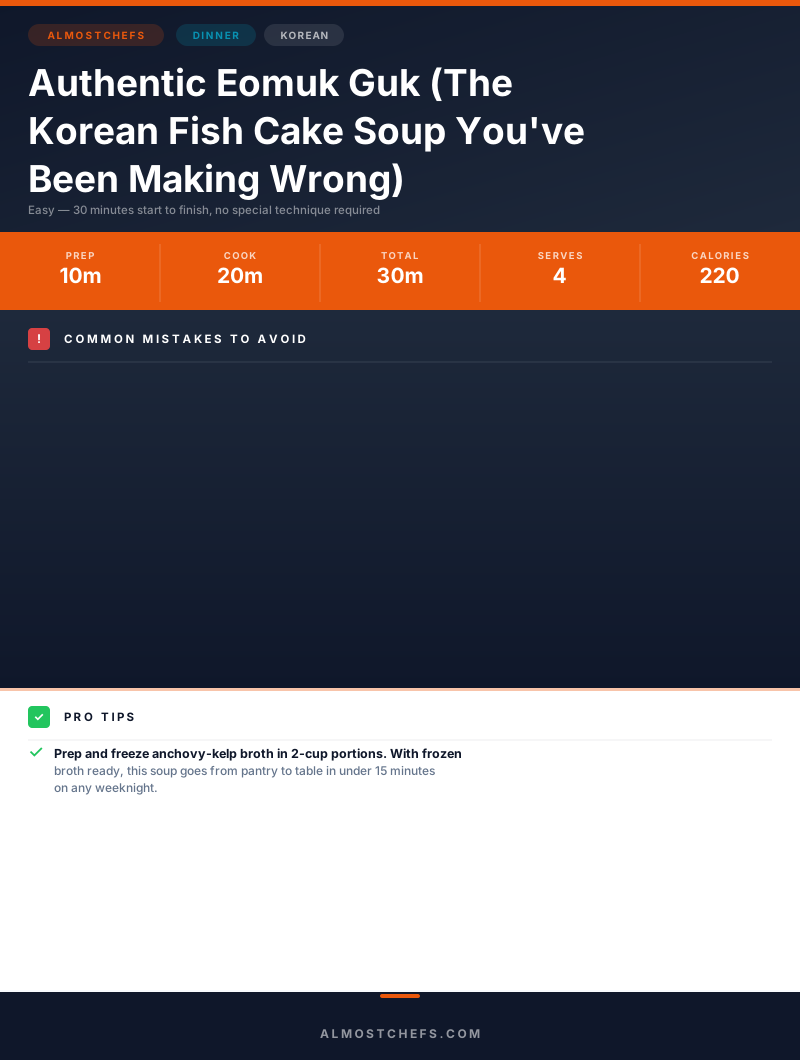
Authentic Eomuk Guk (The Korean Fish Cake Soup You've Been Making Wrong)
A clean, deeply savory Korean fish cake soup built on a proper anchovy-kelp broth with tender radish and silky eomuk. Most recipes skip the broth entirely and simmer fish cakes in plain water — this one corrects that mistake in 10 minutes flat.

“Eomuk guk is what Koreans make when they need something warming, fast, and deeply satisfying from a nearly empty fridge. The version you'll find online most often skips the broth entirely — fish cakes dropped into salted water and called done. That is not eomuk guk. That is fish cake water. A proper anchovy-kelp broth takes exactly 10 minutes and turns this into something that actually tastes like something.”
Why This Recipe Works
Eomuk guk does not ask much of you. Thirty minutes, a handful of pantry staples, and one technique that most online recipes skip entirely. That skipped technique is why most home versions taste like nothing in particular — pleasant in a vague, warm-liquid way, but not something you find yourself thinking about later.
The technique is the broth.
The Anchovy-Kelp Foundation
Korean soup cooking runs on myeolchi-dasima yuksu — anchovy-kelp broth — the same way French cooking runs on veal stock. It is the invisible backbone of dozens of dishes, and eomuk guk is one of them. Dried anchovies contribute intense umami through glutamic acid and inosinic acid, two flavor compounds that amplify each other exponentially when combined. Dried kelp (dasima) carries additional glutamates. Together, they create what food scientists call synergistic umami enhancement — the whole significantly greater than the sum of its parts.
The process takes 10 minutes in cold water starting from scratch. That is the entire investment. Strain it clean and you have a broth with more depth than most Western stocks achieve in two hours.
The cold-start method matters. Dropping anchovies into boiling water extracts flavor fast but brutally — you get a sharp, aggressive brine. Starting cold and bringing the temperature up gradually coaxes a rounder, more complex extraction. The same principle applies to French press coffee versus espresso: speed extracts intensity, patience extracts nuance.
What Radish Actually Does
Korean mu (radish) in a soup context is not about eating radish. It is about what radish does to the liquid around it. During its 10-minute simmer, radish releases natural sugars and mild vegetal sweetness that round out the sharp savory edges of the anchovy broth. The result is a balanced, harmonious soup base rather than something that tastes like seasoned fish water.
The texture goal for radish in eomuk guk is just-tender — yielding when pressed with a spoon, not collapsing. Overcooked radish turns translucent and watery, releasing too much moisture and diluting the broth you just spent 10 minutes building.
Fish Cake Science
Eomuk (어묵) is a processed product — pollock or other white fish ground, seasoned, combined with starch, and cooked before packaging. This matters for cooking time: it is already done. Your job is to heat it through and allow it to exchange flavor with the broth around it, not to cook it from raw.
Five minutes is the correct window. In that time, the eomuk warms completely, releases some of its internal seasoning into the broth (which is why you taste and adjust soy sauce after adding the eomuk, not before), and absorbs the anchovy-kelp flavor in return. Past 10 minutes, the protein matrix tightens and the texture shifts from springy to dense. The fish-forward processed flavor that good eomuk keeps in the background starts to dominate.
Quality of eomuk matters more than most recipes acknowledge. Higher fish content means cleaner flavor and better texture. Read the label: fish should be the first ingredient, and the total ingredient count should be short. The thick, slightly irregular-looking sheets found at Korean grocery stores consistently outperform the uniform, perfectly pale versions found elsewhere.
Blood Sugar and Why This Soup Works
Eomuk guk's health reputation in Korean home cooking is grounded in what it does not contain. No refined sugar, minimal starch, high protein from the fish cake, and fiber from the radish and green onions. The broth itself is essentially calorie-free. For anyone managing blood sugar, soup-based meals slow gastric emptying compared to dry rice dishes, meaning glucose enters the bloodstream more gradually.
The sodium is the honest trade-off. Fish cakes arrive pre-salted, the broth adds more, and ganjang adds more still. Rinsing the eomuk and using a lighter hand on the soy sauce brings it down, but this is not a low-sodium dish by design.
Restraint as Technique
What makes eomuk guk worth making correctly is exactly what makes it easy to underestimate: it is a clean soup. No gochujang cloud, no sesame seed avalanche, no garnish architecture. A Korean earthenware pot, a clear amber broth, pale radish, green onion, and fish cake. The visual restraint mirrors the flavor restraint — everything in service of a single clear, savory impression.
Trust the broth. Trust the timing. Walk away for 30 minutes and you will have something that actually tastes like what Korean grandmothers mean when they say comfort food.
Where Beginners Mess This Up
Before we start, read this. These are the 4 reasons your authentic eomuk guk (the korean fish cake soup you've been making wrong) will fail:
- 1
Using plain water instead of broth: Eomuk is a processed, lightly seasoned product. It needs a flavorful foundation to come alive — not more dilution. A 10-minute anchovy-kelp broth adds layered umami depth that plain water cannot manufacture. Without it, you are eating pale soup dressed up with fish cake slices.
- 2
Overcooking the eomuk: Fish cakes are already fully cooked before they go in the package. All they need is 5 minutes in hot broth to heat through and release their flavor. Cook them longer and the texture turns dense and spongy, pushing processed fish flavor forward rather than letting the broth carry the dish.
- 3
Skipping the radish: Korean radish (mu) is not optional garnish. It simmers in the broth for 10 minutes, contributing natural sweetness that rounds out the savory anchovy base and adds body to the soup. Skip it and the soup tastes flat and one-dimensional.
- 4
Over-seasoning before tasting: Eomuk is already salted during production. Your anchovy broth adds more salt. Add guk ganjang carefully and taste before adding any more — it is far easier to season up than to rescue an over-salted broth.
🛠️ Core Equipment
- Medium saucepan or Korean ttukbaegi (earthenware pot)A [ttukbaegi](/kitchen-gear/review/korean-earthenware-pot) retains heat exceptionally well and keeps the soup hot from pot to table — the traditional choice for this dish. A standard saucepan works perfectly; the soup just cools faster.
- Fine-mesh strainerFor straining the anchovy-kelp broth cleanly before adding the vegetables. Anchovy fragments left in the soup turn gritty and can introduce bitterness. A clean, clear broth is the entire visual and textural goal.
- Kitchen scissorsThe fastest way to cut eomuk sheets into strips or bite-sized rectangles. A knife works, but scissors are the standard Korean kitchen tool for fish cakes — faster, cleaner, and no cutting board to wash.
Authentic Eomuk Guk (The Korean Fish Cake Soup You've Been Making Wrong)
🛒 Ingredients
- ✦300g eomuk (fish cake sheets or tubes), cut into bite-sized pieces
- ✦200g Korean radish (mu), peeled and cut into 1/4-inch rectangles
- ✦3 green onions, cut into 1-inch pieces
- ✦7 cups cold water
- ✦15 large dried anchovies (myeolchi), heads and intestines removed
- ✦2 pieces dried kelp (dasima), approximately 4x4 inches each
- ✦1 tablespoon soup soy sauce (guk ganjang)
- ✦1 tablespoon regular soy sauce
- ✦3 cloves garlic, minced
- ✦1 teaspoon sesame oil
- ✦1/2 teaspoon gochugaru (optional, for heat)
- ✦Sea salt to taste
👨🍳 Instructions
01Step 1
Combine the cold water, dried anchovies, and kelp in a medium saucepan. Bring to a medium simmer over medium heat and cook uncovered for 10 minutes.
02Step 2
Remove the kelp after 10 minutes (leave the anchovies). Strain the entire broth through a fine-mesh strainer into a clean pot and discard the solids.
03Step 3
Return the strained broth to medium heat. Add the radish pieces and simmer for 10 minutes until just tender but not falling apart.
04Step 4
Add the minced garlic, guk ganjang, and regular soy sauce. Stir and taste — the broth should be savory and clean with mild sweetness from the radish.
05Step 5
Add the eomuk pieces and simmer for 5 minutes. Nothing more.
06Step 6
Add the green onions and gochugaru if using. Cook for 1 minute until the onions are just wilted.
07Step 7
Turn off the heat. Drizzle sesame oil over the surface. Taste one final time for salt and adjust.
08Step 8
Serve immediately in bowls with steamed rice and kimchi alongside.
Nutrition Per Serving
Estimates based on standard preparation. Adjustments alter macros.
🔄 Substitutions
Instead of Dried anchovies (myeolchi)...
Use Dashima broth powder or instant dashi granules
Adds umami without the prep step. Use 1 teaspoon per 2 cups of water. The flavor is slightly one-dimensional compared to a full anchovy-kelp broth but perfectly serviceable for a weeknight version.
Instead of Guk ganjang (soup soy sauce)...
Use Regular soy sauce in the same quantity
Guk ganjang is lighter in color and saltier with a cleaner flavor profile. Regular soy sauce works but darkens the broth slightly and adds a mildly different flavor. Not a dealbreaker.
Instead of Korean radish (mu)...
Use Daikon radish
Nearly identical in flavor and texture. Korean mu tends to be sweeter and less spicy than daikon, but daikon is an appropriate substitute in equal amounts.
Instead of Eomuk (fish cake)...
Use Japanese chikuwa or hanpen fish cake
Japanese fish cakes have a slightly different texture and milder flavor but work in this broth. Korean eomuk has a firmer, springier bite that is the intended texture.
🧊 Storage & Reheating
In the Fridge
Store the soup in an airtight container for up to 2 days. The eomuk continues to absorb broth as it sits — the soup will taste more concentrated and the fish cakes will be slightly softer the next day.
In the Freezer
Freeze the anchovy-kelp broth alone for up to 3 months. The assembled soup does not freeze well — eomuk texture degrades significantly after thawing.
Reheating Rules
Reheat gently in a saucepan over medium-low heat until just simmering. Add a splash of water if the broth has reduced. Do not microwave at high power — it makes the eomuk rubbery.
❓ Frequently Asked Questions
Why does my eomuk guk taste watery even with broth?
Your broth likely needed more anchovies or a longer simmer. Fifteen large anchovies per 7 cups of water is the baseline. If your anchovies are small or old, use 20. The broth should taste distinctly savory on its own before any soy sauce is added — if it tastes like faint fish tea, start over with more anchovies.
Can I make eomuk guk without anchovies?
Yes. A kelp-only broth (dasima water) produces a clean, lighter soup that is fully vegan depending on your eomuk brand. Simmer the kelp in cold water for 15 minutes. The soup will lack the deep savory layer that anchovies provide but will still be far better than plain water.
Why is my broth cloudy?
You boiled the broth too hard or too long. Anchovy broth should simmer gently, not boil. Hard boiling emulsifies the anchovy fat into the broth and turns it opaque and sometimes bitter. Keep it at a calm simmer with small bubbles, not a rolling boil.
What kind of eomuk should I buy?
For soup, flat sheet eomuk (네모 어묵) or tube-shaped eomuk are both traditional. Flat sheets can be folded accordion-style and skewered, which is the pojangmacha (street stall) presentation. Tubes hold their shape better in the broth. Avoid the very thin, lacy eomuk — it disintegrates quickly.
Is eomuk guk actually good for blood sugar?
Relatively speaking, yes. Eomuk is high in protein and low in carbohydrates compared to most Korean comfort foods, and the broth itself has negligible sugar content. The radish contributes fiber that slows digestion. Paired with brown rice instead of white, this is a reasonable choice for blood sugar management.
Can I add other vegetables?
Zucchini (hobak), mushrooms, and tofu are the most common additions. Add them with the radish for the full 10-minute simmer. Keep additions minimal — eomuk guk is a clean, restrained soup and benefits from not being crowded.
The Science of
Authentic Eomuk Guk (The Korean Fish Cake Soup You've Been Making Wrong)
We turned everything on this page into a beautiful, flour-proof PDF cheat sheet. Print it out, stick it to your fridge, and never mess up your authentic eomuk guk (the korean fish cake soup you've been making wrong) again.
*We'll email you the high-res PDF instantly. No spam, just perfectly cooked meals.
AlmostChefs Editorial Team
We translate the internet's most popular cooking videos into foolproof, beginner-friendly written recipes. We analyze multiple methods, test them in our kitchen, and engineer a single "Master Recipe" that gives you the best possible result with the least possible stress.