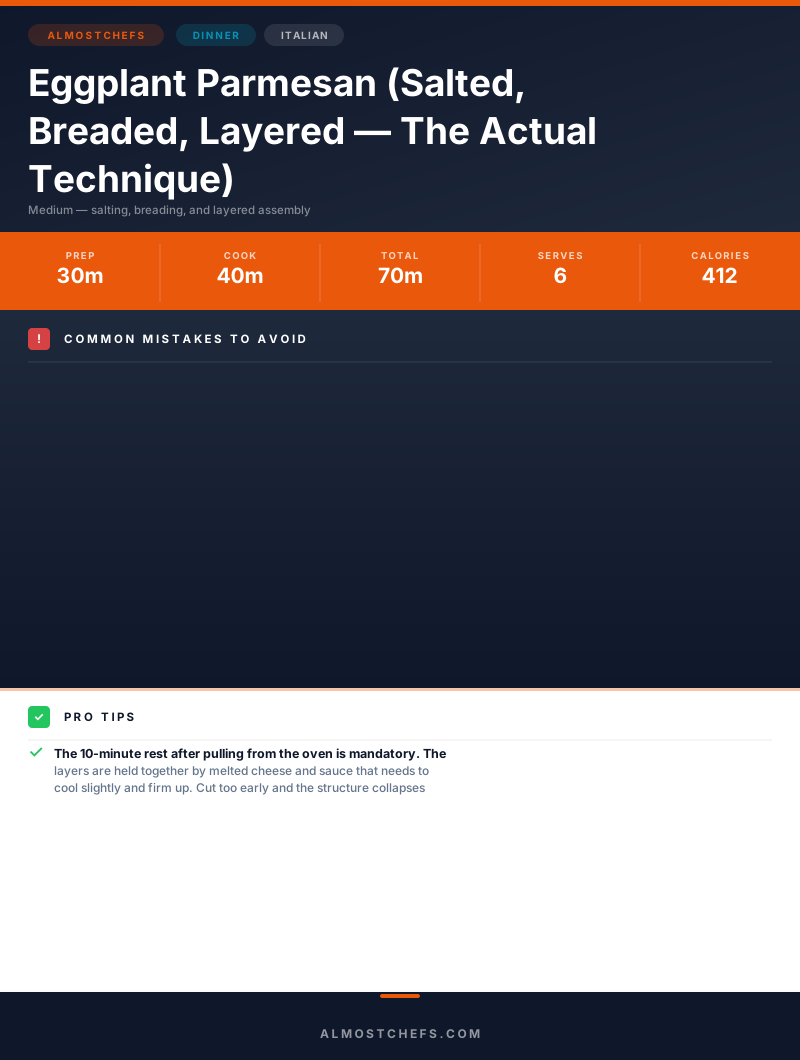
Eggplant Parmesan (Salted, Breaded, Layered — The Actual Technique)
Eggplant parmesan that works — salt-drawn moisture removal, proper breading sequence, layered assembly. The salting step removes the bitterness and excess water that makes most versions soggy.

“Soggy eggplant parmesan is not bad luck — it's physics you didn't account for. Eggplant is 92% water by weight, and when that water has nowhere to go during cooking, it turns your carefully assembled layers into a swamp of dissolved breadcrumbs and watery sauce. The salting step exists to remove that water before it becomes your problem. Skip it and nothing else you do will save the dish.”
Why This Recipe Works
Eggplant parmesan is a dish that looks manageable until you eat a bad version. Then you understand what went wrong and you realize that every soggy, structurally compromised, blandly watery plate you've eaten was the result of someone skipping the foundational step — the salting — because it seemed slow and optional. It is not optional. It is the entire reason the dish works.
This is a technique recipe masquerading as a comfort food recipe. The ingredients are simple. The technique is specific. Here is what's actually happening.
Osmosis and Why Eggplant Is a Problem Ingredient
Eggplant is approximately 92% water by weight. This is not a rounding error — it's the defining physical characteristic of the ingredient, and it's the reason most home eggplant parmesan fails. That water doesn't stay put during cooking. It migrates outward when heat is applied, turning your fried, crispy breading into a steam-softened sponge from the inside.
Osmosis is the mechanism that the salting step exploits. When you apply salt to the cut surface of an eggplant slice, you create a concentration gradient: the salt on the surface has a higher solute concentration than the fluid inside the cells. Water moves through the cell membranes from high water concentration (inside) to lower water concentration (outside), carrying it to the surface where it beads visibly. This is not metaphor — you can watch it happen in real time. Within 20 minutes, the slices glisten with drawn moisture.
At 30 to 45 minutes, a meaningful volume of water has been removed. The cells that held it have partially collapsed, which gives the cooked eggplant a denser, meatier texture rather than the spongy interior of unsalted eggplant. It also removes a portion of the compounds responsible for bitterness, which while less critical in modern cultivated varieties is a secondary benefit.
After rinsing, the slices must be genuinely dry before entering the breading sequence. Residual surface moisture is the enemy of adhesive breading — it converts the flour dredge into paste, which doesn't hold the egg wash evenly. Paste breading blisters in oil and separates during baking. The paper towel step is not optional. Dry means dry.
The Breading Sequence — Each Layer Has a Job
Flour, egg, breadcrumb is a sequence, not a preference. Each layer exists to solve a specific adhesion problem.
Raw eggplant surface is too smooth and too moist for dry coating to grab onto directly. The flour dredge creates a dry, slightly rough surface that provides mechanical grip for the egg wash. Flour also absorbs any remaining surface moisture that the towel missed, eliminating it from the system before it can interfere with subsequent layers.
The egg wash is the glue. Egg proteins are amphiphilic — they have regions that bind to the starchy flour layer below and regions that bind to the breadcrumb layer above. When heat is applied, these proteins denature and lock both adjacent layers in place. Without the egg wash, the breadcrumb layer sits on dry flour with only gravity holding it down. The first contact with hot oil launches it into the pan.
Breadcrumbs are the texture layer. Italian seasoned breadcrumbs are the traditional choice here — fine-ground, with herbs pre-incorporated — and they produce a dense, even crust that holds the layers together structurally. Panko produces a crunchier exterior with more visible texture but is slightly more fragile in a layered bake where steam from the sauce will be working against it. Either works; the difference is textural.
Adding Parmigiano-Reggiano directly to the breadcrumb mix is not just about flavor — the proteins in the cheese brown faster than plain breadcrumb under heat, accelerating Maillard browning across the entire surface of each slice. The result is color and flavor development that happens faster and more evenly than with breadcrumbs alone.
Frying vs. Baking — Not an Equal Trade
Frying in olive oil at 350°F produces a crust that baking cannot replicate. Direct contact with oil drives rapid Maillard browning — the complex chain of reactions between amino acids and reducing sugars that produces the hundreds of aromatic compounds responsible for the flavor of browned food. Oven heat at 425°F can approach this, but it takes longer, and longer means the eggplant is softer by the time the crust develops color.
The more important distinction is structural. A fried breadcrumb crust has gone through a rapid phase change: the water in the outer layers evaporates explosively when the cold, damp breading contacts 350°F oil, and the resulting bubbling action creates the physical texture of a crispy crust. Oven-baked breading doesn't achieve this — the moisture evaporates gradually, and the crust forms more slowly and less distinctly.
In the context of a layered bake, a fried crust has more structural integrity to resist the steam from the sauce. A baked crust — already softer before assembly — is less equipped to hold its form in a moist baking environment. The final dish is noticeably less texturally interesting when the eggplant is oven-prepared instead of pan-fried. This is the trade-off you accept when you choose the lighter method, and it's worth knowing it's a trade-off rather than an equivalent choice.
Resting the fried slices on a cast iron skillet-adjacent wire rack before assembly solves a separate problem: hot fried food releases steam as it cools. If you stack fried slices or lay them on a flat plate, that steam condenses under the bottom slices and re-saturates the crust you just developed. A wire rack lets steam escape downward. Ten minutes of resting time is the minimum — the crust needs to cool from frying temperature before it encounters the moisture environment of the baking dish.
Layering — Architecture with Consequences
The order and proportion of layers in the baking dish determines the final texture of every tier. Too much sauce means too much water. Too little means dry eggplant. Too much cheese means greasy, separated pools. The layering ratios in this recipe are calibrated for a three-tier assembly in a 9x13-inch dish, and they produce a result where the interior layers are moist and cohesive, the exterior has textured, browned cheese, and the structure holds when cut.
The foil-first bake (25 minutes covered, 15 uncovered) solves two problems with one technique. Covered, the ambient steam inside the foil tent heats the interior layers without browning the cheese before they're fully heated. Uncovered, the surface moisture evaporates and the cheese browns — that's the visual finish the dish needs. Baking entirely uncovered over-browns the top while leaving the interior cold. Baking entirely covered produces a pale, unfinished surface and traps excessive moisture.
The 10-minute rest after baking is structural, not optional. The layers are bonded by molten cheese and hot sauce. Cutting immediately produces collapse — the layers slide apart before the cheese has had time to firm slightly and act as mortar. Wait ten minutes. The dish holds together cleanly and serves without the structural failure that makes the bottom half of the pan an unrecognizable pile.
The Role of the Cheese
Mozzarella provides melt, pull, and moisture retention across the layers. Parmigiano-Reggiano provides salt, umami, and browning acceleration. Neither alone accomplishes what both together do. The Parmesan on the top layer is what gives the finished surface its browned, slightly crisped character — mozzarella alone would produce a pale, soft top that never develops a visual crust.
Use freshly grated Parmigiano-Reggiano, not the pre-grated shelf-stable product. Pre-grated Parmesan contains cellulose additives that prevent clumping during storage and also prevent clean melting during cooking. Real Parmigiano-Reggiano melts smoothly, browns properly, and carries the full umami signature that gives the dish its savory backbone. The difference in flavor is not subtle.
This is a dish that rewards patience at every stage — the salting, the drying, the resting, the layering. Each waiting period has a physical reason. Skip any of them and you feel the consequence in the final plate. Follow them all and you get eggplant parmesan that actually works.
Where Beginners Mess This Up
Before we start, read this. These are the 5 reasons your eggplant parmesan (salted, breaded, layered — the actual technique) will fail:
- 1
Skipping or rushing the salt-draw: Salting eggplant for less than 30 minutes accomplishes almost nothing. Osmosis — the process by which salt draws water from inside the cells to the surface — requires time. A light sprinkle for 10 minutes releases a fraction of the available moisture. Give it the full 30 minutes minimum, and rinse and press the slices dry before they go anywhere near the breading station.
- 2
Wet slices going into the flour: After salting, rinsing, and patting dry, the slices must be genuinely dry on the surface before they touch flour. Residual moisture converts the flour dredge into a paste that won't hold the egg wash evenly. Paste breading blisters in the oil and separates from the eggplant in sheets during baking. Pat dry twice if you need to.
- 3
Overcrowding the frying pan: Eggplant dropped into crowded oil drops the oil temperature below the frying threshold — typically below 325°F — and starts steaming rather than frying. Steamed breading is soft before it ever hits the baking dish. Fry in batches with full recovery time between rounds. The slices should sizzle immediately and aggressively on contact.
- 4
Assembling before the fried slices cool: Hot fried eggplant releases steam as it sits. Layer it into a baking dish immediately and that steam is trapped between the layers, re-softening the breading you just crisped. Let the fried slices rest on a wire rack for at least 10 minutes before assembly.
- 5
Too much sauce between layers: Marinara is water-heavy. Excess sauce between layers turns the assembly into a saturated sponge by the time it exits the oven. Use a controlled, sparing hand — a thin, even layer of sauce per tier, not a flood. The sauce adds flavor and moisture; it is not structural.
The Video Reference Library
Want to see it in action? Here are the exact videos we analyzed and combined to build this foolproof recipe translation:
The foundational reference for this recipe. Chlebowski demonstrates the salting stage, the frying technique, and the layering assembly with clear explanations of what each step is actually doing at a physical level.
🛠️ Core Equipment
- Wire rack with baking sheetFried eggplant slices need to shed steam from all sides as they cool, not just the top. A wire rack elevates them above the surface so hot moisture escapes downward rather than condensing under the slice and re-saturating the bottom crust.
- Heavy-bottomed skillet or Dutch ovenConsistent oil temperature is critical for breaded frying. A [cast iron skillet](/kitchen-gear/review/cast-iron-skillet) or enameled Dutch oven maintains temperature across multiple batches better than thin stainless. Temperature recovery between batches is faster when the vessel has high thermal mass.
- Instant-read thermometerIf you want to know whether your oil is at frying temperature (350°F) without guessing, an [instant-read thermometer](/kitchen-gear/review/instant-read-thermometer) tells you. A pinch of breadcrumb dropped in the oil is a rough proxy — immediate, steady sizzle means you're close. But a thermometer removes the guesswork entirely.
- 9x13-inch baking dishThe standard dish for a three-layer eggplant parm using two large eggplants. A smaller dish stacks the layers too tall and the center never heats evenly. A larger dish spreads the layers too thin and the sauce evaporates during baking.
- Colander and paper towelsFor the salting and drying stage. The colander lets you salt all the slices in a stack and let the drawn water drain freely. Paper towels do the final moisture removal before breading.
Eggplant Parmesan (Salted, Breaded, Layered — The Actual Technique)
🛒 Ingredients
- ✦2 large eggplants, sliced into 1/4-inch rounds
- ✦2 tablespoons kosher salt (for drawing)
- ✦1 cup all-purpose flour
- ✦3 large eggs, beaten
- ✦2 cups Italian breadcrumbs
- ✦1 teaspoon garlic powder
- ✦1 teaspoon dried oregano
- ✦1 cup freshly grated Parmigiano-Reggiano, divided
- ✦2 cups shredded mozzarella, divided
- ✦3 cups marinara sauce
- ✦Olive oil for frying (about 1/2 cup total)
- ✦Fresh basil leaves, for garnish
- ✦Kosher salt and black pepper to taste
👨🍳 Instructions
01Step 1
Slice eggplants into 1/4-inch rounds. Arrange in a colander in a single layer (or stacked layers), salting each layer generously. Let rest 30–45 minutes until water beads visibly on the surface.
02Step 2
Rinse the salted eggplant slices under cold running water to remove excess salt. Pat each slice completely dry on both sides with paper towels — press firmly to remove as much surface moisture as possible.
03Step 3
Set up the breading station: flour seasoned with salt and pepper in the first shallow bowl; beaten eggs in the second; breadcrumbs mixed with garlic powder, oregano, and 1/4 cup of the Parmigiano-Reggiano in the third.
04Step 4
Dredge each slice in flour, shaking off all excess. Dip in beaten egg to coat fully. Press firmly into the breadcrumb mixture on both sides.
05Step 5
Heat 1/4 inch of olive oil in a heavy-bottomed skillet over medium-high heat to 350°F. Working in batches of 3–4 slices, fry each slice 2–3 minutes per side until deep golden brown.
06Step 6
Transfer fried slices to a wire rack set over a baking sheet. Do not stack them. Let rest at least 10 minutes before assembly.
07Step 7
Preheat oven to 375°F.
08Step 8
Spread a thin layer of marinara sauce across the bottom of a 9x13-inch baking dish — just enough to prevent the bottom layer from sticking.
09Step 9
Arrange a layer of fried eggplant slices over the sauce, slightly overlapping if needed. Spoon a thin layer of marinara over the eggplant. Scatter 1/3 of the mozzarella and 1/4 cup of the Parmigiano-Reggiano over the sauce.
10Step 10
Repeat the layering — eggplant, sauce, mozzarella, Parmigiano-Reggiano — for a second and third tier. Finish the top with the remaining sauce and a generous layer of both cheeses.
11Step 11
Cover with foil and bake 25 minutes. Remove foil and bake an additional 15 minutes until the cheese on top is golden and bubbling at the edges.
12Step 12
Rest 10 minutes before cutting. The layers need time to set — cutting immediately produces a collapse. Scatter fresh basil over the top and serve.
Nutrition Per Serving
Estimates based on standard preparation. Adjustments alter macros.
🔄 Substitutions
Instead of Eggplant...
Use Zucchini (same technique)
Slice zucchini at the same 1/4-inch thickness. The salting step still applies — zucchini is also high in water content and must be drawn before frying. The flavor is milder and the texture is softer in the final dish, but the technique is identical.
Instead of Italian breadcrumbs...
Use Panko breadcrumbs
Panko produces a crunchier, lighter crust with more visible texture. It browns faster than Italian breadcrumbs, so watch the oil temperature carefully — reduce heat slightly if the coating is browning before the eggplant underneath has fully softened.
Instead of Parmigiano-Reggiano...
Use Pecorino Romano
Sharper and saltier than Parmigiano-Reggiano. Use 25% less by volume to avoid over-salting the dish. The sheep's milk base gives Pecorino a distinct funk that works well against the sweetness of marinara.
Instead of Shredded mozzarella...
Use Provolone
Slightly sharper and denser melt than mozzarella. It strings less dramatically than mozzarella, so expect a different pull when you cut the serving. The flavor is more pronounced — combine half provolone, half mozzarella if you want both character and classic stretch.
🧊 Storage & Reheating
In the Fridge
Cover tightly and refrigerate for up to 4 days. The dish holds structure better after it's cooled overnight — the layers bind together and individual servings lift cleanly. This is one of the few dishes that is genuinely improved by a night in the refrigerator.
In the Freezer
Freeze assembled but unbaked, or freeze fully baked and cooled in portion-size airtight containers for up to 3 months. Thaw overnight in the refrigerator. If freezing unbaked, add an extra 10 minutes to the covered bake time.
Reheating Rules
Reheat covered with foil in a 350°F oven for 20–22 minutes until warmed through. Remove foil for the last 5 minutes to re-crisp the cheese surface. Microwave reheating works for individual servings but softens all texture — use it only when oven access isn't available.
❓ Frequently Asked Questions
Why does my eggplant parmesan always come out watery?
Either the eggplant wasn't salted long enough, the slices weren't thoroughly dried before breading, the sauce wasn't reduced, or all three. Eggplant releases water throughout the cooking process — salting removes the majority before it starts, but sauce reduction and proper drying at each stage are required to eliminate the rest. All three steps together produce a dry final dish.
Does the salting step actually remove bitterness?
Yes, though the mechanism is indirect. Modern eggplant varieties have been bred to reduce the glycoalkaloids that cause bitterness, so raw modern eggplant is less bitter than it was 50 years ago. However, the cells that hold bitter compounds also hold water — the salt-draw removes both. The salting step is more critical for moisture control than for bitterness in modern eggplant, but it accomplishes both.
Can I bake the eggplant instead of frying it?
Yes. Brush both sides with olive oil, arrange on a wire rack over a baking sheet, and bake at 425°F for 20–25 minutes, flipping once. The result is softer and less crispy than fried — the crust never develops the structural integrity it gets from direct oil contact. Baked eggplant parm is lighter but noticeably less texturally compelling. It's a legitimate trade-off if you're avoiding the oil.
How many layers should I make?
Three layers is the standard for a 9x13-inch dish using two large eggplants. Two layers produce a shallow dish that doesn't hold its shape when cut. Four layers with typical-size eggplants usually exceed the dish height and result in uneven heating — the bottom layers overcook while the top layers are still cold. Three is the structurally correct number.
What's the difference between Italian eggplant parmesan and the American version?
Traditional Italian melanzane alla parmigiana uses very little cheese — primarily Parmigiano-Reggiano — and no mozzarella. The American version, developed in Italian-American communities, added mozzarella for richness and increased the sauce-to-eggplant ratio. The recipe here is Italian-American in its structure but uses quality Italian cheeses and technique-first assembly.
Should I peel the eggplant before slicing?
No. The skin holds the slices together during frying and provides structural integrity in the layered bake. Peeled eggplant slices are more fragile, more likely to fall apart when lifted, and lose some of their ability to hold the breading firmly. The skin is edible and softens fully during cooking — you won't notice it in a properly baked dish.
Can I use store-bought marinara?
Yes, but reduce it first. Pour 3 cups of store-bought marinara into a saucepan and simmer for 8–10 minutes until slightly thickened. This removes the excess water that makes store-bought sauce run thin in a layered bake. San Marzano-based sauces are the best starting point — lower sugar content and higher natural acidity than domestic tomato varieties.
The Science of
Eggplant Parmesan (Salted, Breaded, Layered — The Actual Technique)
We turned everything on this page into a beautiful, flour-proof PDF cheat sheet. Print it out, stick it to your fridge, and never mess up your eggplant parmesan (salted, breaded, layered — the actual technique) again.
*We'll email you the high-res PDF instantly. No spam, just perfectly cooked meals.
AlmostChefs Editorial Team
We translate the internet's most popular cooking videos into foolproof, beginner-friendly written recipes. We analyze multiple methods, test them in our kitchen, and engineer a single "Master Recipe" that gives you the best possible result with the least possible stress.