Easter Egg Ice Cream Rolls (The No-Machine Spring Dessert)
Thai-style rolled ice cream made on a frozen surface, shaped into pastel Easter egg forms and topped with candy decorations. No ice cream machine, no churning, no special equipment beyond a flat metal pan and your freezer. We broke down the technique so the rolls actually curl instead of crumble.

“Rolled ice cream looks like a professional dessert shop trick. It isn't. It's physics: spread a thin layer of sweetened cream on a frozen surface, let it firm up, and roll it with a flat spatula. The whole operation takes under ten minutes once your pan is cold. The Easter egg presentation is just food coloring and restraint — two things most holiday desserts forget entirely.”
Why This Recipe Works
Rolled ice cream is a street food trick that went viral because it looks impossible. It isn't. The entire technique is a straightforward application of one principle: fat-rich cream spread thin on a cold surface freezes fast enough to hold a structural curl. That's it. The pastel Easter egg presentation is cosmetic. The physics underneath it is the same physics running every rolled ice cream cart in Bangkok.
The Frozen Surface Problem
Most home attempts fail before a single drop of cream hits the pan. The standard advice — "put the pan in the freezer for a while" — is vague in a way that causes real failure. "A while" means two full hours minimum for a heavy half-sheet pan. The metal needs to be uniformly cold through its entire mass, not just surface-cold. When you pull a pan that's been in the freezer for twenty minutes, it feels cold to the touch but its thermal capacity is low — it warms back to above-freezing within forty seconds of room air contact. A properly frozen heavy pan holds its temperature for ninety seconds to two minutes, which is exactly the working window you need.
The heavy rimmed sheet pan is doing real engineering work here, not just sitting there. Its mass is your time buffer. This is why flimsy nonstick cookie sheets produce failures: they have no thermal mass, they warm instantly, and the cream never gets cold enough to set. If you only have one takeaway from this recipe, it's this: buy a good half-sheet pan, freeze it for two hours, and then move with purpose.
Why Whipped Cream and Not Liquid Cream
Liquid cream spread on a frozen surface takes too long to freeze uniformly — the bottom solidifies while the top layer stays liquid, and the roll tears on the wet-dry boundary. Whipping the cream first introduces air bubbles that act as insulation pockets, slowing the heat transfer just enough to let the entire 4mm layer freeze at roughly the same rate. The result is a sheet with consistent texture from top to bottom — firm enough to roll but not so brittle it cracks.
The sweetened condensed milk is the structural secret. Its high sugar content lowers the freezing point of the cream slightly, keeping it pliable at the moment of rolling rather than snapping like a frozen solid. This is the same science behind professional ice cream formulas — sugar as antifreeze. Too much condensed milk and the roll won't firm up at all. Too little and it cracks. The ratio in this recipe is calibrated for a household freezer running at 0°F.
Color Without Compromise
Pastel colors in dairy applications are a trap. Liquid food coloring introduces water into the cream, breaking down the fat network that makes the roll structurally sound. A few drops of red liquid food coloring turns whipped cream into a pale pink soup that won't roll, curl, or stand up. Gel coloring is pigment suspended in a glycerin base — it's essentially zero water. One small dot of Americolor Soft Pink turns a full cup of whipped cream into a clean pastel without adding a single meaningful drop of liquid. This is not a minor technical detail. It's the difference between a recipe that works and one that produces pink puddles.
The division into four colors also creates the visual diversity that makes the Easter egg concept land. A single color looks like rolled ice cream. Four different pastels arranged in a cup look like a basket of Easter eggs. The presentation cost is zero — you're already dividing the base into portions, and adding a different gel color to each takes thirty seconds.
The Roll Is a Commitment
There is no such thing of a hesitant ice cream roll. The motion from spatula contact to finished curl needs to be one continuous forward stroke. Any pause — to reposition, to check the angle, to second-guess yourself — creates a fault line in the cream sheet that becomes a tear. Watch the source video above once to internalize the motion before touching the pan. The bench scraper should meet the cream at a forty-five degree angle, slide under cleanly, and push forward without stopping until the roll is complete.
The re-freeze step after rolling is not optional and not conservative. The cream is at its most structurally vulnerable immediately after rolling — the curl is held by surface tension and very little else. Ten minutes in the freezer turns that soft curl into a firm cylinder that will hold its shape through topping, transport, and the walk from kitchen to table. Skipping it to serve immediately means watching your rolls slowly unwind into abstract cream puddles. The Easter eggs don't work if they've relaxed into scrambled eggs.
Where Beginners Mess This Up
Before we start, read this. These are the 4 reasons your easter egg ice cream rolls (the no-machine spring dessert) will fail:
- 1
Pan not cold enough before you start: This is the only failure mode that actually matters. If your sheet pan hasn't been in the freezer for at least two hours, the cream layer won't firm up fast enough to roll without tearing. It'll smear instead of curl. Pull the pan out of the freezer only when you're ready to work, and work fast — you have about 90 seconds before the surface warms too much.
- 2
Cream layer spread too thick: Thick layers don't freeze evenly through. The bottom gets firm while the top stays liquid, and when you try to roll, the wet top layer collapses the curl. Spread the cream mixture to no more than 4mm — roughly the thickness of two stacked pennies. Thin is everything.
- 3
Scraping too early or too late: Timing the roll is feel-based but learnable. The cream is ready when it looks matte instead of glossy and holds a line when you drag a finger across the edge. Too early and it tears. Too late and it cracks instead of curling. Thirty to forty-five seconds after spreading is the usual window depending on your freezer temperature.
- 4
Skipping the re-freeze before serving: Freshly rolled ice cream is soft and will unroll if disturbed. After placing the rolls in their cups or on their plate, return them to the freezer for 10-15 minutes to firm up. This is also when you add the Easter egg decorations — cold surface helps the toppings adhere properly.
The Video Reference Library
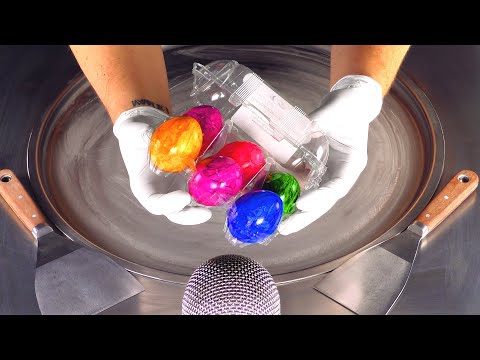
Want to see it in action? Here are the exact videos we analyzed and combined to build this foolproof recipe translation:
🛠️ Core Equipment
- Heavy rimmed sheet pan (half-sheet size)This is your rolling surface. It needs mass to hold its frozen temperature once removed from the freezer. Thin, lightweight pans warm up within 30 seconds and ruin the roll. A full-gauge aluminum half-sheet holds cold for 2-3 minutes — enough for 4 rolls per batch.
- Offset spatula or bench scraperThe tool that makes or breaks the roll. A bench scraper gives you a straight, firm edge to push under the frozen cream at a consistent angle. An offset spatula works but requires more wrist control. Never use a flexible silicone spatula — it bends instead of scoops.
- Stand or hand mixerFor whipping the heavy cream to soft peaks before spreading. Whipped cream freezes faster and rolls cleaner than liquid cream because the incorporated air reduces density. A whisk works but adds 8-10 minutes of arm effort.
- Shallow serving cups or small bowlsRolled ice cream is served upright in cups, not on plates. The cup holds the rolls in position while they firm up in the freezer. For the Easter egg presentation, use clear cups so the pastel colors are visible through the side.
Easter Egg Ice Cream Rolls (The No-Machine Spring Dessert)
🛒 Ingredients
- ✦2 cups heavy whipping cream, cold
- ✦1/2 cup sweetened condensed milk
- ✦1 teaspoon pure vanilla extract
- ✦2 tablespoons powdered sugar
- ✦Pinch of fine sea salt
- ✦Gel food coloring in pastel pink, yellow, lavender, and mint green
- ✦1/4 cup mini chocolate eggs (such as Cadbury Mini Eggs), for topping
- ✦2 tablespoons pastel nonpareil sprinkles
- ✦2 tablespoons white chocolate chips, melted, for drizzle
- ✦1/4 cup crushed graham crackers
- ✦Whipped cream in a can, for serving
- ✦Edible gold luster dust (optional, for finishing)
👨🍳 Instructions
01Step 1
Place a heavy rimmed half-sheet pan in the freezer for a minimum of 2 hours. The pan must be thoroughly frozen — not just cold.
02Step 2
Combine cold heavy cream, powdered sugar, and sea salt in a chilled mixing bowl. Whip with a hand or stand mixer on medium-high until soft peaks form — the cream should hold a curl but not look stiff or grainy.
03Step 3
Gently fold the sweetened condensed milk and vanilla extract into the whipped cream using a rubber spatula. Fold slowly from the bottom up — you want to keep as much air in the cream as possible.
04Step 4
Divide the cream base evenly into 4 small bowls. Add a small amount of gel food coloring to each — one pastel pink, one yellow, one lavender, one mint green. Fold each color in until uniform. Gel coloring only: liquid food coloring adds water and disrupts the texture.
05Step 5
Remove the frozen sheet pan from the freezer. Working quickly, pour one color of cream onto a section of the pan and spread it into a thin rectangle approximately 6 inches by 4 inches and no more than 4mm thick.
06Step 6
Wait 30-45 seconds. The cream is ready to roll when the surface looks matte rather than glossy and holds a clean line when you drag a finger across the far edge.
07Step 7
Using a bench scraper or offset spatula held at a 45-degree angle, push firmly under the near edge of the cream rectangle and roll it away from you in one continuous motion. Work across the width of the rectangle to create a tight cylindrical roll.
08Step 8
Transfer each roll upright into a serving cup as you go. Repeat with the remaining three colors.
09Step 9
Place the filled cups in the freezer for 10-15 minutes to firm the rolls.
10Step 10
Remove from freezer and finish: drizzle with melted white chocolate, scatter mini chocolate eggs and pastel sprinkles on top, and dust with edible gold luster if using. Add a small rosette of canned whipped cream and a pinch of crushed graham crackers.
11Step 11
Serve immediately or keep frozen for up to 1 hour. Beyond that, the rolls begin to crystallize and lose their smooth texture.
Nutrition Per Serving
Estimates based on standard preparation. Adjustments alter macros.
🔄 Substitutions
Instead of Heavy whipping cream...
Use Full-fat coconut cream (chilled overnight)
Whips into stiff peaks similarly to dairy cream. Adds a mild coconut flavor that works well with the Easter candy toppings. The rolls will be slightly more delicate.
Instead of Sweetened condensed milk...
Use Sweetened condensed coconut milk
Identical function, fully dairy-free. Available at most large grocery stores in the international aisle. Same quantity, same technique.
Instead of Mini chocolate eggs...
Use Chopped peanut butter cups, M&Ms, or crushed meringue cookies
Any small, firm candy topping works. Avoid anything with caramel or soft centers — they freeze solid and become difficult to bite through.
Instead of White chocolate drizzle...
Use Pastel candy melts
Candy melts come pre-colored in Easter pastels, which eliminates the coloring step entirely. They set faster than white chocolate, which is actually an advantage when you're working against clock on a frozen surface.
🧊 Storage & Reheating
In the Fridge
Not recommended. Refrigerator temperature is too warm — the rolls will soften and unroll within 30 minutes.
In the Freezer
Store assembled cups covered with plastic wrap for up to 24 hours. Beyond that, ice crystals form on the surface and the texture degrades. These are best consumed the day they are made.
Reheating Rules
Not applicable. Remove from freezer and let stand at room temperature for 3-4 minutes before eating to soften slightly — straight-from-freezer rolls can be rock hard.
❓ Frequently Asked Questions
Why won't my ice cream rolls curl — they just crack?
Two causes: the cream layer is too thick, or the surface has warmed up too much. Spread thinner (4mm maximum) and work faster. If the pan has been out of the freezer for more than 90 seconds, put it back and wait 20 minutes before trying again.
Can I make these ahead for an Easter party?
Yes, with limits. Make them the morning of the party and keep covered in the freezer until 5 minutes before serving. Do not assemble more than 24 hours in advance — surface crystallization makes them look frosted and dull rather than glossy.
Do I need a commercial freeze plate to make these?
No. A heavy-gauge aluminum half-sheet pan works perfectly after 2+ hours in a household freezer. Commercial freeze plates are kept at around -22°F; your home freezer runs at 0°F. The difference means your working window is slightly shorter — about 60-90 seconds versus 3-4 minutes. Work efficiently and you don't need the equipment.
How do I get the pastel colors to look bright and not muddy?
Use gel coloring, not liquid. Add it one small dot at a time and fold gently — over-mixing deflates the cream and muddies the color. Also, start with white cream base, not off-white or yellowed cream. Use fresh, cold heavy cream from a freshly opened carton.
Can I add mix-ins to the cream before rolling?
Small, flat mix-ins like mini chocolate chips or crushed freeze-dried strawberry work. Chunky or uneven mix-ins (graham cracker pieces, large sprinkles) create weak points in the cream sheet where it tears during the roll. Keep the cream base clean and put the interesting stuff on top.
My rolls unrolled when I put them in the cup. What happened?
The roll wasn't firm enough when you transferred it. After rolling, place each roll directly into the cup and return the whole assembly to the freezer for 10-15 minutes before doing anything else. The re-freeze sets the curl permanently. Trying to add toppings to a freshly rolled, still-warm roll will always end in disaster.
The Science of
Easter Egg Ice Cream Rolls (The No-Machine Spring Dessert)
We turned everything on this page into a beautiful, flour-proof PDF cheat sheet. Print it out, stick it to your fridge, and never mess up your easter egg ice cream rolls (the no-machine spring dessert) again.
*We'll email you the high-res PDF instantly. No spam, just perfectly cooked meals.
AlmostChefs Editorial Team
We translate the internet's most popular cooking videos into foolproof, beginner-friendly written recipes. We analyze multiple methods, test them in our kitchen, and engineer a single "Master Recipe" that gives you the best possible result with the least possible stress.