The Easter Brunch Spread (Everything on the Table at Once)
A complete Easter brunch menu built around a honey-glazed spiral ham, deviled eggs, spring vegetable frittata, and buttermilk biscuits — all timed to land simultaneously. We reverse-engineered the cook order so nothing goes cold, nothing sits under foil for 45 minutes, and the table actually looks like the photos.

“Easter brunch fails in one specific way: the ham is ready, the eggs are cold, the biscuits came out 30 minutes ago, and someone is reheating the frittata in a microwave that smells like last Tuesday's fish. The food was never the problem. The order of operations was. This recipe is a timing blueprint as much as it is a collection of dishes — built around the ham's resting window, the egg's chill time, and the biscuit's narrow window between golden and cardboard.”
Why This Recipe Works
Easter brunch has a structural problem that no individual recipe can solve: it's a multi-component meal expected to hit the table at the same time, cooked in a single oven, by someone who spent the previous three hours hiding plastic eggs in the backyard. The solution is not better recipes. It is better sequencing.
The Ham Is the Anchor
Everything else on this table exists in relation to the ham. A 7.5-pound spiral ham needs roughly 2 hours and 15 minutes from oven to table — including the rest period and final glaze blast. That timeline is non-negotiable. It's your fixed point. Every other component gets scheduled around it.
This matters more than any ingredient swap or technique refinement. A perfect frittata served cold because you forgot to time it against the ham is a failure. A merely good frittata that hits the table hot alongside the ham is a success. Brunch is logistics.
Spiral hams are pre-cooked, which is why most instructions say "heat to 140°F." You're not cooking — you're warming. The danger is overshooting. Past 150°F, the protein fibers in the ham have fully seized and squeezed out their moisture, leaving you with something that tastes fine but shreds into dry strands rather than cutting into clean, glossy slices. The instant-read thermometer is your single most important tool on this table.
The honey-Dijon glaze gets two applications: one at the 130°F mark to start building caramelization, and a second brush immediately out of the oven while the surface is still hot enough to absorb. Both applications matter. A single glaze pass at the end produces a sticky surface coating with no depth. Two passes creates the lacquered, mahogany shell that makes a spiral ham look the way it looks in every Easter photograph ever taken.
The Egg Problem, Solved in Advance
Deviled eggs are a brunch anchor and also the easiest thing to ruin by making them at the wrong time. Fresh-filled eggs have thin, airy filling that runs at the edges and tastes bright but flat. Overnight-chilled eggs have filling that has set into a dense, pipeable cream — the flavors have had time to round out and the vinegar's sharpness has mellowed into the fat. The timing difference is 8 hours and costs you zero effort.
The same logic applies to the hard-boil technique. An 11-minute boil followed by an ice bath produces yolks that are fully set with no green ring — the sulfuric reaction that turns yolks grey-green only begins after about 13 minutes of heat exposure. An ice bath stops carryover cooking immediately. These are not fussy techniques. They are just the correct ones.
The Frittata Window
A frittata is a forgiving dish masquerading as a difficult one. The stovetop-to-oven method exists for a single reason: if you try to cook a thick egg dish entirely on the stovetop, the bottom burns before the top sets. Moving it to the oven lets indirect heat reach the top while the already-set bottom stays intact rather than scorching.
The key is not overcooking it. Pull the frittata when the center has a very slight jiggle — residual heat will finish it in the 5-minute rest. An over-baked frittata turns rubbery and weeps moisture onto the plate. A properly cooked frittata is silky, slightly puffed, and holds a clean slice. The goat cheese melts to a soft, tangy cream layer that reads as intentional richness rather than an afterthought. Use a 12-inch oven-safe skillet with a heavy base and sides — a thin pan makes the bottom set too fast before the eggs can build any structure.
The Biscuit Timing Problem
Buttermilk biscuits are the most time-sensitive item on this table and should be baked last, timed to emerge about 8 minutes before you call everyone to eat. They are at their peak for exactly 15 minutes — after that, the steam inside redistributes and the exterior softens from a crisp, buttery shell to a uniform doughy texture that is, technically, still a biscuit but is missing the entire point of a biscuit.
The key technique is cold butter, minimal mixing, and sides touching on the pan. Cold butter creates steam pockets during baking — those pockets are what become layers. Over-mixing develops gluten, which makes the dough tight and produces a bread roll rather than a biscuit. Touching sides force the biscuits upward rather than outward, giving you height rather than spread. Three rules, one perfect biscuit.
Where Beginners Mess This Up
Before we start, read this. These are the 4 reasons your the easter brunch spread (everything on the table at once) will fail:
- 1
Starting the ham too late: A spiral ham needs 15-18 minutes per pound at 325°F plus a 15-minute rest before glazing and a final 10-minute blast under the broiler. Most people underestimate this by 40 minutes. Anchor your entire brunch timeline to the ham's pull time and work backward from there.
- 2
Making deviled eggs the same morning: Deviled eggs need at least 2 hours in the fridge for the filling to firm up and the flavors to meld. Eggs filled and served immediately taste thin and sharp. Make them the night before. Cover tightly with plastic wrap and refrigerate — they'll be better for it.
- 3
Pulling biscuits too early and leaving them uncovered: Buttermilk biscuits reach peak texture in the first 12 minutes out of the oven. After that, the steam inside redistributes and the crust softens. Bake them last, time them to come out 8 minutes before you call everyone to the table, and never cover with foil — it traps steam and kills the crust.
- 4
Oversalting the frittata before it sets: Eggs tighten as they cook, concentrating whatever salt you added before the oven. Season the egg mixture lightly before baking and finish with flaky salt at the table. A frittata that tasted perfect in the pan will taste aggressively salty after 20 minutes at 375°F.
The Video Reference Library
Want to see it in action? Here are the exact videos we analyzed and combined to build this foolproof recipe translation:

🛠️ Core Equipment
- Roasting pan with rackElevating the ham allows hot air to circulate underneath, cooking the bottom as evenly as the top. A pan without a rack produces a steamed bottom and caramelized top — inconsistent throughout.
- 12-inch oven-safe skilletThe frittata starts on the stovetop to set the bottom and transfers to the oven to finish the top. A skillet that can't handle 375°F oven heat is a single-use pan that can't do the job.
- Pastry cutter or forkCutting cold butter into flour by hand gives you precise control over butter chunk size. A food processor over-processes in seconds. Pea-sized butter chunks are what create steam pockets and flaky layers in buttermilk biscuits.
- Instant-read thermometerSpiral hams are pre-cooked — you're heating them to 140°F internal, not cooking from raw. Without a thermometer you're guessing, and guessing usually means either a dry ham or an underdone centerpiece.
The Easter Brunch Spread (Everything on the Table at Once)
🛒 Ingredients
- ✦1 bone-in spiral-cut ham (7-8 pounds, pre-cooked)
- ✦1/3 cup honey
- ✦2 tablespoons Dijon mustard
- ✦2 tablespoons apple cider vinegar
- ✦1 teaspoon ground cloves
- ✦12 large eggs, divided (8 for frittata, 12 for deviled eggs)
- ✦12 large eggs for deviled eggs
- ✦1/3 cup mayonnaise
- ✦1 tablespoon Dijon mustard (for deviled eggs)
- ✦1 tablespoon apple cider vinegar (for deviled eggs)
- ✦1 teaspoon smoked paprika, plus more for garnish
- ✦1 cup whole milk
- ✦1/2 cup heavy cream
- ✦1 cup fresh asparagus, cut into 1-inch pieces
- ✦1 cup baby spinach, roughly chopped
- ✦1/2 cup grape tomatoes, halved
- ✦1/2 cup crumbled goat cheese
- ✦3 tablespoons olive oil, divided
- ✦3 cloves garlic, minced
- ✦4 scallions, thinly sliced
- ✦2 cups all-purpose flour
- ✦1 tablespoon baking powder
- ✦1 teaspoon fine sea salt
- ✦1/2 teaspoon baking soda
- ✦6 tablespoons unsalted butter, very cold, cubed
- ✦3/4 cup cold buttermilk, plus 2 tablespoons for brushing
- ✦Flaky sea salt for finishing
- ✦Fresh chives and dill for garnish
👨🍳 Instructions
01Step 1
The night before: hard-boil 12 eggs. Place in cold water, bring to a boil, cook for 11 minutes, then transfer immediately to an ice bath for 15 minutes. Peel, halve, and remove yolks.
02Step 2
Mash the yolks with mayonnaise, Dijon, apple cider vinegar, smoked paprika, salt, and pepper until completely smooth. Pipe or spoon into egg white halves. Cover tightly with plastic wrap and refrigerate overnight.
03Step 3
Remove the ham from the refrigerator 1 hour before cooking to take the chill off. Preheat oven to 325°F. Place ham cut-side down on a rack in a roasting pan. Add 1/2 cup water to the pan bottom.
04Step 4
Cover the ham tightly with aluminum foil and roast for 15-18 minutes per pound, until an instant-read thermometer inserted into the thickest part (not touching bone) reads 130°F.
05Step 5
While the ham roasts, make the honey glaze: combine honey, Dijon, apple cider vinegar, and ground cloves in a small saucepan. Simmer over low heat for 3-4 minutes until slightly thickened. Set aside.
06Step 6
When the ham hits 130°F, remove the foil. Brush generously with half the glaze. Return to oven uncovered and roast another 15-20 minutes until the internal temperature reaches 140°F and the glaze is caramelized and lacquered.
07Step 7
Remove ham from oven and let rest 15 minutes before carving. Brush with remaining glaze while still hot. Raise oven temperature to 375°F for the frittata.
08Step 8
While the ham rests, start the frittata. Heat 2 tablespoons olive oil in a 12-inch oven-safe skillet over medium heat. Add garlic and scallions, cook 2 minutes. Add asparagus and cook 3 minutes until just tender. Add spinach and tomatoes, cook 1 minute until spinach wilts.
09Step 9
Whisk 8 eggs with milk, heavy cream, 1/2 teaspoon salt, and black pepper. Pour the egg mixture over the vegetables in the skillet. Cook undisturbed on the stovetop for 3-4 minutes until the edges begin to set.
10Step 10
Scatter goat cheese over the top of the frittata. Transfer the skillet to the 375°F oven and bake for 15-18 minutes until puffed, set in the center, and lightly golden on top.
11Step 11
While the frittata bakes, make the biscuits. Whisk together flour, baking powder, salt, and baking soda in a large bowl. Cut in the cold butter using a pastry cutter until the mixture resembles coarse crumbs with some pea-sized butter pieces remaining.
12Step 12
Add cold buttermilk and stir with a fork just until the dough comes together — 10-12 strokes maximum. It should look shaggy and rough. Turn onto a floured surface, pat to 3/4-inch thickness, fold in thirds like a letter, and pat again. Cut into rounds with a sharp biscuit cutter or glass.
13Step 13
Place biscuits on a parchment-lined baking sheet with sides touching. Brush tops with buttermilk. Bake at 425°F for 13-15 minutes until deeply golden. Pull the frittata from the oven first, raise temp, then slide in the biscuits.
14Step 14
Remove frittata and let stand 5 minutes. Scatter fresh dill and flaky salt on top. Pull biscuits when golden. Arrange everything on the table and bring out the deviled eggs from the fridge. Serve within 10 minutes.
Nutrition Per Serving
Estimates based on standard preparation. Adjustments alter macros.
🔄 Substitutions
Instead of Spiral ham...
Use Bone-in lamb leg
More traditional in European Easter menus. Requires significantly longer cook time — 20-25 minutes per pound at 325°F to reach 145°F internal. Adjust your timeline by at least an hour.
Instead of Goat cheese in frittata...
Use Gruyère or sharp white cheddar
Melts rather than softens, giving a more cohesive interior texture. Slightly more crowd-pleasing for guests who find goat cheese polarizing.
Instead of Buttermilk in biscuits...
Use Whole milk with 1 tablespoon lemon juice, rested 5 minutes
The acid in buttermilk activates the baking soda, creating lift. This substitute works reasonably well but produces a slightly less tangy, less tender biscuit.
Instead of Honey glaze...
Use Brown sugar and orange marmalade glaze
Combine 3 tablespoons brown sugar, 3 tablespoons marmalade, 1 tablespoon whole grain mustard, and 1 teaspoon red wine vinegar. Slightly more bitter, more complex.
🧊 Storage & Reheating
In the Fridge
Store each component separately in airtight containers for up to 3 days. Ham keeps exceptionally well and slices cleanly cold — excellent for next-day sandwiches.
In the Freezer
Ham freezes well for up to 2 months. Slice before freezing for easier portioning. Frittata freezes adequately for up to 6 weeks but loses some texture. Biscuits freeze raw — bake from frozen at 425°F, adding 4 minutes to bake time.
Reheating Rules
Ham: wrap in foil with a splash of apple juice and reheat at 300°F for 20 minutes. Frittata: room temperature is ideal, or reheat uncovered at 325°F for 8 minutes. Biscuits: 350°F for 5 minutes, never microwave.
❓ Frequently Asked Questions
Can I prepare any of this the day before?
Yes — and you should. Deviled eggs are better made the night before. The glaze can be made 2 days ahead. The frittata can be baked, cooled, covered, and refrigerated, then served at room temperature or gently reheated. Doing these three things the night before reduces Easter morning from a 2.5-hour sprint to a 45-minute calm stretch.
How do I know when the ham is actually done?
Internal temperature of 140°F in the thickest part, not touching bone. Spiral hams are pre-cooked — you're heating them through, not cooking from raw. Going much beyond 145°F dries the meat out significantly. Use a thermometer every time.
Why do my biscuits spread instead of rise?
One of three things: the butter was too warm and smeared into the flour instead of staying in discrete pieces, the dough was overworked (activating too much gluten), or the biscuits weren't placed close enough together on the pan. Touching biscuits support each other and force the rise upward rather than outward.
Can I make this for a smaller group of 4 people?
Halve the frittata and biscuit recipes. For the ham, buy a smaller boneless pre-cooked ham or a half-spiral — adjust cook time based on weight. The deviled egg recipe halves cleanly. The timing structure stays the same.
What should I serve alongside this?
Fresh fruit salad with mint and a drizzle of honey requires zero oven time and anchors the table visually. Mimosas and a simple green salad with lemon vinaigrette round it out without adding any kitchen complexity.
Can the frittata be served cold?
Yes, and it's actually quite good cold or at room temperature. This makes it the most forgiving component of the spread — pull it from the oven 20 minutes early and it will hold at room temp through the entire meal without any quality loss.
The Science of
The Easter Brunch Spread (Everything on the Table at Once)
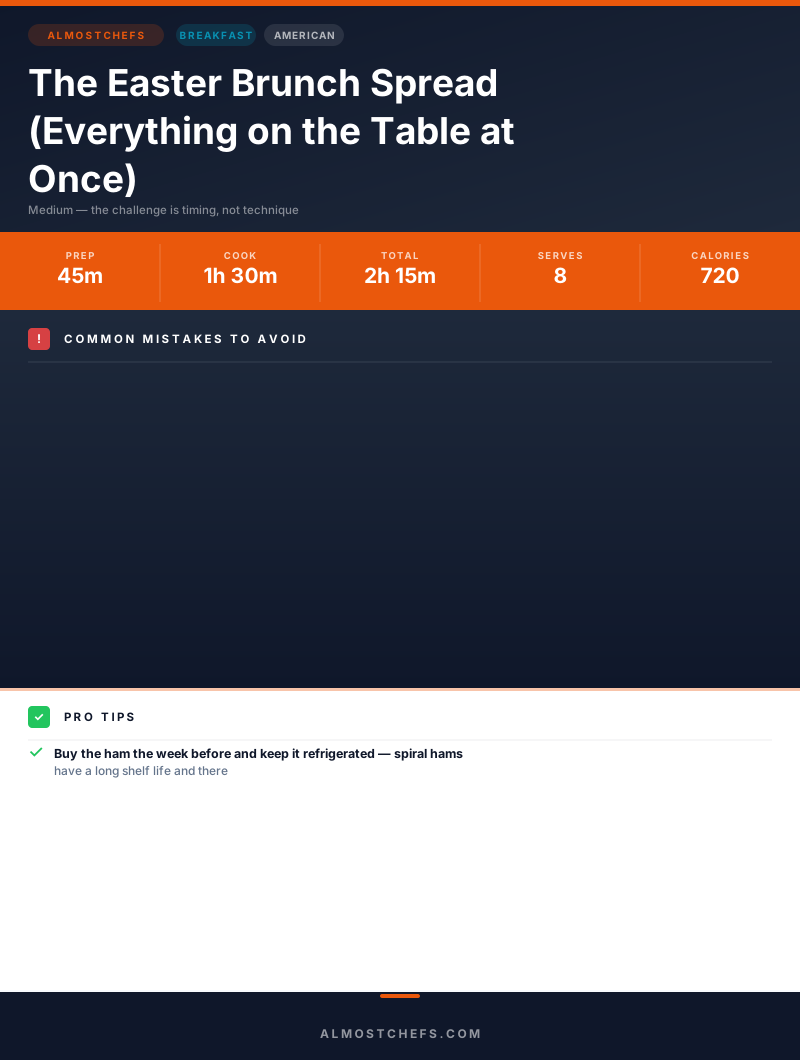
We turned everything on this page into a beautiful, flour-proof PDF cheat sheet. Print it out, stick it to your fridge, and never mess up your the easter brunch spread (everything on the table at once) again.
*We'll email you the high-res PDF instantly. No spam, just perfectly cooked meals.
AlmostChefs Editorial Team
We translate the internet's most popular cooking videos into foolproof, beginner-friendly written recipes. We analyze multiple methods, test them in our kitchen, and engineer a single "Master Recipe" that gives you the best possible result with the least possible stress.