Dubu Jorim (Braised Tofu)
Pan-fried tofu slices braised in a savory-sweet soy-gochugaru sauce. The banchan that converts tofu skeptics — crispy outside, silky inside.
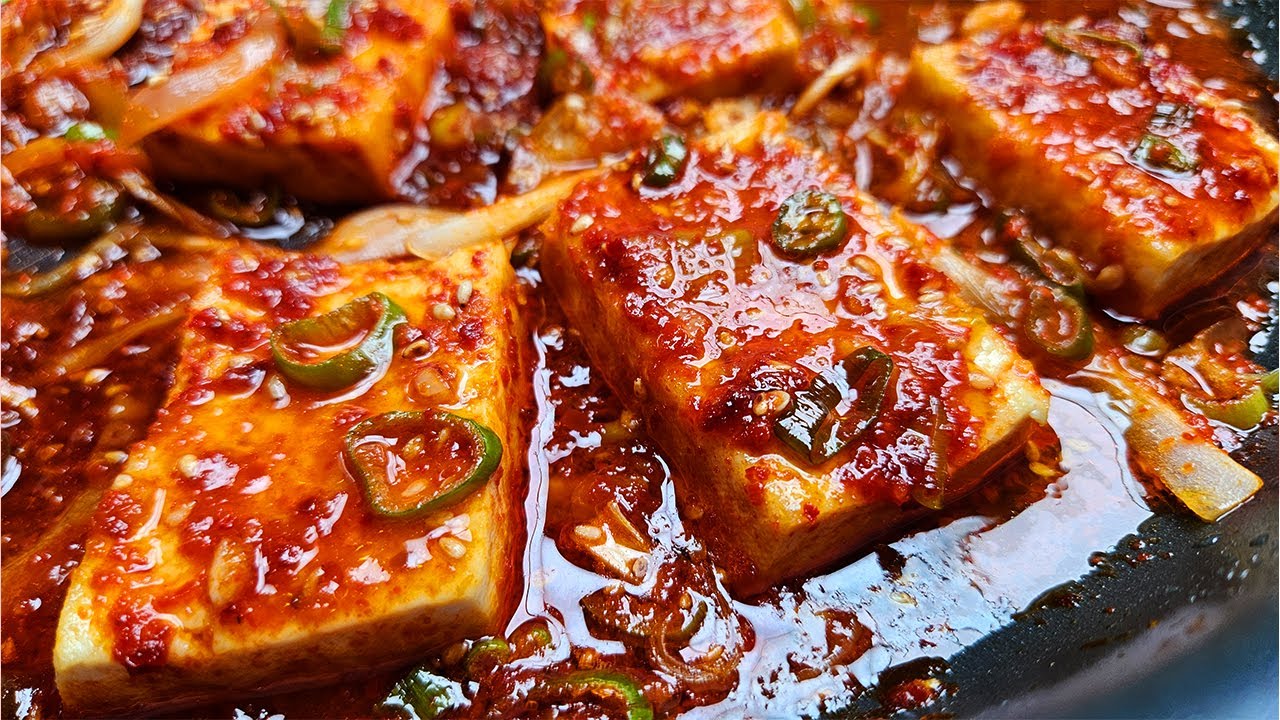
Why This Recipe Works
Most people who claim to dislike tofu have never eaten it correctly. They've eaten it steamed, boiled, or — worst of all — dropped raw into a broth and called it cooking. Dubu jorim is the corrective. It is not a gentle dish. It is a two-phase construction: controlled dehydration followed by aggressive sauce reduction, executed in sequence, with no shortcuts. Understand the phases, and you understand why this recipe produces something fundamentally different from the gray, waterlogged tofu that ruined your first encounter with Korean banchan.
Let's be methodical about it.
Phase One: The Maillard Argument
Tofu is approximately 85% water by weight. That is not a problem you can season your way out of — it is a structural fact you have to solve mechanically before any flavor work can begin. The instruction to pat each slice dry with paper towels is not a suggestion. Surface moisture is the enemy of crust formation. Any residual water on the tofu surface will flash-steam in the hot oil, dropping pan temperature, preventing browning, and guaranteeing a pale, soft exterior that holds sauce about as well as wet cardboard.
Once the surface is genuinely dry, the non-stick pan becomes the operative tool. A non-stick pan is the correct choice here — not cast iron, not stainless. Tofu has no collagen, no fat cap, and very little structural integrity until that crust forms. Cast iron retains too much heat unevenly and will tear the slices when you attempt to flip. Non-stick gives you the controlled release you need to get a full golden crust on both sides without the tofu disintegrating mid-flip.
At medium-high heat, with two tablespoons of a neutral vegetable oil, the Maillard reaction begins at the tofu surface. The proteins and residual sugars in the soy begin to brown. Three minutes per side. You are building a shell — a rigid golden casing that serves two purposes: textural contrast (crispy outside, yielding inside) and structural sauce-holding capacity. The crust acts as a sponge matrix once the braising liquid is introduced. Skip the fry step and you are braising raw tofu, which is a different dish and a lesser one.
Phase Two: The Sauce Reduction and Why the Ratios Are Not Arbitrary
The sauce is five components: soy sauce, gochugaru, sugar, garlic, and water. Each is load-bearing.
Soy sauce is the salt and umami backbone. It is not interchangeable with tamari or fish sauce in this context — the specific salinity curve of Korean soy sauce (ganjang) is calibrated to the gochugaru. Use what the recipe calls for.
Gochugaru — Korean red pepper flakes — is not interchangeable with cayenne or standard crushed red pepper. Gochugaru is fruity, mildly smoky, and moderately hot. It adds color and depth rather than pure heat. If you substitute crushed red pepper flakes, halve the amount and accept that the flavor profile will be blunter.
Sugar is a functional ingredient, not an indulgence. It accelerates caramelization in the reducing sauce and balances the salt load of the soy. The one teaspoon specified is precisely enough to promote glaze formation without tipping the dish sweet.
Garlic provides allicin bite that blooms in the hot pan once the sauce hits. Mince it fine — chunky garlic in a quick-reducing sauce is undercooked garlic, and undercooked garlic tastes like a mistake.
Water thins the sauce for distribution across all tofu slices during the early simmer, then evaporates as the sauce reduces to a thick, glossy coating. If you omit the water and pour the sauce concentrate directly, you'll scorch the pan and over-salt the exterior slices.
The target endpoint is a glaze, not a pool of liquid. If the sauce is still thin after five to six minutes of simmering at medium heat, increase the flame briefly. A properly reduced dubu jorim sauce clings to each slice independently — when you plate it, the sauce should coat, not run.
The Sesame Oil Close
Sesame oil is added off-heat, after the braise is finished. This is not optional technique — it is chemistry. Sesame oil's aromatic compounds are volatile. Applied during high-heat cooking, they dissipate before they reach the plate. Applied as a finishing drizzle over the resting slices, they bloom on contact with residual heat and stay. The toasted sesame seeds and green onion garnish add textural punctuation and fresh allium brightness to cut the richness of the glaze.
The Baekban-jip Standard
Baekban-jip (백반집) are the Korean home-style restaurants where the meal comes as a set: rice, soup, and six to eight rotating banchan for under eight dollars. Dubu jorim appears on roughly ninety percent of baekban-jip tables across the country. It is not on those tables because it is easy — it is on those tables because, executed correctly, it is one of the most efficient protein banchan in Korean cuisine: cheap ingredients, a fifteen-minute cook window, a flavor profile that deepens as it sits, and enough structural integrity to serve at room temperature without degrading.
Chef Kim Daiseok's version of this recipe — the one behind a million views — succeeds because it refuses to approximate. The sauce-to-tofu ratio is precise. The fry-before-braise sequence is non-negotiable. Every element earns its place.
This is not tofu you tolerate. This is tofu you build a meal around.
Dubu Jorim (Braised Tofu)
🛒 Ingredients
- ✦1 block (14 oz) firm tofu
- ✦2 tablespoons soy sauce
- ✦1 tablespoon gochugaru (Korean red pepper flakes)
- ✦1 teaspoon sugar
- ✦1 teaspoon sesame oil
- ✦2 cloves garlic, minced
- ✦1 green onion, finely sliced
- ✦1 teaspoon toasted sesame seeds
- ✦1/4 cup water
- ✦2 tablespoons vegetable oil for pan-frying
👨🍳 Instructions
01Step 1
Slice tofu into rectangles about 1/2 inch thick (roughly 8-10 slices per block). Pat each slice dry with paper towels.
02Step 2
Heat vegetable oil in a non-stick pan over medium-high heat. Pan-fry tofu slices until golden brown on both sides, about 3 minutes per side.
03Step 3
While tofu fries, make the sauce: combine soy sauce, gochugaru, sugar, garlic, and water. Stir until mixed.
04Step 4
Once tofu is golden, pour the sauce directly into the pan. Reduce heat to medium. Simmer for 5-6 minutes, flipping the tofu once, until the sauce thickens and coats the slices.
05Step 5
Drizzle with sesame oil. Garnish with green onions and sesame seeds. Serve warm or at room temperature.
Nutrition Per Serving
Estimates based on standard preparation. Adjustments alter macros.
🔄 Substitutions
Instead of Firm tofu...
Use Extra-firm tofu
Even crispier, holds shape better, less pressing needed
Instead of Gochugaru...
Use Crushed red pepper flakes (half amount)
More heat, less depth — add a pinch of paprika for color
🧊 Storage & Reheating
In the Fridge
Store for up to 3 days. The sauce flavors deepen overnight.
In the Freezer
Not recommended — tofu texture changes.
Reheating Rules
Re-crisp in a dry pan for 2 minutes per side. Or microwave briefly — won't be as crispy but still delicious.
❓ Frequently Asked Questions
Why pan-fry before braising?
Pan-frying creates a golden crust that has two benefits: (1) it adds texture contrast — crispy outside, silky inside, and (2) the crust absorbs and holds the sauce better than raw tofu surface. Skipping the frying step makes a completely different (and less delicious) dish.
What makes Korean braised tofu different from Chinese or Japanese?
Korean dubu jorim always uses gochugaru (red pepper flakes) and soy sauce as the base, giving it a distinctly spicy-savory Korean flavor. Chinese braised tofu often uses doubanjiang and Sichuan peppercorns. Japanese uses mirin-heavy sweet soy. All are different worlds.

The Science of
Dubu Jorim (Braised Tofu)
We turned everything on this page into a beautiful, flour-proof PDF cheat sheet. Print it out, stick it to your fridge, and never mess up your dubu jorim (braised tofu) again.
*We'll email you the high-res PDF instantly. No spam, just perfectly cooked meals.
AlmostChefs Editorial Team
We translate the internet's most popular cooking videos into foolproof, beginner-friendly written recipes. We analyze multiple methods, test them in our kitchen, and engineer a single "Master Recipe" that gives you the best possible result with the least possible stress.