Dubu-Gamja Jeon (Tofu & Potato Pancakes)
Crispy golden pancakes made from mashed tofu and grated potato — no flour needed. A clever Korean technique that's naturally gluten-free.
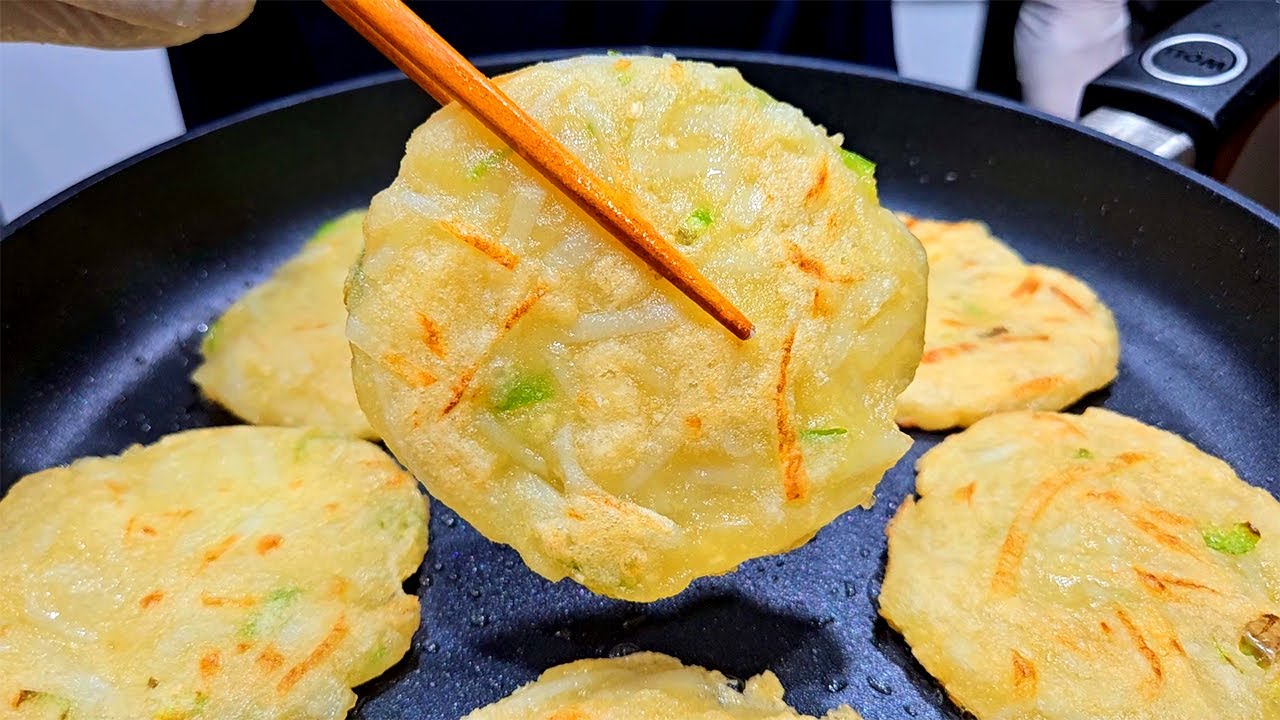
Why This Recipe Works
There is a particular kind of culinary arrogance that comes from reaching for the flour bag every time you need a batter to hold together. It is reflexive, unthinking, and — in the case of dubu-gamja jeon — completely unnecessary. Chef Kim Daiseok's approach here is not innovation for its own sake. It is the application of basic starch chemistry to a problem that most Western-trained cooks have been solving incorrectly for decades.
The pancake works because of two intersecting physical phenomena: protein coagulation and starch gelatinization. Neither of these requires wheat flour. Neither of them requires a specialty gluten-free blend from an overpriced grocery aisle. What they require is cold water pressed out of two ingredients that are, by nature, full of it — and the patience to actually do the work before the pan gets hot.
The Tofu Pressing Imperative
Firm tofu, directly from the package, is approximately 85% water by weight. That is not a flaw. That is the product. The flaw is in how most people handle it — they drain it, maybe press it for thirty seconds, and then wonder why their jeon is pallid, steaming, and structurally incoherent. Water in the pan creates steam. Steam prevents the Maillard reaction. No Maillard reaction means no golden crust. No golden crust means you have made an expensive, protein-rich mush and called it a pancake.
Five minutes of sustained pressure with a clean kitchen towel — not a paper towel, which shreds and fails — is the non-negotiable entry point to this recipe. You are trying to drop the water content enough that when the tofu hits the hot oil in your non-stick pan, the surface dehydrates rapidly and crisps rather than poaches in its own moisture. This is not a suggestion. It is physics.
The Starch Mechanism
Grated potato is the binding agent here, and understanding why it works explains why you should never use pre-shredded or rinsed potato for this application. When you grate a raw potato, the ruptured cells release amylose and amylopectin — the two polymers that constitute potato starch. These starches, in the presence of heat and moisture, gelatinize: they absorb water, swell, and form a continuous gel matrix that locks the batter together.
This is the exact same mechanism that makes a roux thicken a sauce. The difference is that here, the starch is embedded directly in the batter rather than added as a paste. When the pancake hits the hot oil, the outer starch layer gelatinizes and sets almost immediately, forming the rigid, lacy crust that is the defining textural characteristic of a properly made jeon. The interior continues cooking through conduction, setting the egg and tofu proteins while the starch shell holds everything in place.
Squeezing the grated potato before adding it to the bowl is mandatory. Not because you want to remove all moisture — you need some for the starch to gelatinize — but because excess free water dilutes the starch concentration and delays crust formation. You are calibrating moisture, not eliminating it.
The Egg's Supporting Role
The single egg is often misunderstood as the primary binder in this batter. It is not. Egg proteins coagulate at around 70°C (158°F), which means they set well before the surface reaches crust temperature. What the egg does is provide structural reinforcement in the interior: it fills the gaps between the tofu crumbles and vegetable pieces, coagulating into a cohesive matrix that prevents the pancake from fragmenting when you flip it.
Without the egg, you are relying entirely on starch gelatinization, which is more brittle and less forgiving. The egg adds plasticity. It is also the reason the cornstarch-slurry substitution (for egg-free versions) uses a 1:1 cornstarch-to-water ratio rather than straight starch — the hydration is calibrated to approximate the structural contribution of the egg white without introducing excess liquid that would undermine the crust.
The Size Constraint
Three-inch pancakes are not an aesthetic preference. They are an engineering decision. A larger pancake has a higher interior-to-edge ratio, which means the center takes longer to cook through. By the time the center is set, either the exterior has burned or you have lowered the heat so aggressively that crust formation has stalled. Small pancakes cook through rapidly, allowing you to maintain the high surface temperature — around 175–180°C (350–360°F) in the oil — that drives proper browning throughout the cook time.
This is why the non-stick pan matters: even heat distribution at medium temperature, with enough oil to shallow-fry the edges. You are not deep-frying. You are not dry-frying. You are holding the pancake in approximately 3 tablespoons of oil at consistent medium heat, which delivers both conductive heat through the pan surface and convective heat through the oil contact on the sides.
The Dipping Sauce as Counterbalance
The soy-vinegar-gochugaru sauce is not decoration. Tofu and potato are both mildly flavored, high-starch foods. Left without acid or heat, the dish reads as flat — texturally interesting but gastronomically one-dimensional. The rice vinegar cuts the richness of the pan-fried exterior. The gochugaru adds a slow, dry heat that doesn't compete with the crust. The sesame seeds provide a textural counterpoint that registers in the chew.
This is a complete dish only when all components are present. Serve it without the sauce and you have made something competent. Serve it with the sauce and you have made something that will be requested again.
Dubu-Gamja Jeon (Tofu & Potato Pancakes)
🛒 Ingredients
- ✦1 block (14 oz) firm tofu
- ✦1 large potato, peeled and grated
- ✦1 egg
- ✦3 green onions, finely chopped
- ✦1 small carrot, finely diced
- ✦1 teaspoon salt
- ✦1/2 teaspoon black pepper
- ✦3 tablespoons vegetable oil for pan-frying
- ✦Soy dipping sauce: 2 tablespoons soy sauce + 1 tablespoon rice vinegar + 1 teaspoon gochugaru + 1 teaspoon sesame seeds
👨🍳 Instructions
01Step 1
Drain tofu and wrap in a clean kitchen towel. Press firmly to squeeze out as much water as possible — this takes 5 minutes of pressing.
02Step 2
Crumble the pressed tofu into a large bowl with your hands until it resembles coarse ricotta.
03Step 3
Grate the potato directly into the bowl. Squeeze the grated potato in your hands to remove excess starch water.
04Step 4
Add egg, green onions, carrot, salt, and pepper to the bowl. Mix thoroughly until a cohesive batter forms.
05Step 5
Heat vegetable oil in a large non-stick pan over medium heat. Scoop 1/4 cup portions of batter and flatten into 3-inch rounds.
06Step 6
Pan-fry for 3-4 minutes per side until golden brown and crispy on both sides.
07Step 7
Mix the dipping sauce ingredients. Serve pancakes hot with the soy dipping sauce.
Nutrition Per Serving
Estimates based on standard preparation. Adjustments alter macros.
🔄 Substitutions
Instead of Firm tofu...
Use Extra-firm tofu
Less pressing needed — already drier. Crumbles more easily.
Instead of Potato...
Use Sweet potato
Slightly sweeter result, equally good binding power
Instead of Egg...
Use 2 tablespoons cornstarch slurry
For egg-free version — add 2 tablespoons cornstarch mixed with 2 tablespoons water
🧊 Storage & Reheating
In the Fridge
Store cooked pancakes for 2-3 days. They lose crispness but reheat well.
In the Freezer
Freeze cooked pancakes layered with parchment for up to 1 month.
Reheating Rules
Re-crisp in a dry pan over medium heat for 2 minutes per side. Or air-fry at 375°F for 5 minutes.
❓ Frequently Asked Questions
Why do my tofu pancakes fall apart?
Two common causes: too much water in the tofu (press harder and longer), or the potato wasn't grated finely enough (the starch needs to be released). The potato starch is the glue — without it, the batter won't hold.
Can I make these without potato?
Yes, but you'll need a substitute binder. Use 2-3 tablespoons of flour or cornstarch. The potato is what makes Chef Kim's version naturally gluten-free and gives the distinctive crispy edge.

The Science of
Dubu-Gamja Jeon (Tofu & Potato Pancakes)
We turned everything on this page into a beautiful, flour-proof PDF cheat sheet. Print it out, stick it to your fridge, and never mess up your dubu-gamja jeon (tofu & potato pancakes) again.
*We'll email you the high-res PDF instantly. No spam, just perfectly cooked meals.
AlmostChefs Editorial Team
We translate the internet's most popular cooking videos into foolproof, beginner-friendly written recipes. We analyze multiple methods, test them in our kitchen, and engineer a single "Master Recipe" that gives you the best possible result with the least possible stress.