Dongchimi (Radish Water Kimchi)
Whole Korean radishes fermented in a clean, tangy brine with garlic, ginger, and pear. Korea's refreshing winter kimchi — the broth is the star.
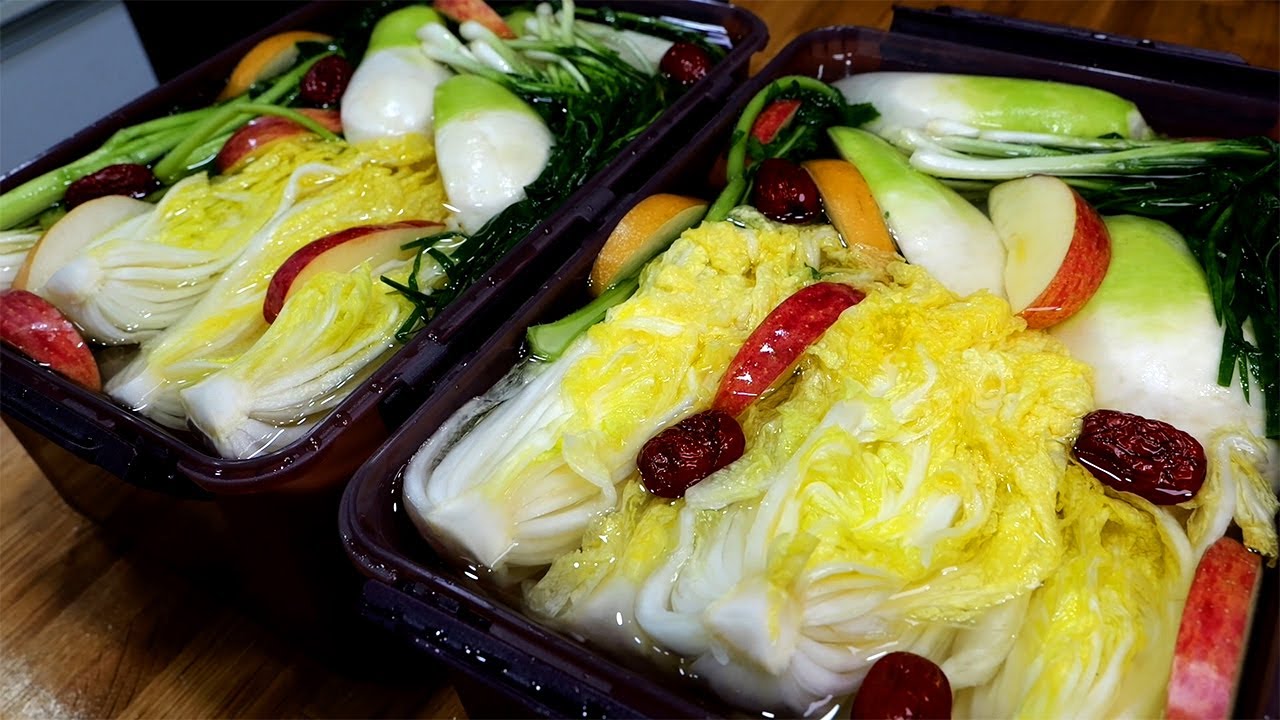
Why This Recipe Works
Most people encounter kimchi as a violently red, aggressively spiced condiment that announces itself from across a room. Dongchimi is the corrective. It is the version Korean grandmothers make when they want to demonstrate that restraint is not weakness — that fermentation, given the right conditions and left entirely alone, produces something more complex than any amount of chili paste can manufacture. This is the kimchi that does not perform. It simply works.
The mechanism behind dongchimi is lactic acid fermentation, the same controlled bacterial process behind sauerkraut, dill pickles, and sourdough. Korean radish — mu — is dense, high in water content, and carries a population of naturally occurring Lactobacillus bacteria on its skin. When salt draws moisture out of the radish tissue through osmosis, it creates a saline brine inhospitable to pathogenic bacteria but perfectly suited to Lactobacillus. The survivors multiply, consume available sugars, and excrete lactic acid. The brine acidifies. The radish firms slightly, then softens in a different way — not the collapse of heat but the gradual, cellular transformation of fermentation. The result is a radish that bites back with a clean, cold snap and a brine that drinks like something alive.
The salt concentration matters more here than in most kimchi recipes, and it matters in a specific direction. Too little salt and the wrong bacteria win — you get soft, slimy vegetables and a brine that smells wrong. Too much salt and you suppress fermentation entirely, producing a jar of salty radish with no effervescence, no tang, no character. The recipe's two-salt approach — a direct rub followed by a measured brine — is not redundant. The first salt draws out radish liquid that contains radish sugars and cell enzymes, becoming the foundational flavor base. The second salt calibrates the brine's salinity precisely for optimal Lactobacillus activity. These are not interchangeable steps.
The Asian pear is where the recipe departs from a basic salt-water ferment and becomes something intentional. Pear contributes fructose and glucose — simple sugars that feed the lactic acid bacteria more readily than the complex carbohydrates in radish, accelerating early fermentation and producing a more effervescent brine. Simultaneously, pear contains enzymes that break down certain proteins and tenderize plant tissue, contributing to the final brine's unusual depth. You could omit the pear. You would know you had.
Garlic and ginger are not present for aromatics alone. Both contain antimicrobial compounds — allicin and gingerols, respectively — that selectively inhibit certain pathogenic microorganisms while having minimal effect on Lactobacillus strains. This is old-world food science deployed without conscious knowledge of mechanism, refined across centuries of winter survival. The result is a fermentation environment that consistently produces safe, clean-flavored kimchi. The chili peppers, characteristically mild in this recipe rather than explosive, contribute capsaicin as an additional antimicrobial agent and give the brine its faint, unobtrusive heat.
Container selection is not aesthetic preference. A large glass jar allows you to monitor fermentation visually — watching bubble formation, brine clarity, and color development are the primary indicators of a healthy ferment. Traditional Korean cooks used earthenware crocks, which regulate temperature through their porous walls and carry established bacterial cultures from previous batches, accelerating fermentation and contributing flavor complexity that a sterile glass jar cannot replicate. If you own a proper earthenware fermenting vessel, use it. If you do not, glass is acceptable and honest.
Submersion is non-negotiable. Any radish surface exposed to air will oxidize, develop off-flavors, and invite the wrong microbial guests. A small plate weighted down, a zip-lock bag filled with brine — whatever keeps the vegetables under the liquid surface is correct. What does not work is checking the ferment once, deciding it looks fine, and leaving it alone. You need to monitor and keep things submerged. Fermentation is not passive cooking; it is a managed process that requires attention.
The brine that results from five to seven days of patient, cold fermentation is one of Korean cuisine's most underappreciated byproducts. It is lightly carbonated from CO2 produced by bacterial metabolism — Korea's original sparkling water, predating Perrier by centuries. It is tangy without being sharp, cold-serving cold against the palate, and dense with probiotic organisms that genuinely support digestion. Keep a ladle in the jar at all times. Serve the brine alongside the radish. Drink it straight after a heavy meal. This is not garnish. The brine is the point of the entire exercise — the radish is merely the architecture that builds it.
Dongchimi is what fermentation looks like when you understand that control is the removal of interference, not the addition of complexity. Salt, water, radish, time. Every other ingredient earns its place through documented biochemical function. There is nothing decorative in this jar.
Dongchimi (Radish Water Kimchi)
🛒 Ingredients
- ✦4 small Korean radishes (mu), about 2 lbs total
- ✦3 tablespoons coarse sea salt (for salting radishes)
- ✦6 cups water
- ✦2 tablespoons coarse sea salt (for brine)
- ✦1 Asian pear, quartered
- ✦6 cloves garlic, halved
- ✦1 inch piece ginger, sliced
- ✦1 medium onion, quartered
- ✦4 green onions
- ✦2 Korean green chili peppers
- ✦2 red chili peppers
👨🍳 Instructions
01Step 1
Peel radishes and quarter them lengthwise (or halve if small). Rub generously with 3 tablespoons coarse salt. Let sit for 2-3 hours, turning occasionally, until radishes are flexible and have released liquid.
02Step 2
Place salted radishes in a large jar or container (glass or earthenware is best). Tuck pear quarters, garlic, ginger, onion, green onions, and chili peppers around the radishes.
03Step 3
Dissolve 2 tablespoons salt in 6 cups water. Pour the brine over the radishes until everything is submerged. Use a small plate to weigh down the radishes and keep them underwater.
04Step 4
Cover loosely (not airtight — fermentation produces gas). Leave at room temperature for 2-3 days until tiny bubbles appear and the brine develops a slightly tangy, effervescent taste.
05Step 5
Once fermentation begins, transfer to the refrigerator. It's ready to eat in 5-7 days total, and improves over 2-3 weeks.
06Step 6
Serve sliced radish in bowls with the cold brine. The brine is the prize — drink it or use it as a cold soup base.
Nutrition Per Serving
Estimates based on standard preparation. Adjustments alter macros.
🔄 Substitutions
Instead of Korean radish (mu)...
Use Daikon radish
Similar but milder and less sweet. Works well — slightly different character.
Instead of Asian pear...
Use Apple (half a Fuji)
Similar sweetness and fermentation-feeding effect
Instead of Coarse sea salt...
Use Kosher salt
Use about 20% less — kosher salt is denser than coarse sea salt
🧊 Storage & Reheating
In the Fridge
Keeps for 2-3 months in the refrigerator. Flavor deepens and becomes more sour over time.
In the Freezer
Not recommended — the radish texture changes.
Reheating Rules
Serve ice cold. Never heat dongchimi — the cold brine is the entire point.
❓ Frequently Asked Questions
What does dongchimi mean?
Dongchimi (동치미) literally means 'winter kimchi.' Dong (동) = winter, chimi (치미) = kimchi. It's traditionally made during kimjang season (late November) alongside tongbaechu-kimchi. While regular kimchi is spicy and red, dongchimi is clear, tangy, and refreshing.
Why is the brine important?
In dongchimi, the brine IS the dish. The fermented liquid develops a complex, effervescent tanginess that's used as a cold soup base (for naengmyeon), a drinking broth (digestive), and a refreshing palate cleanser. A good dongchimi is judged by its brine quality, not just the radish.

The Science of
Dongchimi (Radish Water Kimchi)
We turned everything on this page into a beautiful, flour-proof PDF cheat sheet. Print it out, stick it to your fridge, and never mess up your dongchimi (radish water kimchi) again.
*We'll email you the high-res PDF instantly. No spam, just perfectly cooked meals.
AlmostChefs Editorial Team
We translate the internet's most popular cooking videos into foolproof, beginner-friendly written recipes. We analyze multiple methods, test them in our kitchen, and engineer a single "Master Recipe" that gives you the best possible result with the least possible stress.