Dakgangjeong (Sweet Crispy Fried Chicken)
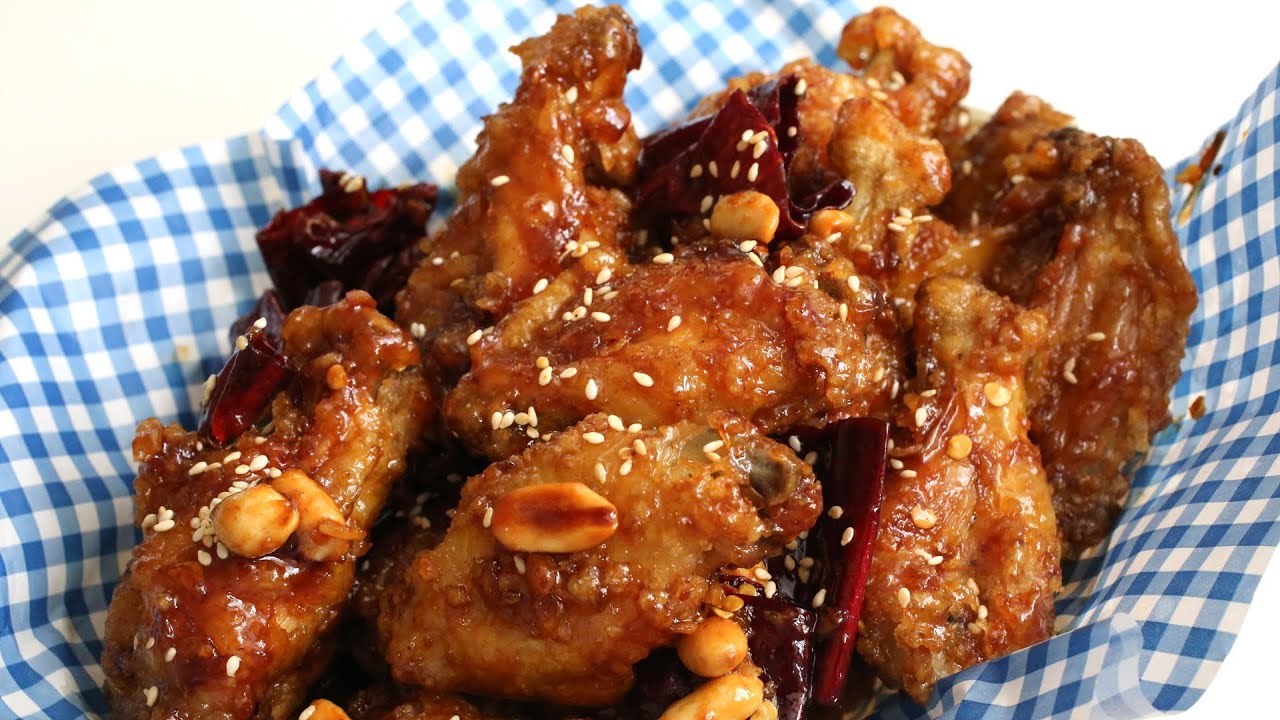
Maangchi's most-viewed recipe — bite-size chicken pieces double-fried until impossibly crunchy, then tossed in a sweet, sticky, garlicky glaze with toasted peanuts.
Why This Recipe Works
Most fried chicken recipes lie to you. They tell you the secret is buttermilk, or a special spice blend, or some proprietary seasoning that costs seventeen dollars a jar. Dakgangjeong does not lie. It shows its work. Every structural decision in this recipe exists for a documented, reproducible reason — and if you ignore any one of them, the result degrades in a predictable, measurable way. This is the kind of cooking that rewards people who actually pay attention.
The Physics of the Double-Fry
The double-fry method is not a gimmick. It is applied thermodynamics. During the first fry at 340°F, the chicken's internal moisture converts to steam and pushes outward through the coating. The coating sets into a porous, semi-rigid shell — cooked through, but still holding residual water in its structure. Remove the chicken at this stage and you have something acceptably crispy. Wait for it to cool slightly, then drop it back into oil at 375°F, and something categorically different happens.
At the higher temperature, the residual surface moisture flash-evaporates. The starch granules in the coating undergo a second round of gelatinization and then rapid dehydration, collapsing into a glass-like matrix. This is the crust that shatters when you bite it. Single-frying cannot produce this structure — you'd need to leave the chicken in the oil so long that the interior overcooks before the crust achieves the same state. The double-fry is not tradition for tradition's sake. It is the only thermally rational path to this specific texture.
A Dutch oven is the correct vessel for this. The mass of the pot stabilizes oil temperature between batches. Lighter pans spike and crash — you drop cold chicken in and the temperature tanks, the coating absorbs oil instead of repelling it, and you get greasy, soft chicken that no amount of second-frying will fully rescue. Thermal mass is your insurance policy.
Potato Starch Is Not a Substitute — It's the Specification
The recipe calls for potato starch as the primary coating agent, and this is not a soft preference. Potato starch granules are larger than cornstarch granules. Under heat, they swell and then set in a way that creates a coarser, more open matrix — one that fries drier and fractures more cleanly than the smoother, more homogenous film that cornstarch produces. The egg in the batter is the binder; the potato starch is the architecture. Cornstarch works as a fallback, but the texture ceiling is lower. If you use all-purpose flour as your primary starch, you have made a different dish and should reckon with that honestly.
Moisture Is the Enemy — Treat It Like One
Patting the chicken dry before coating is not a suggestion buried in the fine print. It is the first structural decision in the entire recipe, and it compounds everything that follows. Water on the surface of the chicken disrupts the adhesion of the starch batter, causes localized oil temperature drops during frying, and steams the coating from the inside during the first fry rather than allowing it to set cleanly. Two to three minutes with paper towels, pressing firmly against every surface, is not excessive. It is the difference between a crust and a shell.
Once the chicken is coated and fried, drainage matters. A wire rack set over a sheet pan keeps the chicken elevated so steam escapes from all sides. Draining on paper towels seems intuitive but is actively counterproductive — the towels trap steam, which condenses back into moisture and softens the underside of the crust within seconds. Use the rack. It costs nothing in effort and is worth everything in texture.
The Glaze: Adhesion Over Flavor
The sauce in dakgangjeong is not complicated, but its execution timing is absolute. You build it in a large skillet — soy sauce, rice syrup, sugar, gochugaru, garlic, ginger, rice vinegar — and you keep it at an active bubble when the chicken goes in. This is not for flavor. This is for adhesion mechanics.
Hot glaze hitting a hot, porous crust immediately begins to penetrate slightly and then set as it cools. If the glaze is warm but not bubbling, it runs off the surface before it can set, pooling at the bottom of the pan. If the chicken is not fresh from the fryer, the crust has already begun to absorb ambient steam, the surface pores have closed, and the glaze sits on top rather than bonding to the texture. The fifteen-second window between pulling chicken from oil and tossing it in bubbling sauce is where dakgangjeong either succeeds or fails.
Rice syrup — mulyeot — is the correct sweetener here, and it is correct for a structural reason: its long-chain glucose polymers create a viscous, stretchy sauce that clings to irregular surfaces. Corn syrup approximates this. Honey does not — it crystallizes as it cools, producing a different mouthfeel and a glaze that tightens rather than stretches. The peanuts go on last, pressed into the glaze while it is still tacky, so they adhere rather than scatter.
The Fifteen-Minute Lifespan
Dakgangjeong has a hard expiration window. The glaze, by design, is hydrophilic — it attracts atmospheric moisture. Within fifteen to twenty minutes of plating, the crust begins to soften as the glaze mediates moisture transfer from the air into the coating. This is not a flaw. It is the inherent tradeoff of a sauce this sticky on a crust this porous. The solution is not a better recipe. The solution is to serve it immediately, eat it quickly, and make peace with the fact that this dish does not wait for anyone.
Cook it right. Eat it fast. The science is straightforward. The execution is the only variable still under your control.
Dakgangjeong (Sweet Crispy Fried Chicken)
🛒 Ingredients
- ✦2 lbs chicken wings or drumettes, cut into bite-size pieces
- ✦1/2 cup potato starch (or cornstarch)
- ✦1/4 cup all-purpose flour
- ✦1/2 teaspoon salt
- ✦1/4 teaspoon black pepper
- ✦1 egg, beaten
- ✦Vegetable oil for deep frying
- ✦3 tablespoons soy sauce
- ✦3 tablespoons rice syrup (or corn syrup)
- ✦2 tablespoons sugar
- ✦2 tablespoons gochugaru (Korean red pepper flakes)
- ✦4 cloves garlic, minced
- ✦1 tablespoon fresh ginger, minced
- ✦1 tablespoon rice vinegar
- ✦1/4 cup roasted peanuts
- ✦Dried red chili peppers for garnish
👨🍳 Instructions
01Step 1
Cut chicken into bite-size pieces (about 1.5 inches). Pat very dry with paper towels — this is essential for crispy skin.
02Step 2
Combine potato starch, flour, salt, and pepper in a bowl. Add beaten egg and mix into a light batter. Toss chicken pieces to coat evenly.
03Step 3
Heat oil to 340°F (170°C) in a heavy pot or Dutch oven. Fry chicken in batches for 8-10 minutes until cooked through. Remove and drain on a wire rack.
04Step 4
Increase oil temperature to 375°F (190°C). Fry the chicken a second time for 3-4 minutes until deeply golden and extra crispy.
05Step 5
While the chicken fries the second time, make the sauce: combine soy sauce, rice syrup, sugar, gochugaru, garlic, ginger, and rice vinegar in a large pan over medium heat. Stir until the sugar dissolves and the sauce bubbles.
06Step 6
Add the hot, crispy chicken to the sauce. Toss quickly and thoroughly to coat every piece.
07Step 7
Sprinkle with roasted peanuts and dried chili peppers. Serve immediately while the crust is still crunchy.
Nutrition Per Serving
Estimates based on standard preparation. Adjustments alter macros.
🔄 Substitutions
Instead of Chicken wings...
Use Boneless chicken thighs
Cut into 1.5-inch cubes. Slightly less dramatic but easier to eat
Instead of Rice syrup (mulyeot)...
Use Corn syrup or honey
Corn syrup gives the closest texture. Honey crystallizes differently but tastes great
Instead of Potato starch...
Use Cornstarch
Slightly less crispy but still very good
Instead of Peanuts...
Use Toasted almonds or cashews
Any roasted nut works — peanuts are traditional
🧊 Storage & Reheating
In the Fridge
Store for 1-2 days, but the crispy coating will soften significantly.
In the Freezer
Not recommended — the crispy coating does not survive freezing.
Reheating Rules
Reheat in a 400°F oven for 8-10 minutes to restore some crunch. Do not microwave.
❓ Frequently Asked Questions
Why is my dakgangjeong not crispy?
Three common reasons: (1) The chicken wasn't dry enough before coating, (2) you skipped the double-fry, or (3) the oil wasn't hot enough. The second fry at 375°F is what creates the shatteringly crispy crust.
What's the difference between dakgangjeong and yangnyeom chicken?
Dakgangjeong uses bite-size pieces with a starch-based coating and a sticky glaze with peanuts. Yangnyeom chicken uses larger pieces with a batter coating and a saucy, wet glaze. Dakgangjeong is crunchier; yangnyeom is saucier.
Can I air fry dakgangjeong?
Yes, but the texture won't be identical. Spray the coated chicken with oil and air fry at 380°F for 15 minutes, then increase to 400°F for 5 minutes. The double-fry effect is harder to replicate in an air fryer.

The Science of
Dakgangjeong (Sweet Crispy Fried Chicken)
We turned everything on this page into a beautiful, flour-proof PDF cheat sheet. Print it out, stick it to your fridge, and never mess up your dakgangjeong (sweet crispy fried chicken) again.
*We'll email you the high-res PDF instantly. No spam, just perfectly cooked meals.
AlmostChefs Editorial Team
We translate the internet's most popular cooking videos into foolproof, beginner-friendly written recipes. We analyze multiple methods, test them in our kitchen, and engineer a single "Master Recipe" that gives you the best possible result with the least possible stress.