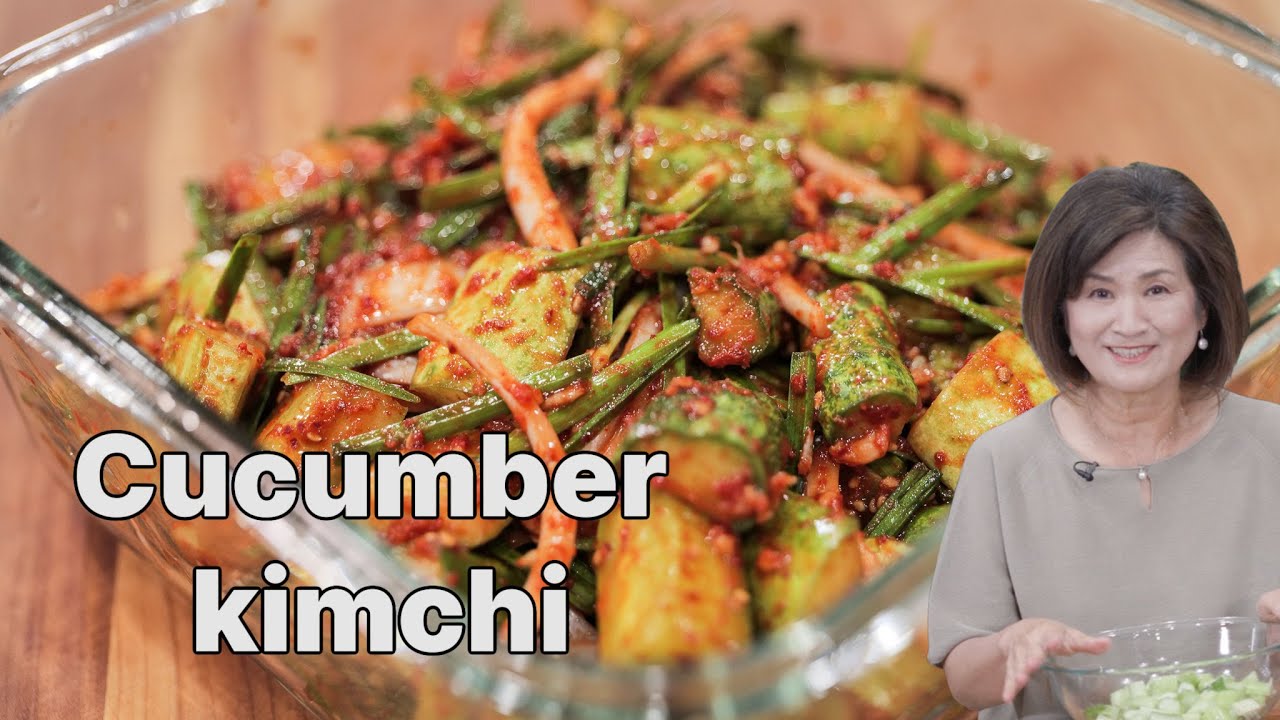
Oi Sobagi (Cucumber Kimchi)
Crisp Korean cucumbers stuffed with a spicy chive-radish filling and quick-fermented overnight. Summer's freshest, crunchiest kimchi.
Why This Recipe Works
Most kimchi fails not because of bad ingredients but because of bad physics. The cook doesn't understand what salt is actually doing, or why fermentation time is a variable and not a fixed rule, or why the geometry of a cut matters. Oi sobagi — stuffed cucumber kimchi — is deceptively simple on its surface and brutally unforgiving underneath. Get the mechanics right and you produce something cold, crunchy, and electric. Get them wrong and you end up with a soggy, underseasoned vegetable swimming in lukewarm regret. Here is why this version works, explained with the precision the dish deserves.
The Cross-Cut Is Not Decorative
The signature technique of oi sobagi is the cross-cut: a lengthwise incision made in two perpendicular planes, stopping short of both ends so the cucumber holds together as a single intact piece. This is not aesthetic theater. It is structural engineering. The four resulting petals of cucumber flesh dramatically increase the interior surface area exposed to both the salting process and the filling. A whole cucumber or a simple halved cucumber would require far longer salting and far more passive diffusion time to achieve equivalent seasoning penetration. The cross-cut is the entire reason this kimchi is ready in one to two days rather than weeks.
Osmosis, Not Flavor — The Salt Phase
When you rub coarse sea salt into the cuts and over the skin, you are not seasoning the cucumber. You are triggering osmosis. The high concentration of salt on the exterior draws cellular moisture outward through the cucumber's membrane, collapsing its water-logged vacuoles. This does two things. First, it concentrates the cucumber's flavor — less water means more cucumber. Second, and critically, it renders the flesh supple enough to accept the filling without splitting or cracking. Thirty minutes is not arbitrary. It is the minimum contact time required at room temperature for meaningful moisture extraction without crossing into limpness. Rinse briefly after salting. You want the salt gone. The structural change it caused remains.
The Filling Is a Flavor System
The chive-radish filling reads like a short ingredient list. It functions like a layered flavor system. Garlic chives (buchu) provide a sharp, allium-forward base that regular chives categorically cannot replicate — their garlicky volatile compounds are distinct. Julienned Korean radish adds a secondary crunch that counterpoints the cucumber rather than competing with it. Gochugaru delivers heat and the deep brick-red color that makes this kimchi visually unmistakable. Fish sauce and minced salted shrimp (saeujeot) are both umami delivery vehicles, each contributing a slightly different register of fermented marine depth. Garlic and sugar balance the heat and salt respectively. Sesame seeds add fat and a faint nuttiness. Nothing in this filling is redundant. Remove any single component and the balance shifts noticeably.
The Fermentation Window Is Deliberate and Narrow
Oi sobagi is a summer kimchi, which means it operates on a fundamentally different fermentation logic than tongbaechu-kimchi. It is not designed for long aging. The cucumber's cellular structure cannot survive extended lacto-fermentation without losing the cold snap that is the entire point of the dish. The one to two day window at refrigerator temperature after an initial six to eight hour room-temperature kickstart is the fermentation sweet spot: enough lactic acid development to produce tanginess, not enough to destroy the cucumber's crunch. After five days, the texture begins to degrade. After a week, you have a different dish entirely — not a bad dish, but not oi sobagi. Eat it cold, eat it fast.
The Container Is Load-Bearing Equipment
This is not a recipe where storage is an afterthought. An airtight container is not optional — it is a functional component of the fermentation environment. A loose-lidded or poorly sealed vessel allows CO₂ to escape too freely, disrupts the anaerobic conditions that favor lactic acid bacteria over unwanted microbes, and accelerates moisture loss from the cucumber surface. The cucumbers should be packed tightly enough that they press against each other, limiting air pockets. Any remaining filling is packed on top and around the cucumbers — it continues to season the exterior during fermentation and should not be discarded.
Why Korean Cucumbers Specifically
Korean cucumbers (oi) are thinner-skinned, crunchier, and less water-saturated than English or standard American cucumbers. Their lower water content means the salting phase extracts proportionally less moisture, preserving more structural integrity. Their thinner skin means they absorb the filling's seasoning more readily. Persian cucumbers are the only acceptable substitute — similar dimensions, thin skin, low water content. English cucumbers, despite their ubiquity, are too large, too watery, and produce a structurally inferior result. This is not preference. It is produce science.
The Cold Serve Is the Point
Oi sobagi is served cold, straight from the airtight container it fermented in. The thermal contrast — cold crunchy cucumber, spicy filling, tangy fermentation brine — is the entire sensory experience this kimchi is built around. It is not a room temperature dish. It is not a warm side dish. It is a cold, crunchy, spicy counterpoint to rich grilled meat or hot rice, and it performs that function with a ruthless precision that no other kimchi quite matches in midsummer heat.
Oi Sobagi (Cucumber Kimchi)
🛒 Ingredients
- ✦6 Korean cucumbers (or Persian cucumbers)
- ✦2 tablespoons coarse sea salt (for salting)
- ✦1 cup garlic chives (buchu), cut into 1/2 inch pieces
- ✦1/4 cup Korean radish (mu), julienned finely
- ✦2 tablespoons gochugaru (Korean red pepper flakes)
- ✦1 tablespoon fish sauce
- ✦1 tablespoon salted shrimp (saeujeot), minced
- ✦2 cloves garlic, minced
- ✦1 teaspoon sugar
- ✦1 teaspoon sesame seeds
👨🍳 Instructions
01Step 1
Trim the ends of the cucumbers. Cut a cross into each cucumber lengthwise, leaving 1/2 inch intact at each end — the cucumber should open like a pocket but stay in one piece.
02Step 2
Rub coarse salt into the cuts and over the outside of each cucumber. Let sit for 30 minutes to draw out moisture.
03Step 3
While cucumbers salt, make the filling: combine garlic chives, julienned radish, gochugaru, fish sauce, salted shrimp, garlic, sugar, and sesame seeds. Mix well.
04Step 4
Rinse the salted cucumbers briefly under cold water. Gently squeeze out excess moisture.
05Step 5
Stuff the chive-radish filling into each cucumber's cross-cut pockets. Pack it in generously — the filling should be visible.
06Step 6
Place stuffed cucumbers in an airtight container. Press down gently. Spread any remaining filling on top.
07Step 7
Leave at room temperature for 6-8 hours to kick-start fermentation, then refrigerate. Ready to eat in 1 day, best at 2-3 days.
Nutrition Per Serving
Estimates based on standard preparation. Adjustments alter macros.
🔄 Substitutions
Instead of Korean cucumbers...
Use Persian cucumbers
Closest substitute — similar size, thin skin, crunchy. Don't use English or regular cucumbers — too watery.
Instead of Garlic chives (buchu)...
Use Regular chives + 1 extra clove garlic
Milder flavor but works in a pinch
Instead of Salted shrimp (saeujeot)...
Use Extra fish sauce (1 tablespoon)
For a vegetarian version, use soy sauce + a pinch of kelp powder
🧊 Storage & Reheating
In the Fridge
Best within 3-5 days while cucumbers are still crunchy. After a week they soften.
In the Freezer
Not recommended — cucumbers turn mushy.
Reheating Rules
Serve cold, straight from the fridge. No reheating needed.
❓ Frequently Asked Questions
Why is it called oi sobagi?
Oi means cucumber and sobagi means stuffed. It's one of several 'sobagi' kimchis in Korean cuisine — vegetables stuffed with seasoned filling and fermented. The technique of cross-cutting and stuffing is unique to Korean pickling.
How is cucumber kimchi different from regular kimchi?
Regular kimchi (tongbaechu-kimchi) uses napa cabbage, ferments for weeks to months, and develops deep sour complexity. Cucumber kimchi is a quick, fresh kimchi — ready in 1-2 days, meant to be eaten within a week, and prized for its cold crunch rather than funky depth.

The Science of
Oi Sobagi (Cucumber Kimchi)
We turned everything on this page into a beautiful, flour-proof PDF cheat sheet. Print it out, stick it to your fridge, and never mess up your oi sobagi (cucumber kimchi) again.
*We'll email you the high-res PDF instantly. No spam, just perfectly cooked meals.
AlmostChefs Editorial Team
We translate the internet's most popular cooking videos into foolproof, beginner-friendly written recipes. We analyze multiple methods, test them in our kitchen, and engineer a single "Master Recipe" that gives you the best possible result with the least possible stress.