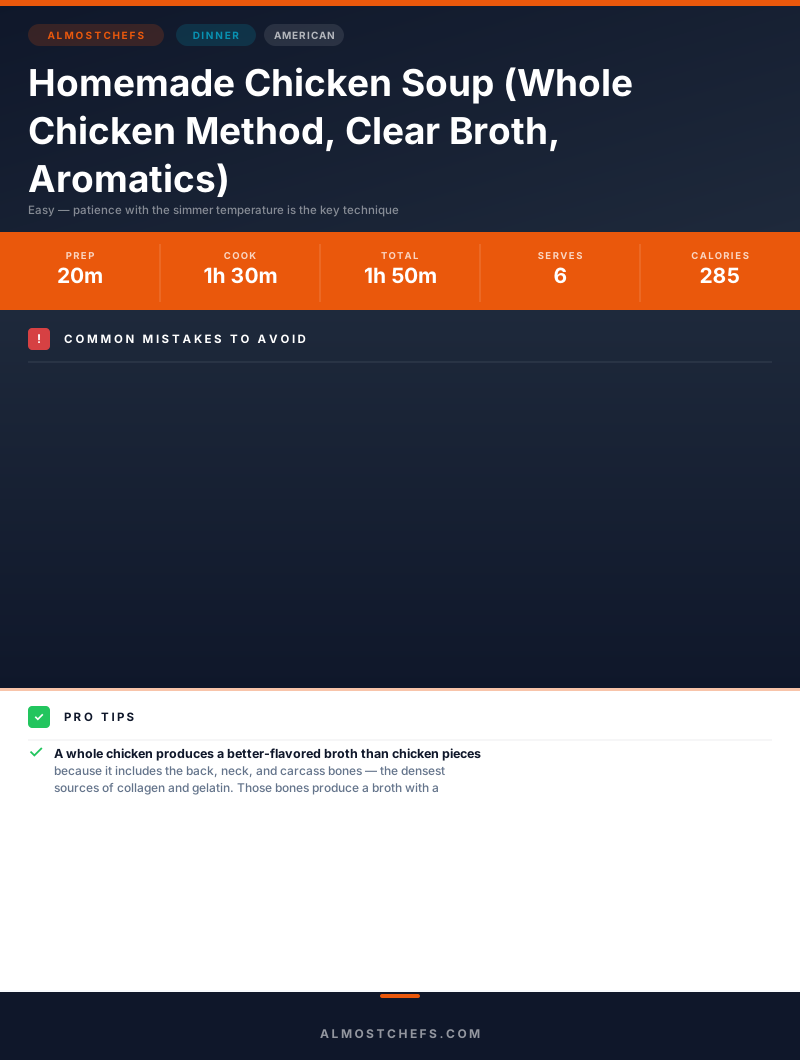
Homemade Chicken Soup (Whole Chicken Method, Clear Broth, Aromatics)
Chicken soup built on a whole chicken simmered in cold water with mirepoix aromatics, producing a rich, clear broth with deep flavor and tender pulled meat.

“Most homemade chicken soup ends up murky, greasy, or flat. It's a simmer temperature problem and an extraction problem. Cold water, a whole bird, and consistent low heat are the three variables that separate a clear, rich, golden broth from the grey, cloudy result that makes people think good chicken soup requires a restaurant kitchen.”
Why This Recipe Works
Chicken soup is the most forgiving recipe in the home cook's repertoire on the surface — chicken plus water plus vegetables, simmered together. It is also, when done correctly, a precise application of extraction chemistry, temperature control, and collagen science. The difference between a murky, thin, flat-tasting broth and a clear, golden, rich one is almost entirely technique, not ingredient quality.
Cold Water Extraction: The Fundamental Variable
The most counterintuitive instruction in stock-making is to start with cold water. Every instinct says warm the water first — it's more efficient, it saves time. This is the wrong instinct.
Cold water and chicken interact through osmosis. Osmosis is the movement of dissolved substances across a permeable membrane from a higher-concentration environment to a lower-concentration environment. The muscle fibers, fat cells, and connective tissue of a raw chicken contain high concentrations of dissolved proteins, collagen, sugars, minerals, and flavor compounds. Cold water surrounding the chicken has low concentrations of all of these things. The concentration gradient drives a slow, continuous migration of compounds out of the chicken tissue and into the water.
This gradual extraction is not just about flavor — it's about clarity. The proteins and cellular debris that cause murky, cloudy broth are released slowly from the meat as the temperature rises from cold. They rise to the surface as foam before they disperse into the liquid, which is why the foam skimming window exists. Hot water, by contrast, causes the exterior proteins to coagulate immediately on contact. The same proteins and cellular debris that would have floated to the surface as skimmable foam are instead locked into the meat surface and gradually disperse through the liquid as the cook proceeds, producing cloudiness that cannot be removed by skimming.
The physics here are unambiguous: cold water start plus aggressive early skimming equals clear broth. Hot water start equals murky broth, regardless of technique applied afterward.
Mirepoix: The Aromatic Foundation
The classic French mirepoix — onion, carrot, celery in a 2:1:1 ratio — is the standard aromatic base for Western stocks and soups. Each vegetable contributes specific flavor compounds that interact with the chicken flavor in distinct ways.
Onion provides sulfur compounds (thiosulfinates, disulfides) that become sweet and savory when long-simmered at low temperatures. Raw onion is sharp; 90-minute-simmered onion contributes a gentle, sweet depth that reads as umami-adjacent rather than allium-forward. The Maillard reaction does not occur at simmering temperatures — there is no browning chemistry. The onion simply surrenders its flavor compounds to the surrounding liquid over time.
Carrot provides beta-carotene and related carotenoids that contribute to the characteristic golden color of chicken broth, along with natural sugars that give the broth a slight sweetness that balances the savory chicken flavor. The carotenoids are fat-soluble — they dissolve into the rendered chicken fat and distribute with it throughout the broth, producing the golden color most associated with excellent homemade chicken soup.
Celery contributes phthalides, a class of aromatic compounds that add a fresh, slightly herbal background note. Celery has a lower flavor intensity than onion or carrot but provides important aromatic complexity — broth without celery tastes flatter and more one-dimensional than broth with it.
Garlic, added whole and smashed rather than minced, contributes allicin and related sulfur compounds at a lower intensity than onion. Smashing rather than mincing creates a large surface area for compound release without making the garlic flavor dominant.
Collagen, Gelatin, and Broth Body
A whole chicken simmered for 90 minutes releases collagen from its connective tissue and bones. Collagen is a structural protein — the primary component of tendons, cartilage, and the connective tissue that holds muscle groups together. At sustained temperatures above 160°F, collagen hydrolyzes (breaks down) into gelatin.
Gelatin dissolved in the broth does something important to its physical properties: it increases viscosity and creates a slight lip-coating body that transforms the mouthfeel from watery to rich. This is why a properly made chicken broth gels in the refrigerator — the gelatin concentration is high enough that the broth sets like loose Jell-O when cold. This is not a defect; it is the marker of a well-extracted, collagen-rich broth. Broth that stays liquid in the refrigerator has very low gelatin content and will taste noticeably thinner.
The bones contribute more collagen per gram than the meat. This is why whole chicken — which includes the back, neck, and carcass — produces a more body-rich broth than boneless chicken pieces. Chicken backs and necks specifically, if available, are the highest-collagen parts of the bird. Adding them to the pot is the fastest way to increase gelatin content and broth body.
Temperature Control: Why 185°F Matters
The simmer temperature — roughly 185-200°F — is below the boiling point of water (212°F at sea level) for a specific physical reason: fat emulsification.
Rendered chicken fat floats to the surface of the simmering broth as large droplets. Large fat droplets can be skimmed. When the liquid boils, the mechanical agitation of the rolling boil breaks those large fat droplets into tiny emulsified particles through the shear force of the bubbles. These tiny particles are suspended throughout the liquid and cannot be separated from it by skimming — they are too small and too distributed. The result is a permanently opaque, greasy-tasting broth.
A gentle simmer keeps the liquid's surface quiet. Fat rises and pools there, removable with a ladle. The entire flavor difference between a restaurant-quality clear broth and a home kitchen cloudy one is frequently just a matter of maintaining 185-200°F rather than 212°F for the full cook time.
A good Dutch oven is useful here because its thermal mass allows for fine temperature control — once at the right simmer, the stored heat in the walls and base keeps the temperature stable even as you reduce the burner setting. Thin pots oscillate between too hot and too cool as you adjust the burner, making consistent temperature maintenance more difficult.
Where Beginners Mess This Up
Before we start, read this. These are the 4 reasons your homemade chicken soup (whole chicken method, clear broth, aromatics) will fail:
- 1
Starting with hot or boiling water: Dropping a chicken into boiling water causes the exterior proteins to seize and coagulate immediately, trapping impurities inside the meat rather than allowing them to leach gradually into the surrounding liquid. Cold water extraction works through osmosis: as the water temperature rises slowly from cold, impurities, blood proteins, and fat gradually migrate out of the chicken into the cooler surrounding liquid, where they can be skimmed from the surface. Starting with cold water produces a cleaner, clearer broth. Starting with boiling water produces a murky, grey-tinged liquid that cannot be clarified by skimming.
- 2
Boiling the soup instead of simmering: A rolling boil agitates the liquid violently. Fat released from the chicken skin and bones is emulsified into the broth by this agitation — the mechanical action of the boil breaks fat droplets into tiny particles that distribute throughout the liquid and cannot be skimmed off. A gentle simmer, with the surface barely moving and occasional bubbles breaking the surface, keeps fat as large droplets that float and can be removed with a ladle or skimming spoon. The boil vs. simmer distinction is the primary determinant of final broth clarity. Temperature target: 185-200°F, not 212°F.
- 3
Not skimming the foam in the first 20 minutes: As the cold water heats and the chicken proteins begin to leach out, a grey-white foam accumulates on the surface. This foam is primarily denatured blood proteins and myoglobin — the stuff that makes stock murky and gives it an off-flavor at high concentrations. The skimming window is the first 15-20 minutes of heating, before the foam re-incorporates and disperses. Skim aggressively during this period with a wide, flat spoon. Once the foam phase is complete, skimming becomes less critical.
- 4
Overcooking the chicken past the pull stage: Chicken breast meat cooked beyond 165°F begins to dry out as the muscle proteins contract and squeeze out moisture. In a long-simmered whole chicken, the breast is done well before the legs and thighs, and keeping the whole pot simmering for 90 full minutes cooks the breast far past its optimal temperature. The solution is to pull the whole chicken at 60-75 minutes, remove the breast meat, and return the carcass and leg/thigh sections for the remaining time to continue flavoring the broth. The breast meat, added back at the end in pulled pieces, stays tender rather than stringy.
The Video Reference Library
Want to see it in action? Here are the exact videos we analyzed and combined to build this foolproof recipe translation:
The primary technique reference for this recipe. Covers cold water extraction, skimming technique and timing, simmer temperature visual cues, and the chicken pulling method. The visual comparison of simmered versus boiled broth clarity is essential viewing.
Explains the physics of fat emulsification through agitation, cold water osmotic extraction, and why the first skimming window is so critical for final broth clarity. Technical but accessible.
Covers the specific flavor compounds contributed by onion, carrot, and celery in a simmered stock, why garlic is added later than the mirepoix, and how bay leaf and peppercorns interact with long cooking times.
🛠️ Core Equipment
- Large stockpot (6-8 quart)A whole chicken plus 12 cups of water plus aromatics requires significant volume. A pot that is too small forces the chicken partially above the waterline, producing uneven extraction — some sections of the bird are submerged and contribute to the broth, while the exposed sections contribute nothing until turned. The bird should be fully submerged with at least 2 inches of headspace above the liquid.
- Wide, flat skimming spoon or ladleThe skimming step requires a tool that can skim the surface of the liquid without disturbing the broth below. A flat skimming spoon removes foam efficiently. A regular spoon scoops too much liquid along with the foam, making the skimming process slow and wasteful. A fine-mesh spider skimmer is ideal.
- Tongs and two forks for pulling chickenPulling a whole cooked chicken into pieces from a large pot of hot broth requires tongs for extracting the bird and forks for shredding the meat. A proper pull (not chop) produces irregular meat pieces with more surface area that absorb broth better than cleanly sliced pieces.
- Fine mesh strainerStraining the finished broth through a fine mesh strainer removes small bone fragments, herb stems, peppercorns, and the remnants of the long-cooked aromatics. This produces a visually clear broth and removes any textural intrusions from the finished bowl. Line the strainer with cheesecloth for an even cleaner result.
- Fat separator or wide shallow bowlAfter straining, the broth contains a layer of rendered fat. For the cleanest, lightest finished soup, this fat should be removed. A fat separator lets you pour off the fat-free broth directly. Alternatively, cool the strained broth in a shallow container — the fat rises and solidifies as a layer that can be lifted off in one piece. The [Dutch oven](/kitchen-gear/review/dutch-oven) is ideal here as it retains heat evenly and goes from stovetop to refrigerator without thermal shock.
Homemade Chicken Soup (Whole Chicken Method, Clear Broth, Aromatics)
🛒 Ingredients
- ✦1 whole chicken (3-4 lbs), or equivalent chicken pieces (bone-in, skin-on)
- ✦3 large carrots, halved crosswise
- ✦4 celery stalks, halved crosswise
- ✦1 large yellow onion, quartered
- ✦6 cloves garlic, smashed
- ✦2 bay leaves
- ✦1 tablespoon whole black peppercorns
- ✦1 teaspoon dried thyme
- ✦Small bunch fresh flat-leaf parsley (stems and leaves)
- ✦12 cups cold water
- ✦2 teaspoons kosher salt (plus more to taste)
- ✦For serving: 8 oz wide egg noodles or 1 cup white rice, cooked separately
- ✦For serving: 2 medium carrots, finely diced
- ✦For serving: 3 celery stalks, finely diced
- ✦Fresh parsley, chopped, for garnish
👨🍳 Instructions
01Step 1
Place the whole chicken breast-side up in a large stockpot. Add the halved carrots, celery, quartered onion, smashed garlic, bay leaves, peppercorns, thyme, and parsley. Add 12 cups cold water — the chicken should be fully submerged.
02Step 2
Place the pot over medium-high heat and bring slowly to a simmer — not a boil. This should take 20-25 minutes. As the water heats, grey-white foam will accumulate on the surface.
03Step 3
Once simmering, reduce heat to maintain a very gentle simmer — the surface should show occasional lazy bubbles, not a rolling boil. Simmer uncovered for 60-75 minutes, skimming occasionally.
04Step 4
After 60-75 minutes, check the chicken. The leg joints should move freely and the thigh meat should read 165°F+ on an instant-read thermometer. Carefully remove the whole chicken from the pot and let it rest on a cutting board until cool enough to handle, about 15 minutes.
05Step 5
While the chicken rests, continue simmering the broth and aromatics for an additional 15-20 minutes to extract the remaining collagen from any remaining bones.
06Step 6
Pull all the meat from the chicken, discarding the skin and bones. Separate the breast meat (which will be firmer) from the darker leg and thigh meat. Shred or pull into bite-sized pieces. Set aside.
07Step 7
Strain the broth through a fine mesh strainer into a large bowl or second pot, pressing on the aromatics to extract any remaining liquid. Discard the strained solids.
08Step 8
Return the strained broth to the pot. If there is a visible fat layer, skim with a wide spoon or use a fat separator. Taste and adjust salt significantly — the broth has been cooking unseasoned and will need substantial salt to reach a balanced flavor.
09Step 9
Add the finely diced fresh carrot and celery to the seasoned broth and simmer for 8-10 minutes until just tender.
10Step 10
Add the pulled chicken meat back to the pot. Ladle the hot soup over pre-cooked egg noodles or rice in individual bowls. Finish with fresh chopped parsley.
Nutrition Per Serving
Estimates based on standard preparation. Adjustments alter macros.
🔄 Substitutions
Instead of Whole chicken...
Use Bone-in, skin-on chicken thighs and backs
Use 3 lbs of bone-in thighs plus 1 lb of chicken backs or necks if available. Backs and necks are the most collagen-dense parts of the chicken and produce a gelatin-rich broth. Boneless chicken produces a thin, flat broth — the bones and connective tissue are non-negotiable for flavor.
Instead of Fresh parsley...
Use Dried parsley or fresh thyme
Dried parsley at 1 teaspoon provides some herbal background but lacks the fresh green character of fresh parsley. Fresh thyme, used as the primary herb, shifts the broth toward a more savory, slightly woody profile. Both work; fresh flat-leaf parsley is the optimal choice for this recipe.
Instead of Egg noodles...
Use Orzo, ditalini, or rice
Any small pasta or grain that holds its shape after cooking works for serving. Orzo is particularly useful as it looks similar in scale to the pulled chicken pieces. Cook all starches separately from the broth regardless of type.
Instead of Yellow onion...
Use Leeks
Two large leeks (white and light green parts only), halved lengthwise and washed thoroughly, substitute 1:1 for the onion. Leeks produce a milder, slightly sweeter flavor profile in the broth — less pungent, more delicate. An excellent choice for a more refined version of the soup.
🧊 Storage & Reheating
In the Fridge
Store broth and pulled chicken separately for up to 4 days. The broth will gel in the refrigerator — this is correct. Reheat gently on the stovetop. Keep noodles or rice separate from the broth entirely; add per bowl at serving time.
In the Freezer
Freeze the broth and pulled chicken in separate containers for up to 3 months. Freeze broth in 2-cup portions for practical use. The broth freezes and reheats with no quality loss. The pulled chicken becomes slightly drier after freezing but is acceptable in a soup context.
Reheating Rules
Reheat broth over medium heat until simmering. Add fresh-cooked noodles or rice per bowl. Do not reboil vigorously — a gentle simmer preserves clarity and prevents fat re-emulsification.
❓ Frequently Asked Questions
Why is my chicken soup cloudy?
Almost certainly a simmer temperature problem. The most common cause is boiling the soup rather than simmering it — the violent agitation emulsifies fat into the liquid as tiny droplets that can't be skimmed out. The second cause is insufficient skimming in the first 20 minutes of heating. There is no fix for a cloudy broth once the fat is emulsified — the cloudiness is permanent. To rescue the flavor while accepting the appearance, strain the broth and move on. For a clear broth, the temperature must stay below a boil for the entire cook.
Why use a whole chicken instead of just chicken breasts?
Chicken breasts are pure muscle meat with minimal fat and zero connective tissue. They contribute very little flavor to the surrounding liquid and produce a thin, flat broth. The flavor and body in chicken broth comes from the bones (which leach calcium and collagen), the connective tissue (which converts to gelatin), and the dark meat (which is higher in fat and flavor). A whole chicken provides all of these. Chicken breast-only soup tastes like very lightly flavored hot water.
Can I make this in a slow cooker?
Yes, with a trade-off in broth clarity. A slow cooker maintains a gentle temperature well, but many models run hot enough to produce occasional bubbles that emulsify fat. Add the chicken and cold water, cook on LOW for 6-7 hours. Skim the surface when the lid is first removed. Strain and proceed as directed. The broth will likely be slightly cloudier than stovetop but will taste excellent.
Why add the serving vegetables (diced carrot and celery) separately from the stock vegetables?
The stock vegetables simmer for 90 minutes and become entirely depleted of flavor and texture — they exist only to give to the broth, and after 90 minutes they have nothing left. Adding them to the finished soup would mean serving exhausted, flavorless vegetable pieces. The fresh diced vegetables added at the end are bright, with intact texture and flavor, and cook only 8-10 minutes — just enough to become tender while retaining their character.
How do I know the broth is done?
Taste it. A properly extracted chicken broth tastes rich, savory, and unmistakably of chicken with a slight aromatic sweetness from the mirepoix. The broth should have slight body — not as thick as gravy, but noticeably more viscous than plain water. If it tastes thin and watery, continue simmering for 20-30 more minutes to reduce and concentrate. Salt to taste before making the final judgment.
Can I make this ahead and freeze it?
This recipe is specifically well-suited for batch cooking and freezing. Make a double batch, freeze the broth in 2-cup portions, and freeze the pulled chicken in 1-cup portions. A weeknight chicken soup becomes a 15-minute reheat rather than a 2-hour project. The broth quality is indistinguishable from fresh after properly sealed freezer storage.
The Science of
Homemade Chicken Soup (Whole Chicken Method, Clear Broth, Aromatics)
We turned everything on this page into a beautiful, flour-proof PDF cheat sheet. Print it out, stick it to your fridge, and never mess up your homemade chicken soup (whole chicken method, clear broth, aromatics) again.
*We'll email you the high-res PDF instantly. No spam, just perfectly cooked meals.
AlmostChefs Editorial Team
We translate the internet's most popular cooking videos into foolproof, beginner-friendly written recipes. We analyze multiple methods, test them in our kitchen, and engineer a single "Master Recipe" that gives you the best possible result with the least possible stress.